
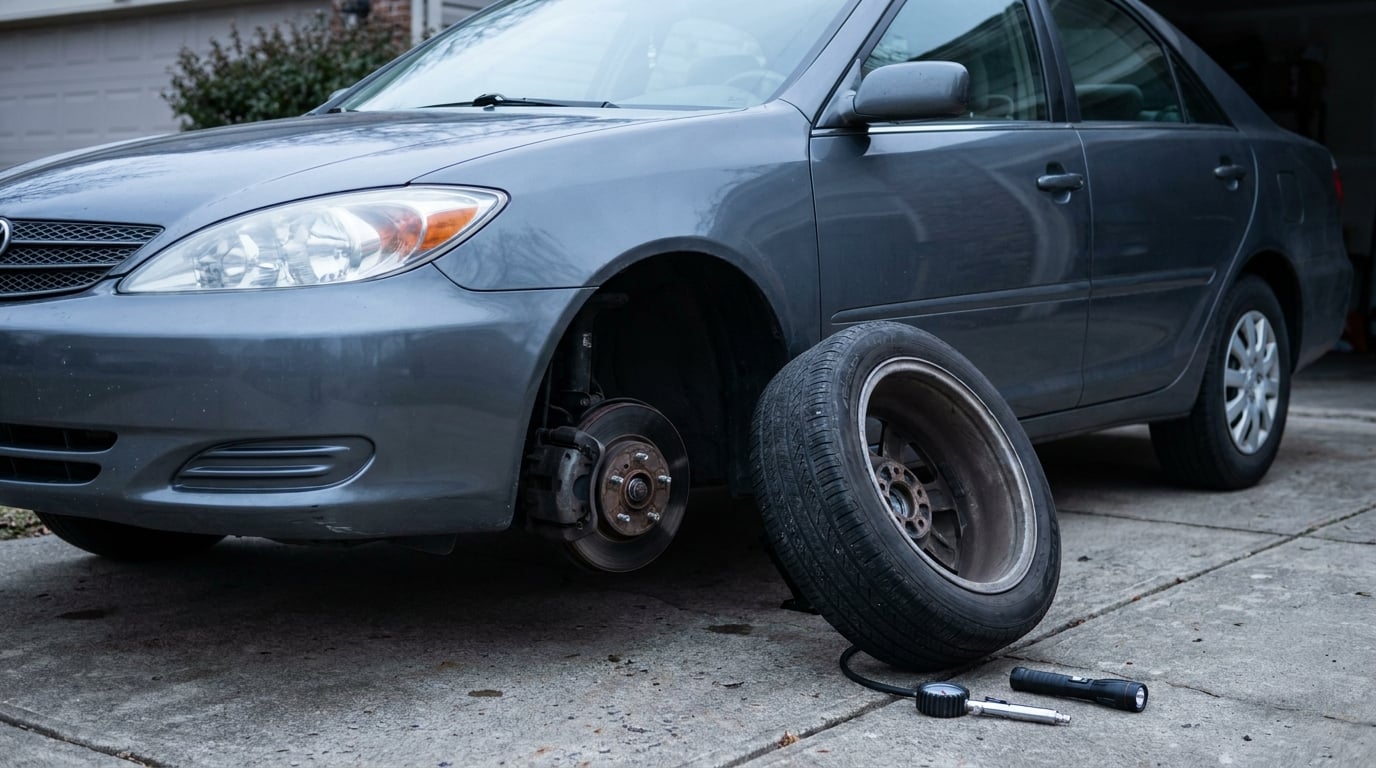
Why does my car pull to one side when braking? Because the left and right brakes are not applying the same amount of stopping force. One corner is usually dragging, or failing to clamp at all, so the car yaws toward the weaker side.
The most common culprits are a seized or sticking caliper, a collapsed rubber brake hose, contaminated pads, uneven tire pressure, and worn suspension parts. A surprising share of cases show up right after brake, tire, or alignment work, which narrows the search considerably.
I will walk through the causes in the order I would actually check them, cheapest and easiest first. You can diagnose most of this in a driveway with a jack, a flashlight, and about an hour.
Table of Contents
- Is It Safe to Keep Driving With a Pull During Braking?
- Why Does My Car Pull to One Side When Braking?
- Common Causes of a One-Sided Brake Pull
- How Tire Problems Can Make the Car Pull Under Braking
- How to Test for Uneven Brake Pressure and Mechanical Problems
- What Brake Problems Cause a Pull to One Side?
- Why Wheel, Hub, and Alignment Problems Also Cause Pulling
- How to Diagnose the Side the Car Pulls Toward
- A Simple DIY Troubleshooting Order
- When a Mechanic Should Inspect the Car
- Frequently Asked Questions
- Can low tire pressure make my car pull to one side when braking?
- Is brake pull more likely caused by the tires or the alignment?
- Why does my car pull only when I press the brakes hard?
- Can a worn wheel bearing cause the car to pull while braking?
- Should I drive to a mechanic if the car pulls during braking?
- Can contaminated brake pads be fixed without replacing the rotors?
- Conclusion
Is It Safe to Keep Driving With a Pull During Braking?
Usually, yes, but slowly. A one-sided pull on a car with working ABS is far less urgent than a pedal that goes soft or a grinding noise, and most tire and alignment causes are safe to drive to a shop at reduced speed.
Slow down your normal speed by a third, leave extra following distance, and avoid hard braking. Skip highway driving until you know what is causing it, and stay out of rain and on hills where stopping performance matters most.
Stop driving and get it inspected the same day if any of these show up:
- The brake pedal feels soft, spongy, or travels farther than usual.
- There is a burning smell after a stop, or one wheel is visibly hot.
- You hear grinding, squealing, or a scraping sound as the car slows.
- The pull is sudden and severe rather than a gentle drift.
- You see a fluid leak under the car near a wheel.
- The steering wheel hits a hard stop instead of returning to center.
- The ABS, brake, or stability control light is on.
Road crown can mimic a pull on its own, so do not panic over a faint drift on a crowned road. The difference is that a real mechanical pull reproduces on a flat, straight surface and gets stronger the harder you brake.
Why Does My Car Pull to One Side When Braking?
Why does my car pull to one side when braking? Unequal stopping force
Braking shifts the car’s weight forward, so the front tires carry most of the stopping work. Every tire pushes backward against the road, and those forces act on either side of the centerline.
When the left front grips harder than the right front, the car rotates slightly around that stronger tire and drifts to the right. Brake engineers call this yaw, and ordinary drivers just call it pulling.
Here is the rule worth memorizing: a pull to the right means the left side is not braking hard enough. The car always leans away from the dragging or weak wheel. Most people check the side the car pulls toward, which is backwards.
The short list of causes
- Sticking or seized brake caliper – the caliper on one side stays clamped after you release the pedal and drags on its rotor constantly.
- Collapsed rubber brake hose – the hose bulges internally and slows pressure release, so the caliper never fully retracts.
- Contaminated or unevenly worn brake pads – oil, fluid, or a glazed friction face grabs on one side only.
- Warped rotor or excessive disc runout – a bent rotor grips harder at one point in its rotation.
- Seized slide pin or slide-pin hardware – common on a car that just had pads and rotors replaced.
- Uneven tire pressure or uneven tire wear – the simplest check, and the most commonly missed one.
- Worn suspension or steering parts – worn ball joints, tie rod ends, or control arm bushings let the wheel move under braking load.
- Wheel or hub damage – a bent wheel, a loose lug nut, or hub play changes how the tire sits while stopping.
If the pull only appears when you press the brakes, you are almost certainly looking at the brake or tire side. If the car drifts constantly, even while coasting, the cause is alignment, a worn tire, or suspension wear instead.
Common Causes of a One-Sided Brake Pull
This table ranks the causes by how quickly you can check them at home and how urgently they need attention. Read it as a decision tree rather than a list of possibilities.
| Symptom | Likely cause | How to confirm | DIY difficulty |
|---|---|---|---|
| Pull to one side, one wheel hot after driving | Sticking or seized caliper | Jack the front, spin each wheel, the hot wheel stops first or keeps rubbing | Easy to check, moderate to fix |
| Pull grew worse over months, no recent service | Collapsed brake hose | Pistons compress separately but not together, and move with the bleeder open | Easy to test, needs a shop for the part |
| Pull started within days of brake work | Slide pin, caliper hardware, or pistons not retracting | Remove the wheel and check the caliper slide and pad retraction | Easy to check |
| Pedal vibrates, brake pedal pulses | Warped rotor or disc runout | Feel the rotor while the engine runs, it feels rough or wobbles | Easy to check, needs a shop to machine or replace |
| Steering wheel sits off center after stopping | Alignment changed with a drag present | Compare road feel; a drag usually leaves the wheel off center | Shop work |
| Pull only in the rain or on a wet road | Tread depth difference, low pressure, worn tires | Check pressure cold, compare tread depth across the axle | Easy |
| Pull with a rhythmic clunk, wheel visibly loose | Bent wheel, loose stud, or hub play | Wiggle test at the 12 and 6 o’clock positions | Easy to check, urgent to fix |
| Constant pull, even when coasting | Worn suspension parts, wheel alignment, uneven tire wear | Compare left and right ride height and play at each joint | Shop work |
| Pull only on crowned or banked roads | Road crown and camber, sometimes normal | Test on a flat straight road, the pull should disappear | No repair needed |
How Tire Problems Can Make the Car Pull Under Braking
Tires are where you should start, because a pressure check takes five minutes and a lot of suspected brake problems turn out to be tire problems.
A tire that is 10 PSI underinflated on one corner has a smaller contact patch and a different grip level than its neighbor. Under braking, where grip limits decide your stopping distance, that difference becomes a sideways force the driver never asked for.
Uneven tread wear matters for the same reason. If one front tire still has most of its tread while the other is down to the wear bars, they hook up differently in the rain and in a hard stop. Cupping, meaning the tread blocks wear into a repeating high-low pattern, does the same thing and usually comes from a worn shock absorber, an out-of-balance wheel, or a wheel that needs balancing.
Mismatched tires on the same axle are a bigger problem. Two tires with different tread patterns, different compound, or different remaining depth will fight each other under braking, and the car will wander. A set of four identical tires is the only setup where axle-to-axle grip matches cleanly.
Uneven wear on one side only is not a tire problem at all. That pattern points at an alignment fault or a suspension part that is letting the tire lean into the road. If you want to understand what cupping looks like before you go shopping, what tire siping is and whether it helps covers the tread cutting in plain terms.
One more false alarm: crowned roads. Many two-lane highways are built with a slight arc for drainage, and a perfectly healthy car will drift toward the crown. If the pull vanishes on a flat parking lot, you may have found your answer.
How to Test for Uneven Brake Pressure and Mechanical Problems
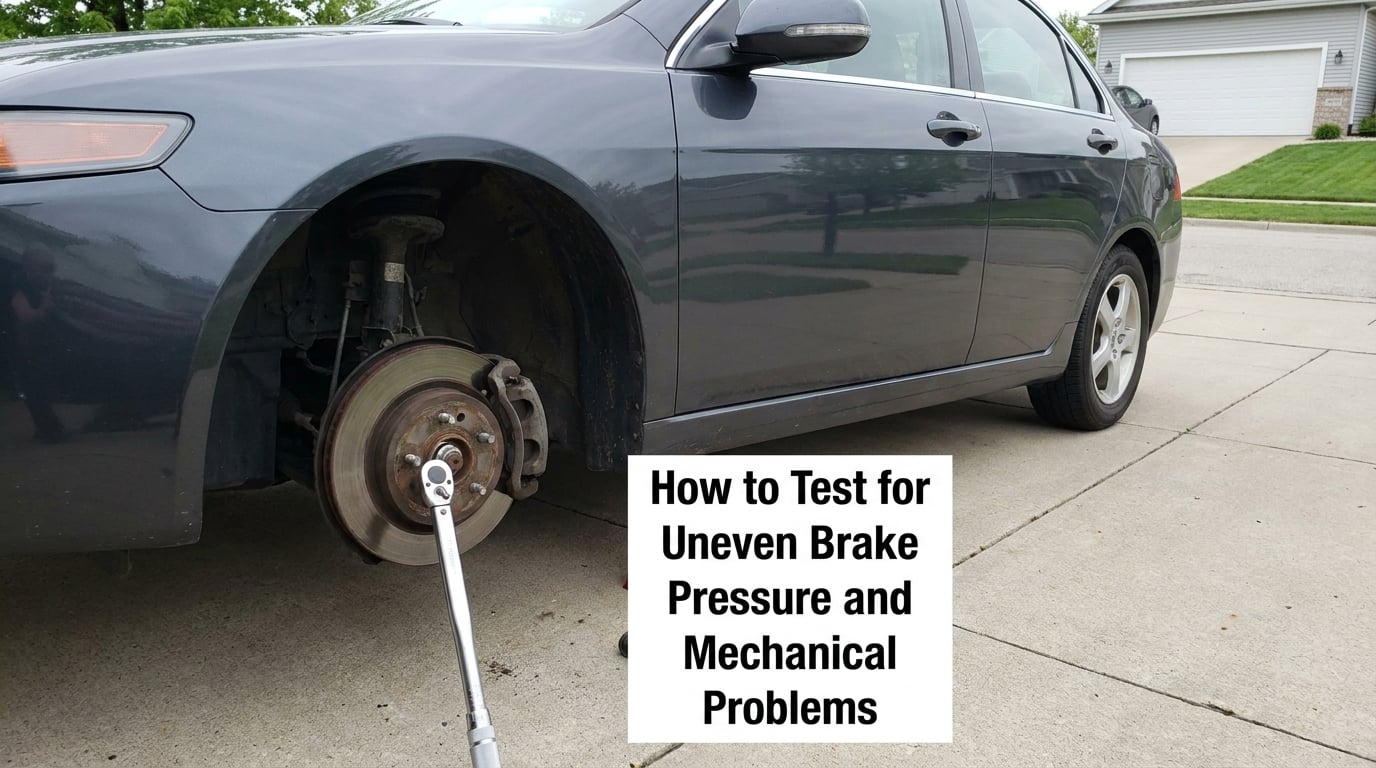
Work from the outside in. This sequence costs nothing and catches most of the common causes before you remove anything.
Check for warning lights first. A brake warning light, an ABS light, or a stability control light changes the conversation. Brake fluid level and condition matter here too, especially on a car that sits outside. If the fluid is old and the pedal travels far, read about how long brake fluid lasts in the bottle before assuming the calipers are at fault.
Check all four tire pressures cold. Use the number on the driver’s door jamb sticker, not the number molded into the tire sidewall. Inflate to spec, then drive for ten minutes and recheck, because a tire that loses air has its own problem to solve.
Look at the wheels. Run your hand along each rim looking for a dent, a crease, or a scuffed lip. A hard pothole can bend a wheel enough to change how the tire sits, and a wheel is the cheapest thing on the car to replace. Check lug torque while you are there, and never over-tighten. If a lug is loose, the wheel can be moving relative to the hub under braking load.
Jack the front and roll the car.
The simplest test on this page. With the vehicle safely supported on jack stands, lift the front end just enough to roll, turn the steering to full lock one way, then the other, and push the car forward and back by hand. The wheel that resists, or the wheel you can see rubbing on the rotor, is your dragging side. This is the same test owners use on the brake forums, and it takes about five minutes. It matters that this is the wheel the car pulls away from.
Compare wheel temperature. After a drive where the pull showed up, hold your hand a few inches from each front wheel. A noticeably hotter wheel is dragging. This test is unreliable when the problem only shows up when the brakes are cold, so repeat it on a different drive before you rule anything out.
Feel the rotor. With the engine running and the parking brake set, reach through the wheel and touch the rotor face. A warped or heavily grooved rotor feels rough in one spot. A hot rotor that stops the car from rolling forward is telling you the same story as the hot wheel.
Check pad thickness by eye. With the wheel off, look through the caliper opening at the pad material and the rotor edge. Some cars need the caliper fully removed to see the inboard pad, which is a job for a shop unless you have done it before.
Test the brake hose. This one is worth knowing because it is cheap to replace and expensive to misdiagnose. Squeeze each caliper piston by hand in turn, then try pushing both pistons in together. A collapsed hose is diagnosed exactly this way: the pistons move individually but not together, and they both move when the bleeder valve is opened. That pattern is a failed hose, and no amount of caliper cleaning will fix it.
What Brake Problems Cause a Pull to One Side?
A seized or sticking caliper
This is the single most common cause, and the signs are consistent. The wheel on the dragging side runs hot, the pedal feels normal or slightly firm, and the pull worsens the harder you press. Sliding calipers rely on lubricated slide pins and machined abutments to move inboard for pad clearance, and when that hardware rusts, freezes, or gets coated with the wrong grease, the caliper stays clamped.
Seized caliper pistons are a related failure. A piston that will not fully retract keeps the pad touching the rotor even with the pedal released. On some cars the piston physically seizes inside the bore, which means the caliper has to be replaced rather than cleaned.
A right-hand pull on an older truck often turns out to be a seized brake pin on the rubbing side, even after the caliper and hose have already been replaced. The question worth asking in those cases is whether the system was bled properly afterward, because a new part that never got bled behaves exactly like the old fault.
A collapsed rubber brake hose
Rubber brake hoses look fine on the outside and fail on the inside. The inner layer can separate, and the hose starts holding pressure back like a one-way valve. The caliper receives pressure when you press the pedal and fails to release it when you let go.
The signature is intermittent. Owners often describe four or five clean stops followed by a pull that then goes away, which is exactly what a temperature-sensitive or pressure-sensitive hose produces. A classic pattern is a car that stops straight for the first several stops, then begins pulling with more force the harder the pedal is pressed.
Contaminated or unevenly worn brake pads
Brake fluid, gear oil, coolant, or a grease fitting that leaked onto the friction material kills the pad surface and the rotor together. The contaminated side grabs and the steering yanks toward it. A thin layer of fluid that dries into glaze can also make one corner louder and harsher than the other.
Uneven pad wear is normal to a degree, since the inner and outer pads see slightly different loads, but a big difference between left and right means something is wrong. That something is usually a caliper sticking, a slide pin jammed, or an alignment problem that is loading one pad harder.
A warped rotor and disc runout
A rotor that is not perfectly flat grips harder at the high spot, and that single point creates a repeating pulse you feel through the pedal. Rotors warp from heat cycling, uneven torque at the wheel, overloading the car, or simply time.
Runout is the measurable version of the same thing. A dial indicator on the rotor face reads lateral wobble, and past a few thousandths of an inch the pads pulse against a moving surface. The symptom that separates runout from a caliper problem is vibration, and a rotor that heats unevenly can also contribute to a pull.
Where a car sits between drives explains a lot of this, and why brakes rust when a car sits covers the corrosion that ends up on the friction surface.
Why the pull often starts right after brake service
If the car went straight last week and pulls now, list the recent work first. It is a short list of common shop mistakes and it is worth checking before you buy any parts.
- The caliper pistons were not fully retracted after the new pads went in, so the pads sit against the rotor.
- The slide pins and caliper hardware were reinstalled dry, so the caliper cannot slide inboard.
- Mismatched pad compounds were installed on the left and right sides.
- The wheel was installed backward, putting the wheel face inboard and offsetting the caliper.
- The lug nuts were not torqued in the correct order, leaving the wheel sitting at an angle.
- The system was not bled properly after a caliper or hose replacement.
- A new rotor was installed with the retaining screw loose, letting the hat float and the face wobble.
Any of these produces a pull that started with the work rather than with the mileage. It is also the situation where owners are most frustrated, because paying for brake service and then getting a pull feels like being charged twice for the same fault.
Rear drum brake and parking brake drag
On older cars and trucks, the rear shoes can stay slightly applied after you release the pedal. Rear drag usually shows up as a pull, a burning smell, and reduced fuel economy, and it is easy to miss because the front brakes dominate the stopping feel. A sticking parking brake lever or a misadjusted drum adjuster produces the same signature.
Why Wheel, Hub, and Alignment Problems Also Cause Pulling
Not every one-sided pull lives in the brake system. Braking loads the front suspension hard, and any free play in it gets amplified exactly when the tire is trying to hold a skid mark on the road.
A worn ball joint, tie rod end, or control arm bushing lets the wheel shift under load. Owners report the same pattern over and over, that a large share of brake-pull cases trace back to worn suspension parts that stay invisible until you brake hard. That matches what the symptoms look like: a car that tracks fine at cruising speed and pulls hard under heavy braking.
Wheel and hub problems show up differently. Hold the top and bottom of a lifted wheel and rock it. Any play at the 12 and 6 o’clock positions is hub or bearing play, and play at 9 and 3 is a ball joint or tie rod. A wheel bearing often sounds like a hum that changes with speed and gets quieter in neutral, and a worn bearing changes the way the tire sits under braking load.
Alignment is the one people blame most often and it is the one least likely to be a brake-only symptom. True alignment problems are present all the time, not just under braking. If the car tracks straight, holds a line through a curve, and returns the wheel to center, the alignment is probably fine and you are looking at drag instead.
The exception is an alignment that changed recently. If the car pulled before a four-wheel alignment and stops pulling after it, the shop may have masked a brake fault by changing the geometry, which usually comes back. If the car started pulling right after an alignment, verify tire pressures first, then look for brake drag, because an alignment cannot by itself create unequal stopping force.
How to Diagnose the Side the Car Pulls Toward
Five checks separate a real mechanical pull from the road and from your own steering habits.
Straight-line hard braking. On a flat, dry, straight road, brake firmly from about 35 mph. Note the direction and how hard it yanks. A brake fault is strongest here.
Gentle left and right turns. Brake lightly while turning. If the car pulls toward the outside of the turn, the inner wheel is dragging. This is often the most convincing evidence of a caliper or hose fault, because there is no road crown to blame.
Low-speed braking. Creep to a stop in a parking lot. A caliper that drags will still make the car creep and will often need the parking brake to hold it, because the friction is higher than rolling resistance.
Different road surfaces. Repeat on concrete, then on grass or gravel. A brake pull usually persists. A tire pressure problem often gets worse when the tire is loaded.
Watch the steering wheel, not the road. If the wheel ends up off center after a stop, the car traveled straight while the wheel was turned, which points to alignment. If the car went crooked while the wheel stayed roughly straight, that is drag.
Ignore the wind. A steady crosswind pushes the car and a tired driver fights it, and neither has anything to do with the brakes. Two blind spots cause most misdiagnoses: road crown, and correcting the wheel before the car has finished straightening out.
A Simple DIY Troubleshooting Order
Run the checks in this order. Each step is cheaper and faster than the one after it, and most people never need to get past step four.
1. Reproduce the symptom safely. Note the direction, the severity, and whether it happens every time or only sometimes. Record whether the steering wheel is off center afterward.
2. Inspect all four tires. Cold pressures against spec, tread depth across each axle, cupping, and a physical look at the sidewalls for bulges or cuts.
3. Confirm the dragging wheel. Jack the front safely, roll the car forward and back with the steering turned both ways, and identify the wheel that stops first or rubs.
4. Check the affected wheel for visible damage. Bent rim, loose lug nut, cracked or damaged rotor, thin pad material, and an obvious fluid leak on the caliper.
5. Inspect the brake hardware. Slide pin movement, caliper slide, piston retraction, and the condition of the rubber hoses.
6. Compare left and right suspension play. Wiggle test at each ball joint, tie rod, control arm bushing, and check that ride height and tire wear look even side to side.
7. Get an alignment check or professional diagnosis when the cause is not obvious, when the pull persists after the cheap fixes, or when the car pulls with no drag found at all.
Two rules keep this safe. Never work under a car supported by a jack alone, and never reach near a rotor that moves with the engine running. If the braking itself feels compromised in any way, skip the driveway work and go straight to a shop.
When a Mechanic Should Inspect the Car
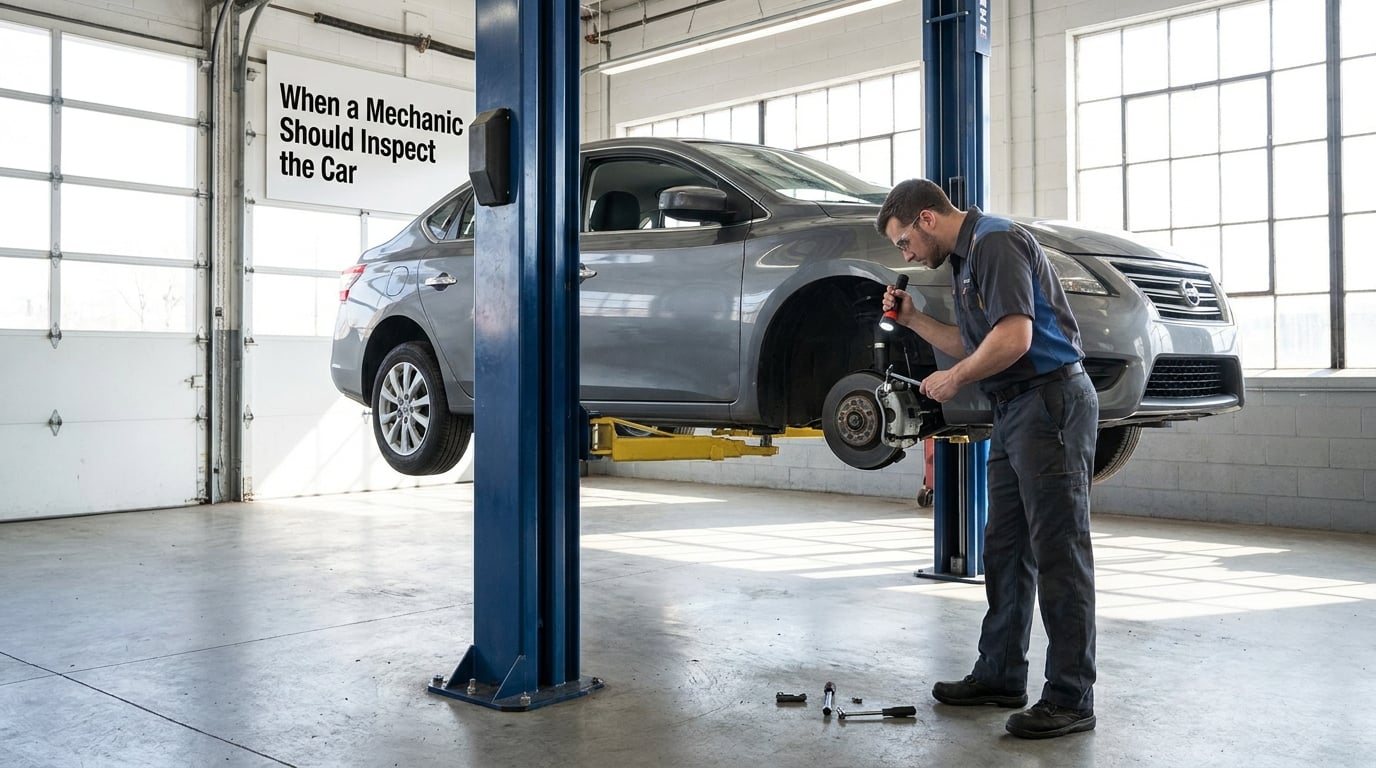
Book an inspection when any of these is true, and describe the symptom rather than asking for a repair quote on the spot.
- The pull persists after pressures are corrected and all four tires are sound.
- The steering wheel does not return to center after a stop.
- Brake pedal travel or pedal feel has changed.
- There is a fluid leak near a wheel or the reservoir is low.
- You hear grinding or squealing, or one side smells hot.
- You found visible damage on a wheel, rotor, or tire.
- There is play at the hub, a ball joint, or a control arm bushing.
- The pull appeared right after brake, tire, or alignment work and has not cleared.
Before the appointment, write down five things: which way it pulls, when the pedal is hardest, whether the wheel is off center after stopping, whether one wheel is hotter, and what service was done in the last few months. That list tells a good technician exactly where to start and saves you a diagnostic fee billed twice.
On the work order, ask them to road test the car in both directions after the repair and to show you the drag measurement on each front wheel. A brake repair that does not include a road test in the opposite direction from the complaint is not finished.
Frequently Asked Questions
Can low tire pressure make my car pull to one side when braking?
Yes, and it is the easiest cause to rule out. A tire that is underinflated on one corner has a smaller contact patch and a different grip level than its neighbor, so under braking the two sides push the car in different directions. Set all four tires to the pressure on the driver’s door jamb sticker, drive for ten minutes, and recheck cold. If the pull disappears, you were done in under fifteen minutes and the tires are almost certainly the whole story.
Is brake pull more likely caused by the tires or the alignment?
Tires and alignment are both common, but they behave differently and you can tell them apart. A tire problem shows up mainly in hard braking, in the rain, and at highway speed, and a road crown can disguise it. An alignment problem is present all the time: the car drifts while coasting, wanders on a straight road, and the steering wheel sits off center. If the car tracks straight and only pulls when you brake, look at the brakes first.
Why does my car pull only when I press the brakes hard?
Hard braking loads the front suspension far more than light braking, so problems with small amounts of play show up only under load. Worn ball joints, tie rod ends, and control arm bushings stay quiet at cruising speed and move the tire when grip demand is highest. A pad or rotor fault that is marginal can behave the same way. The harder you press and the worse it pulls, the more likely you are looking at a mechanical play or drag problem rather than a tire.
Can a worn wheel bearing cause the car to pull while braking?
It can contribute, though it is not the most common culprit. A worn bearing lets the hub move slightly under load, which changes how the tire sits against the road during a stop. The giveaway is play in the wheel when you rock it, plus a hum that changes with road speed and goes quiet in neutral. A seized bearing is urgent: the tire can start to wobble or, in the worst case, come off. Get it inspected rather than driving on it.
Should I drive to a mechanic if the car pulls during braking?
Usually yes, at reduced speed, as long as the pedal feels normal and you see no warning lights, leaks, or grinding. Slow down, leave extra following distance, avoid hard braking, and stay off the highway if you can. Do not drive it if the pedal is soft or spongy, one wheel is visibly hot, there is a burning smell, or the steering hits a hard stop. Those mean the fault is bigger than a tire or alignment problem.
Can contaminated brake pads be fixed without replacing the rotors?
Sometimes. If brake fluid, coolant, or gear oil only touched the friction material, the pads can sometimes be cleaned with dedicated brake cleaner and the hardware cleaned and lubricated, then the friction surface on the rotor can be resurfaced by a machine shop. Once fluid has soaked deep into the pad material or the rotor is pitted and thin, both pads and rotors have to be replaced together. Never put a contaminated pad back on, because it will fail again quickly.
Conclusion
A one-sided pull under braking is an unequal stopping force problem, and the car always leans away from the dragging or weak wheel. A pull to the right means the left side is not doing its job.
Back off your speed, check all four tire pressures cold against the door jamb spec, and look at each wheel for a bend, a loose lug nut, or a visibly hot rotor. Then note whether the pull is steady or intermittent, and whether the steering wheel ends up off center. That single detail separates an alignment or suspension problem from a brake drag problem better than anything else you can do at home.
If the cheap checks come up clean, get the front end inspected for drag and the suspension checked for play. A sticking caliper, a collapsed hose, and a seized slide pin account for most of what turns up, and all three are things a technician can confirm in a single appointment.