
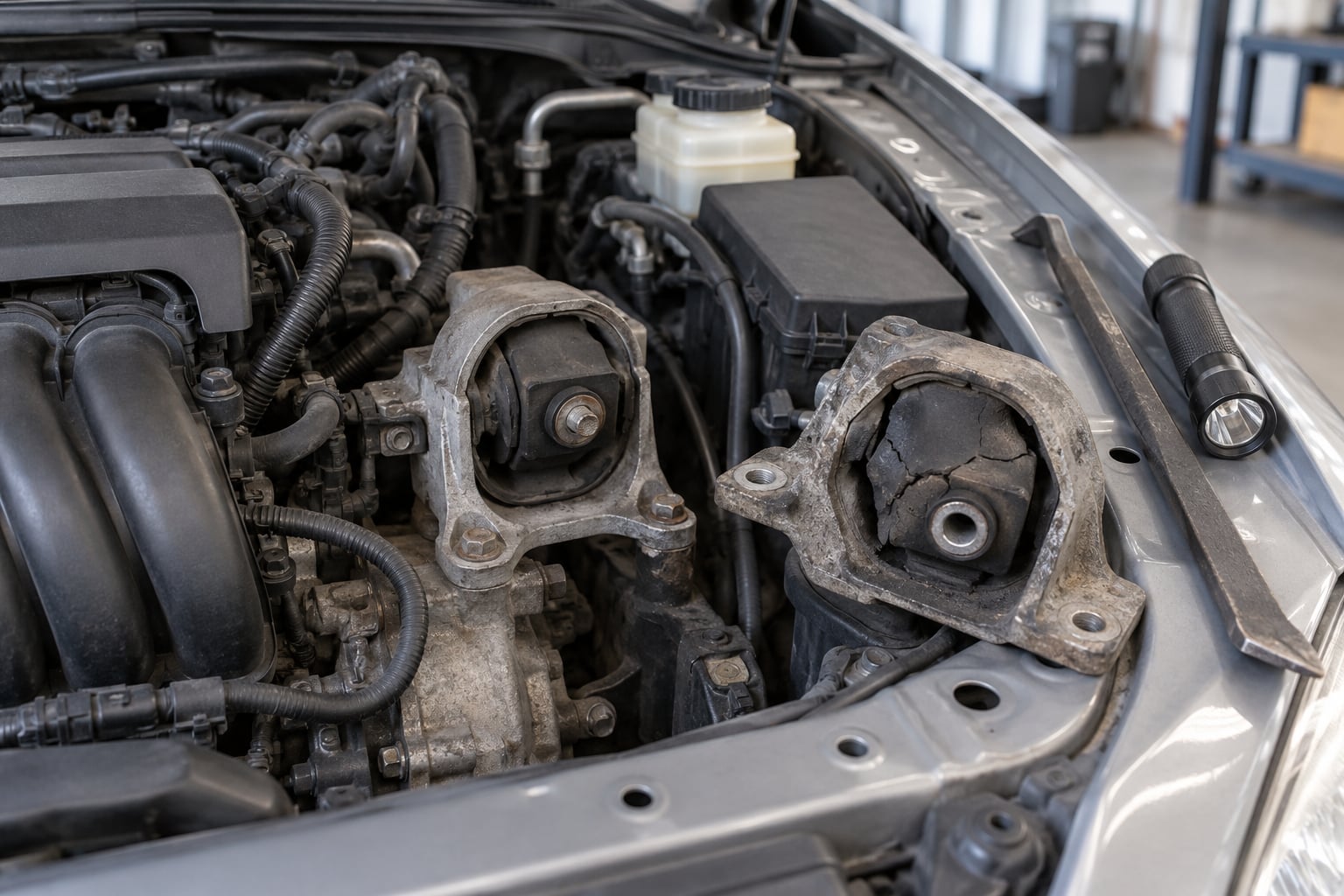
The most common bad engine mount symptoms are vibration you feel through the seat or steering wheel, a clunk on start-up or when the transmission goes into drive, and visible engine rock when you rev in park. A worn mount lets the engine move further than it was designed to, and that movement travels straight into the body.
Here’s the honest part before we go further. A mount is rarely the whole story on its own, and the noise it makes gets blamed for problems coming from the transmission mount, a bent wheel, or a worn CV joint. Most of the time, that misdiagnosis is what costs people money. This guide walks through the eight signs in the order they usually show up, what actually makes each one, how to test a mount yourself in about twenty minutes, and when it’s fine to keep driving.
Table of Contents
- What Are Engine Mounts and What Do They Do?
- Bad Engine Mount Symptoms and the Noises They Cause
- 1. Vibration through the seat or steering wheel at idle
- 2. A clunk the moment the engine starts
- 3. A clunk or thunk when you put it in drive or reverse
- 4. A thud when you get on the gas, especially at low speed
- 5. Shudder or judder in a narrow rev range
- 6. Visible engine movement
- 7. Cracks, gouges, or metal-to-metal contact marks
- 8. Visible damage to neighbouring parts
- What Does a Failed Engine Mount Sound Like?
- What Causes Engine Mounts to Fail?
- How to Check Engine Mounts on Your Car
- Engine Mount Symptoms vs. Other Common Problems
- How to Fix Bad Engine Mounts
- When to Replace an Engine Mount
- Frequently Asked Questions
- What to Do First
What Are Engine Mounts and What Do They Do?
An engine mount is the bracket that bolts the engine to the vehicle’s subframe and body. Most cars use three or four, spaced apart so the engine hangs from several points rather than one.
Each mount does two jobs, and both fail quietly until one is badly worn. First, it holds the engine in position, keeping the engine and transmission at the exact height and angle the manufacturer engineered. Second, it swallows vibration and noise so you don’t feel every combustion pulse as a shudder through the seat.
What an engine mount is not
It helps to sort out the neighbours. The transmission mount holds the back of the gearbox to the body, usually at the opposite end from the engine mounts. Body or subframe bushings hold the structure itself to the chassis and have nothing to do with engine movement. Both of those make noise that sounds identical to a bad engine mount, which is why we’ll sort them out later.
The four mount types you’ll run into
| Mount type | How it works | How it fails |
|---|---|---|
| Rubber | Rubber block bonded to metal studs, acts as a spring | Cranks, tears, separates from the metal stud; gradual and noisy |
| Hydraulic | Fluid and a floating piston absorb low-frequency vibration | Leaks internally or weeping from the casing, often with no obvious noise at all |
| Solid polyurethane | Hard plastic in place of rubber, better for performance use | Transmits more noise than rubber, cracks after heat cycles |
| Electronically controlled | Oil-filled mount with a solenoid that stiffens it under load | Fails silently; a failed solenoid lets the engine sit in soft mode and shudder under torque |
Hydraulic and electronic mounts are the reason owners get confused. A hydraulic mount can lose its damping without ever showing a puddle under the car, so the only symptom is a soft, greasy-feeling idle that gets worse the longer you drive.
Bad Engine Mount Symptoms and the Noises They Cause
Here’s the list, ordered roughly from earliest to most serious. Most cars show two or three of these together, and the early ones are the easiest to talk yourself out of.
1. Vibration through the seat or steering wheel at idle
This is usually the first thing owners notice, and usually the first thing they ignore. The engine sways in its mounts at idle, and the shake shows up wherever the body is thinnest, often the driver’s seat frame, the floor pan, or the steering column.
Rubber that has hardened loses its damping even when it isn’t visibly cracked. If the steering wheel shakes gently while stopped but the car is perfectly smooth at speed, that’s worth checking.
2. A clunk the moment the engine starts
Engine sag is the reason. Overnight the engine settles and the mounts take up a slightly different position. On the first crank, the engine drops into its working position and the mount bottoms out, producing one dull clunk before it settles.
A single clunk on cold start that goes away is normal on many cars. A clunk that repeats every time, or two clunks in a row, is not.
3. A clunk or thunk when you put it in drive or reverse
Shifting into gear puts a real load on the driveline and lets the engine rock against the mounts. This is the single most common bad engine mount symptom people bring into shops, and it’s also the one most often confused with a transmission mount.
Parked, in park, and shifting between drive and reverse: a thump means engine or transmission mount. Wheel to wheel at the same speed: it isn’t the mount.
4. A thud when you get on the gas, especially at low speed
Hard acceleration twists the engine against its mounts. When the rubber has gone soft, the engine moves back and the mount’s metal-to-metal stud hits the bracket and makes a dull, low thud. In a V8 or a heavy front-drive car you’ll feel it in the seat as a shove.
5. Shudder or judder in a narrow rev range
Hold a steady speed around 2000 to 2500 rpm and listen for a rhythmic shake that comes and goes with engine speed. Diesel owners report this one constantly on turbocharged four-cylinder engines.
Be careful here. Mounts are a genuine candidate, but a shudder at a specific rpm with the needle bouncing usually points at mounts or engine movement causing the driveline angle to change under load. It can also be a driveline angle issue that has nothing to do with a mount. Before you price a mount, rule out low compression with a compression test on the engine — uneven cylinder pressure produces a very similar shake.
6. Visible engine movement
Put the car in neutral, hold the brake, and rev the engine. If you can see the engine shift more than a few millimetres, the mount on that side has lost its shape. From the top of the bay looking down at the mount, a healthy one is square and fully engaged on its stud. A failed one is visibly gapped or cracked through.
7. Cracks, gouges, or metal-to-metal contact marks
Run a finger along the rubber. A surface mount that’s still good feels slightly textured and springs back. Cracked rubber feels like dried-out tyre rubber, flaking and hard. If the metal bracket has shiny bright marks or a dent where the stud has been bottoming out, that mount has already failed even if the rubber looks acceptable.
Fluid weeping around a hydraulic mount, or oil stains that reappear after a wipe, points to a damping fluid loss rather than a rubber problem.
8. Visible damage to neighbouring parts
This is the late stage and the expensive one. An engine moving too far stretches the exhaust flex pipe until it cracks, pulls the vacuum and coolant hoses out of position, wears through the wiring loom against the bracket edge, and changes the driveshaft angle.
If you can see shiny metal where rubber should be, or a bright scrape mark on the subframe where the mount or engine has been hitting it, stop checking and start booking.
What Does a Failed Engine Mount Sound Like?
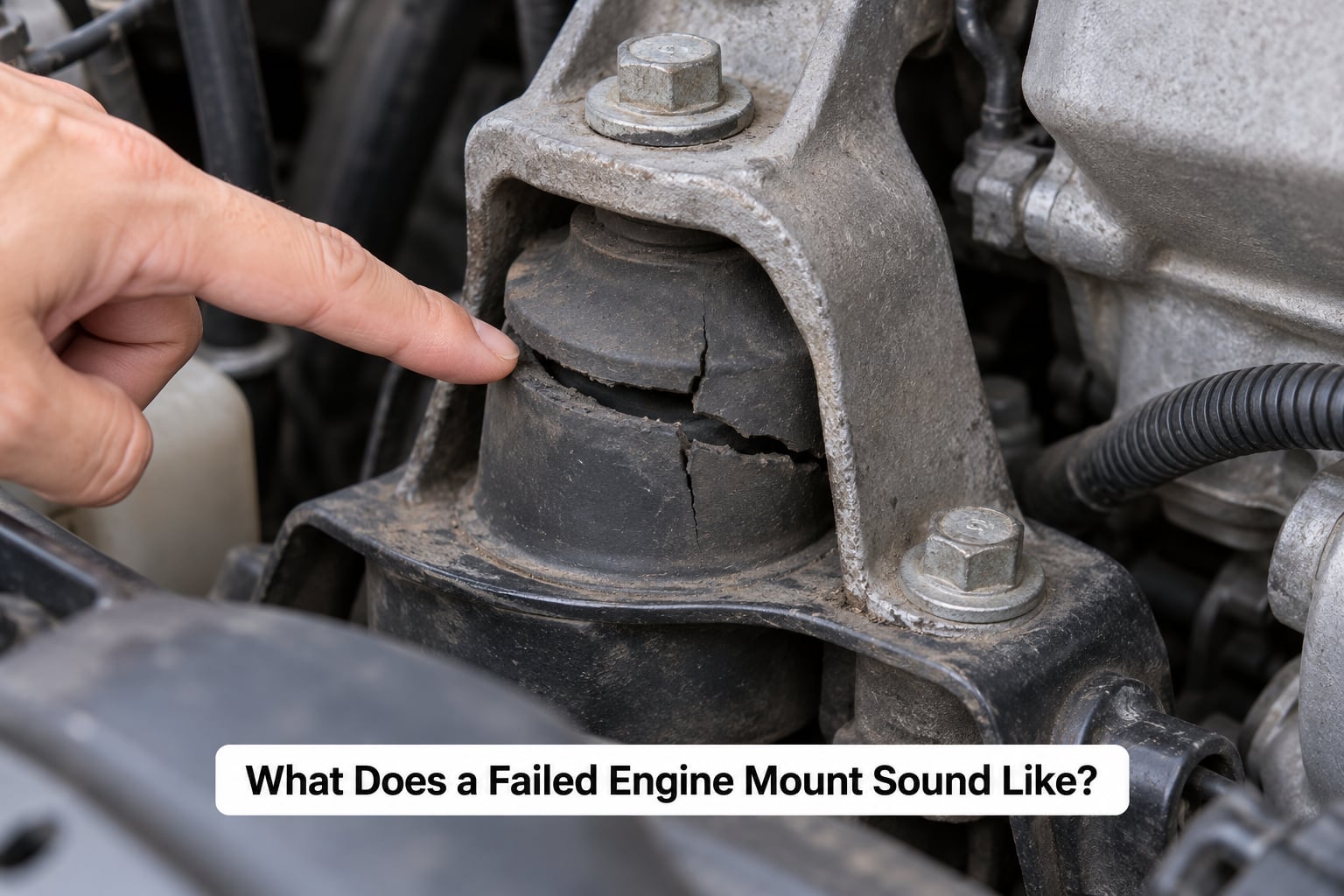
Because the noise changes with load, the single most useful trick is to listen at four moments: cranking, idling, shifting into gear, and full throttle. Each one points at a different part of the driveline.
Clunk is metallic and hollow, two hard surfaces meeting. At start or on a gear change, that’s mount-to-bracket contact. Thunk is lower and duller, the sound of rubber being compressed and released, and it’s the classic sound of a sagging or torn mount.
Judder or shudder is a vibration rather than a discrete noise, tied to engine speed. Squeal from a mount area is rare but real, usually a hydraulic mount’s internal seal or a bushing letting go. Rumble that rises and falls with revs and comes from under the car is more likely a driveshaft or a wheel bearing than a mount.
Two sounds get mistaken for mounts more than anything else. A ticking or tapping that rises with rpm is usually the valvetrain, not the mounting. A deep boom at steady speed that changes with road texture is usually an exhaust leak or a hanger. If the noise follows the engine’s load, suspect the mounts. If it follows road speed, suspect something in the wheels or driveline.
What Causes Engine Mounts to Fail?
The short answer is age and heat. The long answer is that a rubber mount lives a hard life and has almost no margin, so several things push it over at once.
Rubber deterioration from age and heat. Engine bays on modern cars run hot, and the exhaust side of the engine bakes one mount harder than the others. Rubber hardens, loses its damping, and then cracks. On BMW models and other longitudinal cars with a rear differential mount, that mount also carries driveline torque, so it ages faster than the front pair.
Fluid attack. An oil leak or a coolant leak running over a mount will destroy it in a fraction of the time it would otherwise last. If a mount looks soft and swollen next to a fresh oil stain, the leak came first. Some of the worst examples are engine bay leaks that pool right on a mount, like BMW oil filter housing gasket leak symptoms on the N52 and N54 engines.
Impact damage. Bottoming out over a speed bump, kerbing badly, or a collision can split a mount internally while the rubber still looks intact on the outside. This is why the driver-side mount on many cars fails worse than the passenger side, it’s usually the one taking the hit from a kerb or a steep drive-axle angle.
Corrosion and perishing of the steel. The stud and the bracket rust through at the bushing, then the mount develops the play it was never designed to have.
Over-torqued fasteners and engine sag. When a mount bolt is tightened beyond spec and held there, the rubber is pre-loaded and cannot move to damp anything. That mount will crack early. On a car with a weakened mount, the engine sags, the driveline angle shifts, the bolts carry more load than they should, and the remaining mounts start failing in sequence. This is the usual explanation for a car that needed mounts twice in two years.
Previous repairs. Cracked subframe mounts, or a subframe that has been repaired or welded, will move the engine’s mounting points and can ruin new mounts within months. If vibration returned after a replacement, look here first.
How to Check Engine Mounts on Your Car
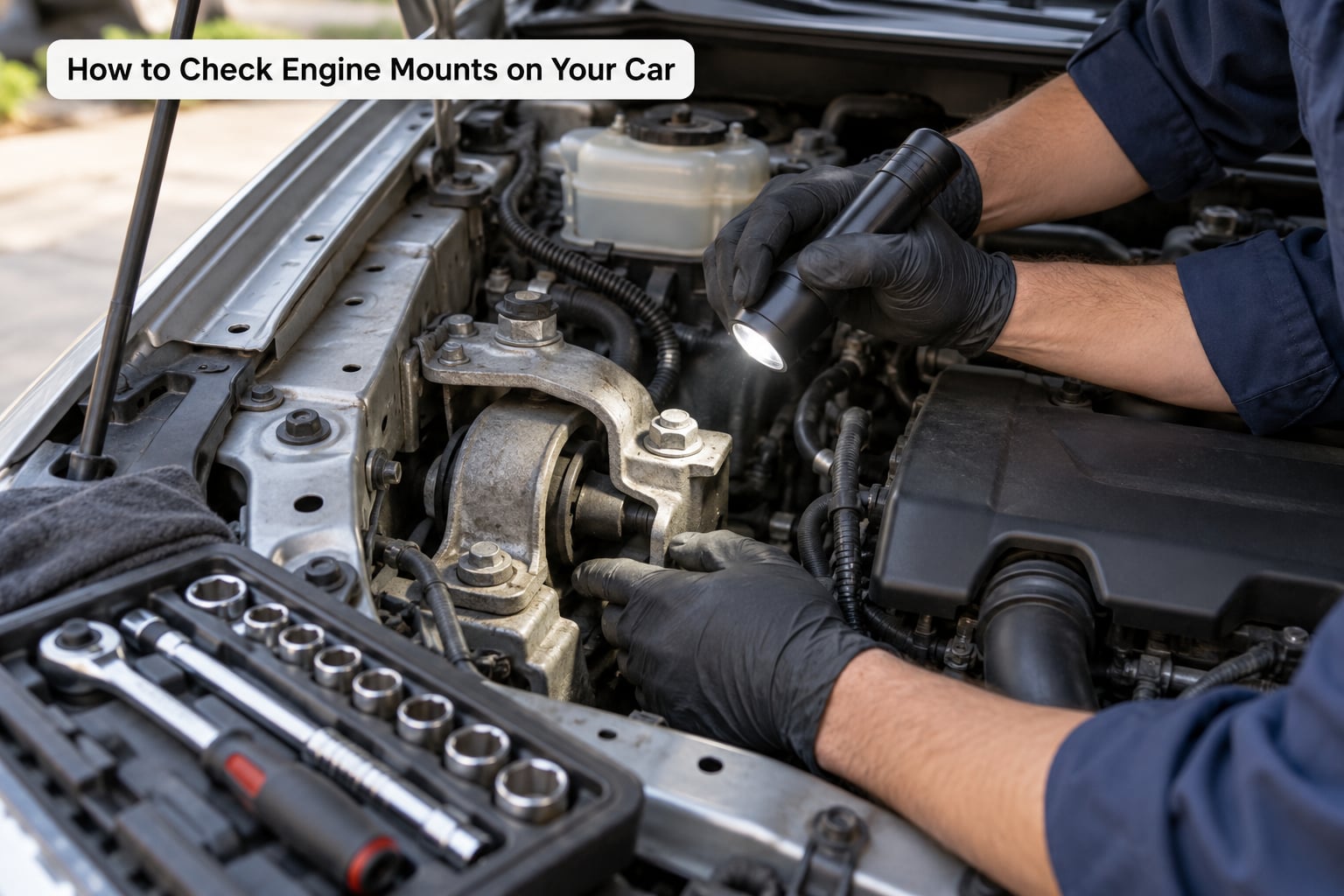
You can narrow it down to a specific mount in about twenty minutes without removing anything. Work on a cold engine, on level ground, with the owner’s manual open.
Safety first. If your test involves putting load on the engine with a bar or a pry bar, support the engine properly on a rated jack and axle stand at the manufacturer’s approved lifting point first. An unsupported engine weighs several hundred kilograms and will come down hard if a mount lets go. Never wedge a pry bar against the subframe and pull with the engine free.
1. The visual check
Look down at each mount from above with a torch. Check for gaps at the stud, cracks across the rubber, shiny contact marks on the bracket, and any wet film around a hydraulic mount. Fresh rub marks on the underside of a bracket mean the engine has already been hitting it.
2. The engine rock test
Automatic: put it in park or neutral, parking brake on, and have someone hold the brake while you slowly blip the throttle. Watch the mount from the side. Visible movement of more than a few millimetres is a failed mount. Manual: watch for the same movement while the clutch is released at idle.
3. The pry bar test
With the engine supported as above, put a wide pry bar on the engine’s structural bracket near the mount, not on a hose, line, or wiring loom, and apply gentle pressure. Healthy rubber offers firm resistance with a little give. A dead mount lets the bar move several millimetres with almost no resistance, and you’ll often see the rubber crack or the stud gap open as you push.
4. The cold start listen
Start the engine and note the first two seconds. Listen for a clunk that resolves, a knocking that repeats, or a momentary shudder as the engine settles into its running position.
5. The gear engagement test
Slowly shift from park into reverse, then into drive. A single thump as the driveline loads is worth investigating. Repeat in reverse and note which end of the car the sound seems to come from, which helps separate engine mounts from the transmission mount.
Do bad engine mounts throw a code?
Rarely, and this is the biggest reason owners assume they’re imagining it. A worn rubber mount has no sensor attached to it, so nothing gets stored and your check engine light stays off. The exception is an electronically controlled mount with a position or height sensor, and on those the failure can show up as a drivability message or an entry about a mount or solenoid rather than a classic engine fault.
With no code to go on, you diagnose by feel and by listening. A hand on the mount while the engine idles is still the most direct test available: if you can feel the vibration coming through the rubber into your hand faster than you can feel it anywhere else on the engine, the mount is spent. If a code is stored but the mount looks fine, chase the sensor side instead — what a bad crankshaft position sensor does covers the symptoms that look similar.
Engine Mount Symptoms vs. Other Common Problems
This is where most wasted money happens. The symptom-to-source table below is the fastest way to rule parts in or out before you buy anything.
| What you hear or feel | When it happens | Likely source |
|---|---|---|
| Clunk on start, thump on gear change | Load applied to driveline | Engine mount or transmission mount |
| Shudder in one narrow rpm band | Steady throttle, under load | Engine mount, or driveline angle |
| Seat and steering shake at idle only | Stopped, engine running | Engine mount damping loss |
| Thump accelerating, no noise when coasting | Under throttle, low speed | Engine mount or transmission mount |
| Brake pedal shudder as you stop | Braking from speed | Wheel or hub runout, worn pads or rotors |
| Hum or growl rising with road speed | Rolling, changes in turns | Wheel bearing |
| Shake at one speed range on smooth road | Steady highway speed | Tire or wheel balance |
| Ticking that rises with rpm | Every rev, top to bottom | Valvetrain, not the mount |
| Boom or hiss, louder on overrun | Changes with throttle | Exhaust leak or failed hanger |
| Clunk at one road speed that changes with load | Rolling, varies | Driveshaft or U-joint |
| Knock on bumps and turns | Uneven surfaces | Control arm or subframe bushing |
| Car pulls, uneven tire wear | Always | Alignment, not the mount |
The rule underneath the table is simple. If the noise changes when you change the engine’s load, it belongs to the engine or transmission side. If it changes with road speed, it belongs to the wheels, tires, or driveline. That single split eliminates half the parts on the shelf before you start.
Engine mount vs. transmission mount
These two get confused constantly, and owners often replace both when only one was bad.
| Engine mount | Transmission mount | |
|---|---|---|
| Location | Alongside the engine, between engine and subframe | Behind or below the transmission, at the opposite end |
| Primary noise | Thunk on start, shudder at idle | Thump or clunk on gear engagement and hard acceleration |
| Movement you can see | Engine rocks side to side or fore and aft | Transmission moves relative to the body, drive shaft angle changes |
| What it can damage | Exhaust flex pipe, hoses, wiring loom, subframe | Driveshaft, U-joints, shifter mechanism, crossmember |
| Easy test | Rock the engine with the transmission in neutral | Load the driveline in park or neutral and watch the gearbox end |
| Can it affect the transmission | Not usually | Yes, sustained angle changes wear U-joints and the centre support bearing |
A worn transmission mount can genuinely damage a driveline over time because the angle the driveshaft runs at changes, and that loads the joints and the centre support bearing continuously. Engine mounts usually don’t touch the transmission, but severe engine movement can drag across and disturb driveline geometry anyway.
How to Fix Bad Engine Mounts
Replacing engine mounts is a moderate job. On a front-drive car with a subframe mount, it usually means supporting the engine, removing the subframe or working around it, and swapping two or three brackets. On a longitudinal car with a transmission mount and a differential mount, the transmission often has to come out, which is a full-day job for a shop.
The general process is the same everywhere: support the engine or subframe at the approved lifting points, remove the mount bolts, swap the mount, and refit to the manufacturer’s torque specification. Not the number a workshop uses by habit, and not hand-tight. Over-torquing is one of the top reasons new mounts crack early.
What to inspect while the mount is out
This is where a good tech earns their money. Look at the exhaust flex pipe for cracks and check that it still clears, examine the wiring loom for chafing at the bracket edge, inspect coolant and vacuum hoses for stretch and splits, check the subframe bushings, and confirm the subframe mounting points aren’t cracked. If a mount failed catastrophically and the engine dropped or swung, treat the subframe as suspect even if it looks fine from outside.
Why mounts keep failing on the same car
If new mounts fail within months, the cause is elsewhere. Over-torqued fasteners, a leaking fluid soaking the rubber, a cracked subframe, or an engine that sags because a hydraulic mount has lost its fluid will all do it again. Fixing the mounts without finding that reason just buys another set.
Hydraulic mounts need their fluid level and bleed procedure done exactly as the manufacturer specifies, and many need a bleed cycle with the engine running and the load off the mount. Skipping that leaves the mount soft and the shudder comes back within days.
When to Replace an Engine Mount
Replace a mount when the rubber is cracked, separated, or permanently deformed, when the mount lets the engine move more than a few millimetres, when there’s visible play at the stud, when it’s weeping fluid, or when the noise and movement match what you’ve confirmed with the tests above. A mount that’s hardened but still damping the engine properly is not yet a repair.
Most cars use three or four mounts, and they age at roughly the same rate. Replacing them as a set is standard practice, because replacing one leaves the others loaded and usually means paying for labour twice. If one has failed dramatically, treat the rest as due.
A professional inspection is worth it when the diagnosis isn’t clean. A tech can put the engine on a hoist, load it from different angles, and confirm the failing mount in a way you can’t from the driveway. That’s also the right call if a mount has already broken free or the engine has been dragging.
Don’t drive it if: the mount is visibly broken or separated, the engine is resting on metal or hanging on a hose, you can see the exhaust flex pipe cracked open, the steering feels vague or the car tracks oddly, or the engine touches the bodywork. In those cases the engine can shift enough to affect steering and braking, and that’s an open-ended risk. Anything short of that, a short trip at moderate speed to a shop is usually fine.
Frequently Asked Questions
Can I drive with a bad engine mount?
Usually, yes, for a short distance, but it depends how far gone the mount is. If the rubber is cracked but the engine still sits in place, a careful drive at moderate speed to a shop is generally fine. If the engine visibly rocks, hangs on a hose, is resting on the subframe, or has cracked the exhaust flex pipe, stop driving. That much movement can change driveline angle and can affect steering and braking.
Why does my car make a clunk when I accelerate?
A clunk on acceleration usually means the engine is twisting against a worn mount and the stud is hitting the bracket. It is the classic bad engine mount symptom. The other common cause is a transmission mount, which produces the same thump as the driveline loads. Watch which end of the car the sound comes from, and test with the transmission in neutral to tell them apart.
Are engine mounts expensive to replace?
The parts themselves are usually the cheaper half of the job, but labour varies a lot by layout. A transverse front-drive engine with a subframe mount is often a few hours of work. A longitudinal engine with a transmission mount and a differential mount can mean removing the transmission, which is a much bigger job. Ask for an itemised quote that includes inspecting the exhaust flex pipe and subframe while the mount is out.
Should all engine mounts be replaced at the same time?
Yes, as a rule. Most cars use three or four mounts that age at the same rate, and they share the load. Replacing only one leaves the others carrying more than they were designed for, which is one of the main reasons a second set fails within months. If one mount has already failed dramatically, the rest are due regardless of how they look.
What other parts should be checked with engine mounts?
Check the exhaust flex pipe for cracks, the coolant and vacuum hoses for stretching, and the wiring loom for chafing where it runs against the bracket edge. Inspect the driveshaft and U-joints if the mount failed hard, along with the subframe bushings and the subframe mounting points themselves. A cracked subframe will move the engine’s mounting points and destroy new mounts.
Can bad engine mounts cause rough idling?
They can, but usually as a vibration rather than an unsteady idle. A mount that has lost its damping lets the engine sway, which you feel through the seat, floor, or steering wheel while stopped. If the idle is genuinely hunting and the revs rise and fall on their own, that points elsewhere, usually a vacuum leak, a dirty throttle body, spark plugs, or an idle air control valve.
What to Do First
Start with the cheapest test that rules the most parts out. Park on level ground, look down at each mount with a torch, then blip the engine in neutral and watch for movement. Twenty minutes of that tells you more than most people get from guessing at parts.
If the mounts check out, the noise that follows engine load rather than road speed is pointing at the transmission mount or the driveline, and that’s where to look next. Either way, if the engine is visibly moving, get it looked at before it stretches the exhaust pipe and turns one rubber bracket into three.