
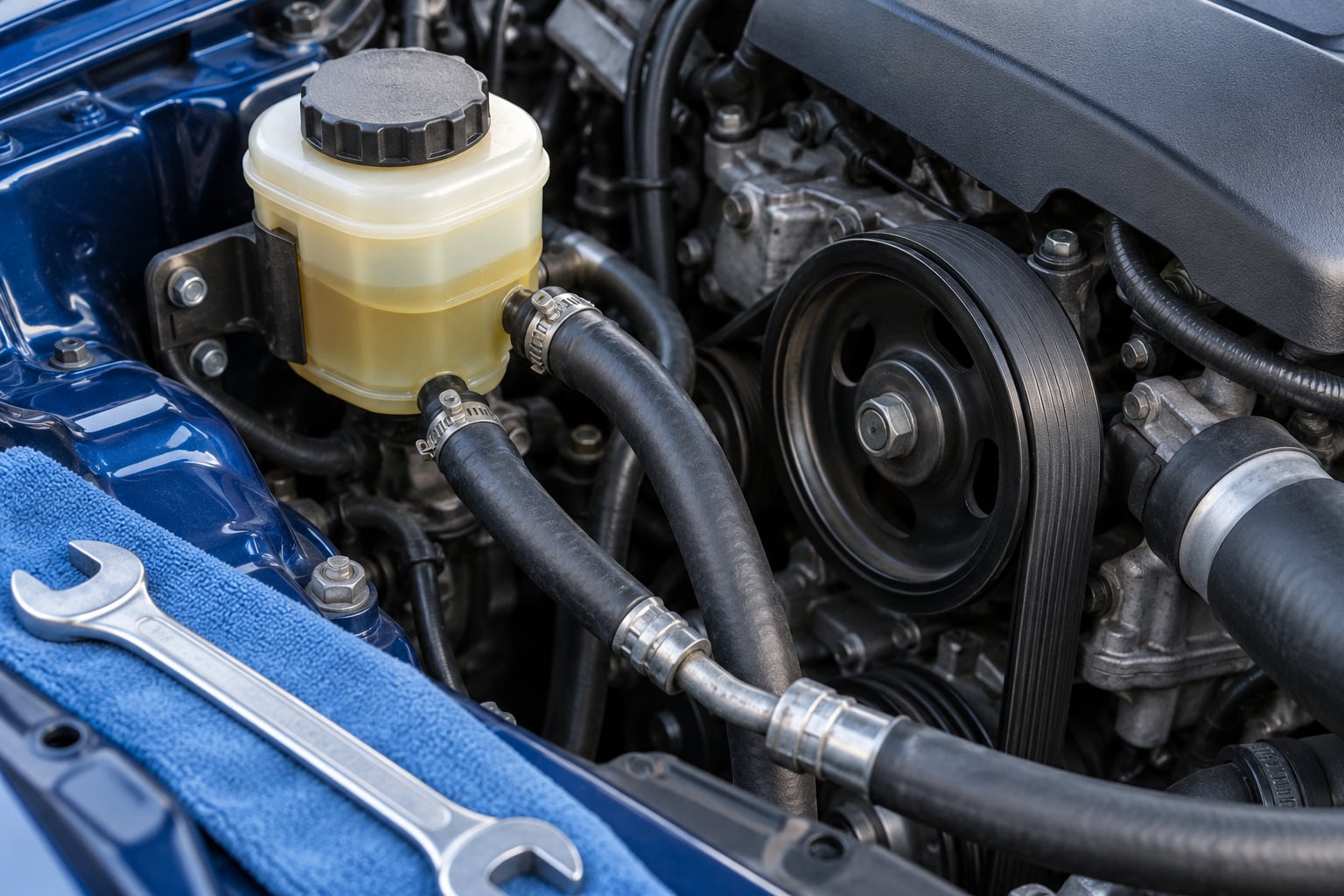
Most power steering whine comes down to four things: fluid level, air trapped in the system, a pump that no longer holds pressure, or fluid that has broken down. The sound itself tells you which one, because each cause changes pitch, volume, and timing in a different way. Start by matching the noise to a pattern rather than by ordering a pump.
In practice the expensive part is rarely the first suspect. A reservoir two marks below MAX, a hose weeping at the rack end, or a serpentine belt glazed from a hidden fluid leak will all produce the same squeal, and all of them cost far less than a rack assembly.
This guide covers what the noise is telling you, the eight causes that account for nearly every case, and a safe check you can do in the driveway before deciding whether you need a specialist. It applies most closely to hydraulic systems, with a separate section on electric-assist racks, which behave differently and have no fluid at all.
Table of Contents
- Power Steering Whine Noise Causes at a Glance
- Is It Normal for a Power Steering Pump to Whine?
- What Does the Whining Sound Tell You?
- What Are the Most Common Power Steering Whine Noise Causes?
- How to Diagnose the Noise Safely
- Can You Fix Power Steering Whine Without Replacing the Rack?
- When Is Steering Whine a Safety Problem?
- Frequently Asked Questions
- What to Check First
Power Steering Whine Noise Causes at a Glance
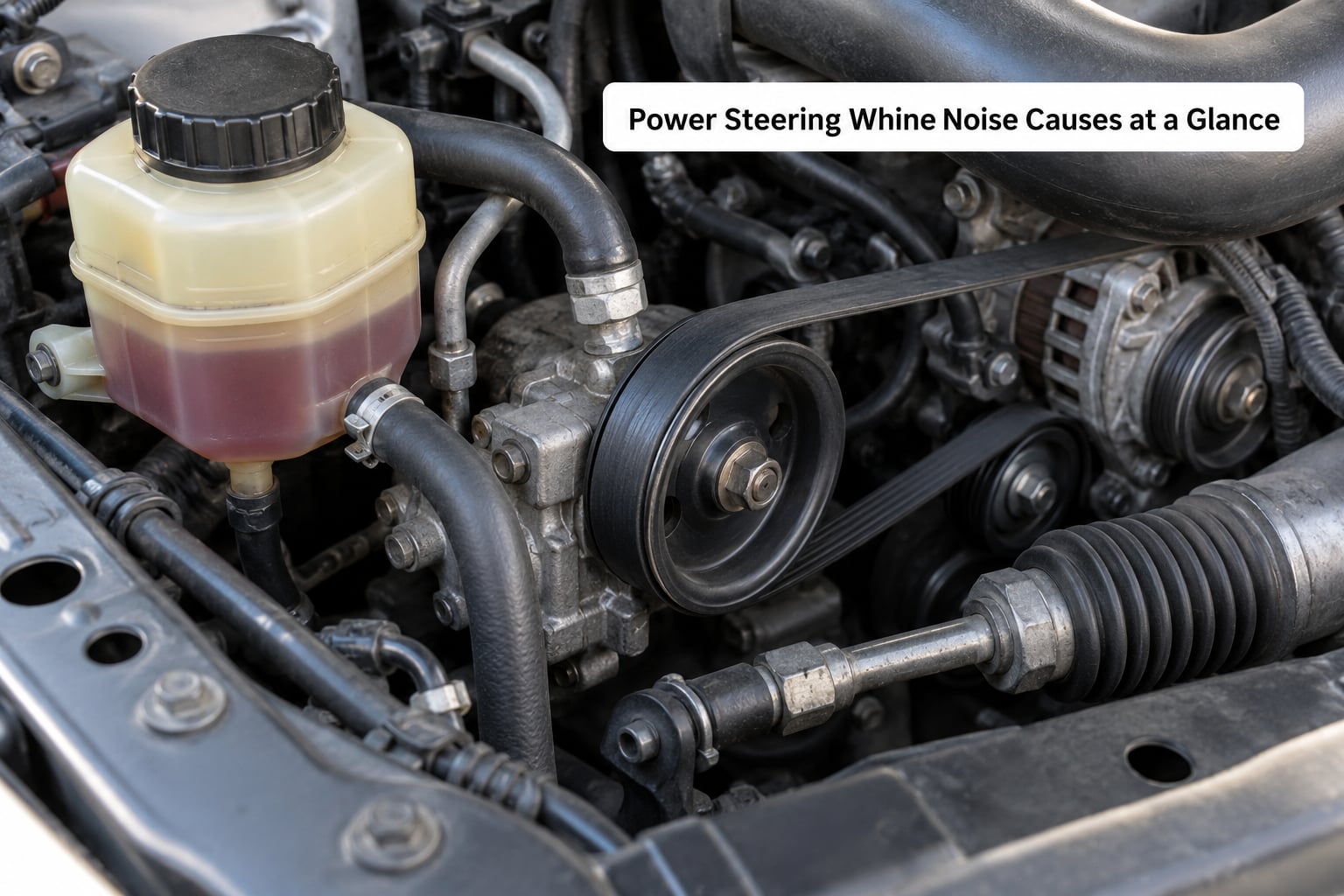
This table maps how each common cause sounds, when it shows up, and how much urgency it carries. Find the row that matches your noise, then confirm it with the checks in the diagnosis section.
| Likely cause | How it sounds | When it appears | Urgency |
|---|---|---|---|
| Low fluid level | Rising whine that grows with steering load | Worse on a cold start, quieter once warm | Check within days |
| Air in the system | Buzzy, gurgling hiss under load | After a fluid change, a leak, or sitting unused | Check within days |
| Failing pump | Squeal that follows engine speed at all times | Constant, or worse at idle and full lock | Book soon |
| Slipping or worn belt | Chirping or squealing that changes with revs | Any engine speed, sometimes only on start-up | Book soon |
| Contaminated fluid | Rattly whine with a groan under load | Gradual, often after years or a mixed service | Book soon |
| Restricted hose or rack valve | Groaning that eases when you straighten the wheel | Worst at lock and parking manoeuvres | Book soon |
| Rack or boot damage | Rumble or grinding felt through the floor | Worse over bumps and at low speed | Book soon |
| Electric-assist fault | High hum tied to the electric motor | Often with a warning message on the dash | Follow the manual |
Only the first two rows are things most owners can resolve in an afternoon with a jug of the correct fluid. The rest want a proper diagnosis before parts get bought, which is where the checks later in this guide come in.
Is It Normal for a Power Steering Pump to Whine?
Sometimes, yes. A healthy hydraulic pump spins with the engine and always makes some noise. A brief, quiet whir that fades once fluid circulates and disappears entirely when the oil warms up is normal on many cars.
What is not normal is a whine that stays with you for the whole drive, climbs in volume when you turn, or changes pitch in a way you can feel through the wheel. That pattern means the pump is chasing pressure it cannot hold, and the system is starting to fail.
Electric-assist systems are a different animal. They have no fluid, no pump spinning off the belt, and the motor only runs while it is correcting the steering. A faint hum at the wheel during parking is expected there; a hum under way, or a whine with a warning light, is a module, wiring, or steering-rack fault that needs a scan tool.
One more thing worth knowing: a factory pump can whine for a decade and still steer fine. Owners have reported running original pumps that sounded rough for years without failure. That does not mean to ignore it, but it does mean the noise alone is not a countdown.
What Does the Whining Sound Tell You?
Diagnose by behaviour, not by volume. Note the pitch, how long it lasts, and what makes it change, then match that to the table above.
Follow the engine speed
Rev the engine while the car is parked and the wheels are straight. If the whine rises and falls exactly with the revs, you are hearing a hydraulic pump or an accessory on the same belt. If the noise stays flat while the engine speed changes, the pump is not your culprit.
Follow the vehicle speed
Noise that appears at road speed and fades at idle usually belongs to the wheels or the alternator, not the steering. A noise tied to road speed alone is a wheel bearing or tyre issue, and our wheel bearing noise guide covers how to separate those two.
Watch what the wheel is doing
Groaning that quiets down when you straighten the wheel points to pressure being starved at lock, which is a restriction or a worn internal valve. A squeal that gets louder the faster you turn in one direction usually means fluid is being pulled past a leak on that side of the system.
Note the cold start
A whine that is loud for the first few minutes and then fades is very often air or a fluid level issue. Cold oil is thicker and takes longer to fill the pump’s internal clearances, so any starvation shows up first thing in the morning.
Check whether it is steering at all
Try the wheel at a standstill with the engine running. If the same noise comes from the engine bay without any steering input, the steering system is not making it, and you are listening to the alternator, an idler pulley, or the belt instead.
Two other noises get mixed up constantly. A rhythmic click at one wheel per revolution is often a CV boot, covered in our clicking noise when turning guide. A single tick that repeats while the car is stationary is usually a CV joint with no load on it. If a dashboard light comes on alongside the noise, check what a yellow steering wheel light means before chasing the sound.
What Are the Most Common Power Steering Whine Noise Causes?
Ranked roughly by how often each one turns out to be the answer when a car comes in with a steering complaint.
1. Low power steering fluid
The first sign is usually a reservoir sitting below the MAX line, sometimes with a light film of fluid on the filler neck. The pump cavitates when it cannot stay submerged, and cavitation is exactly the sound people describe as a whine that comes and goes with demand.
The limitation is obvious: you need the engine off and the fluid cold to read the level accurately, and on many cars you also need to remove a cover to reach it. Check the dipstick or sight glass, then look underneath the car for a puddle before topping up.
2. Air in the system
Air compresses instead of flowing, so the pump’s pressure arrives in pulses. That produces a buzzy, gravelly hiss rather than a clean tone, and it often disappears while the wheel is held still. Look for a foamy residue in the reservoir or a leak stain that explains how the air got in.
Air usually follows an event: a fluid change, a low-level episode, a hose crack, or the car sitting parked for months. If the car has not moved in a long time, expect to bleed it even if the level is perfect.
3. A failing power steering pump
A worn pump cannot make full pressure, so the assist drops and the whine stays with engine speed even when the wheel is straight. Two symptoms together point here: a squeal that never changes character, and a heavy or vague-feeling wheel on the road.
Where the fluid goes matters. If the level keeps dropping with no visible leak, the pump is passing fluid internally, and that is a pump job rather than a hose job.
4. A slipping, glazed, or worn belt
The pump and the alternator and the water pump all share the same belt on many cars, so a belt problem looks like a steering problem. Listen for chirping at start-up that fades once warm, and for a squeal that changes when you blip the throttle. Watch the pulley for a wobble or a shiny edge.
A worn pulley bearing can mimic pump whine closely. A cheap mechanic’s stethoscope settles it in seconds by letting you hear the bearing directly instead of hearing it through the bracket.
5. Contaminated or broken-down fluid
Steering fluid carries additives and lubricates the rack more than most people expect. Old fluid that has picked up metal particles, water, or the wrong ATF turns into a grinding paste, and the system starts to sound rattly under load.
Pull a sample with a straw or a clear tube. Milky fluid means water intrusion, black and gritty fluid means internal wear, and a smell that lingers long after the drive usually means the wrong product went in.
6. A restricted hose or a sticking control valve
Over time, hoses kink and internal passages narrow. The signature is a groan that appears at lock and eases off when you straighten up, and sometimes a sticky feeling at one end of the steering travel. The wheel may not return to centre on its own any more.
This is harder to confirm from the driver’s seat. It is one of the reasons the diagnosis steps below exist before anyone commits to parts.
7. Rack or boot damage
A torn rack boot sprays fluid onto the rack bar and lets dirt in, and the internal damage that follows is expensive. The warning is different from a pump: a rumble or grinding through the floor, sometimes a vibration that changes with the road surface.
Check underneath for fresh fluid on the rack housing, and inspect the rubber boots and their clamps. Dark, wet-looking rubber with a mist of fluid around it has failed.
8. Electrical faults on an electric-assist rack
If your car has no reservoir and no pump, the whine is coming from the electric motor, its wiring, or the assist module. Common triggers are a weak 12-volt battery, a corroded ground strap, a failing motor, or moisture in a connector under the cowl.
This is where a scan earns its keep. Body control modules store power steering codes that a generic reader can pull in minutes, and the codes narrow the search before anyone removes a part.
How to Diagnose the Noise Safely
Work in a fixed order and the diagnosis takes about thirty minutes, most of it spent listening. Keep your hands clear of the belt and pulleys with the engine running, and set the parking brake firmly.
How Power Steering Whine Noise Causes Be Isolated Step by Step
- Stationary engine check. With the car parked, the wheels straight, and the engine at idle, listen. Turn the wheel slowly lock to lock and note exactly when the noise changes. Then blip the throttle and see whether the pitch follows the revs.
- Read the level cold. Engine off, fluid cold, transmission in park or neutral with the parking brake set. Check the reservoir dipstick or sight glass and the fluid colour in the filler neck.
- Look underneath. Before adding anything, get the car on a ramp or drive it back so you can see the rack, the hoses, and the area around the front wheels. Puddles and weeping joints tell you where the fluid went.
- Inspect the belt and pulleys by hand with the engine off. Look for glazing, fraying, missing ribs, and a pulley that wobbles when you spin it by hand. A belt that shines rather than grips is finished.
- Follow the hoses. Feel along the pressure and return lines for hardness, kinks, and swelling. A hose that feels stiff and flattened at a bend is restricting flow.
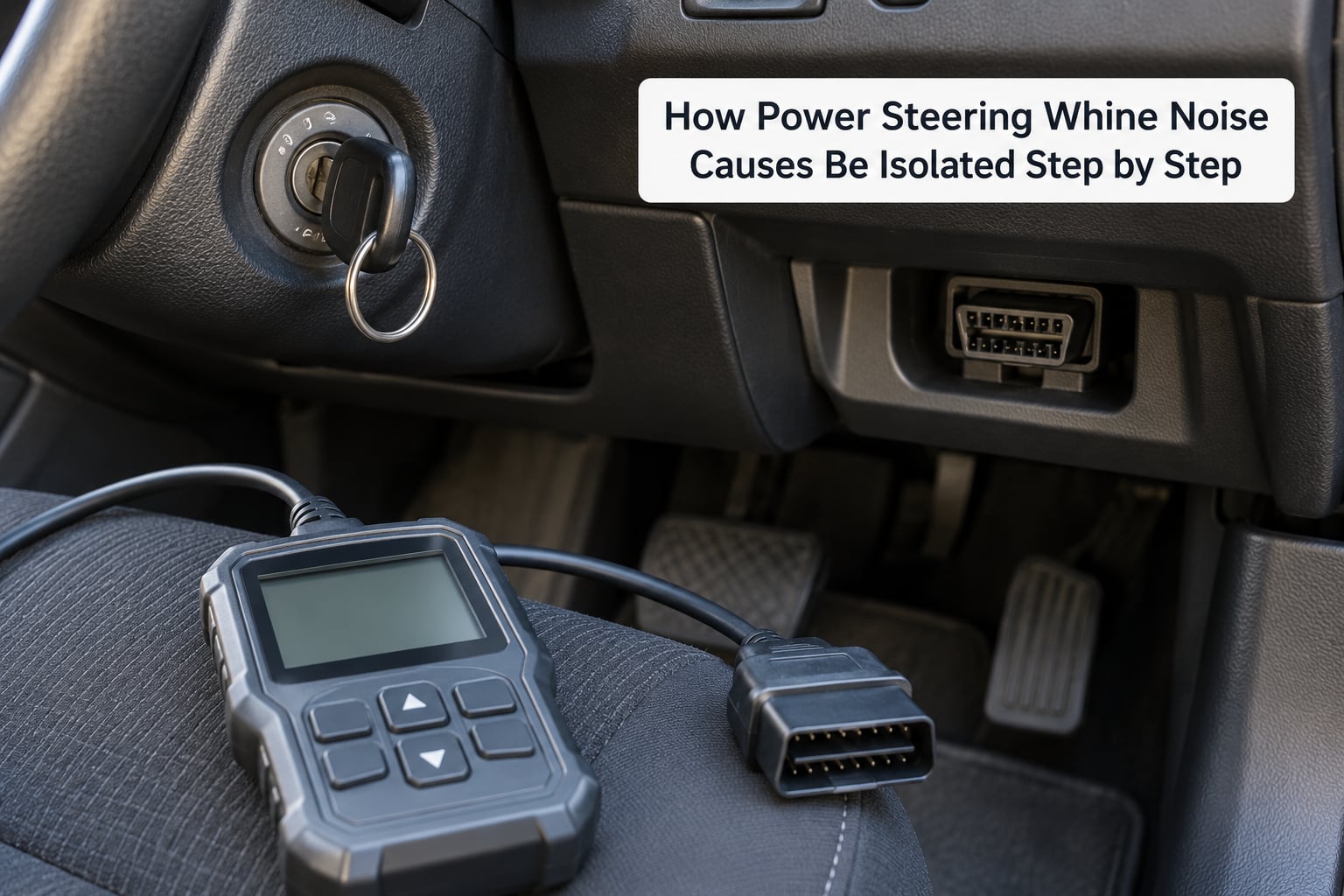
- Scan for codes if your car has electric assist. Plug an OBD reader into the port, turn the ignition on, and read stored and pending faults in the steering module before clearing anything.
If the noise follows engine revs, it is hydraulic or belt-related. If it ignores the engine and follows road speed, you are listening to something at the wheel. If it only appears with the wheel turned, the problem is pressure or flow inside the rack.
One extra trick worth having in the box: a stethoscope on the pump housing, an alternator body, and each pulley in turn. It takes a minute and removes most of the guesswork from the belt-versus-pump argument that eats the most diagnostic time.
Can You Fix Power Steering Whine Without Replacing the Rack?
In most cases, yes. The rack is the last thing on the list, not the first, and a large share of complaints leave the driveway with a jug of fluid and an afternoon of work.
Fixes you can do yourself
Top up with the correct fluid. Match the specification in your owner’s manual, not the label on the bottle. Many systems call for a specific ATF, some use a synthetic hydraulic fluid, and mixing products is what turns a low-level complaint into a contaminated one.
Bleed the system after a level loss. Turn the engine on, keep the level topped up, and work the wheel lock to lock slowly several times. Pump the fluid down into the cylinder, then shut the engine off and let it settle, checking for foam in the reservoir. Repeat until the fluid stays clear and the noise goes quiet.
Replace a worn belt or a hose. Match the belt to the engine and note the routing before you remove anything. Fit the hose with new seals and clamp it to spec, then bleed again because opening the line reintroduces air.
Work for a specialist
Pump replacement, rack rebuilds, internal valve work, and any EPS module or motor repair belong to a qualified steering technician. These jobs need the rack properly bled and torqued, and a half-bleed leaves you with the same whine plus a new part.
Many cars also use the power steering fluid as a coolant or a hydraulic fluid in another circuit, which is why a flush has to follow the manufacturer’s procedure rather than a generic one.
When Is Steering Whine a Safety Problem?
Whine on its own is a nuisance noise. Whine that arrives with any of the following is a stop-and-check situation.
- Grinding or metal-on-metal sound instead of a smooth whine
- Foaming, milky, or aerated fluid in the reservoir
- Fluid sitting on a hot exhaust manifold or engine block
- A steering wheel that feels heavy, vague, or slow to return to centre
- Assist that comes and goes, or a sudden jump while turning
- A steering warning message or a light on the cluster
Loss of assist turns a routine car into a much harder one to control, and at motorway speed that is not a risk worth taking. Park it, arrange an inspection, and follow the owner’s manual for the severity it assigns to each symptom. If the wheel still steers normally and the fluid is clean and at level, driving carefully to a steering specialist is reasonable.
One more practical note that gets missed: if the fender liner or underbody insulation has come loose, the same pump noise can sound dramatically worse. Owners who chased a “new” whine discovered the liner was drumming against the body. Check it while you are looking underneath for leaks.
Frequently Asked Questions
Why does my power steering whine when I turn the wheel?
Turning loads fluid across the rack, and the pump has to build pressure to help. When fluid is low, aerated, contaminated, or the pump is worn, that pressure arrives unevenly and the flow noise becomes audible as a whine. Note whether it changes with the angle of the turn, because a noise that only appears at full lock points to a restriction or low fluid rather than a failed pump.
Is it normal for power steering to whine all the time?
A constant whine is rarely normal once the oil is warm. Brief, soft whirring that fades after a minute or two often is, especially on cars with a high-pressure pump. A noise that stays at the same pitch for the whole drive means the pump is not holding pressure. Check the level and look for leaks before assuming the pump has failed.
Why does the steering noise get louder when the engine is cold?
Cold fluid is thicker and slower to flow, and the pump’s internal clearances take longer to fill. Any air in the system expands more when cold, which adds to the hiss. Cold weather also stiffens the rack and hoses. If the noise fades completely once the fluid is at operating temperature, air and a marginal fluid level are the first things to rule out.
Can low power steering fluid make a whining noise?
Yes, and it is the most common cause. A pump that cannot stay submerged cavitates, and cavitation sounds exactly like a whine. The level is only accurate with the engine off and the fluid cold, so read the dipstick on a cold morning. If the level is correct and the whine remains, look for a hidden leak before moving on to the pump.
Why does my power steering whine after replacing the belt?
A fresh belt sometimes needs a few minutes to bed in, and it can chirp briefly while it does. A whine that persists points elsewhere: the new belt may be routing or tensioning differently, or the noise you hear now was the pump all along and the old belt masked it. Recheck the pulley for a wobble and confirm the belt matches the engine spec before blaming the steering system.
What to Check First
Start with the reservoir on a cold engine, then look underneath for a leak and inspect the belt and hoses by hand. If the fluid is right and nothing is dripping, listen again with the wheel straight and with it turned: a noise that follows engine speed is hydraulic or belt-related, and one that follows road speed belongs to the wheel or tyre instead. That single test narrows the field faster than any part you could buy.