
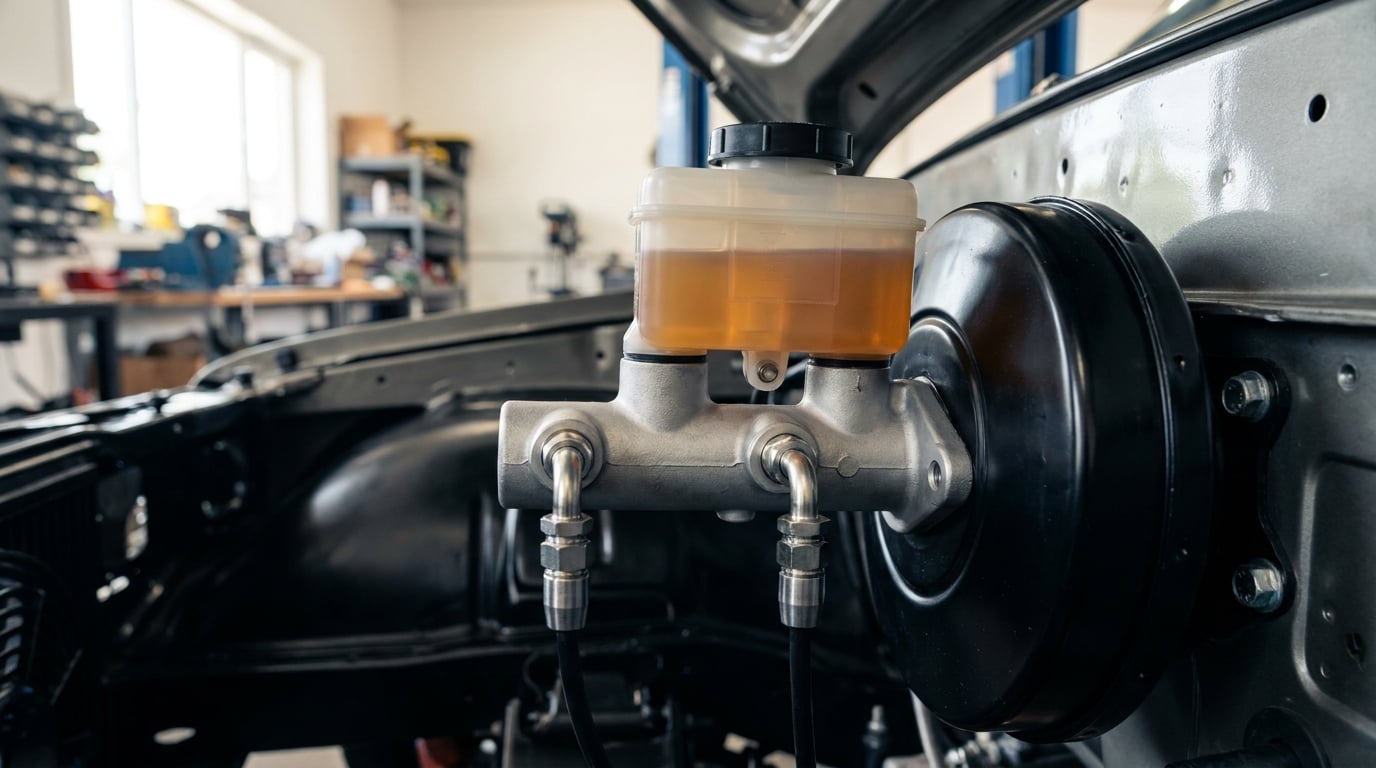
Of all the brake master cylinder failure symptoms, the one owners notice first is a pedal that feels firm for the first inch or so, then slowly travels to the floor while you keep steady pressure on it at a stoplight. If yours does that, stop driving and have it inspected. A master cylinder can also fail quietly, leaving you with fluid that looks normal and a pedal that is merely soft, which is why owners miss it for months.
Here is the short version: the master cylinder is the pump that turns your foot pressure into hydraulic pressure for the whole car. When it wears out, that pressure bleeds away past worn internal seals, and you feel it in your foot before you ever see it under the car.
Table of Contents
- What Brake Master Cylinder Failure Symptoms Mean
- 9 Brake Master Cylinder Failure Symptoms to Recognize
- 1. A Brake Pedal That Sinks Toward the Floor
- 2. A Soft or Spongy Brake Pedal
- 3. A Brake Pedal That Returns Slowly
- 4. Brake Fluid Leaking From the Master Cylinder
- 5. Low Brake Fluid or an Empty Reservoir
- 6. Brake Fluid in the Reservoir Looks Dark or Contaminated
- 7. Brake Warning Lights or Messages
- 8. Uneven or Poor Braking After the Car Has Been Parked
- 9. Moisture, Corrosion, or Damage Around the Cylinder
- What Causes a Brake Master Cylinder to Fail?
- How to Inspect the Brake Master Cylinder Safely
- Do These Symptoms Require an Immediate Repair?
- Frequently Asked Questions
- What to Do First
What Brake Master Cylinder Failure Symptoms Mean
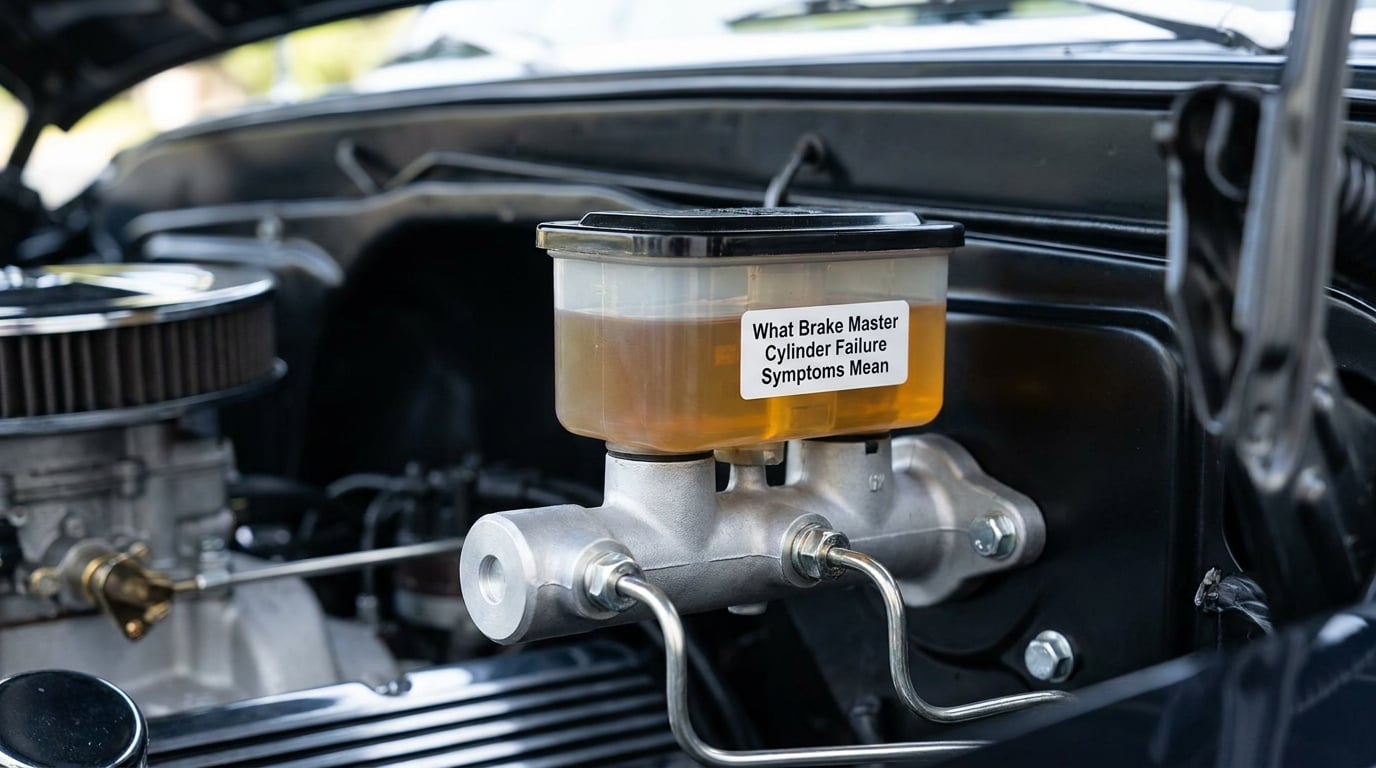
Press the pedal and a pushrod moves a primary and a secondary piston inside a cast metal cylinder. That pressurizes brake fluid and sends it down two separate lines, usually split diagonally so one front corner and the opposite rear corner share a circuit. The fluid reaches calipers and wheel cylinders, and the pads clamp the rotors.
Because every circuit gets its pressure from this one part, a master cylinder is a single point of failure for the entire braking system. On most modern cars with a diagonal split, a failure in one circuit still leaves you braking on two diagonal wheels, which is a partial loss rather than a total one, but the pedal response becomes vague and your stopping distance grows. On older single-circuit setups the consequences are more immediate.
The distinction that matters most is where the fluid goes. An external leak shows up on the ground, on the firewall, or on your driveway. An internal leak takes the fluid into the cylinder itself, so there is no puddle anywhere, only a pedal that slowly gives way under steady pressure. Mechanics on r/MechanicAdvice repeat the same rule: pedal sinks under steady pressure with the engine running means look at the master cylinder, pedal is simply soft and bouncy means bleed first.
| What you see | Internal leak | External leak |
|---|---|---|
| Fluid on the ground | None, by definition | Puddle under the car or stain on the firewall |
| Pedal at a standstill | Firm, then creeps to the floor | Normal until fluid level drops low |
| Reservoir level | Often still near full | Drops steadily between services |
| Pedal feel while moving | Fades, longer stopping distance | Fades only after the level gets low |
| Typical fix | Replace the cylinder and bleed the system | Replace the cylinder, inspect the booster, bleed |
One more warning about external leaks: a failed rear seal on the master cylinder often bleeds into the brake booster instead of onto the ground. Owners on r/Justrolledintotheshop post photos of rear flanges soaked in fluid that made it to the booster diaphragm, and the booster then fails a few months later because that fluid attacks the rubber. If you find fluid at the booster, replace both.
9 Brake Master Cylinder Failure Symptoms to Recognize
1. A Brake Pedal That Sinks Toward the Floor
This is the signature brake master cylinder failure symptom and the one to act on. Worn internal seals let pressurized fluid bypass the pistons, so the primary piston returns without building pressure and the pedal runs out of travel. You notice it first at a long stop, holding the pedal while the engine idles.
New pads on a new rotor feel different for the first few miles, and a stretched or misadjusted pedal can feel long, but neither of those creeps downward while you hold pressure. Creeping travel under held pressure is a hydraulic leak until proven otherwise.
2. A Soft or Spongy Brake Pedal
A spongy pedal feels mushy, bouncy, or vague, and it does not firm up after you pump it a few times. Air in the lines is the usual cause, and so is fluid that has absorbed water or picked up contamination, since both change how the fluid compresses under pressure.
This is where people waste money. A soft pedal that never sinks is often a bleed, a fluid flush, or a problem in the ABS modulator rather than a dead cylinder. If the pedal is soft and also travels to the floor under pressure, you have two problems and the cylinder is very likely one of them.
3. A Brake Pedal That Returns Slowly
When you lift off, the pedal should snap back quickly. A slow return often means the pedal return spring is weak, the pedal bushing is worn or stuck, or the master cylinder piston is not retracting cleanly because of corrosion or sticky fluid. Multiple threads on community.cartalk trace a stubborn return to the pedal components rather than the cylinder.
Check the return before you call it a master cylinder. A cylinder with a healthy seal still builds pressure on the next push even if the pedal stays down, so a slow return by itself is not a failure sign, it is a warning sign.
4. Brake Fluid Leaking From the Master Cylinder
External leaks show up in predictable places: the master cylinder body or reservoir seam, the fittings where the brake lines enter the cylinder, the mounting flange bolts at the firewall, or the pushrod seal where it enters the booster. Fresh fluid is clear or amber, so a wet shine under the car with no rain is worth a look on a dry day.
Our guide to how to check brake calipers for leaks covers the other end of the system, and the same visual approach works up here. Look with a flashlight at the area above the pedal, and never open a hot system or top the reservoir up with the fluid still hot.
5. Low Brake Fluid or an Empty Reservoir
Fluid level is a gauge, and a level that keeps dropping with no pad or rotor service to explain it is a leak somewhere. If your low brake fluid warning light comes on between services, assume a leak until you find it.
Open the hood on level ground, engine cold, and look at the reservoir against the molded MAX and MIN lines. Clean the cap and the fluid surface first, because a film of dust on top of the fluid reads as a false low level. A warning light that flickers over bumps often means the level sensor is near the minimum, and that is a reservoir-to-master-cylinder seal problem worth checking.
6. Brake Fluid in the Reservoir Looks Dark or Contaminated
New DOT 3 or DOT 4 fluid is transparent, straw colored, and it smells faintly sharp. Fluid that is dark brown to black, cloudy, or full of grit has been taking on moisture and corrosion products for a long time, and owners on several forums describe spotting it in the reservoir before the pedal ever felt different.
Moisture is the real enemy here. It corrodes the bore and hardens the internal seals from the inside, which is how a cylinder ends up leaking into itself. Our walkthrough of how to test brake fluid with a moisture tester covers the water content check. Contaminated fluid can damage a new cylinder in weeks, so a flush belongs in the same job, not three months later.
7. Brake Warning Lights or Messages
A red BRAKE lamp usually means low fluid, a worn parking brake, or a pressure problem in the system. A yellow ABS lamp means the anti-lock module has seen a wheel speed signal it does not believe, which can happen when hydraulic pressure is irregular. Some cars also display a brake system or pressure message in the instrument cluster.
The light alone does not prove the master cylinder is done. It tells you the car is unhappy with the hydraulic system, and the pedal feel plus the fluid condition tell you where to start looking.
8. Uneven or Poor Braking After the Car Has Been Parked
Slowly leaking fluid draws air into the circuit, and air is compressible, so the first firm part of the pedal disappears and what is left responds late. The car takes longer to stop from the same speed, and on a diagonal split circuit the two corners sharing the weak circuit can pull the car to one side under light braking.
Pulling to one side has far more common causes than the cylinder. Worn pads on one side, a bent or scored rotor, a sticking caliper slide, or a low fluid level are all cheaper to fix. Diagnose pads, rotors, calipers, and the ABS module before a shop quotes you a cylinder.
9. Moisture, Corrosion, or Damage Around the Cylinder
Look at the area around the cylinder and the booster with a light. Stained paint on the firewall, crusty white or green deposits around the line fittings, a damp sheen at the flange, or a crust forming at the reservoir ports all point at a leak or long-term moisture exposure. The same wet-shine trick that finds a caliper leak works on the cylinder body.
Be careful about the source. Corrosion around a flare nut or a brake hose can weep fluid that runs down and pools near the cylinder, so trace the wet trail upward before you decide which part failed.
What Causes a Brake Master Cylinder to Fail?
Age and internal wear are the usual story. The rubber seals inside the cylinder harden and take a set from the inside, and the bore picks up corrosion pits that let fluid slip past the primary piston. On a well-kept car this can show up past 100,000 miles, and on a neglected one much earlier, though plenty of original cylinders on high-mileage vehicles have never been touched.
Moisture is the accelerant. A reservoir cap that no longer seals, an aging plastic reservoir, or a small external leak lets water in, and water plus heat plus steel makes corrosion. A cylinder that is repeatedly topped up with the wrong fluid spec also fails early, because the wrong chemistry does not protect the seals.
Damage from a leak you ignored is the third path. Once fluid is at the rear seal, it gets into the brake booster, and the booster’s diaphragm and check valve take on fluid that never dries out. A cylinder replaced without inspecting the booster often comes back as a repeat failure.
Installation mistakes finish some cylinders off too. A cylinder torqued crooked or with a line fitting cross-threaded, a reservoir installed with trapped air, or a cylinder that was never bench bled before it went into the car gives you a soft pedal from day one that gets blamed on the wrong part.
How to Tell a Master Cylinder Problem From Other Brake Problems
Use the pattern of symptoms, not any single clue. These are the comparisons that come up constantly in the diagnosis threads I have read, and they line up with what a shop would actually test.
| Likely cause | Symptom pattern | Test that confirms it |
|---|---|---|
| Failing master cylinder | Pedal firm, then creeps to the floor under held pressure, no visible leak | Engine running, hold pedal: it drops to the floor. Engine off: pump three times, hold, it stays put |
| Air in the brake lines | Soft or bouncy pedal, improves when pumped, no sinking under steady pressure | Pedal firms up after several pumps and bleed all four corners |
| Weak brake booster | Pedal is hard and requires effort, or brakes feel vague with the engine running and sharp with it off | Compare pedal feel engine off versus engine running |
| Worn pedal bushing or return spring | Pedal sits at an odd angle, feels notchey, returns slowly, pressure still builds when pushed | Inspect bushing and return spring for wear and missing clips |
| Proportioning or combination valve | Brakes feel different under light and heavy pressure, sometimes a grinding noise as the valve works | Check for valve adjustment and fluid condition at the valve body |
| ABS module or modulator | Soft pedal that returns after a full bleed, yellow ABS lamp, codes stored | Scan for ABS codes and check pedal feel after the manufacturer bleed sequence |
| Worn pads or damaged rotors | Reduced or uneven braking, noise, pedal feels fine, no fluid level change | Measure pad thickness and rotor thickness and surface |
| Leaking caliper or wheel cylinder | Fluid on the wheel, rotor sometimes rusty or scored on one side | Trace the wetness down from the caliper, not from the pedal |
The engine-on hold test is the one that sorts most of this out in a minute. With the engine off, pump the pedal three or four times, then hold it firmly: a healthy system holds that pressure. Start the engine and hold the same pressure: a healthy pedal drops slightly as the booster assists and then stays. If it keeps dropping all the way to the floor, you are looking at an internal leak in the master cylinder.
How to Inspect the Brake Master Cylinder Safely
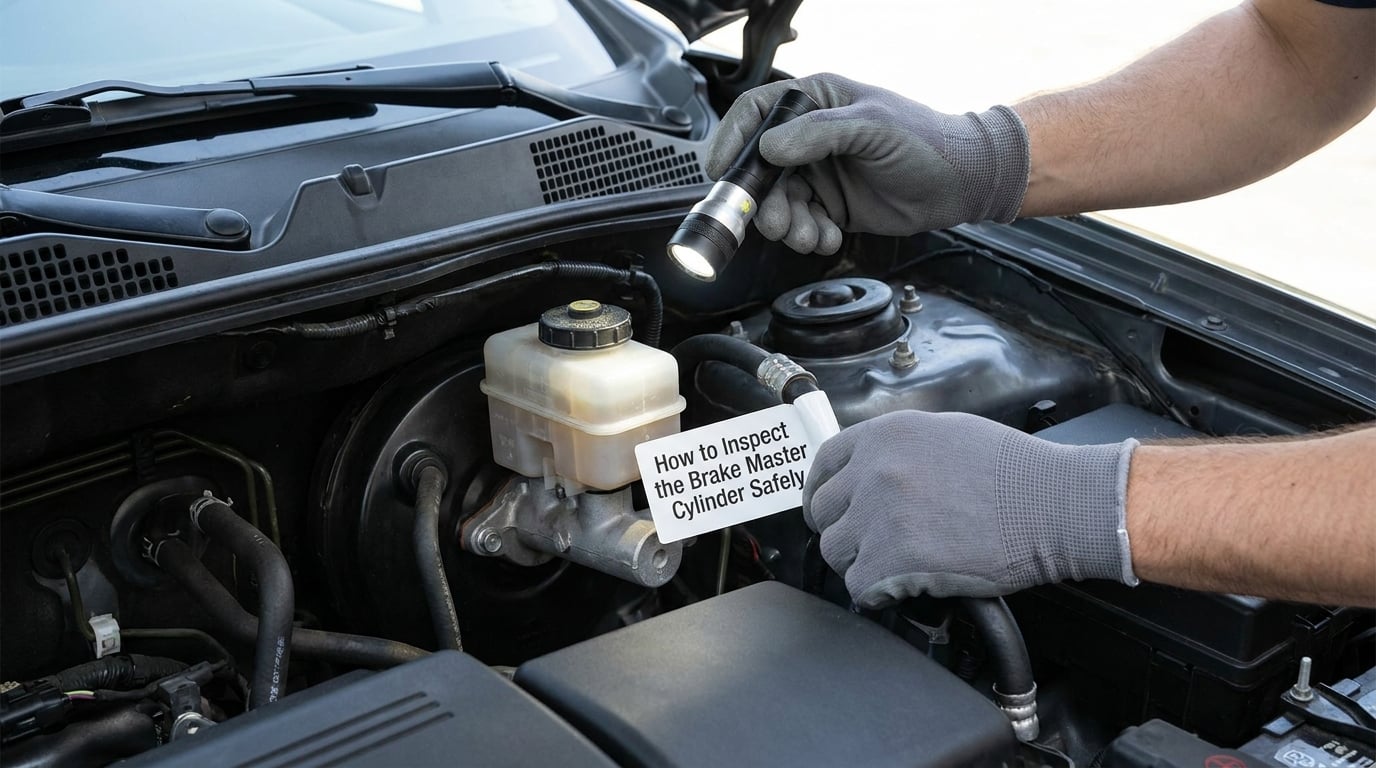
Level ground, parking brake set, transmission in park or first gear, engine cold. If the car has been driven hard, wait an hour so nothing is hot enough to burn you or to boil fluid out of the reservoir when you open it.
Start with the fluid. Open the reservoir cap, check the level against the MAX and MIN lines, and look at the color in clean daylight. Clear or light amber is normal. Brown, black, cloudy, or gritty fluid means flush the system and test it for moisture before anything else gets done.
Then read the area around the cylinder. With a flashlight, look at the cylinder body, the two line fittings, the flange bolts, and the pushrod seal at the booster. Any fresh fluid, staining, or corrosion crust there is evidence of an external leak. Follow the wet trail upward so you know which seal or fitting actually failed.
Next, do the two pedal tests. Engine off, pump three times and hold; engine on, hold again. A pedal that creeps to the floor with the engine running, or a pedal that goes down and stays down after you shut the engine off and keep holding, points at the cylinder. A pedal that is only soft but firm enough to hold is more likely air, a booster issue, or contamination.
Finally, scan for codes and check the warning lamps. An ABS fault code changes the diagnosis completely, because the modulator can hold air in the circuit after a perfectly good bleed. Follow the manufacturer’s bleed sequence for your car rather than assuming the old push-until-pedal-is-firm method worked.
On BMWs and other cars with a brake pedal position sensor or electronic parking brake, a sinking pedal can also set stored codes, so read them before you start replacing parts. Your owner’s manual specifies the fluid type and bleed order for the model, and both matter.
Do These Symptoms Require an Immediate Repair?
Some symptoms are a slow decline and some are a stop sign. Here is how I rank them.
Treat it as urgent, drive only to a shop if you must, when the pedal sinks under held pressure, when fluid is visibly leaking, when the reservoir is near empty, or when the red BRAKE lamp is on with a low level. Do not drive, tow it, when the pedal goes to the floor and stays there, when one circuit is gone and the car pulls hard under braking, when you have fluid in the booster, or when the pedal goes soft immediately after a fluid change or brake work.
A pedal that is only slightly long, a slow return, or dark fluid with no change in feel is a prompt appointment, not an emergency. It still matters, because the same conditions that discolor the fluid are the ones that will eventually pit the bore.
Understand what you are risking. Brakes are how you stop for pedestrians, intersections, and whatever is in the lane behind you, and the failure is often progressive rather than sudden. A cylinder that leaked a little this morning may leak its last of the fluid on a highway on-ramp tomorrow.
Frequently Asked Questions
Can a brake master cylinder fail without leaking?
Yes. An internal leak happens when the rubber seals inside the cylinder harden or tear and fluid bypasses the pistons into the cylinder body instead of out into the lines. Nothing appears under the car, the reservoir level often stays near full, and the only clue is a pedal that is firm at first and then creeps to the floor while you hold it. Compare the pedal engine off and engine running to confirm.
How do I diagnose a sinking brake pedal?
With the car on level ground, engine cold, pump the pedal three times with the engine off and hold it. If it holds, start the engine and hold the same pressure. A pedal that drops and keeps dropping to the floor points at an internal master cylinder leak. A pedal that only feels soft but holds pressure points at air in the lines, a weak booster, or contaminated fluid. Check the reservoir color and look for external leaks at the same time.
Can I drive with a bad brake master cylinder?
Do not, if the pedal sinks under held pressure. Braking performance falls off unpredictably, and on a diagonal split system one circuit can lose pressure while you are driving, leaving you with braking on two corners only. Park it on level ground and have it inspected, or tow it. A slight change in pedal feel with no sinking, no leak, and a normal fluid level is a scheduled repair rather than a reason to stop driving today.
Why does my brake pedal sink after I replaced the master cylinder?
Four things cause it. The new cylinder was installed without a bench bleed, so air is trapped inside it. Air remains in the ABS modulator because the vehicle was not bled in the order the manufacturer specifies. A stuck pedal return or a missing pushrod clip keeps the piston partially applied. Or the booster took fluid through a failed rear seal and is dead now. Check stored ABS codes first, then bleed properly in the correct sequence.
What is the lifespan of a brake master cylinder?
There is no fixed number, because fluid condition and maintenance matter more than mileage. A cylinder on a vehicle that never had its fluid drained, never had contaminated fluid, and never leaked can run well past 100,000 miles. One that sat with a loose reservoir cap, absorbed moisture, and rusted internally can fail far earlier. If the fluid is clean and the seals stay intact, most cylinders reach the end of their useful life through age-related seal hardening rather than mileage alone.
What to Do First
If the pedal sinks under held pressure, leave the car parked on level ground and do not drive it. Let everything cool, then look at the reservoir level and the fluid color, and put a flashlight on the cylinder body, the line fittings, and the booster flange to see whether there is any external leak.
Then get a proper diagnosis using your vehicle manufacturer’s fluid specification and bleed procedure, so the next conversation you have with a shop starts from a test result instead of a guess. On the symptoms list above, the one that ends the driving question is a pedal that travels to the floor and stays there.