
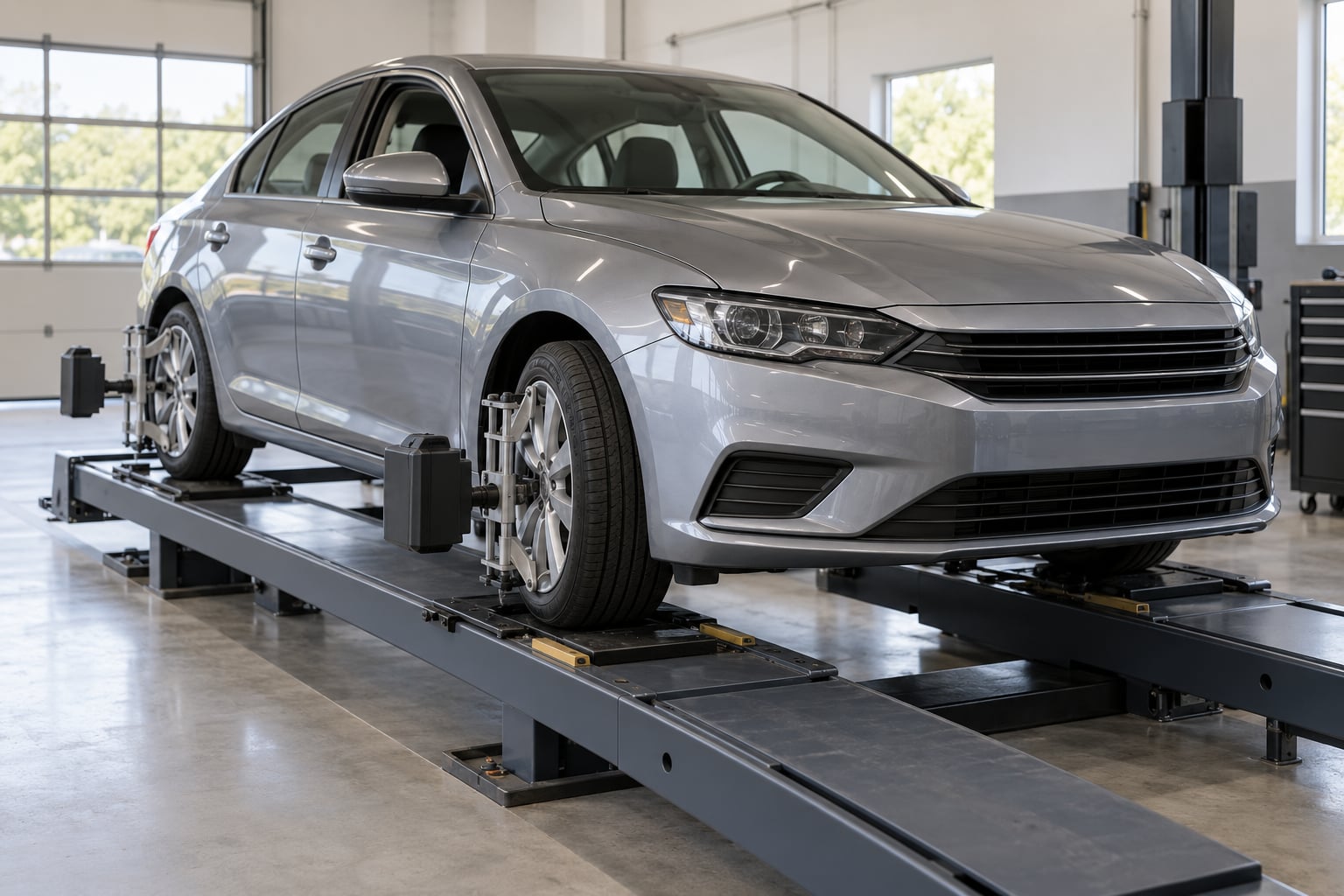
A steering wheel off center after an alignment almost always comes down to one thing: the wheel itself was not locked dead center on the rack before the tech set your toe. An alignment measures toe, camber and caster against the rack centerline, and steering wheel position is not one of those spec numbers, so a job can print out perfectly and still leave you driving with the rim cocked a few degrees to one side.
Here is the useful distinction. If the car tracks straight and holds itself straight at freeway speed, you have a steering-position problem, mostly a comfort issue. If the car drifts or pulls and you are constantly correcting the wheel, you have a real geometry problem that will eat tires. Most people asking this question fall into the first group and assume the worst. If you are not sure which category you are in, start with how to tell if you need an alignment.
Table of Contents
- Why Is the Steering Wheel Off Center After an Alignment?
- What Does an Off-Center Steering Wheel Mean?
- Why Does It Happen? Common Causes and Fixes
- How to Check the Problem Before Visiting a Shop
- What Should You Ask the Alignment Shop to Do?
- How to Fix a Steering Wheel That Stays Off Center
- When Is It a Safety Problem?
- Frequently Asked Questions
- Is it normal for the steering wheel to be off center after an alignment?
- Why is my steering wheel off center but the car drives straight?
- Can I drive with a crooked steering wheel?
- Which way do I turn the tie rods to straighten the steering wheel?
- Should I reset the steering angle sensor after an alignment?
- How much does it cost to fix an off-center steering wheel?
- What to Do First
Why Is the Steering Wheel Off Center After an Alignment?
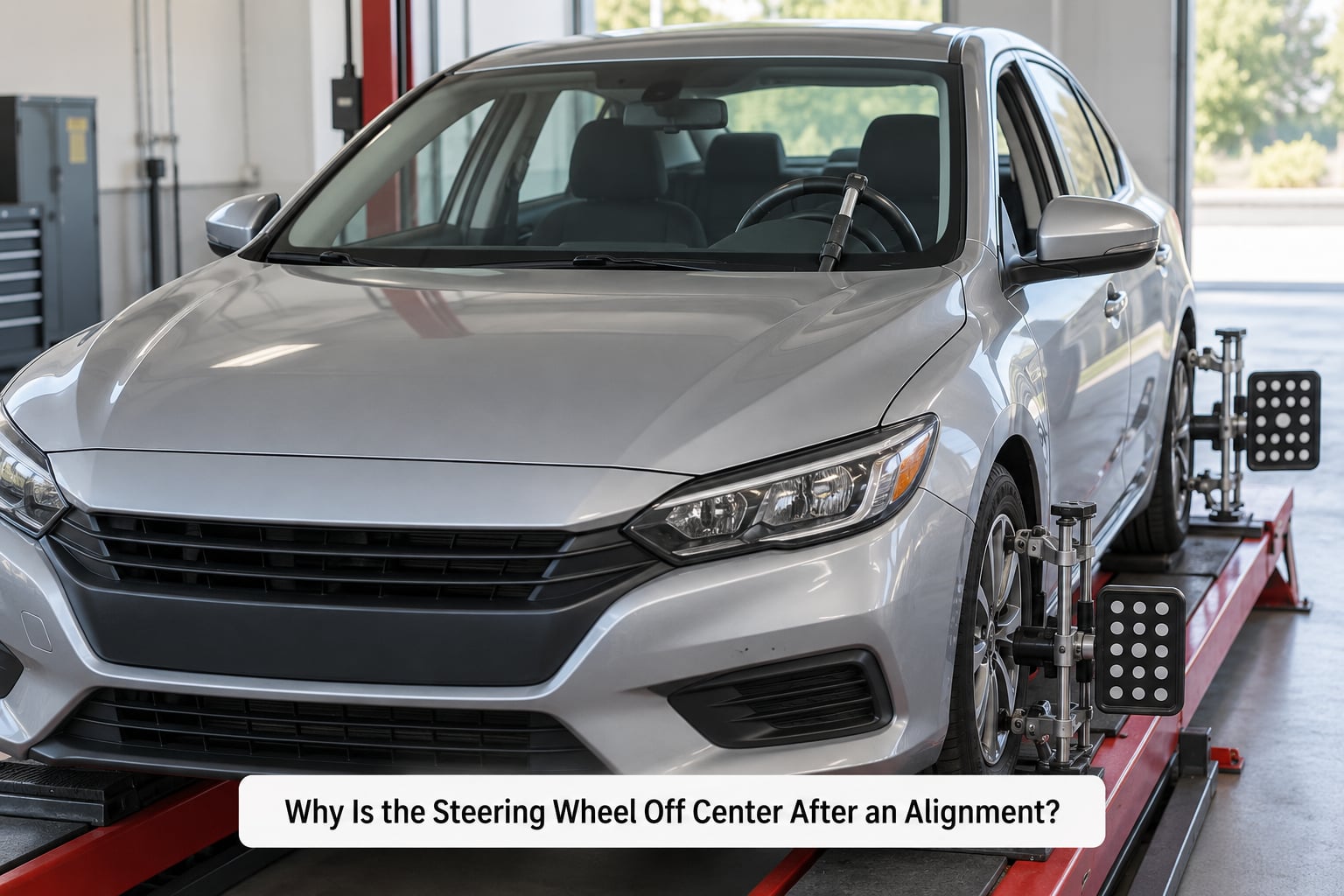
Because the alignment rack centers your wheels, not your wheel. When the car goes up on the rack, the turn plates let the tech roll the steering through lock in both directions and settle at the mechanical center of the steering rack. That center position then locks in with a steering wheel holder, and only then does toe get set.
Skip that step and the tech is adjusting toe against a rack that is sitting a few degrees off its true center. The numbers come out exactly where the spec sheet wants them, measured from wherever the rack happens to be pointing. The printout says pass, and the rim on your way home is crooked.
This point shows up over and over on the enthusiast forums that dominate the search for this problem. The consensus on BimmerPost is blunt: the direction of the steering wheel is not indicated on any alignment spec, and it is up to the tech to center it on the rack. Miata owners put the same thing a different way, that the steering wheel and the rack must be centered and attached correctly before the alignment can be done properly.
What Does an Off-Center Steering Wheel Mean?
It means the rim sits a few degrees off vertical while the car is going straight. How much is a problem depends entirely on whether the car pulls, so run this fork before you spend any money.
| What you notice | What it probably is | Urgency |
|---|---|---|
| Wheel sits crooked, car tracks dead straight at every speed | Rim position only. Rack center was wrong at setup, or the tie rods were moved unevenly afterward | Comfort, not safety. Fix it before it bothers you daily |
| Car drifts to one side, you correct with small wheel inputs | Real toe or thrust angle error, or rear geometry out of spec | Safety and tire wear. Get measured |
| Wheel crooked and car pulls, but pull is gentle | Mixed: rim position plus a slight thrust or toe error | Both. Needs a full four-wheel check |
| Wheel off center by a large amount, near 20 degrees or more | Something is bent, seized, or a part was replaced and toe was never rechecked | Stop and inspect before driving far |
Ten degrees or less with a straight-tracking car is a nuisance, not a danger. Forum owners regularly talk about living with three or four degrees for months before getting it sorted. Past roughly ten degrees you are moving your hands more than you want to at highway speed, and many people find the wheel ends up at an awkward height after a big turn, which is its own nuisance.
Straight-line tracking is the test that settles it. Get on a flat, straight road with light traffic, set the cruise control, and take your hands off the wheel for a few seconds at a time. If the car holds its lane, the geometry is fine and the rim is simply mounted or centered wrong. If it walks across the lane, stop ignoring the wheel angle and get the numbers checked.
Why Does It Happen? Common Causes and Fixes
Work through these in order, because the first one explains most cases and the last one is the expensive answer.
| Cause | Why it happens | How to confirm | Fix |
|---|---|---|---|
| Wheel not locked centered before toe was set | Toe was referenced to an off-center rack position | Car tracks straight, rim is crooked | Return to the rack, center and clamp the wheel, re-set toe |
| Uneven tie rod adjustment after service | One side was turned and the other was not, which rotates the rim and changes toe | Outer tie rod lengths differ side to side, measured center-to-center | Turn both equally in opposite directions so toe stays where it was |
| Binding turn plates or a locked steering lock | The rack could not settle at true center, so the geometry reference was wrong. A Tundra owner traced his crooked wheel to a rack with binding turn plates | Tech checks that the wheel spins freely both ways with the rack centered | Free or binding rack service, then redo the alignment |
| Toe set wrong, or rear geometry off | A front alignment with a bent or shifted rear axle or thrust angle error produces a pull you compensate for at the wheel | Car pulls, and a four-wheel printout shows rear or thrust out of spec | Full four-wheel alignment with rear measurements included |
| Bent or seized steering component | Curbs, potholes or collision work move the rack, tie rod, strut or control arm out of position | Uneven tire wear on one edge, visible bend, wheel not sitting square in the arch | Replace the damaged part, then align. A Mustang owner whose wheel stayed crooked after a supposedly good alignment concluded something was bent and moved to a second shop |
| Tire pressure or uneven wear | A soft or mismatched tire changes how the car reads the road and can hold a wheel at an angle | Pressure check on a cold tire, tread depth and wear pattern comparison across all four | Set pressures to spec, replace worn or mismatched tires, then recheck |
| Steering angle sensor not zeroed | On cars with electronic stability control, the sensor remembers a straight-ahead reference and can fight a mechanically straight wheel | ESP or ABS light, cruise or hill hold behaving oddly, wheel that self-centers poorly | Zero the steering angle sensor with a scan tool after the geometry is right |
The rule for a steering wheel off center after alignment
If you adjust tie rods yourself, the change has to be equal and opposite. Shorten one side and lengthen the other by the same amount, and the rim rotates toward center while toe barely moves. Turn only one rod and the wheel looks straighter but you have just changed your toe, which is exactly how people end up with a straight wheel and a car that pulls.
How to Check the Problem Before Visiting a Shop
Before you call anyone, spend ten minutes on these checks. They take a tape measure and a tire gauge, and they tell the shop exactly what to look at.
Set tire pressures on cold tires to the placard value in the door jamb, not the number molded into the sidewall. Then walk around the car and compare all four tires for tread depth and wear pattern. A tire shodded on one shoulder while its partner wears evenly is pointing at camber or a bent part rather than at the rim position.
Park on level ground and look at the wheel from the driver’s seat and again from directly in front of the car. If the rim looks centered from the front but is skewed from the seat, that is a rim clocking issue. If the rim looks tilted rather than turned, the top of the wheel is leaning, which is a different conversation entirely.
Next, check straight-line tracking on a quiet straight road with the cruise control. Take your hands off briefly and watch whether the car holds a lane. This is the single most useful piece of information you can hand a shop, so note it before you call.
With the engine off, rock the wheel gently left and right and then up and down at the straight-ahead position. More than a little free play means play in the tie rods, pitman idler or steering column. Heavy or inconsistent effort points at power assist, a binding rack or a drag from a seized joint.
Finally, read your owner’s manual on the tire wear chart and note any warning lights. An illuminated stability control or ABS light after an alignment usually means the steering angle sensor reference and the actual wheel position disagree. Write down what the manual says the wear pattern means so you can talk to the shop in their language.
What not to do at home: do not pry on the steering column to recenter the rim on a modern car with a spiral cable or a collapsible steering shaft, and do not rotate the steering wheel with the wheels off the ground and the car on stands. Neither is worth the airbag or clock-spring bill. Unbalanced wheels produce a very different vibration problem, and it is worth knowing wheel balancing vs alignment before you blame geometry for a shake you can feel through the seat.
What Should You Ask the Alignment Shop to Do?
You will get a much better result if you make the request specific. Shops say no to vague complaints because the printed spec genuinely does not cover wheel direction. Say this instead.
Ask them to re-center the steering wheel with the rack unloaded and the front wheels straight, then lock it with a wheel holder before re-setting toe. Ask for a printed alignment report showing before and after numbers for front toe, camber and caster, plus rear thrust angle, so you can see the geometry is genuinely in spec.
Ask them to confirm the rack turn plates roll freely in both directions and that the steering lock is fully released. Binding turn plates are a real rack fault that produces this exact symptom, and it takes a tech thirty seconds to rule out.
Ask them to inspect what could physically prevent centering: outer tie rod length left and right, straightness of the tie rods and strut mounts, ball joint play, and whether anything was replaced without a follow-up alignment. A Focus owner on r/MechanicAdvice had tie rod ends replaced and was told the crooked wheel was simply the result, because the shop would not correct the front camber at the same time. Ask for those things to be checked in writing on the invoice.
If the shop pushes back with the readings are in spec answer, that is fair and also beside the point. The measurements describe the wheels relative to the rack, not the rim relative to you. Ask what they will do to make the wheel straight, and if the answer is nothing, you have a service conversation to have before you leave the keys.
Owners of European cars often hear that the steering angle sensor needs a dealer-only reset. That procedure exists and it is sometimes part of the answer, but it should be the last step, not the first explanation, because zeroing a sensor while the rim is mechanically crooked just teaches the electronics the wrong straight-ahead position.
How to Fix a Steering Wheel That Stays Off Center
On the rack, the sequence matters. The tech rolls the steering through lock and back to settle the rack at true center, centers the rim, clamps it, releases the steering lock and re-checks that the rim is still centered, then sets toe and camber and measures rear thrust. Road test, re-measure, and only then hand the car back.
The DIY version works for a wheel that is off center on an otherwise straight car. Jack the front, support the car properly, spray both inner tie rod jam nuts with penetrating oil and let them sit, then back both nuts off a couple of turns. Turn the wheel to straight, work the tie rod threads in opposite directions, and count the same number of turns on each side. A club Xterra owner described the whole job as ten to twenty minutes.
Turn the wheel by hand as you work and watch the rim. Once it looks centered, tighten the jam nuts to torque and do a road test. Expect the tire to track slightly differently, because you moved toe even a little, which is why a rack measurement afterwards is worth the money.
On an aging car, expect the jam nuts to resist. If they will not break free, stop and take it to a shop rather than rounding the corners off a castle nut. Penetration oil, heat and patience beat a snapped stud every time.
When Is It a Safety Problem?
A crooked rim on a straight car is a comfort problem, but these symptoms move it into the safety column. Our wheel alignment symptoms and cost breakdown covers the full list with what each repair runs.
- The car pulls to one side at speed, or drifts across a lane when you let go of the wheel
- Uneven tire wear that keeps coming back after a new set of tires
- Vibration through the wheel or seat that changes with speed
- Heavy, jerky or inconsistent steering effort, or a wheel that does not return to center after a turn
- Free play in the wheel, a knock when you turn, or a visible gap where the tie rod meets the steering knuckle
- A damaged tire, a bulge in the sidewall, or a wheel sitting visibly out of square in the arch
- Illuminated stability control, ABS or tire pressure warning lights
If the car pulls hard, shudders, or the steering feels loose, drive it slowly and directly to a shop and stop using the highway. If a wheel is visibly bent or a tire is damaged, do not drive on it. A steering wheel that cannot be held straight at all means something mechanical has moved, and that is a repair, not a comfort adjustment.
Frequently Asked Questions
Is it normal for the steering wheel to be off center after an alignment?
No. Alignment specs cover toe, camber, caster and thrust, not the direction the rim sits. A good tech locks the steering wheel centered on the rack before setting toe, so a crooked rim after the job is a centering error rather than normal variation. Ask the shop to re-center it and hand you a before-and-after printout.
Why is my steering wheel off center but the car drives straight?
Because the wheels point correctly while the rim sits rotated relative to them. Toe was measured from a rack that was sitting off its mechanical center, or the tie rods were turned unevenly after the work was done. Steering wheel direction is not a spec value, so perfect readings and a crooked rim can coexist. Shorten one tie rod and lengthen the other by the same amount to correct it.
Can I drive with a crooked steering wheel?
Yes, if the car tracks straight and the steering feels normal, though you are holding the rim at an angle and most drivers find that tiring within a few days. Do not drive it if the car pulls, the wheel vibrates, the steering is heavy or loose, the rim will not hold center, or a stability control, ABS or tire pressure light is on. Drive those cases slowly to a shop.
Which way do I turn the tie rods to straighten the steering wheel?
Whichever direction moves the rim toward center, and you must do both sides at once. Turning one rod only straightens the rim but changes your toe, which is how you end up with a straight wheel and a car that pulls. Shorten one side and lengthen the other by the same number of thread turns, then recheck tracking. A string across the front tires tells you roughly where toe sits.
Should I reset the steering angle sensor after an alignment?
Only after the geometry and the rim position are correct. On cars with electronic stability control the sensor stores a straight-ahead reference, and zeroing it while the wheel is still mechanically crooked teaches the electronics a false center. If the wheel is now straight but the car still pulls, feels vague, or lights stability control, ABS, cruise or hill hold warnings, have the sensor zeroed and the geometry verified.
How much does it cost to fix an off-center steering wheel?
If the car already tracks straight, re-centering the wheel and re-setting toe on a rack is usually a short correction visit, and many shops redo their own work at no charge. A DIY correction with a breaker bar and penetrating oil costs the price of a few tools, though a post-fix alignment measurement is still wise. Bent parts, seized tie rod jam nuts or a required steering angle sensor reset add time and money on top of that.
What to Do First
Photograph the wheel from the driver’s seat while the car is on level ground and going nowhere, so you have a record of the exact position. Then set your tire pressures cold and compare all four tires for tread depth and wear. After that, take the car onto a quiet straight road, set the cruise and confirm whether it holds its lane or pulls.
Those three things take ten minutes and tell any shop whether this is a rim centering correction or a real geometry fault. Take the car back to a qualified alignment shop and ask for the rim centered with the rack unloaded, the steering lock released, the wheel clamped before toe is set, and a printed report with before and after numbers for both axles. If the car pulls, get the rear and thrust angle measured too.
A steering wheel off center after an alignment is almost never a mystery and almost never a warranty problem once you know to ask for the centering step by name. Update before 2026: the procedure is unchanged, but good shops expect the request.