
How to flush power steering fluid is simpler than most guides make it sound: draw the old fluid out of the reservoir, the hoses and the rack, refill with the exact approved fluid, then bleed the air out while the engine idles. On a BMW with hydraulic assist it is a garage job that takes about 30 to 90 minutes and costs little more than the fluid itself.
Two things decide whether the job goes smoothly. The first is the fluid specification in your owner’s manual, which changes between model years even within one BMW generation. The second is knowing which BMW you actually have, because some use electric power steering with no hydraulic fluid at all.
A typical hydraulic system holds somewhere between one and three quarts, so buy a couple of quarts of the correct fluid and keep the second one for topping off. Wear gloves, keep a catch pan under everything, and never force the wheel against a stop while the engine is running.
Table of Contents
- What You Need
- Step-by-Step
- When to Ask a Mechanic
- Frequently Asked Questions
- Can you flush power steering fluid with water?
- Can I use brake fluid in my power steering system?
- Do I need to remove the power steering reservoir to flush it?
- How do I get air out after changing power steering fluid?
- How often should power steering fluid be changed?
- What power steering fluid does my BMW require?
- Conclusion
What You Need
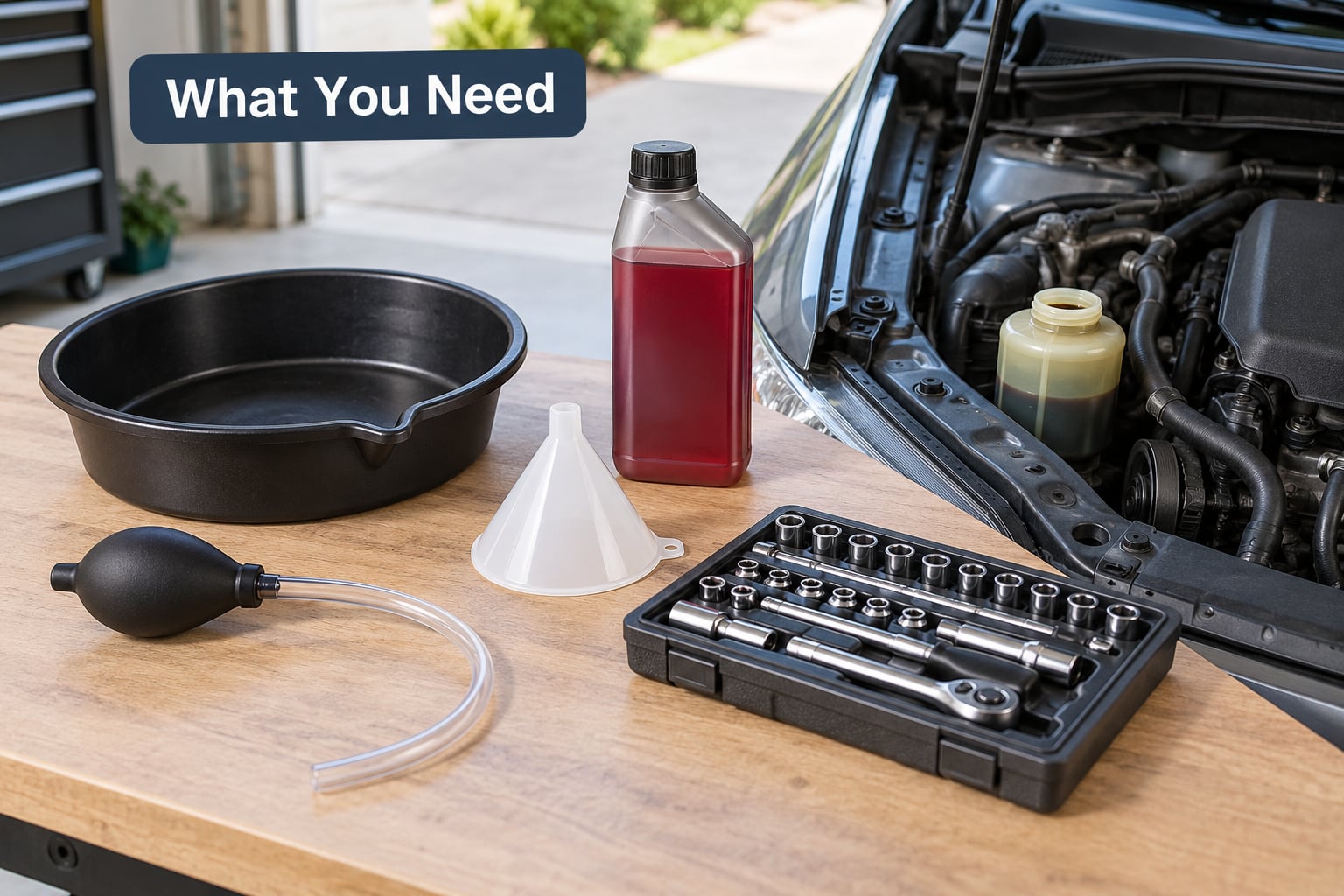
The fluid is the only item on this list that cannot be substituted. Everything else you can borrow from a neighbor.
- The exact fluid your manual specifies. Not “ATF” in general. Match the standard, the colour and the brand family the manual names, and keep the container until the job is done so you can top off from the same batch.
- A drain pan or fluid catch basin large enough to hold everything you will pull. A shallow baking tray works in a pinch but spills easily.
- A turkey baster or manual suction bulb for pulling fluid out of the reservoir before you disconnect anything.
- A clean plastic funnel that seats in the reservoir neck without sealing it shut.
- Socket set and basic hand tools for the reservoir fasteners and any line clamps or banjo bolts you may reach.
- Clear vinyl tubing and small hose clamps so you can route the drained fluid into the pan and keep the connection secure.
- Jack stands and wheel chocks, because the front wheels need to come off the ground to steer through full travel.
- Nitrile gloves and eye protection. Used power steering fluid carries metal particles and is not something you want on your skin.
- A sealed container for the old fluid for proper disposal later.
- Your owner’s manual or service manual, open on the fluid specification page.
BMW steering gear falls into three families, and the procedure changes with each one. Older cars use a conventional hydraulic rack with a pump and hoses. Some use a hydraulic-assist setup where fluid still circulates through lines but assist comes partly from electronics. Newer models use fully electric power steering, where there is no reservoir, no pump and nothing to flush. If your car has no fluid cap under the hood, stop here and skip this entire job.
While you have the manual open, note the fill procedure and the bleed procedure for your model, and note whether it calls for the fluid level to be checked with the engine cold or running. Checking fluid with the engine off and cold is the safe default, and our guide to checking brake fluid level and colour covers the same discipline for another fluid in the same bay.
Step-by-Step
Read the whole sequence through once before you turn a single fastener, then work it in order. This is the same general approach we take in our BMW differential fluid change guide — check the spec, drain, refill, verify, dispose of the old fluid properly.
Park on level ground, set the parking brake, chock the rear wheels and let the engine cool completely. Hydraulic fluid gets hot enough to burn, and opening a warm system puts pressure on the seals at the worst possible moment.
How to Flush Power Steering Fluid on a BMW Safely
Start by identifying the reservoir. On most BMWs with hydraulic assist it sits at the rear of the engine bay or along the driver’s side of the firewall, with a screw cap and a dipstick or level marks on the body of the reservoir. Pull the dipstick and look at the fluid before you touch anything. Milky or foamy fluid, black fluid, or a fine layer of grit on the dipstick all tell you something about the condition of the system.
Next, tell the return line from the high-pressure line. The return line is the low-pressure side that carries fluid back to the reservoir, and on most cars it is the hose held by an ordinary clamp. The high-pressure line runs from the pump to the rack and is usually fastened with a banjo bolt or a metal flare fitting. If you cannot tell with certainty, do not guess. The service manual schematic will show you, and some BMWs also route a cooler or a filter into the return side, which is a useful clue.
Now do what you can before anything is disconnected. Use the suction bulb to pull as much fluid out of the reservoir as you can reach, and pour that into your drain pan. This single step prevents the worst outcome, which is a hose coming off and the pump sucking the reservoir empty in seconds.
With the reservoir drained, disconnect only the line your manual names for the procedure. Place the catch pan underneath first, then ease the hose off and immediately route it into the pan with the clear tubing and a clamp. Plug or clamp anything you remove so nothing drips onto the subframe or the exhaust.
Let the fluid run out until it slows to a drip. That residue is what tells you the condition of the system, so pour a little into a clear jar and look at it. Dark fluid with a metallic sheen means the pump or rack is shedding material, and that changes what you do next.
Now refill with the exact approved specification, slowly, in small amounts, and never past the maximum mark. A slow pour gives trapped air somewhere to go. If the fluid is dark and gritty, some owners flush a first pass with a cheaper compatible fluid and finish with the good stuff, which is a reasonable approach as long as both fluids meet the same standard and you are honest about it with whoever services the car next.
Finally, bleed the rack with the engine idling and the wheels off the ground. Turn the wheel through its full range one way, then the other, several times, moving smoothly and stopping well before the rack reaches the end of its travel. Holding the wheel against a stop with the pump building pressure is how people crack rack seals and how air gets forced into the hardest places to remove.
How to Flush Power Steering Fluid With a Manual Pump
The suction method is the one most DIY guides reach for, and it works well on systems that hold one to two quarts. It is the right choice when the return line is awkward to reach, when the car has a sealed rack, or when you simply prefer not to open a hydraulic line at all.
Start with the engine off and cold. Suck the reservoir down as far as the bulb will reach, then empty the bulb into a graduated bottle so you can see how much came out. Repeat until the bulb stops pulling fluid.
Top the reservoir back up with a small, measured amount of the correct fluid, roughly half to two-thirds of what you just removed, and leave the rest of the volume free. This matters, because the fluid below the reservoir level is what the pump draws from, and a reservoir filled to the brim will push fluid out through the overflow before it ever reaches the rack.
Start the engine and let it idle. With the wheels off the ground and the engine at idle, work the wheel slowly through its travel and watch the reservoir. As the rack moves, old fluid comes out of the return port and fresh fluid goes in at the top.
Once the fluid leaving the return port looks clean and matches the colour and clarity of what is in the reservoir, stop. Count the cycles you did, because that number is useful information. If the fluid still looks dark after ten or fifteen full cycles, you have either a second reservoir feeding the rack or an internal loop that a suction flush cannot reach, and it is time to stop and reassess.
A warning about this method on BMWs: some models feed the rack from an auxiliary cooler or reservoir that the bulb cannot touch. You will see the fluid level in the main reservoir dropping faster than you are pumping it back in, and that is the signal that this car needs the line disconnected or the job handed to a shop.
For difficult systems, a hand vacuum pump on the bleed valve or return port changes the game. Around 20 inches of mercury is the usual working figure, with an assistant cycling the wheel for a couple of minutes to move fluid through the rack under vacuum. It pulls bubbles out faster than the idle-and-turn routine, and it is the technique that answers the question readers ask most often, which is how to get air out after changing power steering fluid.
How to Finish the Flush and Check the Result
Let the engine idle for a few minutes with the wheel straight ahead, then shut it off and wait ten or fifteen minutes for the fluid to settle. Recheck the level on level ground and top up to the mark. A level that drops noticeably after bleeding means air is still trapped in the system, and you should bleed again rather than keep topping up.
Reconnect every line and fitting you disturbed, tighten banjo bolts to the manual’s specification, and secure any clamp-style connections so they cannot creep. Then wipe the reservoir, the pump, the rack, the hoses and every fitting dry with a clean rag and look again after a few minutes of idling. New fluid on the outside of a hose is a leak you just found for free, and far better than finding it on the driveway next week.
Confirm the result by driving. Steering should be quiet, effort should feel even through the centre of the travel, and there should be no groaning, chirping or shudder. A little residual noise right after a flush on a high-mileage car is common and often settles over a day or two as the air finishes working out.
Dispose of the old fluid properly. It is a contaminated petroleum fluid, so it does not go on the ground, in a storm drain or in household trash. Take it to a household hazardous waste facility or an auto parts store that accepts used fluid, and keep the container sealed in a bag in case it leaks on the way.
Common Mistakes to Avoid
Most of the horror stories on steering forums trace back to one of these, and every one of them is avoidable.
- Using the wrong fluid. Automatic transmission fluid is not interchangeable with power steering fluid even when both look similar. Some BMWs specified a particular ATF standard in years when most makers specified a dedicated PS fluid. A wrong-fluid system can be fixed with a proper flush, but it is expensive to get there.
- Flushing an electric or sealed system by disconnecting a random hose. If there is no serviceable return line, or the assist is electric, there is nothing to open. You are just introducing a leak and a fault code.
- Overfilling the reservoir. Excess fluid floods the system with air and pushes fluid out through the overflow. It is one of the most common reasons a car leaves a shop with worse steering than it arrived with.
- Forcing the wheel lock to lock with the engine running. That loads the pump and rack against a mechanical stop and is the fastest way to damage a rack seal. Turn through the range, smoothly, and back off before the end.
- Opening a hot system. Warm fluid expands and the pressure goes straight through weakened seals and plastic reservoir tabs.
- Forgetting to bleed the rack. New fluid plus old fluid in the rack equals aeration. Foamy fluid in the reservoir and a groaning pump are what tell you this happened.
- Leaving a hose clamp loose. A hose that pops off mid-cycle empties the system faster than you can refill it, and that is how an afternoon job becomes a tow.
- Reading foamy or black fluid as a successful flush. Foam means air. Black fluid with grit means metal. Neither one is a clean system, and both mean the job is not finished.
- Ignoring a leak or a new noise. If fluid is weeping from the rack boot or the pump, or the noise changes after the flush, stop driving and find it. A power steering additive may quiet a worn pump temporarily, but it does not fix a leak.
When to Ask a Mechanic
There is a point where the job stops being maintenance and becomes repair. These are the signs that you have reached it.
- Foamy fluid in the reservoir that will not clear after two bleed attempts.
- A groaning or grinding pump that gets worse as you turn, or a rack that sounds rough inside.
- A flashing steering warning on the cluster instead of a steady telltale. Our guide to what a yellow steering wheel light means covers the common causes.
- Fluid on the rack boot or weeping at the pump housing. That is a seal or the pump, not a fluid change.
- A return line you cannot identify or cannot reach. If you are guessing between the pressure line and the return line, guess wrong and you have just cracked a fitting under pressure.
- Any electrically assisted steering hardware where the procedure is not in the manual.
- A leak that is still there after every connection is restored and torqued. That is a component problem, and opening the rack is a different job on a different day.
A shop also makes sense if the system has been neglected for years, if it is full of the wrong fluid, or if you do not have jack stands and a solid catch pan. A pump-and-rack job is one of the most expensive repairs on a car, and the cheapest protection available is correct fluid and a system that is not full of air.
Frequently Asked Questions
Can you flush power steering fluid with water?
No. Water is used by some manufacturers as a factory fill in sealed hydraulic systems because it does not attack seals, and it is only ever drained out and replaced with the correct fluid during assembly. Water in your steering system will not mix cleanly with power steering fluid, it will separate, and it corrodes internal metal parts. If water is already in there, the fix is a full drain of the reservoir and hoses with the correct fluid, repeated until what comes out of the return port matches what goes in.
Can I use brake fluid in my power steering system?
Brake fluid is a DOT specification for a completely different job, and it is not interchangeable with power steering fluid. The two have different additives, different viscosity requirements and different seal compatibility, and putting brake fluid into a steering system can swell seals, cause foaming and destroy a rack or pump. The one fluid that sometimes does belong in a power steering system is a specific automatic transmission fluid, but only where the owner’s manual names that exact standard for your model.
Do I need to remove the power steering reservoir to flush it?
Usually not. On most cars you can pull the old fluid with a suction bulb and flush the rest by running the engine and cycling the steering, which clears a surprising share of the system without opening a single line. Removing the reservoir helps on some models with a pickup screen that traps debris, and it is required when the manual lists reservoir removal as part of the procedure. Check your manual first, because on certain BMWs removing the reservoir disturbs sealed connections that are a poor DIY starting point.
How do I get air out after changing power steering fluid?
Put the front wheels off the ground on jack stands, start the engine and idle it, then turn the wheel slowly through its full travel one way and then the other, several times, without holding it against a stop. Keep an eye on the reservoir and top it up as the level drops. If air persists, a hand vacuum pump on the bleed valve or return port at roughly 20 inches of mercury, with someone cycling the wheel for a couple of minutes, will pull bubbles out much faster.
How often should power steering fluid be changed?
Most manufacturers publish no service interval for power steering fluid because the system is sealed and the fluid is treated as a long-life fill. In practice a drain and refill every 50,000 to 100,000 miles, or any time the fluid looks dark, gritty or milky, is a sensible rule of thumb. Fluid also needs replacing after any rack, pump or hose work, and immediately if the wrong fluid went in. Check the colour and smell at every oil change and flush sooner if it has darkened.
What power steering fluid does my BMW require?
It depends entirely on the model and year, and BMW has used more than one specification. Many older BMWs specified an automatic transmission fluid meeting a particular Mercon or Dexron standard, while newer hydraulic-assist cars often list a BMW-branded power steering fluid, and electric-assist cars need none. Find the fluid specification page in your owner’s manual using the model year and the build date on the driver’s door jamb, and buy exactly that before you start the job.
Conclusion
Open the owner’s manual and confirm two things before you touch a line: which steering system your car has, and which fluid specification it requires. If either answer is unclear, that is the moment to ask a shop rather than guess.
From there the sequence is the same every time: drain the reservoir before you disconnect anything, remove the old fluid through the line your manual names, refill with the exact approved fluid below the maximum mark, bleed the rack with the wheels off the ground, then inspect every hose, fitting, the pump and the rack boot for leaks before you drive away.
Hand it to a mechanic if the car has electric power steering, if the return line cannot be identified, or if the noise and the leaks were there before you started. A flush is cheap maintenance. Replacing a rack or a pump is not.