
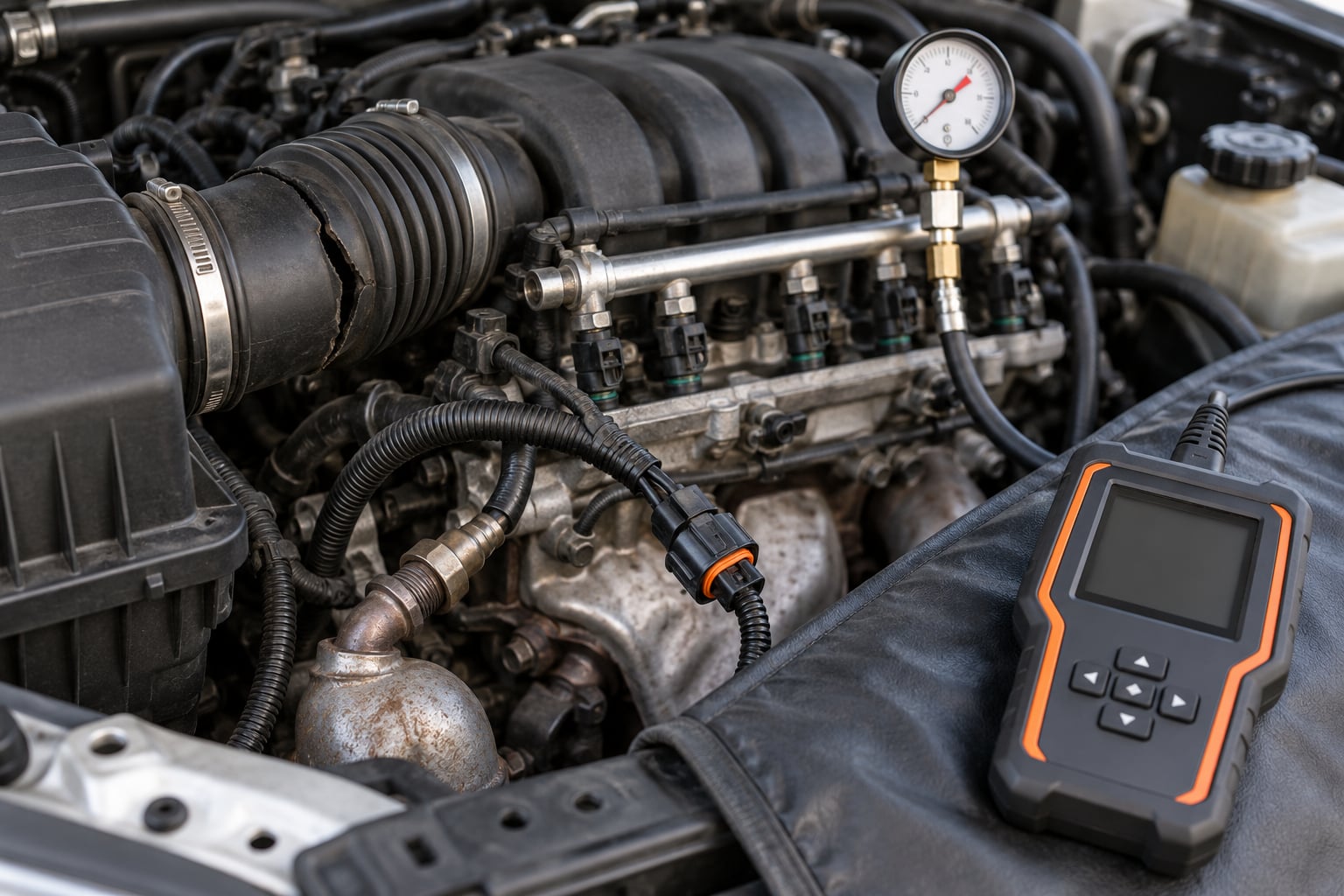
P0171 means the engine computer measured a mixture that is too lean on one cylinder bank and ran out of fuel adjustment to correct it. The code points at the air, fuel, vacuum or sensor side of the system, not at the sensor itself. On a BMW, the usual culprits are a cracked intake boot, a contaminated mass air flow sensor, or an oxygen sensor circuit fault.
This guide walks through P0171 system too lean causes and fixes in the order a technician would actually work them, so you can test each possibility before buying a part. Most of the time the fix is a hose, a clean sensor, or a reseated connector. Updated for 2026, it also covers the mistakes that turn a cheap repair into an expensive one.
If your check engine light is on and the car runs fine, you have time. Keep driving gently and start the diagnosis this week. A lean condition that sits for months can damage the catalytic converter and, on direct-injection engines, wash carbon off the intake valves.
Table of Contents
What Does a P0171 System Too Lean Code Mean?
P0171 is an OBD-II code that reads “System Too Lean (Bank 1).” It means the powertrain control module saw the exhaust oxygen level stay higher than the target air-fuel ratio, added fuel through positive fuel trim, and still could not bring the mixture back to where it wanted it. The computer has run out of correction, so it flags the condition and stores a freeze frame with it.
The sensor circuit that sets the code is the upstream oxygen sensor, the one mounted in the exhaust before the catalytic converter. It measures leftover oxygen in the exhaust and reports it back to the computer, which adjusts fuel pulse width in a continuous loop. That loop, running at roughly fourteen point seven to one by volume on a gasoline engine, is what fuel trim numbers describe.
Bank 1 is the cylinder bank that contains cylinder number one, which on most BMW engines sits on the driver’s side. Bank 2 is the opposite bank, and P0172 reports the same fault there. Inline engines have only one bank, so many owners see P0171 and P0172 together when the fault is something shared like a mass air flow sensor or a fuel supply problem.
One thing worth separating clearly: a stored code is not the same as an active fault. The computer may have set P0171 months ago during a cold start with a loose gas cap, and the trim may be perfectly normal now. Read the live fuel trim data and the freeze frame before deciding anything. If long-term fuel trim sits near zero on a warm engine and the code is only historical, you may be chasing a ghost.
The short version for search readers: a lean mixture means more air than fuel, the computer tried to add fuel, and it could not fix it. Everything from here is about finding which side of the mixture, air or fuel, went wrong.
P0171 System Too Lean: Common Causes and Fixes
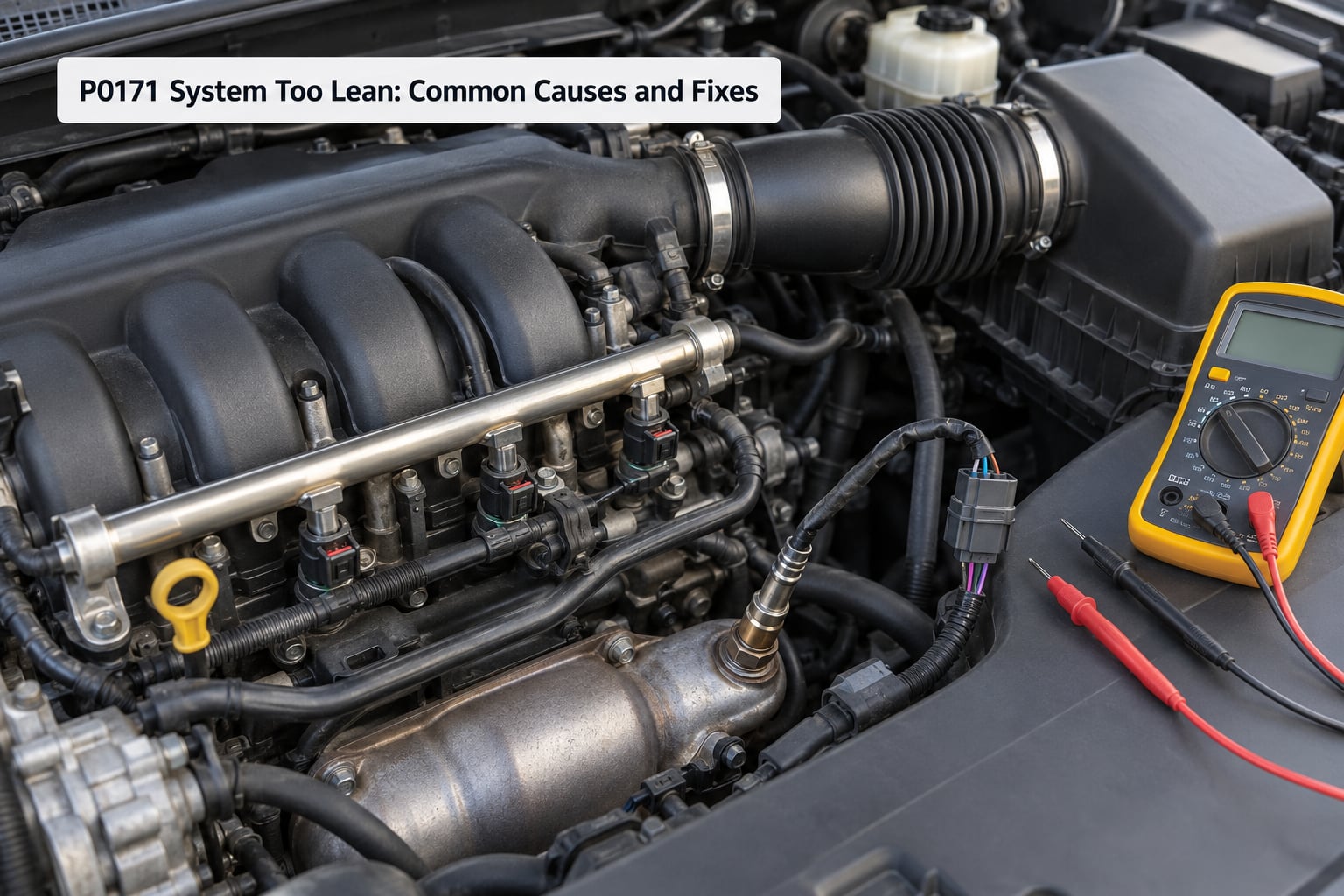
Grouping the causes by system makes diagnosis faster, because each group has a confirming test. Work them roughly in the order below, since intake and vacuum faults are far more common than fuel delivery faults on a BMW.
Fuel Delivery Problems
If the engine cannot get enough fuel, the mixture goes lean no matter how much the computer adds. The confirming measurement is fuel pressure at the rail against the manufacturer’s specification, taken with a gauge while the engine runs.
- Restricted fuel filter. A clogged filter drops pressure under load. On many BMW gasoline engines the filter sits inside the fuel tank as part of the pump module, so a tank drop is a large job rather than a small one. Signs are lean trims that grow worse at high load and worse on a full tank.
- Dirty or leaking injectors. Direct-injection injectors on these engines carbon up over time and dribble after the engine is shut off. Lean trims at idle that improve at higher engine speed fit this pattern.
- Weak fuel pump. A pump that cannot hold pressure shows up as hesitation, stalling, and trims that swing hard during acceleration. Our guide to BMW fuel pump failure symptoms covers the electrical side of the same system.
- Clogged purge valve or wrong fuel pressure. A purge valve stuck partly open floods one bank with extra vapor, and a failed pressure regulator or a failed high-pressure pump on direct-injection engines starves it.
Air Intake and Vacuum Leaks
This is the most common category on these engines. Any air that enters after the mass air flow sensor is unmeasured, and the computer never compensates for it. The confirming test is a smoke test of the intake tract, plus watching short-term trim snap back to normal once the leak is sealed.
- Cracked intake boot. The rubber duct between the airbox or throttle body and the intake manifold hardens and splits on these engines. It is the first place I look on one of these cars, and a boot that flexes visibly when the engine shakes is a giveaway.
- Dirty mass air flow sensor. A contaminated hot-wire element reports less air than is actually entering, so the computer under-delivers fuel. Clean it with proper sensor cleaner and a soft brush before condemning it.
- Loose or cracked intake manifold gasket. A gasket that has pulled away from the manifold leaks air under the intake, on either bank, and often sets both P0171 and P0172.
- PCV system faults. A failed crankcase ventilation valve or a cracked PCV hose either pulls extra air in or pulls it away, and both directions upset the trim.
- Brake booster or auxiliary vacuum line leak. A leaking booster hose is a common and badly misdiagnosed fault, because the symptom appears at idle and disappears under load.
Oxygen Sensor and Wiring Faults
A sensor that is aged, contaminated, or poorly grounded can make a perfectly good mixture look lean. This is the category that sends people to the parts counter first and regret it. The confirming test is watching the upstream sensor voltage sweep cleanly through its range, plus checking for codes on other circuits in the same connector.
- Aged upstream oxygen sensor. A sensor past its service life gets lazy and reads slightly rich or slightly lean all the time, which drags long-term trim with it. Do not replace it on suspicion alone.
- Corroded connector. Green or white deposits on the sensor connector pins cause intermittent readings that look like a sensor failure. Clean the pins and apply dielectric grease.
- Damaged wiring or a bad ground. Chafed harness sections near the downpipe, or a corroded ground strap to the body, produce the same symptom as a failed sensor.
- Intermittent short. A short to ground on the signal wire can drive the sensor reading high and read as a permanent lean condition.
Engine, Exhaust, and Computer Problems
These come last. They are real, but they are not where a P0171 investigation should start, and treating them as first suspects is how owners end up replacing a catalytic converter on a car that only needed a hose.
- Exhaust leak upstream of the oxygen sensor. Air drawn in ahead of the sensor fools the reading and mimics a lean mixture. A leak downstream of it usually causes a rich code instead.
- Unverified work after a repair. A new intake manifold, new injectors, or a new MAF sensor that has not had its adaptation reset can leave the computer fueling for old conditions.
- Software or adaptation faults. Control module updates and adaptations occasionally need to run through a full relearn with the tank topped off and the engine at operating temperature.
- Mechanical faults. Low compression, a leaking head gasket, or worn piston rings on one bank can mimic an air or fuel fault and belong in a compression test rather than in a parts budget.
How to Diagnose P0171 Without Replacing Parts Randomly
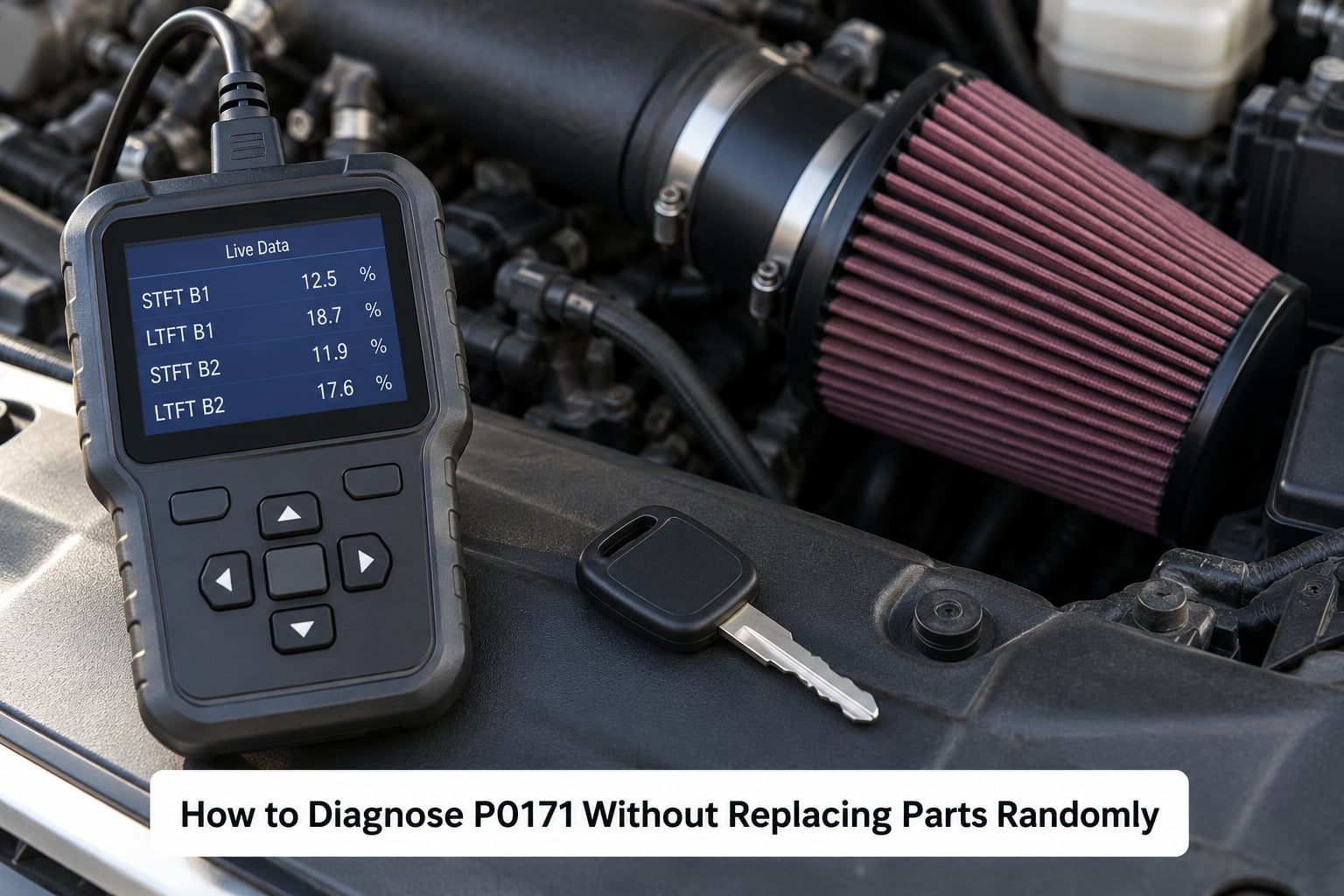
Follow this order and you will usually find the fault with one or two parts at most. Skip steps and you spend the money on the wrong component, which is the most expensive way to lose an afternoon.
- Confirm the code and read the freeze frame. Record the engine load, coolant temperature, and speed at the moment the code set. A fault that only appears at idle after a cold start points somewhere different from one that appears under load.
- Review recent work. Look at what was done in the weeks before the light came on. A part can be new and still be the cause if it was installed incorrectly or was never adapted.
- Read live fuel trim at idle and at 2500 rpm. Warm the engine fully first. Cold readings lie.
- Inspect the intake tract by hand. Wiggle every boot and hose. A hissing sound that rises with engine speed is a strong clue.
- Smoke test the intake. A smoke machine turns an invisible leak into a visible one. Watch the area right after the mass air flow sensor, because air entering downstream of it is the dangerous spot.
- Check fuel pressure. Compare rail pressure against spec with a gauge. Dropping pressure on command tells you the pump or filter is the problem.
- Verify the oxygen sensor signal. Watch the upstream sensor voltage sweep through its full range several times a second. A flat or lazy trace is a sensor or wiring fault.
- Scan for other codes. A lean code alongside misfire or air-fuel ratio sensor codes narrows the search considerably.
- Check the exhaust before the sensor. Listen for leaks in the manifold and the front pipe, which are easy to reach and easy to miss.
This table is the part that saves the most guessing. Read the short-term trim column first, because that is what the computer is doing right now.
| What you see | Short-term trim at idle | Short-term trim at 2500 rpm | Long-term trim | Likely cause |
|---|---|---|---|---|
| Healthy engine | Near 0 percent | Near 0 percent | Within a few percent | Nothing to chase |
| Leak at or after idle only | High positive | Near 0 percent | Drifting positive | Vacuum or intake leak |
| Leak under load only | Near 0 percent | High positive | Drifting positive | Cracked intake boot or gasket |
| Lean at every speed | High positive, at the limit | High positive, at the limit | Pinned high | Fuel delivery or sensor fault |
| Sensor bias | Steady but fixed offset | Steady but fixed offset | Steady offset, never recovers | Oxygen sensor or wiring |
| One bank worse than the other | Bank 1 high, bank 2 normal | Bank 1 high | Bank 1 pinned | Bank-specific leak or injector |
A long-term trim pinned near the limit means the computer has given up correcting and the code has already set. A long-term trim that drifts positive but stays inside roughly ten percent means the fault is still in progress and often shows up more clearly once the engine is fully warm.
What Should You Check First on a BMW?
Start with the intake boot and the mass air flow sensor, then the vacuum and PCV system, then fuel delivery, and only then the oxygen sensor. That order matters. Reversing it is how people end up holding an expensive sensor that did not fix anything.
- Cracked or hardened intake boot between the airbox or throttle body and the manifold, including the second boot on the far side of inline engines.
- Mass air flow sensor contamination, and whether the intake ducting downstream of it is airtight.
- PCV valve and hoses, plus any vacuum line to the brake booster.
- Intake manifold gasket seepage, especially where it meets the head.
- Fuel delivery, starting with fuel pressure at the rail rather than the pump as a guess.
- Upstream oxygen sensor wiring, connector corrosion, and the ground strap, before condemning the sensor.
- Whether the code is bank 1, bank 2, or both, since that tells you whether you are chasing something bank-specific or something shared.
- Any recent service, and whether a fuel system adaptation or module adaptation has been run since it happened.
If the engine has an intermittent mechanical rattle or a lift-off knock complaint alongside the code, look at the valvetrain before you look at fuel. Our article on BMW VANOS rattle causes and fixes covers how that noise changes the diagnosis.
How to Fix P0171 and Confirm the Repair
Fix only what you confirmed. Each of these repairs maps to a specific finding from the diagnostic sequence.
- Intake or vacuum leak found by smoke test: replace the boot, hose, gasket, or PCV piece, then re-run the smoke test until it holds. This is the cheapest and most common repair.
- Dirty mass air flow sensor: clean the element with proper sensor cleaner, let it dry fully, and reinstall the connector latch. Never wipe the hot wire with a cloth.
- Low fuel pressure: replace the pump module or filter, then confirm rail pressure holds at spec under load.
- Injector flow imbalance: replace the leaking or dirty injectors and clean the intake, because debris from a leaking injector often sits in the manifold too.
- Confirmed oxygen sensor fault: replace the sensor and the connector seal, then clear the codes and let the adaptation relearn.
- Exhaust leak upstream of the sensor: repair the leak so the sensor sees real exhaust gas.
After the repair, clear the code and the adaptive memory so the computer relearns on the new hardware. Keep the fuel tank above three-quarters full and drive gently for fifteen to twenty minutes with a few full-throttle pulls on a warm engine to let the adaptation take.
Then verify. Warm the engine fully, check that long-term fuel trim has settled within a few percent of zero, confirm short-term trim is not pinned at the limit, and make sure the code stays cleared through several drive cycles. If the trim sits pinned again after all that, the first diagnosis was wrong and you need to go back to the readings rather than swap another part.
When Should You Take the Car to a Mechanic?
Some symptoms mean the problem is no longer a trimming issue. Book a proper diagnostic if any of these show up, because running a lean engine into one of them can turn a repairable fault into an expensive one.
- The check engine light is flashing rather than steadily lit, or you have misfire codes alongside the lean code.
- Severe loss of power, hard stalls, or the engine will not hold idle.
- A strong fuel smell near the cabin or in the engine bay, which points to an injector or a fuel line.
- Fuel in the oil, or oil in the coolant, which is a head gasket problem until proven otherwise.
- Overheating, or a check engine light that comes back with a temperature reading that does not move.
- Exhaust leaks you cannot locate with a smoke machine, particularly on an engine where the manifold is buried under intake components.
One related note on a BMW: a P0171 accompanied by rising coolant temperature and a drop in oil level is not a fuel trim problem, whatever the scan tool’s headline code says. Cooling faults get their own set of codes and their own causes, as covered in BMW thermostat failure symptoms.
Frequently Asked Questions
Is P0171 always caused by a bad oxygen sensor?
No. The oxygen sensor reports the condition, it rarely causes it. Most P0171 codes trace back to an air or vacuum leak, a dirty mass air flow sensor, or a fuel supply fault, and a surprising number of sensor swaps end with the same code back on the screen. Read the live fuel trim numbers and smoke test the intake before buying a sensor.
Why is my BMW getting a P0171 even after replacing the oxygen sensor?
A new sensor reports accurately, which means it may be revealing a real lean condition that the old sensor was masking. Cracked intake boots, contaminated mass air flow sensors, and leaking manifold gaskets are the usual reasons on these engines. Also run a fuel system adaptation after the sensor change, or the computer keeps fueling for the old conditions.
Should I clear the P0171 code before replacing parts?
Yes, clear the code and the adaptive memory after every repair, otherwise the computer keeps its old corrections and the readings mislead you. Clear it before starting too, so any code that sets again is a fresh one. Drive gently with the tank over three-quarters full for twenty minutes so the adaptation can relearn.
Can a vacuum leak cause a system too lean code?
Yes, it is one of the most common causes on any engine. Air pulled in after the mass air flow sensor is never measured, so the computer never adds fuel for it and long-term trim climbs until the code sets. The pattern to look for is a high short-term trim at idle that returns to normal near 2500 rpm.
What does it cost to fix P0171, and which parts should not be guessed?
Cost depends entirely on the cause, from a hose or a cleaned sensor to a pump module or manifold gasket, and labor often outweighs parts on these engines. Never guess the oxygen sensor or the mass air flow sensor. Those are the two parts most often replaced unnecessarily, and the money is better spent on a smoke test and a fuel pressure reading.
Conclusion: What to Check First
Start by confirming the trim is genuinely lean right now, not just a code sitting in memory, and note whether it affects bank 1, bank 2, or both. Then review what was recently done to the car, since recent work is the fastest clue available.
After that, work the systems in this order: fuel supply and pressure, then the intake and vacuum leaks including the mass air flow sensor and the PCV system, then the oxygen sensor wiring and connector, then the exhaust ahead of the sensor. Only once all four are clean is the sensor itself the suspect.
That sequence is the whole answer to P0171 system too lean causes and fixes. Most cars are fixed by something you can reach with your hands, and the sensor is one of the last places to look, not the first.