
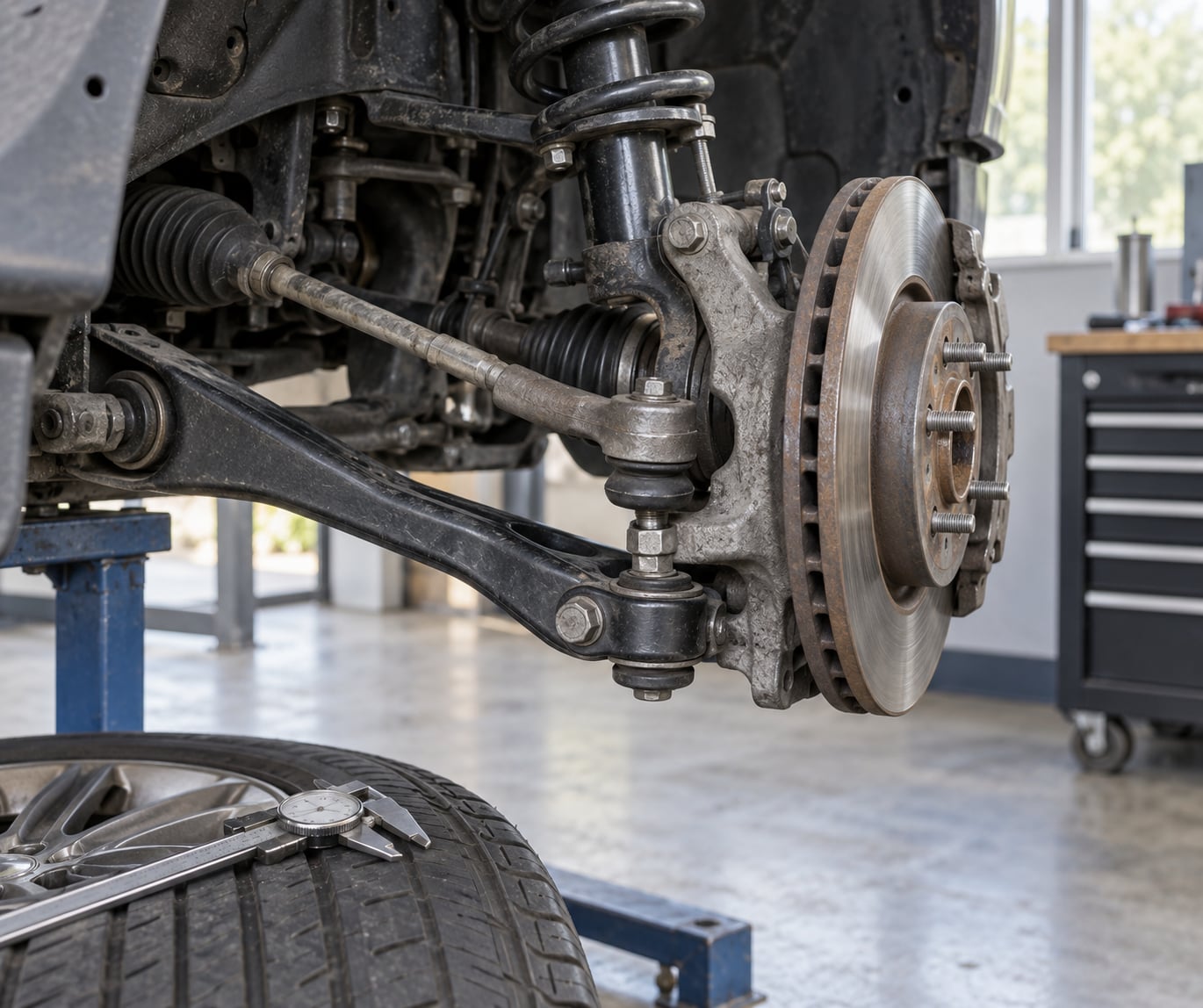
What is bump steer? It is the tendency of a car’s front wheels to steer themselves as the suspension moves up and down, without any input from the driver. Hit a bump with one wheel and the car darts sideways on its own.
If your car wanders over rumble strips, tugs at the wheel after a bump, or wears the outer edge of one front tire faster than the other, this guide will help you sort out whether the cause is geometry, a worn part, or something as simple as tire pressure. Updated for 2026.
Table of Contents
What Is Bump Steer and Why Does It Happen?
Bump steer is a geometry problem, not a tire problem. Your wheels are supposed to point straight ahead no matter where they sit in the suspension travel. When that stops being true, the wheel changes its toe angle while the car is moving, and the vehicle steers itself.
The mechanism is simple once you picture it. The control arm holds the wheel in an arc as it moves up and down. The tie rod connects that wheel to the steering rack, and it also swings through an arc. When those two arcs are close to the same radius and roughly parallel, the tie rod pushes the wheel straight up and down, and the toe angle never changes.
When the arcs do not match, the tie rod pushes sideways as well as vertically. That sideways force swings the wheel, the toe angle shifts, and you get a steering input nobody asked for.
Why toe angle is the whole story
Toe is the angle between the two front wheels when viewed from above. Toe in means the fronts point slightly toward each other, toe out means slightly away. Every suspension design has some toe change through its travel, because metal bends and bushings compress a little under load.
The goal is not zero change. The goal is small and consistent change. A car that goes from a touch of toe out at full droop to the same toe out at full bump stays predictable. A car that swings from toe in to toe out over 4 inches of travel gives the driver a different steering feel every time the suspension moves.
Normal road feedback is worth separating from the real thing. Tires do talk. Expansion joints, washboards and frost seams produce genuine feedback through the steering, and that is the suspension telling you what it is doing. Bump steer is different because the car changes direction without a road input, or because it keeps steering after the road is already smooth.
Ride height changes the same geometry
Static alignment is measured with the suspension sitting at ride height. Lower the car two inches and the control arm and tie rod angles at rest are different, so the alignment you had is no longer the alignment you have. The same is true in reverse when you add a lift, or when the car sits loaded with passengers and cargo.
That is why a car can be perfectly aligned on the alignment rack and still wander on the road. The rack holds it at one ride height; the road does not.
What Does Bump Steer Feel Like When Driving?
Bump steer usually shows up as the wheel tugging or darting rather than a steady pull. Here are the signs worth noting on your next drive.
- The wheel tugs to one side over a single bump. One wheel rises, the toe shifts, and the car turns a few degrees without you touching the wheel.
- The wheel will not return to center. After a bump, the steering sits slightly off center or feels like it wants to go back a different way.
- The car wanders on broken pavement. Constant small corrections over washboards, expansion joints and broken road surface wear you out.
- Uneven return after a turn. The wheel spins more easily one way than the other, so the car straightens out unevenly.
- Uneven tire wear. One front tire feathers or wears on its outer shoulder while the other stays square.
- Steering feels vague above a certain speed. Less crisp response, or a wheel that no longer settles where you left it.
- Knocking or clunking over bumps. That is a separate symptom that points at worn joints and bushings rather than geometry.
The problem shows up most where suspension travel is large and road surfaces are repetitive. Rumble strips, bridge joints and pothole fields are where drivers usually notice it first. It also gets worse with speed, because the same few degrees of unwanted steering travels much further at highway speeds.
Rear bump steer behaves differently. On a multi-link rear suspension, the same arc mismatch can toe the rear wheels as they move, which mostly shows up as vague or nervous handling rather than a sharp tug. Under load, with a hitch or a heavy tongue weight, it can also feel like the back end is wandering out of line with the front.
What Causes Bump Steer in a Car?
The causes fall into a few groups. The first is geometry that was never right, the second is geometry that got changed, and the third is parts that wore out and are now moving more than they should.
Mismatched control arm and tie rod arcs
This is the root cause behind most factory bump steer. Even a new car with a perfect alignment has some, because designers balance arc mismatch against cost, packaging and ride comfort. Lifting or lowering a car increases it, because ride height sets the angle between the two arms at rest. Vehicles with solid axles and leaf springs tend to have more of it than cars with independent multi-link suspensions.
Lifting or lowering the vehicle
Every inch of ride height change shifts the geometry. Add lift springs or a lift kit and the control arm pivots at a different angle than the tie rod, so the mismatch grows. Lower the car on coilovers and the opposite happens, usually with the tie rod now above or below its designed relationship to the arm.
Drop springs and adjusted coilovers are the same story with less travel. Spacers in the knuckle and hub assemblies change it further. If the car was aligned before the suspension work rather than after it, expect problems.
Bent or worn suspension components
A hard pothole or a curb can bend a control arm, tie rod, steering knuckle or Pitman arm by a fraction of an inch. That is enough to change the arc. A worn ball joint, tie rod end or idler arm adds lash on top of that, and the toe angle then changes in both directions as the joint takes up its slack.
Worn control arm bushings do the same job more subtly. A bushing that has hardened lets the arm move under load, so the toe changes when the car is rolling and again when it stops.
If you want to check a joint properly rather than just wiggling it, our guide on what is a bad ball joint and how to check it walks through the test on a lifted car.
Loose steering hardware
A tie rod end nut, a castellated nut or a Pitman arm bolt that has backed off creates free play at the joint. That play lets the toe jump in either direction as the suspension works. On many cars it also means the alignment is being set with the joint in one position and then shifting under load.
Tire pressure and tire condition
Mismatched pressures make a car pull on a flat, straight road, which gets mistaken for geometry all the time. Pressures that differ side to side or front to rear change how the contact patch sits, and a worn or unevenly inflated tire feeds input into the steering that has nothing to do with alignment.
Feathered tires have the same effect. If the tread blocks are angled rather than square across the tire, the tire is scrubbing sideways and pushing the wheel in one direction. Our article on what is tire feathering and what causes it covers how to spot the pattern and what usually causes it.
Alignment that drifts out of spec
Camber and caster also matter. Camber changes toe behavior under cornering and over bumps, and caster controls how quickly the wheel self-centers. A car with correct toe but way out of spec caster will feel vague and wander, which reads as bump steer to a lot of owners. Checking the full alignment numbers, not just toe, is worth the money.
Rear multi-link and solid axle behavior
On a live axle, the whole axle moves as one unit, so the geometry problem shows up more predictably. On a multi-link rear suspension, toe can go one way under compression and the other way under droop, and it changes with load. That is why a car can feel fine solo and unsettled when loaded or towing.
How Can You Check for Bump Steer?
Work through these in order. Most of it costs nothing and rules causes out one at a time before you spend anything.
Step 1: Set tire pressure cold and even
Check all four tires cold against the placard on the door jamb, not the sidewall maximum. Use the same pressure or within a pound or so across the car. Then check tread depth across the width of each tire and look for feathering or uneven shoulder wear. This step alone clears up a surprising share of complaints that were never alignment issues.
Step 2: Look at the hardware
With the car on level ground, check the tie rod ends, idler arm, Pitman arm and steering rack boots. Look for rust streaks on the threads, shiny witness marks where a nut has moved, and torn or cracked boots. Grease seeping from a boot means fluid is out of that joint.
Cracked or perished control arm bushings are visible too. On a solid axle, check the leaf spring bolts and the U-bolts for movement marks.
Step 3: Check for steering play
With the engine off and the wheels straight, ask a helper to turn the steering wheel a few degrees left and right while you watch the tire tread. Then reverse it with the engine running and the wheels hanging. Any visible twist at the tread face with the engine off points to slack in the steering linkage. This check is quick and it separates worn joints from geometry.
Step 4: Look for bent parts
Run your hand along the control arms, tie rods and steering knuckles. A straight edge laid against a control arm will show a bow. Also check whether a wheel sits with obviously uneven gap to the fender liner, which hints at a bent arm after an impact.
Step 5: Measure the toe change
This is the real test, and it is where the do-it-yourself route gets involved. Jack the car so the front wheels just clear the ground, or better, jack it and settle the suspension at ride height so the weight is on the tires as it would be on the road. Support the vehicle properly and never work under a car resting on a jack alone.
Measure front toe at ride height, then mark the tire at the same height on the tread and raise the wheel into full compression. Repeat in full droop. The difference in toe across the two positions, usually written in millimeters or sixteenths of an inch, is your bump steer number. Measuring both sides separately matters too, because the two sides are rarely identical.
Two things will fool you here. An anti-roll bar that has come unbolted or fouls the control arm can hold the suspension at an artificial position, so disconnect or note it first. And calipers that measure at the hub carrier rather than at the rim read differently, so stay consistent about where you measure.
Step 6: Road test, then hand it over if needed
Drive over a section of broken pavement at a speed where you can feel the steering without risking anything, and note whether the wheel tugs, whether it returns to center, and whether the car drifts to one side. If there is play, a bent part, or a toe change well past what you can correct with shims, this is a shop job.
Expect a shop with a laser alignment rack to measure toe, camber and caster together and report the front and rear individually. If the readings come back in spec but the car still wanders, ask them to look at the rear geometry and the load condition too.
How Do You Fix Bump Steer?
Fix the causes in order. Skipping ahead to the alignment means paying twice, because the alignment you set on day one will not survive the parts you replaced on day two.
Fix 1: Tire pressure and loose hardware
Set pressures cold and even. Torque the steering and suspension fasteners to specification with an impact wrench, then re-torque after a short drive if the fasteners are known to settle. Watch for a castellated nut or cotter pin that has backed off, which points at a bigger problem than the nut itself.
Fix 2: Replace worn parts
Swap out tired tie rod ends, ball joints, idler arms, Pitman arms and control arm bushings. Do it in pairs on the same axle so you are not mixing a fresh joint with a tired one. Budget for the fasteners too, because many of them are torque-to-yield or one-time use and reusing them is how a joint goes loose again a few hundred miles later.
Fix 3: Repair accident damage
If a control arm, knuckle, hub or steering gear is bent, replacing the joint on the end of it will not fix anything. This is a replacement, not a shim job. The same goes for a wheel that has been repaired incorrectly or a tie rod bent in a parking lot.
Fix 4: Correct the geometry
Once everything is straight and tight, the toe change through travel can be reduced with a few different approaches.
- Spacers on the tie rod or steering arm. Spacers move the tie rod pickup point closer to the wheel’s arc, which reduces the sideways component of its motion. They are the simplest correction and work well on solid axles.
- Shims at the steering arm. Thin shims between the steering arm and its mount let you tune the correction in small increments, measure, and repeat. This is the iterative approach that got one documented project from 2 mm of toe change per side down to under 0.3 mm.
- Adjustable tie rod ends or rod ends with spacers. Turning the adjuster changes the effective tie rod length, which shifts the angle between tie rod and control arm. Helpful on cars where the geometry needs a fine adjustment rather than a relocation.
- Dropped Pitman arm and drag link or steering arm drops. On a solid axle, lowering the steering pickup point shortens the arc and cuts the mismatch. Paired with track bar relocation on leaf-sprung vehicles, it is the standard off-road correction.
- Bushings with less compliance. Stiffer bushings reduce the extra movement that soft bushings add, though they usually transfer noise into the cabin.
A bump steer kit is usually a bundle of these pieces: spacers, shims, adjustable tie rod ends and the fasteners to fit them. The point of the kit is to give you enough range to tune the correction rather than moving the pickup point once and hoping.
It can never be eliminated entirely. Every suspension has some toe change through travel, so aim for the smallest number you can reach without hurting other geometry, and accept that a little is normal.
Fix 5: Align it last
Alignment sets the static toe, camber and caster at ride height. It does not, and cannot, remove the change that happens as the suspension moves. Align after the geometry work, at the ride height the car actually runs at, and with the tires you will drive on.
For a modified car, ask the shop to align it at your normal ride height with a typical load in the car. If the vehicle is a tow vehicle or a daily driver that carries passengers, an alignment at half load is closer to reality than an empty alignment. More detail on what the readings mean is in our guide to wheel alignment symptoms and cost.
Bump Steer vs. Other Steering Problems
Most steering complaints get labeled bump steer because the words are familiar. A few of them are genuinely different faults that need different parts, so sorting them out before you buy anything saves real money.
Bump steer or roll steer
Roll steer is the toe change that happens as the body rolls in a corner, caused by body roll and suspension deflection rather than by one wheel moving over a bump. Bump steer is about one wheel moving relative to the road. Roll steer is mostly a design characteristic that suspension engineers trade off for handling balance, and it cannot be shimmed away.
Bump steer or steering wheel pull
A steady pull to one side on a flat, straight road is almost never bump steer. Uneven tire pressure, a tire on a different wear pattern, or a bent wheel are the usual suspects. Pull that only shows up over bumps is a different story and belongs with the geometry conversation.
Bump steer or play in the steering
Play is a mechanical slack problem. If you turn the wheel and the tires stay still until the slack takes up, you have a joint, bushing or gearbox problem. Bump steer has no slack; the wheel is tight and still changes direction on its own.
Bump steer or death wobble
Death wobble is a fast oscillation of the steering that builds in speed and typically follows a lift. Bump steer is a single, repeatable reaction to a road input. On a lifted solid-axle truck the two can coexist, which is why so many owners get confused. If the wheel is shaking rapidly and getting worse, stop diagnosing and get the vehicle inspected.
How much bump steer is acceptable
There is no single number, because what matters is how much toe change occurs over the travel that car actually uses. These are the working targets most builders and shops work to.
| Use | Toe change through full travel | Notes |
|---|---|---|
| Street daily driver | Under about 0.5 mm per side | Comfortable and predictable enough for normal driving |
| Track or autocross | Under about 0.2 mm per side | Consistency matters more than the number at rest |
| Off-road and rock crawling | Under about 1 mm per side | Slow, controlled movement is more usable than a sharp dart |
| Towing or heavy load | Measure loaded | Unloaded numbers rarely match loaded behavior |
What matters more than a single figure is the curve. Change that happens smoothly and in the same direction at both ends of travel feels fine. Change that swings from toe in to toe out as the suspension moves is what unsettles drivers and wears tires.
Frequently Asked Questions
How much bump steer is too much?
There is no single hard limit, because it depends on how the car is used. Most builders target under 0.5 mm of toe change per side through full travel for a street car, under 0.2 mm for track work, and under 1 mm for slow off-road driving. What matters as much as the number is consistency: change that stays in the same direction at both ends of travel feels fine, while change that swings from toe in to toe out unsettles the driver and wears tires faster.
What is the purpose of a bump steer kit?
A bump steer kit gives you the parts needed to reduce toe change through suspension travel. It usually contains spacers that move the tie rod pickup point toward the wheel arc, shims for fine incremental adjustment at the steering arm, and sometimes adjustable tie rod ends that change the effective tie rod length. The goal is to bring the control arm arc and tie rod arc closer to matching so the wheel points the same way everywhere in its travel.
Why does my car pull when I hit bumps?
If the car pulls only after a bump, the suspension is very likely changing toe angle as it moves, so the wheel steers itself. A steady pull on a flat road means something else, usually mismatched tire pressure, a tire wearing differently from its pair, or a bent wheel. Start by setting all four pressures cold to the door jamb placard value and comparing the two front tires for uneven wear before assuming anything about geometry.
Will an alignment fix bump steer?
No, not on its own. An alignment sets static toe, camber and caster at ride height, so it corrects a car that is simply misaligned. It cannot remove the change that happens while the suspension moves. You need the geometry corrected first with spacers, shims or rod adjustments, then the alignment done last at the ride height and load the car actually runs at.
Why does my steering wheel feel loose when I hit a bump?
Loose feeling over bumps points at play in the steering rather than geometry, because bump steer itself has no slack. Worn tie rod ends, ball joints, idler arms, Pitman arms and hardened control arm bushings are the usual sources. Turn the wheel a few degrees left and right with the engine off and watch the tread; visible twist at the tire means replace the joint, do not align around it.
How is bump steer measured?
Measure the front toe at ride height, then again with the wheel at full compression and at full droop, and compare. The difference across those positions is your bump steer number, usually written in millimeters. Support the vehicle properly, settle the suspension so the weight is on the tire, disconnect any anti-roll bar that could foul the arm, and take a reading on each side separately. Repeat the readings to confirm they are consistent.
What is bump steer in racing?
In racing it is the same problem, measured and treated more strictly. Any toe change through the travel changes the car’s balance between entry, mid-corner and exit, which shows up as understeer on corner entry and inconsistent steering feel through the corner. Track cars aim for under 0.2 mm per side and measure both sides independently, since unequal readings make the car behave differently turning left than turning right.
Conclusion
Start with the free checks: set all four tire pressures cold and even, look at the tie rod ends, ball joints and steering boots for rust, looseness or torn rubber, and check whether the front tires are feathering or wearing unevenly. If the hardware is sound, measure the toe change through travel on both sides before buying anything.
When the parts are worn or the correction is beyond what shims can reach, fix the parts first, correct the geometry second, and have the car aligned last at the ride height you actually drive at. If the wheel is shaking at speed rather than tugging over bumps, get it inspected rather than diagnosing it yourself.