
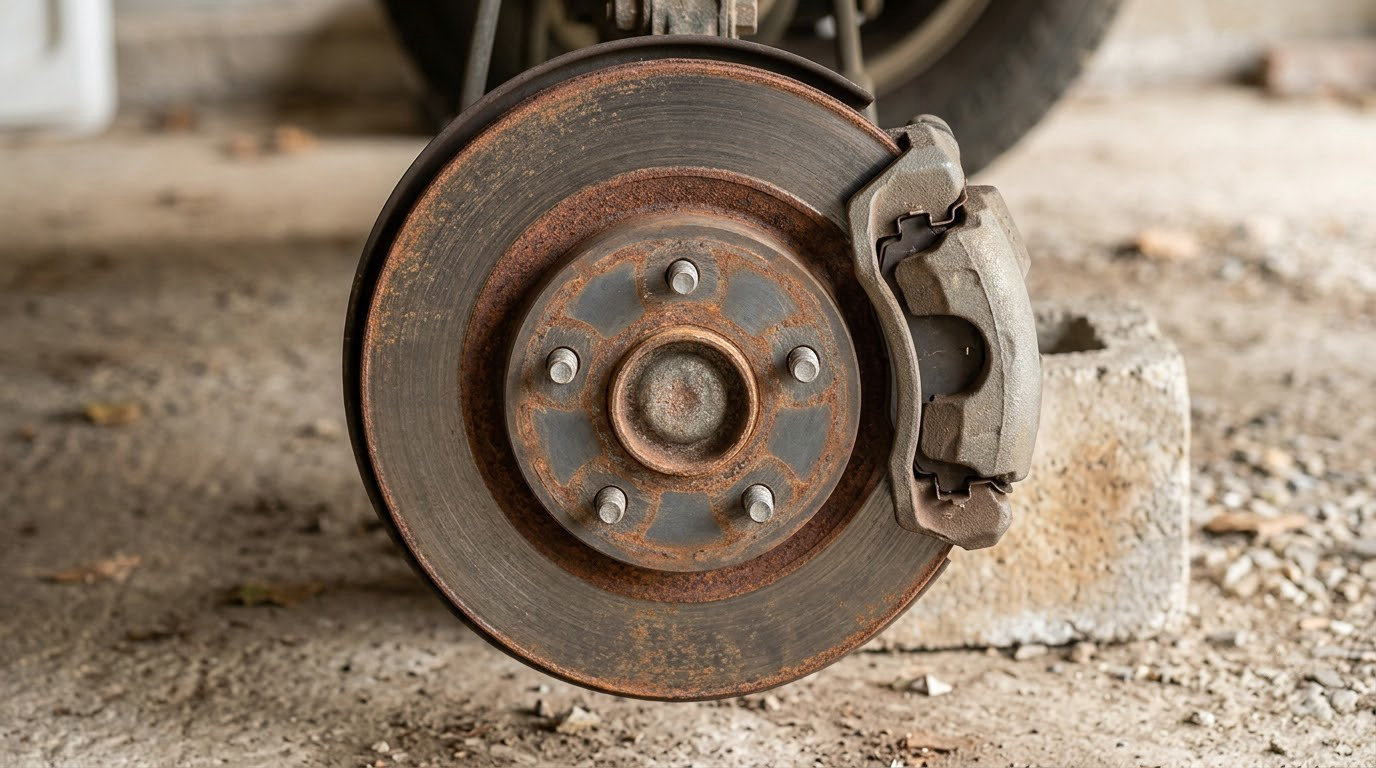
Brakes rust when a car sits because the rotor and drum surfaces are bare cast iron, and iron needs moisture plus oxygen to turn into iron oxide. A parked car gives that combination all day and every night, with no braking to wipe the oxide away. The good news: a thin, even orange film is normal and usually clears in a handful of stops.
Most of the worrying you have seen online is about a different problem, one that also starts with a car sitting still but ends with a seized caliper or a parking brake that stays engaged. Sorting those two things apart is most of the work, so let’s take them one at a time.
Table of Contents
- Why Do Brakes Rust When a Car Sits?
- Which Parts of the Brakes Rust?
- What Causes Brake Rust After a Car Has Been Parked?
- Is It Safe to Drive With Surface Rust on the Brakes?
- How to Prevent Brakes From Rusting While the Car Sits
- How to Remove Rust from Brake Rotors and Calipers
- Frequently Asked Questions
- Conclusion
Why Do Brakes Rust When a Car Sits?
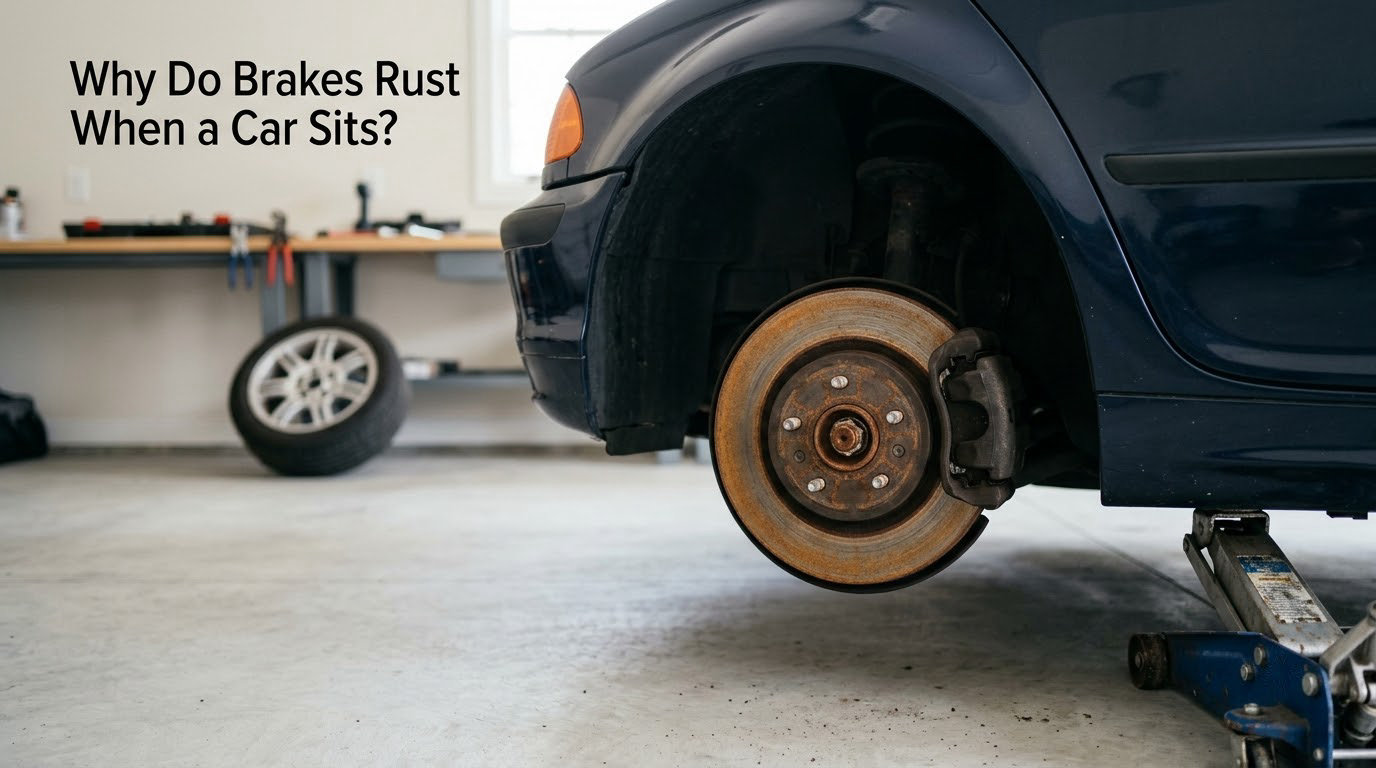
Why do brakes rust when a car sits while the rest of the car looks fine? Because the friction surface is deliberately left unprotected. It has to be, since anything on that face would contaminate the pads. Everywhere else on a car, steel gets paint, plating or a coating. The swept face of a rotor gets nothing but brake heat, which burns off whatever is there.
That is why a car parked in a damp coastal lot can wake up with orange rotors, while the alloy wheel five inches away still looks new.
The three things iron needs to rust
Iron rusts when it meets oxygen and water at the same time. Dry iron is fine for decades. Wet iron, sealed from air, is fine too. It is the combination that does the damage, and a parked brake meets both conditions constantly.
Water gets there in more ways than rain. Dew and frost settle on a cold rotor in the early morning. Condensation forms on the underside of a brake dust shield overnight. Road salt and chloride de-icers stay on the rotor after winter driving and pull moisture out of the air. Parking under a cover traps the damp air that was already there.
Surface rust, sometimes called flash rust, is the thin even layer that forms within hours. It is different from corrosion, which is deep pitting and flaking that eats into the metal.
Why the swept face is bare metal on purpose
A rotor’s swept band is the ring of iron the pads actually touch. The hat, the bell that bolts to the hub, is often painted or plated. The vent channels between the two faces are raw. Only the pad-contact ring is left as clean cast iron, and that ring is where the pads polish it during normal braking.
Owners on r/WRX and focusst.org reach the same conclusion from different directions: rotors are cast iron, cast iron flashes over when wet, and a week of outdoor parking is enough to see it.
Which Parts of the Brakes Rust?
Most of the brake assembly is steel, so most of it will oxidise given enough damp and time. What differs is whether the rust matters where it forms.
| Where the rust is | What it usually means |
|---|---|
| Rotor swept band (pad contact ring) | Surface rust only. The pads scrape it off within a few stops. Cosmetic. |
| Rotor hat or mounting bell | Often protected by paint or plating. Rust here can mean the coating failed, which points to runout if the car vibrates. |
| Vent channels between rotor faces | Holds moisture and salt against the cooling vanes. Reduces cooling and can cause hot spots, so it deserves a look. |
| Brake pad backing plate and shims | Steel shims rust and swell. PriusChat threads describe rusted pad shims as a common source of that first-stop noise and grinding. |
| Caliper body, slide pins, clips | Rust on slide pins and clips is what freezes a caliper, turning a cosmetic problem into a real one. |
| Wheel studs and hub face | Corrosion here can stop a wheel from seating flat, which is its own safety issue. |
One distinction worth keeping in your head: a rotor that looks orange all over but is clean in the middle is showing a normal wear pattern. The pads only ever touched the centre, so the centre stays polished and the outer ring, which the pads never reach, rusts. Someone on r/askcarguys described seeing that pattern in a foggy area and worried the whole disc was ruined. It was not.
Drum brakes rust the same way, since a drum is the same grey cast iron turned inside out. What changes is the symptom, because a drum’s entire inner surface is swept area, so the rust tends to spread across the whole braking face rather than sitting in a ring. Older sedans, many SUVs and most commercial vehicles still use them at the rear.
What Causes Brake Rust After a Car Has Been Parked?
Any combination of humidity, salt and time does it, and the variables stack. Coastal air, fog and a car parked under trees is close to a worst case. So is a concrete parking structure that stays cold and damp long after the rain stops.
Poorly drained lots make it worse in a specific way. Water collects under the car and evaporates slowly, keeping a humid layer right where the rotor and dust shield sit. The same lot drains well in spring and holds a puddle until July in August, and the car parked there tells you about it in the first week of driving.
Garage storage is not automatically better. A car driven into a warm, dry garage after a wet road can actually rust more, because the warm damp air gets trapped in the enclosed space around the still-cool brake hardware.
Why a car wash can leave rotors looking worse
Parking outside is not the trigger, and neither is rain. Washing the car, rinsing the salt off the body and leaving it to air dry is enough. The washer leaves a clean, wet, exposed rotor, and by the next morning there is a fresh film of iron oxide. Owners on focusst.org and bobistheoilguy.com/forums both describe rotors looking fine the day before a wash and orange the morning after, in ordinary weather, on a low-mileage car.
Why some cars rust faster than others
Three things drive it. First, storage duration. A few days of damp weather produces flash rust that clears on the first stop. Several weeks starts to leave real oxidation in the vent channels and around the hardware. Months pushes into the seized-hardware territory.
Second, climate. Chloride de-icers turn a wet brake into a chemically active surface, and coastal humidity keeps the water film in place between drives.
Third, driving pattern. A car driven a few miles a day clears the swept band every trip and keeps it clean. A car that covers two hundred miles a month clears it four times, and spends the rest of the month wet and untouched.
Is It Safe to Drive With Surface Rust on the Brakes?
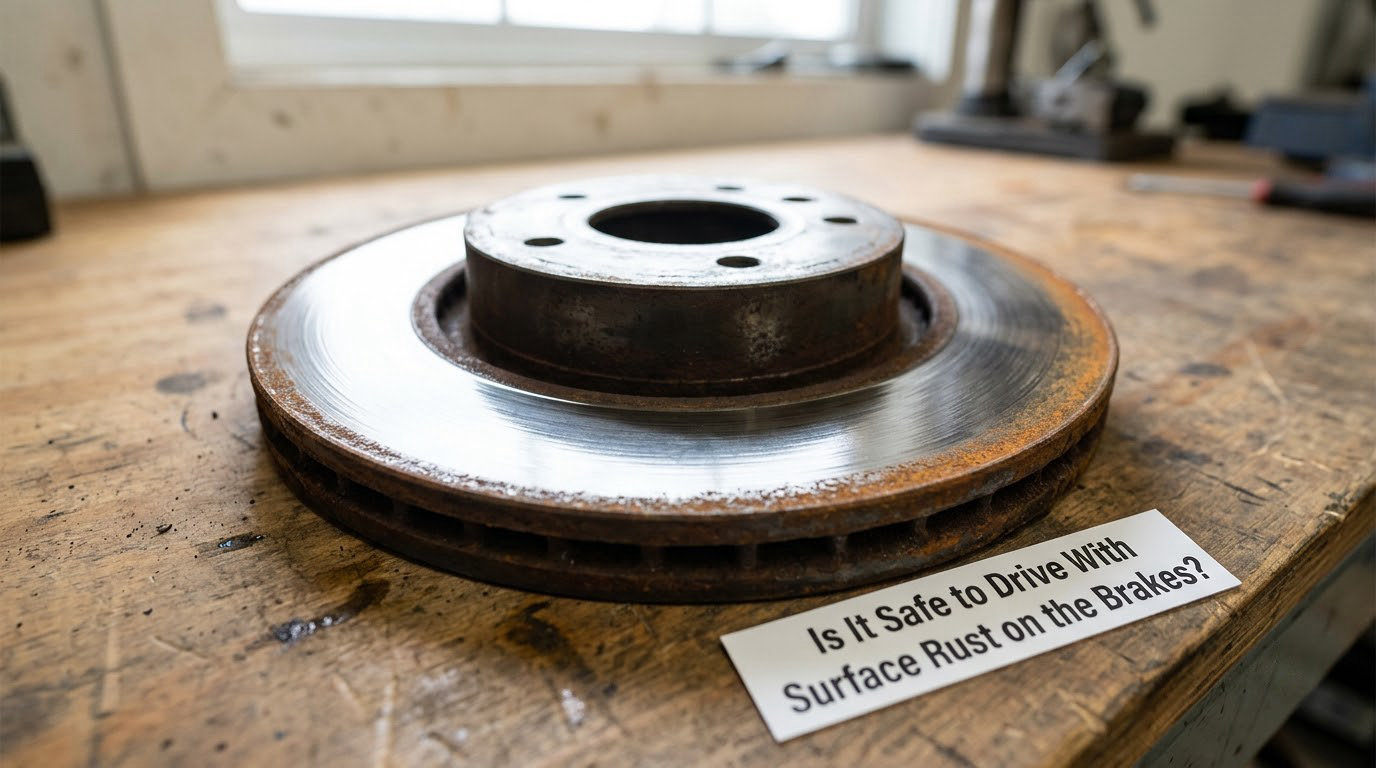
Yes, in most cases. A thin, even, orange-brown film on a cast iron rotor is the normal result of sitting, and it is not a measurement of anything. The pads grind it away as a matter of course, and the heat of braking flashes off any remaining moisture. A rotor that stops making noise after a few stops was never damaged.
It is worth separating this from the thing that actually worries people, which is not rust at all. A caliper that has seized in its slide pins, or a parking brake that has not fully released, will drag a hot pad across a hot rotor from the first metre. That is what wears rotors out and overheats them, and no amount of driving it off will fix it.
The three-stop test
Three firm stops from around 35 mph, spaced out with a little time between them, will tell you almost everything a visual check can. The first stop scrapes. The second is quieter. By the third the noise is usually gone. If it is, the swept surface is fine and you were listening to flash rust.
Do not reverse this into twenty hard stops just to hear the noise finish sooner. Heat cycling a cold rotor hard is a decent way to produce the thickness variation that actually causes pulsation.
| What you see or hear | Most likely cause | What to do |
|---|---|---|
| Squeal or light scraping on the first few stops, gone by the third | Surface rust on the swept band | Drive normally. Nothing else. |
| Grinding that continues after several stops | Rust or debris past the swept band, worn pads, or a pad backing plate shedding | Inspect the pads and the rotor edge before driving further |
| Shaking or pulsation through the pedal, worst when warm | Thickness variation or runout, not surface rust | Needs a technician to measure thickness and runout |
| Car pulls to one side after being parked | Seized caliper on one corner | Do not drive it far. Free the caliper or have it done |
| Pedal feels firm, pedal or pedal returns slow | Sticking caliper piston or partly engaged parking brake | Check the parking brake release before moving |
| Hot wheel or smell of hot metal after a short drive | Dragging brake | Stop and check before driving further |
| Orange staining on the wheel barrel and tire sidewall | Rust runoff from the rotor, not a brake fault | Clean the wheel; ignore it |
| Fine black dust on the wheel, no orange | Brake dust from pad wear, not rust | Nothing to do. This is normal wear debris. |
That last row trips people up constantly. Brake dust is the friction material wearing off, it is black or grey, and it means the pads are working. Rust is orange, it stains the wheel and tire, and it means iron is oxidising. Different problems, different colours, no overlap.
A visual check has one hard limit. You can see surface rust, pitting and obvious cracking. You cannot see how much thickness is left or whether the disc runs out true, because both are measurements. A rotor that looks thin and a rotor that is at the discard limit can look the same from the driveway. Forum consensus on the limit of a visual check is consistent: a technician confirms it, and mechanics on r/MechanicAdvice will happily walk you through what they measure.
Three things never to do:
- Do not spray WD-40, oil, grease, chain lube or silicone on a rotor face. Owners warn about this constantly and they are right. Anything greasy there contaminates the friction material and the pads will no longer bite, long after the contaminant is gone.
- Do not touch a rotor to check it straight after driving. It is hot enough to burn you and hot enough to warp if you handle it badly.
- Do not sandblast, wire-wheel or grind a rotor to remove flash rust. That changes the surface finish and the thickness, which is how a cosmetic problem turns into a machined-rotor problem.
How to Prevent Brakes From Rusting While the Car Sits
You cannot keep iron from oxidising in wet air. What you can do is reduce the time it stays wet, keep the hardware free, and make sure the car gets a few brake applications a month.
- Rinse the brake areas, not just the paint. After driving through winter salt, back into a driveway or bay and hose water into the wheel wells and around the rotor edges. Salt left to crystallise keeps working on the iron.
- Wash the car and drive it straight after. The problem is not the wash, it is the wet rotor left to sit. Wash, then take a fifteen-minute drive that includes a handful of braking applications, and the swept band finishes clean and dry.
- Use a breathable cover, never an airtight tarp. A sealed sheet traps the moisture already in the air around the car. A breathable one keeps rain off while letting vapour escape.
- Drive the car every couple of weeks. A short drive with a few firm stops at low speed is enough to heat the rotors, dry them, and keep the caliper slide pins moving. Twenty minutes on a quiet street does more than any spray.
- Before long-term storage, work the brakes hard once and leave them dry. A long slow drive on a dry road, followed by a clean dry surface, leaves a hot, evaporated rotor rather than a cold, wet one. Storage threads on corvetteforum.com and for winter cars use exactly this routine.
- Never set the parking brake for long storage. Leave it released, or use the transmission park or gear selector. A cable-actuated parking brake held for months encourages the cable to seize and the shoes to stick.
- Lubricate hardware, not friction surfaces. Caliper slide pins, pad abutments and clips get a light coat of the lubricant specified in the service manual before the car is left. It is the difference between a caliper that moves freely in six months and one that needs hydraulic pressure to free.
- Keep salt off the car properly. A rinse in late winter, before temperatures rise and salt gets baked into paint and hardware, is cheap and it protects more than the body panels.
How to Remove Rust from Brake Rotors and Calipers
Most of the time there is nothing to remove. You drive, the pads clean the swept band, and the rust that was there stops existing. A firm brake pedal from a safe speed, a short drive on a dry road, then three or four progressive stops from around 35 mph, and the noise is gone.
When the surface has real scaling on it, a damp cloth and a mild detergent will shift loose oxidation from the outer edge and the hat. Keep the pads out of the way, keep the water away from the caliper piston, and never put anything oily on the swept band. Beyond that, light surface oxidation is not worth removing chemically. It comes off by friction or it does not come off.
How to free a lightly seized brake caliper
This is the one job on the list worth doing yourself, and it has a clear point where you stop.
- Jack the car and remove the wheel. Crank the wheel bolts loose while the tyre is on the ground, then raise the car properly. Never work under a car held by a jack alone.
- Check the parking brake is fully released before you assume the caliper is stuck. A partly engaged parking brake looks exactly like a seized caliper.
- Work the piston. Have someone press the pedal while you pry gently on the inside of the caliper at the boot, or use a brake pedal applier. The pad should move freely with no force. A piston that will not budge under pressure is done as a DIY job.
- Free the slide pins. The pin that will not move is a pin that has rusted solid. Work it with penetrating oil and a hammer and punch, clean it with a wire brush, coat it with the manual-specified lubricant and check it slides by hand.
- Clean the abutments and clips. Rusted pads will not sit square even when the caliper moves, and that is what causes the first-stop grinding and the pad that never retracts.
- Torque, bleed if you opened a hydraulic line, and test. Pump the pedal before you lower the car. Then drive slowly and confirm the rotor is not hot after a few minutes. A mechanic on r/MechanicAdvice puts the line plainly: a piston seized badly enough to need hydraulic pressure to free it usually means a replacement caliper.
When a rotor gets resurfaced instead of replaced
Deep pitting that stays after driving, visible cracking, a lip at the outer edge, or a rotor that is below the minimum thickness stamped on the hat are all machining and replacement territory rather than cleaning territory. Many modern rotors are thin by design, so there is often not enough material left to take off, and a shop will measure thickness, thickness variation and runout before saying so.
Any of these means your visual check has run out of road: a shop needs to measure the rotor, and a caliper that drags needs a look, not a diagnosis from a driveway.
One extra case deserves its own paragraph. If your car is an EV or a hybrid, you will get this worse than everyone else. Regenerative braking handles most of the stopping, so the friction pads barely touch the rotor, and the rust that your neighbour’s car wipes off in three stops is still sitting there three months later. Owners on teslamotorsclub.com and priuschat.com describe exactly that pattern. Expect it, check the hardware periodically, and do not assume the car driving itself is keeping the brakes clean.
Frequently Asked Questions
Is it bad if my brakes rust?
A thin, even orange film on a cast iron rotor is not a problem. It is iron oxide forming from moisture and oxygen, and the brake pads wear it away within a few stops. It becomes a concern when rust is heavy enough to stay after driving, when the rotor is pitted or cracked, or when a caliper has seized and is dragging a pad. Check for a hot wheel or a pulling pedal after a short drive.
How long can you drive on rusted brakes?
You can drive on surface rust. Drive gently for the first few stops so the pads clean the swept band rather than tearing it, then check for a hot wheel and a pedal that returns normally. Do not keep driving if the car pulls to one side, the pedal feels firm, you smell hot metal, or the grinding continues after several stops. Those point to a dragging or seized caliper, not flash rust.
How long does it take for rust to come off brakes?
Flash rust on the swept band comes off in a handful of brake applications. Three firm stops from around 35 mph, spaced out with a little time between them, will clear the noise in most cases. Rust on the rotor hat, in the vent channels or around the pad hardware does not come off by driving at all, because the pads never touch those areas. That kind needs cleaning, lubricating the hardware, or a technician.
How long can a car sit before brakes seize?
A few days or a week of sitting rarely causes trouble. Several weeks of damp storage is when you start seeing rusted slide pins, seized pad abutments and a parking brake that releases slowly. Months is where owners start reporting stuck calipers and drums that will not release. Storage time matters less than humidity and salt, so a dry climate car can sit far longer than the same car parked outdoors by the sea.
How do I prevent my brakes from rusting?
You cannot stop iron oxidising in wet air, but you can shorten the time it stays wet. Rinse salt off the brake areas after winter driving, wash the car and then drive it so the swept band dries, use a breathable cover rather than a sealed tarp, and drive the car for twenty minutes every couple of weeks so the rotors heat and the caliper pins move. For long storage, work the brakes hard once, leave them dry, and keep the parking brake released.
How can I unseize a seized brake caliper?
Jack the car safely, loosen the wheel bolts on the ground first, then check the parking brake is fully released, because a partly engaged parking brake mimics a seized caliper. Have someone press the pedal while you gently pry the piston at the boot. Clean the slide pins with a wire brush, coat them with the lubricant your service manual specifies and confirm they slide by hand. A piston that will not move under pressure needs a shop, not more force from you.
Conclusion
Start with three firm stops from around 35 mph and listen. If the noise is gone by the third, your brakes rust when a car sits, and that is the entire problem. If the car pulls, the pedal feels firm, or a wheel is hot after a few minutes of driving, you have a hardware problem that rust started and inactivity finished, and that is a caliper and parking brake job rather than a rotor job.