
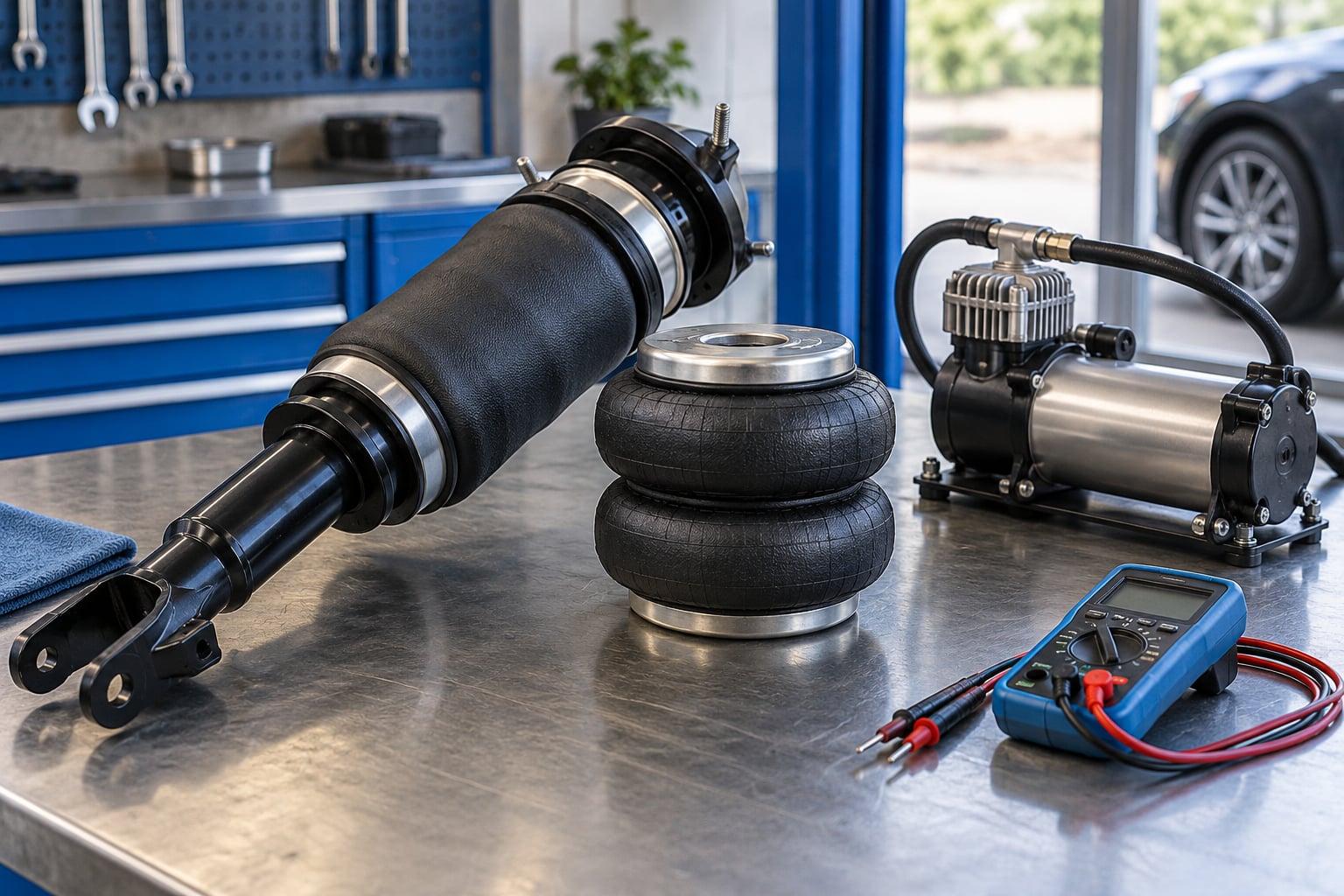
An air suspension repair usually runs between 600 and 2,500 dollars for a single component, and a full system job on a luxury SUV can pass 5,000 dollars. Most of that money is spent on parts, not labor, which is why air suspension problems and repair cost come down to one question: which component actually failed. A leaking rear air spring on a Mercedes, a Jeep Grand Cherokee or a Lincoln Navigator typically costs 400 to 1,200 dollars to replace, while a compressor runs 700 to 1,600 dollars with the valve block.
The most expensive mistake is replacing the compressor when a slow leak caused it. Find the leak first, always.
Table of Contents
Air Suspension Problems and Repair Cost at a Glance
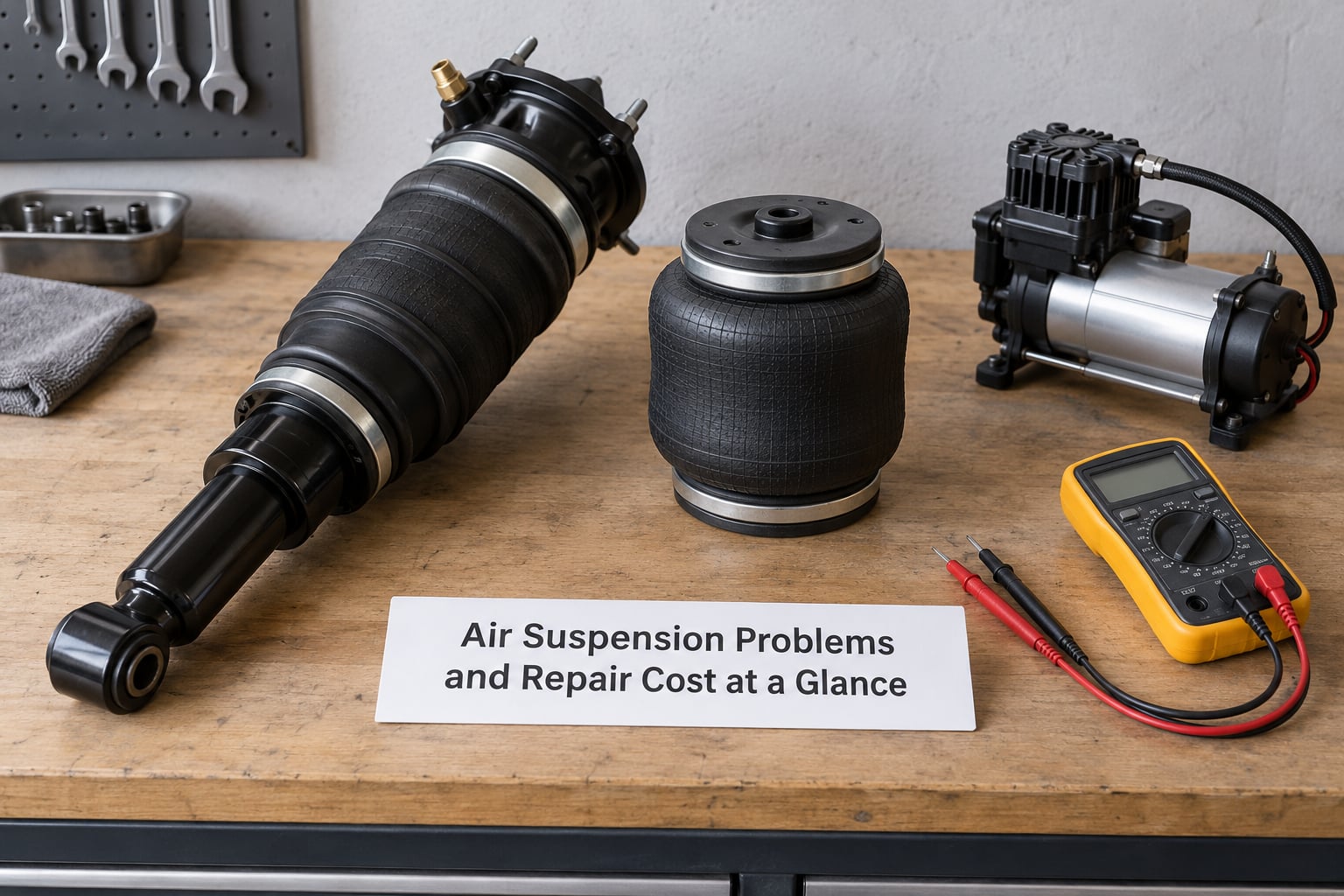
These are typical US ranges in US dollars for a rear air spring or single-corner repair on a mainstream vehicle. A luxury or body-on-frame model runs higher, and labor on the same part can double in a dealership.
| Repair | Parts (USD) | Labor (USD) | Typical total | Difficulty | Symptom it fixes |
|---|---|---|---|---|---|
| Single air spring replacement | 200–600 | 250–500 | 450–1,100 | Moderate | Car sinks on one side or overnight |
| Complete air strut assembly | 700–1,800 | 400–700 | 1,100–2,500 | Moderate to hard | Clunk over bumps with a sagging corner |
| Compressor replacement | 450–1,100 | 250–500 | 700–1,600 | Easy | Compressor runs constantly or not at all |
| Valve block repair or replacement | 350–1,200 | 400–800 | 750–2,000 | Hard | Height drops, no codes, bag will not hold air |
| Height sensor replacement | 120–350 | 150–300 | 270–650 | Easy | Tire wear is uneven, car leans while cornering |
| Air line or fitting repair | 20–90 | 150–350 | 170–440 | Easy | Hissing noise near a wheel or under the car |
| Air dryer cartridge change | 40–120 | 100–200 | 140–320 | Easy | Preventive: stops moisture damage to the compressor |
| Full system overhaul, all four corners | 3,000–7,000 | 1,200–2,500 | 4,200–9,500 | Hard | Multiple leaks, dead compressor and module faults |
| Wheel alignment after any bag or strut job | 0–100 | 100–250 | 100–350 | Easy | Required once ride height changes |
Budget for the alignment. Almost every air spring or strut replacement changes the ride height, and skipping alignment wears tires and eats the repair you just paid for.
What Air Suspension Problems Mean for Your Repair Bill
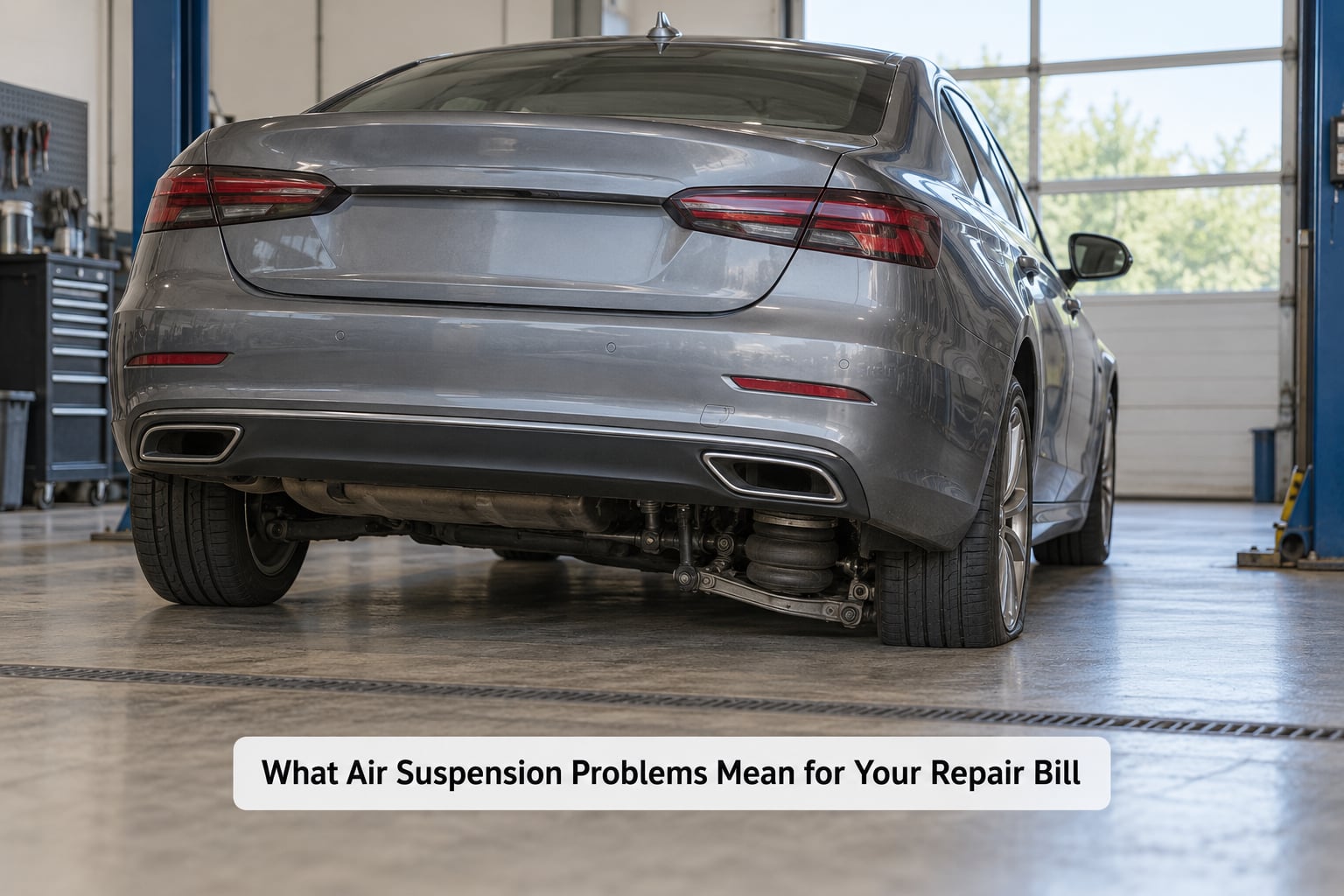
Sagging or uneven ride height means a leak
One corner sitting low while the others are normal is almost always a leaking air spring at that corner. If the car sits on the ground in the morning after being level at night, pressure escaped somewhere overnight. A leak this obvious is the cheapest problem on the list: 450 to 1,100 dollars for a single rear bag, more for a strut assembly.
Rear bags fail more often than front ones, and that pattern repeats across Lincoln, Mercedes, Audi and Land Rover owners. Both rear bags of the same age usually go at the same time, which is worth quoting as a pair.
A hissing sound means a leak you can find yourself
Hissing near a wheel or from under the car is a cracked bellows seam or a fitting that has dried out. A mixture of dish soap and water sprayed on the seam and fittings will bubble where air escapes. That test costs almost nothing and it removes most of the guesswork before a shop charges you a diagnostic fee.
A compressor that never stops means something is leaking
A compressor that runs every few minutes while the car is parked is chasing pressure it cannot hold. The compressor is usually the victim, not the cause. Owners regularly pay for a new compressor, then hear the same noise a week later because the leaking bag was never found.
A new compressor will also overheat itself if it is asked to refill the system continuously. Most units are built for roughly 15 to 20 minutes of continuous run time as a hard ceiling. Beyond that, the motor cooks. Replace the compressor and the valve block together if the compressor has clearly burned, but fix the leak first or you will be back.
Warning lights and failed leveling mean the sensors or the module are involved
When a warning message appears and the car will not level, the fault is often electrical rather than pneumatic. Ride height sensors on the body can drift out of calibration, and a failing sensor makes the system vent air on one side while it fills the other. Replacing a height sensor runs 270 to 650 dollars. A control module failure runs 600 to 1,200 dollars for the part plus programming, and it is the point where a shop becomes necessary.
Clunks and a harsh ride over bumps point at the strut or mounting hardware
A thump over every expansion joint with a sagging corner usually means the air spring is no longer seated properly on its mount, or the top mount and bushings have worn. If you hear a single knock on one side only, compare the ride height before assuming a leak. Our guide to how to diagnose a clunk in the front suspension on a BMW covers how to separate a mount problem from a shock problem.
Moisture damage and premature failure have a root cause
Air springs dry out and delaminate over time even without a puncture, and a system that ingests moisture through worn lines will kill a new compressor within months. Replacing the air dryer cartridge during the repair is 140 to 320 dollars and it is the cheapest insurance on the job. Odometer expectations matter too: owners commonly report 100,000 to 150,000 miles from factory bags, with failures clustering around 80,000 to 100,000 miles on hard-driven examples.
Order of operations is what separates a 900 dollar repair from a 4,000 dollar one. Fix leaks, replace the dryer cartridge, replace the compressor last, then scan for codes and clear them.
What Affects the Price
Make, model and chassis design
Mercedes-Benz, Audi and Lincoln systems use more valving and sensors per corner than a Ford or Chevy truck, so the same task takes longer. Body-on-frame SUVs such as the Jeep Grand Cherokee, Navigator and Range Rover also route air lines through body seams that take extra time to access. Tesla and Range Rover air struts are frequently sold as complete assemblies, which raises parts cost but cuts labor.
Age matters as much as brand. On a chassis past its 10th year, most shops expect the mounting hardware, upper mounts and sensors around the repaired corner to need attention at the same time. Doing them together is cheaper than three separate visits.
OEM parts versus aftermarket
OEM air springs and valve blocks carry the highest parts cost. Quality aftermarket bellows and compressor assemblies typically run 30 to 50 percent cheaper and most shops and owners are satisfied with them on non-SUV-specific applications. The weak spot is bellows crimping: cheap bags can split at the crimp ring in cold weather, which is why the cheapest bag in the box is not always the cheapest repair.
Access, labor rate and shop fees
Compressor access varies enormously. On some trucks the compressor comes out from underneath in under an hour. On others the strut has to come apart to reach the valve block, and labor can double. Independent shops usually run 110 to 180 dollars per hour, while dealerships charge 190 to 280 dollars per hour and add a shop fee. Tax on parts and labor varies by state, so the final invoice runs higher than any quoted range here.
These are typical US ranges that vary by region and change over time. Get a written number for your vehicle, not a range from an article.
Whether a wheel alignment is included
Some shops fold a basic alignment into the strut job, others quote it separately. Confirm the alignment is in the estimate before you approve the work, and check how much a wheel alignment costs so you know whether the line item is reasonable.
If you own an older BMW, the same age logic applies to the rest of the chassis. Our BMW E39 common problems and repair costs guide covers where the money goes on those cars.
Ways to Save
Diagnose before you replace anything
The soap-and-water test finds a leaking bellows in ten minutes and costs nothing. Read the codes with an OBD-II scanner before booking work, and note whether the compressor runs continuously, intermittently or not at all. That single observation decides whether the compressor is even in the conversation.
Compare a complete strut with individual components
On many vehicles the air spring, damper and mount are one welded assembly rather than separate pieces. Where that is true, a complete strut is both cheaper and stronger than stacking an aftermarket bag onto a tired original damper. Where the parts are separate, replacing them individually is fine. Ask which configuration your chassis uses before ordering.
Get an itemized estimate and compare shops
Ask for parts, labor and fees on separate lines. An independent shop is commonly 30 to 40 percent under a dealer for the same air spring and valve block work. Two written quotes is standard practice, not rude.
Replace worn mounting hardware in the same visit
New upper mounts, bump stops and fasteners cost little on their own and much more as a separate labor visit later. Bolt the corner back together once rather than twice.
Know when to stop and when to stop hacking
A complete overhaul on a vehicle worth far less than the repair is not worth doing. Converting to coil springs costs 900 to 2,000 dollars in parts plus labor, permanently stops the compressor cycling and drops the self-leveling ride height, which changes ground clearance and handling. It is a legitimate answer for an old daily driver, not a silent fix.
What is never a legitimate answer is bypassing or disabling the system with the switch and leaving a low corner on the road. If the car has dropped overnight, drive it only if you can inflate it back to full height first and the ride height looks even on all four corners. A low corner changes braking, steering geometry and tire loading, and on a car with an electronic parking brake it can also leave the vehicle stranded. Do not drive it low.
Frequently Asked Questions
Can I drive with an air suspension problem?
Sometimes, but only with full ride height. If the car sits low on one side, the handling, braking and tire loading are all compromised, and you risk ruining the tire and the alignment. You can drive it if the compressor still inflates the car and all four corners end up level. You cannot drive it if it drops overnight, sits on the ground, or pulls to one side. Do not bypass the system to silence the warning.
How much does it cost to replace an air suspension compressor?
An air suspension compressor typically costs 450 to 1,100 dollars for the part and 250 to 500 dollars in labor, so 700 to 1,600 dollars installed on a mainstream vehicle. A bad compressor is often caused by a leak elsewhere, so find and fix that first or the new compressor will burn out the same way.
Can just one air spring or strut be replaced?
Yes, a single air spring or strut can be replaced on its own, and that is the normal repair when one corner sags. Expect 450 to 1,100 dollars for an air spring and 1,100 to 2,500 dollars for a complete strut assembly. If the other bags are the same age, replacing them at the same time often costs less in total labor.
Why does my air suspension keep failing after a repair?
Usually because the underlying leak was never fixed. A compressor that runs constantly overheats and burns out, a worn air dryer lets moisture through and corrodes the new compressor, and a valve block that was marginal fails under the same load. Persistent problems after a repair usually mean the diagnosis stopped at the part that was replaced, not the cause.
Is it cheaper to replace an individual air suspension part or the complete assembly?
It depends on the chassis. Where the air spring, damper and mount are welded into one assembly, the complete strut is cheaper and stronger because there is no separate mounting work. Where the parts bolt together separately, replacing the individual air spring is far cheaper. Ask your shop which configuration your vehicle uses before ordering parts.
Do BMW air suspension problems require coding or calibration after repair?
On BMW models with self-leveling air suspension, yes. After replacing a height sensor, strut or air spring, the suspension control module usually needs the ride height relearned, and some repairs require a scan tool or dealer-level programming. Older models and non-leveling setups may need only a code clear and a wheel alignment, so confirm with the shop before the work starts.
Start with a soap-and-water test and a code read before anyone quotes you a compressor. Find the leak, get an itemized estimate from more than one independent shop, and get the wheel alignment included. That sequence keeps most air suspension problems and repair cost inside the low end of the ranges above.