
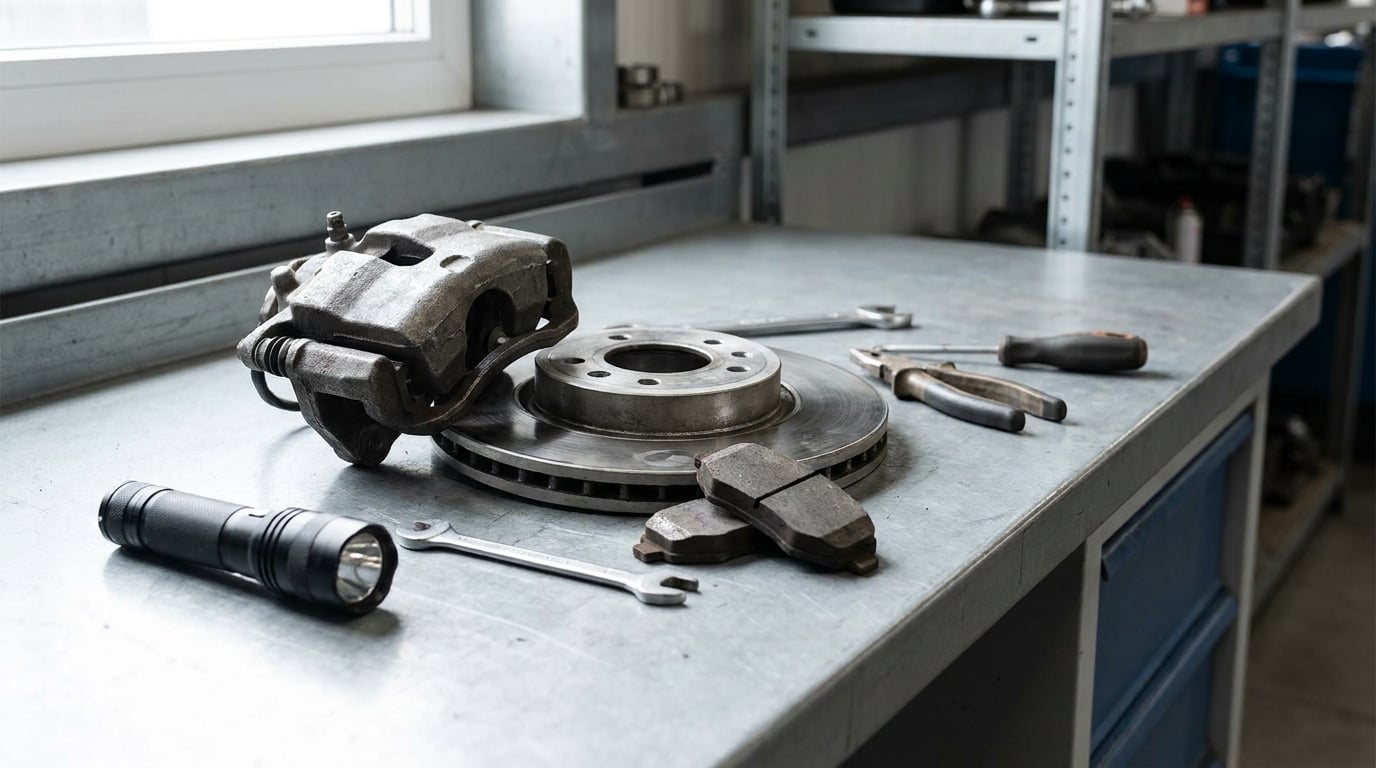
Brakes grind when stopping because the friction material on the pads or shoes has worn away, leaving the steel backing plate scraping against the rotor or drum. Moisture, road debris, a seized caliper or even a worn wheel bearing can make a very similar noise, so the sound tells you something is wrong but rarely tells you exactly what.
That matters because the moment friction is gone, you are braking with metal on metal. Stopping distance grows, the rotor starts getting cut into, and a pad job turns into a rotor or drum job. Here is how to tell the harmless noises from the expensive ones.
Table of Contents
- Why Do Brakes Grind When Stopping?
- What Does Each Grinding Sound Mean?
- What Commonly Makes Brakes Grind?
- Is It Safe to Keep Driving With Grinding Brakes?
- What Can You Check Before Paying for Repairs?
- How Are Common Brake Problems Repaired?
- What Do BMW Owners Especially Need to Check?
- Frequently Asked Questions
- Can new brakes grind when you first drive the car?
- Is it safe to drive if the brakes scrape only after rain or sitting overnight?
- Can low or contaminated brake fluid cause a grinding sound?
- Does brake squeal always mean the pads are completely worn out?
- Do I need to replace the brake rotors when the pads are grinding?
- What Should You Do First?
Why Do Brakes Grind When Stopping?
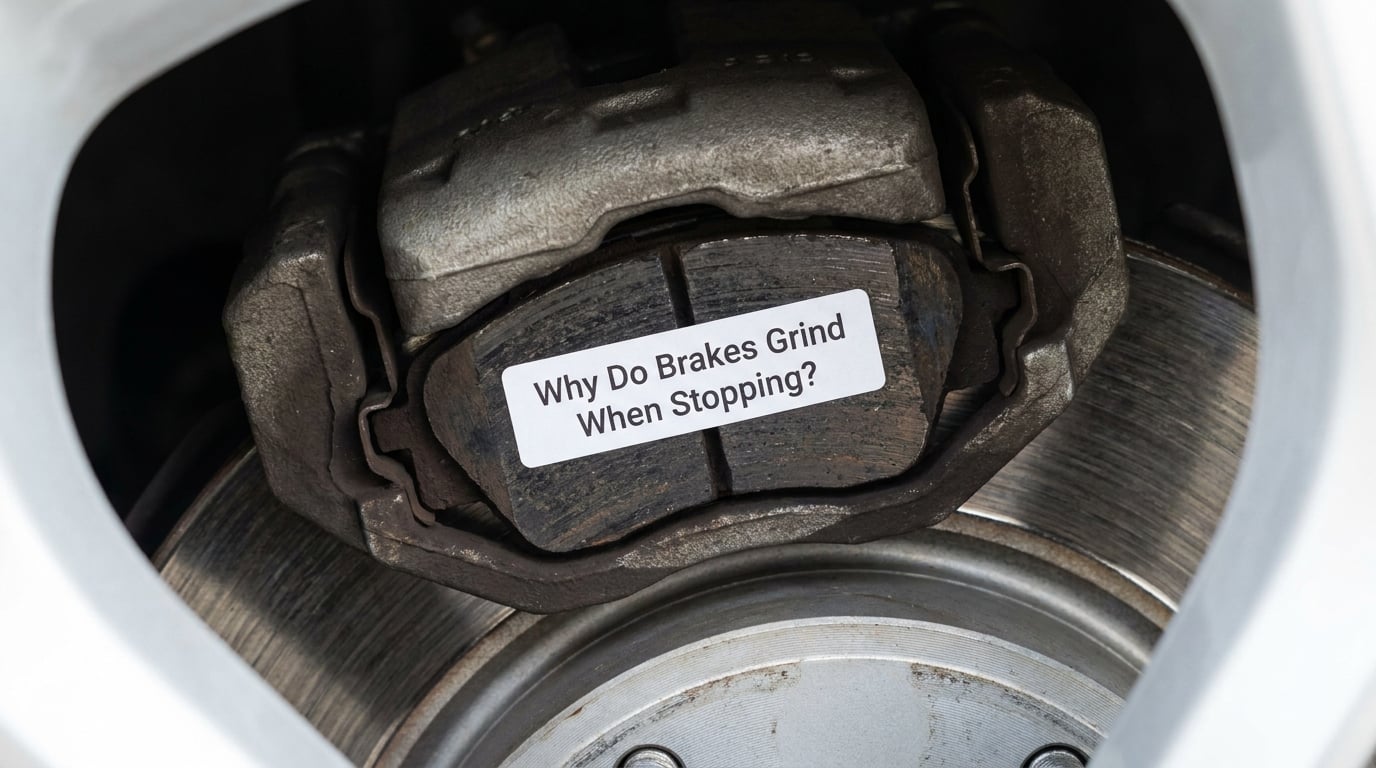
A brake caliper squeezes two pads against a spinning rotor to stop the car. The pads have a soft friction layer bonded to a rigid steel plate, and that layer is what actually slows the car. Once the layer is gone, the plate itself touches the rotor and the stop turns into a sustained metallic scrape that repeats every time you brake.
That is the classic answer, and it is the one to assume first. But metal-on-metal contact is only one of several reasons a brake makes noise, and the others range from a ten-minute cleanup to a caliper that has seized solid.
What Does Each Grinding Sound Mean?
Before you take anything apart, match the noise to the table below. The pitch, timing and location tell you more than most people expect.
| Sound | What it usually means | How urgent |
|---|---|---|
| High-pitched squeal, first thing in the morning or after rain | Light surface rust on the rotor edge, or a worn wear-indicator tab touching the rotor | Low. Often clears within a few stops |
| Sustained coarse scrape, every stop | Friction material gone, the backing plate is on the rotor | High. Stop normal driving |
| Grinding only in the last few feet of a slow stop | Low-speed pad or shoe contact, debris, or a pad sitting proud in the caliper | Medium. Book an inspection |
| Rattling or clunking at low speed, sometimes when turning | Worn brake hardware, a caliper bolt working loose, or a stick-on pad backing plate separating | Medium. Check the hardware |
| Rumble or growl that follows your speed, not your pedal | Wheel bearing or hub, not the brakes | Medium. Do not keep driving far |
| Grinding that only appears on one side | Hardware missing on that corner, or uneven pad wear | High. That corner is the problem |
Why Do Brakes Grind When Stopping in a Specific Situation?
Pay attention to when the noise shows up, because brakes are honest about conditions. A sound that comes and goes with weather points at surface rust, which we cover in why brakes rust when a car sits. Noise that gets louder the harder you press means the pad or shoe is genuinely cutting into the rotor.
Noise that fades as the car slows and reappears at every stop usually means a pad is touching at low speed but the caliper is retracting properly above it. Noise that changes when you steer is a strong hint the wheel bearing is involved rather than the brake. And noise that shows up right after highway driving or a tow is heat, which is its own mechanism entirely.
One quick split: have someone stand behind a safe, parked car while you press the pedal. If the sound plays through the speakers, it is the brakes. If it keeps going with your foot off the pedal and changes with road speed, suspect the bearing or hub.
What Commonly Makes Brakes Grind?
These are the causes I see over and over, roughly in the order they turn up.
| Cause | What you hear | Effect on stopping power |
|---|---|---|
| Worn pads or shoes | Coarse metal scrape on every stop | Much longer stopping distance, longer pedal travel |
| Thin, scored or damaged rotor | Grinding plus a pulse through the pedal or steering wheel | Uneven friction and longer stops |
| Debris in the caliper or a stone wedged behind the pad | Localized grinding, sometimes intermittent | Can gouge a rotor quickly |
| Surface rust on the rotor edge | Brief scrape on the first stop after rain or sitting | None once it wears off |
| Contaminated pads from fluid or grease | Squeal or heavy grinding with no bite | Glazing drops stopping power |
| Sticking or seized caliper | Grinding that continues after the pedal is released, or a hot wheel | Dragging brake overheats and can warp the rotor |
| Worn or missing hardware and anti-rattle clips | Rattling and vibration under braking | Erratic pedal feel |
Two more round out the list. On older cars with rear drums, worn brake shoes make the same grinding noise on the rear axle, and many owners hunt for it on the front because the front is where the sound seems loudest. A wheel bearing worn out is the most common misdiagnosis in the other direction, and it sounds exactly like brake grinding until you change speed.
Rear drum coverage matters here because the shoes are hidden inside the drum. You cannot check them by eye at all, and the whole reason many people believe their pads look fine is that they are looking at a brake that was never the problem.
Is It Safe to Keep Driving With Grinding Brakes?
Not if the grinding is continuous. Once friction material is gone, the metal backing plate is the only thing touching the rotor, and the stopping power you have left is a fraction of normal. Continued driving cuts grooves into the rotor, and if a car has rear drums it can crack the drum outright, which is far more expensive than pads.
Stop driving and have it inspected if the grinding continues, if the pedal feels soft or takes longer to firm up, if the car pulls to one side, if the wheel pulls or steers oddly, or if you see smoke or smell hot metal. In any of those cases, do the fastest thing that gets the car stopped safely, avoid further braking, and arrange a tow rather than driving it across town.
The distinction worth holding onto: a sound that happens once after a rainstorm is not the same as a sound that happens at every stop. One is weather, the other is wear, and they need opposite responses.
What Can You Check Before Paying for Repairs?
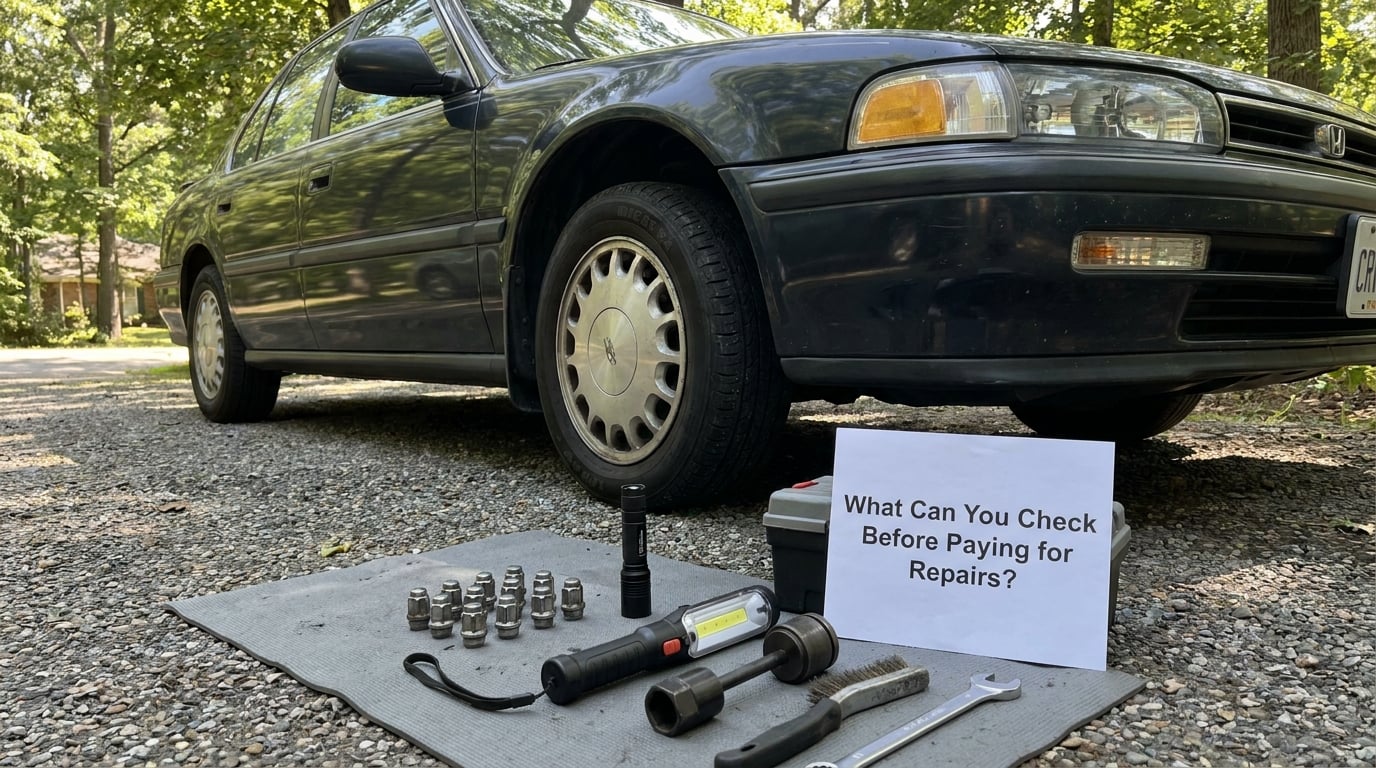
Most of this is checking, not fixing. Do the listening tests above, then look through the wheel spokes at the rotor face for a visible groove or lip, and check whether the wheel or tire has brake dust accumulating unevenly on one side. If the car does not get used much, our guide to maintaining brakes on a car you rarely drive covers the rust-and-seizure pattern that follows long storage.
If you go further, use jack stands on level ground and never get under a car supported by a jack alone. Park the car in gear or with the parking brake set, wear gloves, and remember the rotor and caliper hold enough heat to burn you after a normal drive.
Three thresholds make a home check useful rather than guesswork. Pad friction material under about 2 mm means replace now, 3 mm means worn and worth planning for, and 6 mm or more is healthy. A groove deeper than 0.060 inch, roughly 1.5 mm, means the rotor is past the point of resurfacing. And the minimum thickness specification is stamped on the rotor itself, so a cheap micrometer settles the question without guessing.
Cleaning the brake dust off a rotor and inside the caliper is genuinely free and fixes a surprising share of low-speed grinding. Compressed air or a brake cleaner and a stiff brush will do it. Be careful not to get any of it on your skin or in your eyes.
If you have had pads and rotors replaced recently, check whether the anti-rattle clips and hardware were reinstalled. Forum threads on r/MechanicAdvice and r/Cartalk keep circling the same complaint: new parts, same noise, and the culprit was a missing clip or a pad installed without bed-in.
How Are Common Brake Problems Repaired?
Diagnosis comes before parts. Replacing pads onto an already-scored rotor locks the grinding in permanently, because the new pad rides in the same groove and the noise never changes. A shop that hands you a pad-and-rotor invoice should be able to tell you which rotor surface condition triggered it.
So the repair logic is straightforward. Worn pads and shoes get replaced, and the old hardware is thrown out rather than reused. A scoring or rust-damaged rotor gets resurfaced if it is still above the minimum thickness stamp, and replaced if it is not. A sticking caliper gets rebuilt or replaced, and the slide pins and caliper bolts cleaned and lubricated so it retracts properly next time. A contaminated pad is always replaced, never cleaned, because grease does not come out of friction material.
On new pads, bed-in is the step people skip. Drive on a quiet road for around 20 miles at moderate speed with several firm stops from roughly 30 mph, letting the rotors cool between them, and avoid dragging the brake to a full stop. That lays an even layer into the pad and stops the rubbing noise that shows up for the first few hundred miles. On hybrids and other regen-braked cars the same idea applies in a different form, which we explain in why hybrid brakes last longer.
Ask the shop two questions before you authorize work: what exactly did you find on the rotor surface, and is the hardware being replaced or reused. A good answer names the condition rather than saying the brakes need service.
What Do BMW Owners Especially Need to Check?
BMW hardware varies a lot across the range, so a general answer is often wrong. Wheel size and offset change how the caliper sits over the rotor, and a wheel that worked on one model can hold a pad just off the rotor or crowd it into contact on another. Confirm the correct wheel and rotor pairing against the service manual for your specific chassis before blaming the pads.
The electronic parking brake is a second one. It clamps the rear caliper and holds the car, and a seized actuator or a caliper that never fully releases will drag and grind. The brake pad wear sensors on many models also sound an in-cabin warning before the friction material is gone, which is worth heeding early rather than testing.
Finally, rotor specification and pad wear indicator behavior are model-specific, and the parking brake needs its own service procedure. Read the manual for the year and model rather than assuming every BMW shares the same hardware. It saves the parts bin and the argument.
Frequently Asked Questions
Can new brakes grind when you first drive the car?
A light rubbing or faint scrape for the first few hundred miles after a pad change is normal, and it usually disappears as the pads bed in. A coarse, loud grind that does not settle within about 200 miles, or a noise that appears on only one corner, is not break-in. Check for missing anti-rattle clips or hardware and a caliper that is not retracting before assuming the pads are at fault.
Is it safe to drive if the brakes scrape only after rain or sitting overnight?
Usually yes. A brief scrape on the first stop after rain or a long park is surface rust forming on the rotor edge while the car sits, and normal braking scrapes it away within a few stops. The test is whether the noise disappears once the rotor gets warm and clean. If the grinding continues into the whole drive, or you see the wheel glowing, treat it as real wear and get it inspected.
Can low or contaminated brake fluid cause a grinding sound?
Brake fluid does not make a grinding sound, but it can cause one indirectly. Fluid that has absorbed water or picked up contamination can swell slightly when hot, which makes a sticking caliper worse and leaves the pad dragging after you release the pedal. A soft, spongy pedal that travels farther than usual is a fluid and air-in-the-line symptom, so get the fluid checked rather than just the pads.
Does brake squeal always mean the pads are completely worn out?
No. Squeal is most often a wear-indicator tab designed to chirp as a warning when the friction material nears its limit, but it can also come from cold weather, light surface rust, a polished or glazed pad, or a caliper bolt that needs lubrication. A squeal that fades as the brakes warm up is usually early rather than urgent. A continuous coarse grind is the sound that actually means the friction material is gone.
Do I need to replace the brake rotors when the pads are grinding?
Not automatically. Rotors get resurfaced if they are still above the minimum thickness stamped on them and the scoring is shallow. If a groove is deeper than about 0.060 inch, or the measured thickness is at or below that minimum mark, resurfacing will not work and the rotor has to be replaced. Replacing pads onto an already-scored rotor is the most common reason grinding comes straight back after a job.
What Should You Do First?
Decide whether the sound is a one-off or a pattern. One scrape after rain or a long park is surface rust and it clears itself. A grind that happens at every stop is wear, and once the brake is no longer stopping the car properly, stop driving and have it looked at.
Book an inspection for any persistent grinding, and have the shop replace only the components they confirm need service. Pads, rotors, shoes and hardware are priced and diagnosed separately, so a clear explanation of what they found matters more than what they put in your car.