
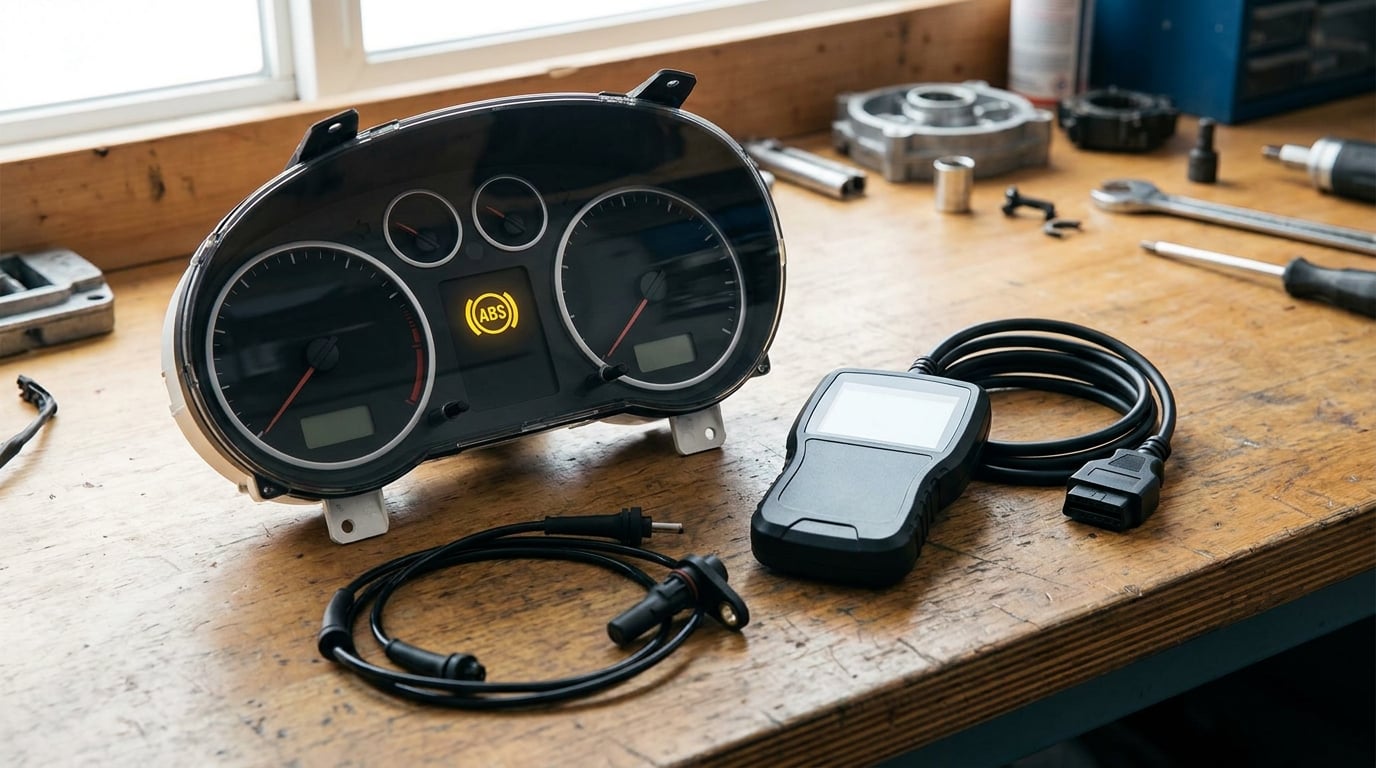
An ABS light on but brakes work fine situation is less alarming than it sounds. The hydraulic brakes that slow and stop your car are still doing their job; what switched off is the anti-lock function that keeps a wheel from locking on a slick surface. You have lost a safety net, not your brakes.
That distinction explains the confusion almost every owner feels. On dry pavement with an easy stop, a car without ABS feels identical to one with it. The two only diverge when you stand hard on the pedal in rain, ice, gravel or snow.
Below is the working order a tech would follow: what the warning is actually telling you, whether you can drive it, the causes that show up most often, and the checks that cost almost nothing before anyone talks about replacing parts. If you want the short version, the light means the ABS control unit has deliberately disabled itself after detecting an inconsistency.
Table of Contents
- ABS Light On but Brakes Work Fine: What It Means
- Can You Drive with the ABS Light On?
- Why Is the ABS Light On When the Brakes Work?
- What the ABS Warning Looks Like on Different BMWs
- How to Diagnose an ABS Light: A Safe Step-by-Step Check
- Why Is the ABS Light On but Brakes Work Fine After a Wheel or Tire Change?
- What to Do First Before Replacing the ABS Module
- Frequently Asked Questions
- Can I safely drive if my ABS warning light is on?
- Will my car pass inspection with the ABS light on?
- Does replacing the brake pads fix an ABS warning light?
- Can disconnecting the battery turn off the ABS light?
- Do I need a BMW-specific diagnostic tool to read ABS codes?
- Why does the ABS light come back after I replace a wheel speed sensor?
- Conclusion
ABS Light On but Brakes Work Fine: What It Means
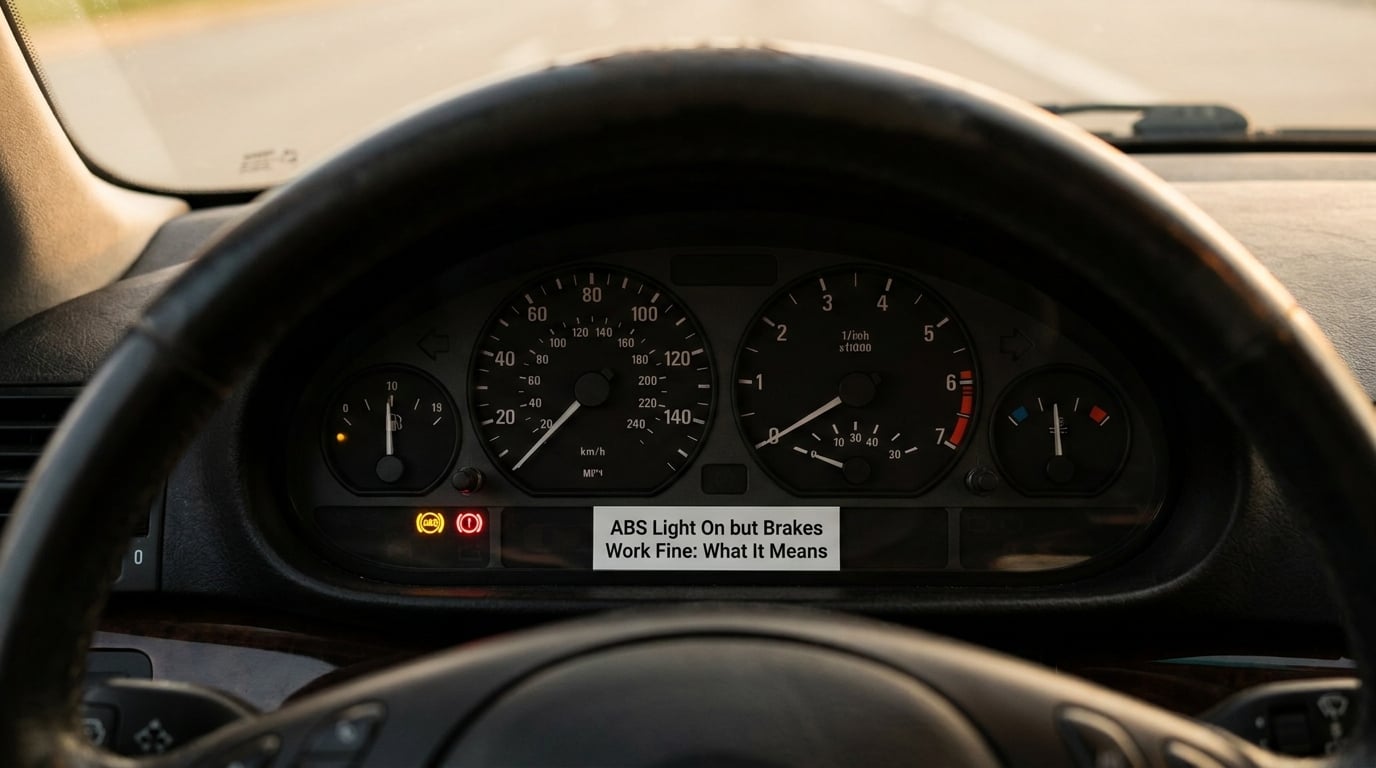
Your ABS control unit constantly compares what each wheel speed sensor reports against the others, and against how the car is actually moving. When those numbers stop agreeing, it does the safe thing: it turns anti-lock off and lights the warning so you know the extra function is unavailable.
It does not turn off the base braking system. Pads, calipers, brake lines and the master cylinder are a completely separate hydraulic system, and they are still doing all the stopping work. The pedal will feel the same as it always did.
Which light you are actually looking at
Dash symbols get redesigned often, and colours vary by model year and trim, so read the shape of the symbol rather than the wording. Still, the three lamps below are the ones that get confused for each other.
- Yellow or amber ABS warning — anti-lock and usually the related stability or traction functions are off. Base braking is intact unless a red warning is also lit.
- Red circle with an exclamation mark — the brake system itself needs attention. This is a different fault and it matters more.
- Red circle with a P in it — the parking brake is engaged. Releasing it clears the lamp on most cars.
If a red brake warning or a low brake fluid message is showing at the same time, stop treating this as an ABS-only problem. A fluid level in the reservoir affects both systems, which is why a low brake fluid warning light deserves its own look before anything else.
Can You Drive with the ABS Light On?
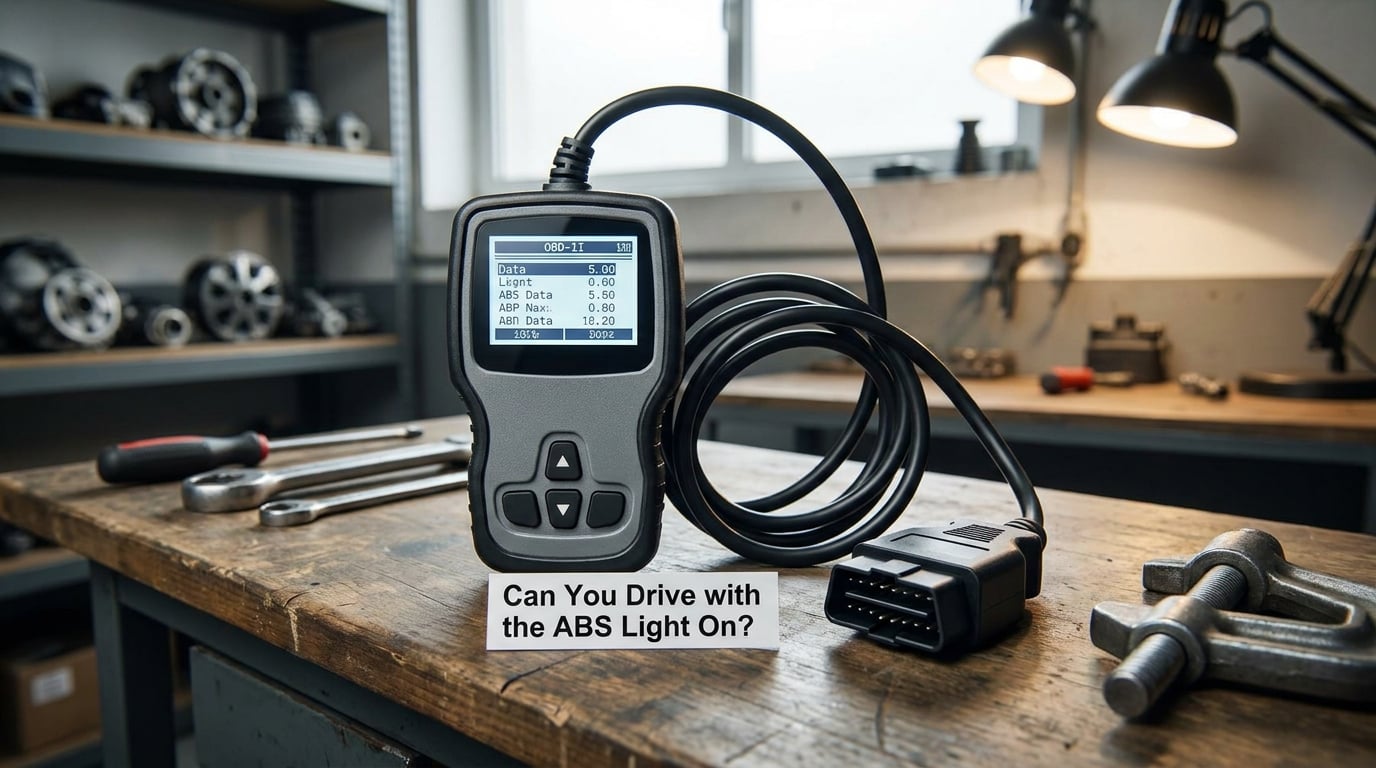
Usually, yes, and that is the honest answer most garages will give you. The car will still brake, it will still stop in a straight line, and on a dry day you probably will not notice a single difference in the pedal. What changes is your margin on a low-grip surface.
Without ABS, a hard stop on wet or icy pavement can lock a wheel. A locked wheel skids, loses steering authority, and needs a longer distance to stop. On a dry road that risk mostly stays theoretical, which is exactly why this warning is easy to ignore for months.
How to drive while the light is on
- Double your normal following distance and leave room to steer around a problem.
- Brake earlier and more gently than you think you need to. Threshold braking in stages avoids the lock-up that ABS would have prevented.
- Avoid driving if rain, ice, snow or unplowed gravel is in the forecast for your route.
- Do not rely on the ABS light as your only warning. A stability, ESP or traction lamp lit alongside it usually shares the same root cause.
Warning combinations that mean stop now
There are conditions where continuing to drive is a bad bet, and they are worth knowing before you need them. Pull over somewhere safe and get the car looked at rather than driving it to the shop.
- Red brake warning illuminated, or a brake fluid level message showing.
- Spongy, soft or unusually long pedal travel, or a pedal that sinks toward the floor.
- Any sign of fluid under the car, near a wheel, or on the reservoir cap.
- A grinding or squealing sound when braking, or a visible leak on a caliper or line.
- A stability, ESP or VSC light combined with a steering-related message or a warning about reduced function.
- Tire damage, a tire down to the wear bars, or a wheel that looks visibly bent after a kerb strike.
Also worth a tow rather than a drive: a car that locked a wheel hard on ice, a noise from a damaged wheel bearing, or a rotor that has been visibly cracked. If the car came off the road hard enough to distort something, a scan from the shop is the cheapest next step.
Why Is the ABS Light On When the Brakes Work?
Because the two systems share very little beyond the same pedal. The base brakes are hydraulic: fluid pressure moves pistons that squeeze pads against discs. The anti-lock layer is electronic: sensors, a control unit, solenoid valves and a pump that can release or hold pressure on individual corners during a slide.
When the electronic layer detects contradictory data, it shuts itself down rather than modulating a slide with numbers it does not trust. Everything mechanical keeps running. That is also why a firm, short pedal is not proof that ABS is functioning, and why a reduced brake travel that feels like an improvement means nothing about the anti-lock system.
The two circuits that explain ABS light on but brakes work fine
| What still works | What you have lost |
|---|---|
| Stopping power from pads, calipers and fluid pressure | Wheel-speed feedback to the control unit |
| Normal pedal feel and pedal travel | Automatic release of a locked wheel |
| Brake lights, unless a red warning is also lit | Traction and stability functions on many cars, since they share the same sensors |
| Parking brake operation | Any short-cut for emergency braking on low-grip surfaces |
The causes, in the order they tend to show up
| Cause | What you notice | Repair scope |
|---|---|---|
| Wheel speed sensor fault | Light on, often after rain or a kerb strike; pedal normal | One sensor, its wiring, or the connector |
| Damaged tone ring | Intermittent light, worse over bumps or in cold weather | Ring on the hub or axle, sometimes the hub itself |
| Chafed wiring or a corroded connector | Light comes and goes with vibration or weather | Harness repair, terminals, protective sleeve |
| Low or contaminated brake fluid | ABS light, sometimes a red brake warning too | Fluid top-up, bleed, fluid service |
| Blown ABS fuse or lost power feed | Light on immediately, several systems may complain | Fuse box check, relay or wiring fault |
| ABS module or pump | Light stays on after everything else checks out | Module, sometimes coding after replacement |
Wheel speed sensor. Each corner has a small sensor at the hub that reports rotation speed. A cracked housing, a sheared wire, or magnetised dirt on the tip produces a signal the module cannot trust. This is the single most common cause by a wide margin.
Tone ring. Also called a relator ring, this is the small gear-like toothed ring pressed onto or built into the hub, and the sensor reads it as it turns. Hit a kerb hard enough to bend the wheel, or let a wheel bearing go dry long enough to chew the ring up, and the module sees an erratic signal. A damaged ring is easy to miss because the sensor and its wiring are perfectly fine.
Wiring and connectors. The harness from the sensor to the module runs through the wheel arch and across suspension joints for its whole life. Chafe against a bracket, a connector pushed half home during a brake job, or corroded terminals inside the plug produce faults that come and go with weather and vibration.
Brake fluid level or condition. Many ABS systems share fluid with the base brakes and monitor that level closely. Low fluid can trigger the ABS warning on its own. Fluid that has absorbed water over years behaves badly at the module’s valves too, and on a car that mostly sits, moisture in the system is the quiet culprit more often than people expect. Our notes on maintaining brakes on a car you rarely drive cover that situation, and why brakes rust when a car sits explains the corrosion side of it.
Blown fuse or missing power. The ABS circuit and its pump have their own fuse and often their own relay. Other telltale lamps appearing alongside the ABS light is a clue here, and so is a module that behaves erratically when the engine is cranked. Many modern modules also stop talking to the rest of the car when supply voltage dips hard, which is a behaviour to ask about specifically.
ABS module or pump failure. A sticking solenoid or a failed pump motor means the control unit disables the system even though the sensors report correctly. This is the least common cause in most workshops and the most expensive one, which is exactly why it is last on the list.
Aftermarket sensors that do not suit the car. An incorrect length, wrong connector pin count, or a passive sensor fitted where the car expects an active one can leave a light on immediately after installation. Members on the Toyota FJ Cruiser forum learned from a sensor maker that active-style sensors cannot be verified properly with a resistance meter, so a passing ohmmeter reading means very little on a large share of modern cars.
Tires, wheel bearings and battery voltage. A noticeably different tire diameter on one corner, a worn bearing with visible play, or a weak battery that drops voltage during cranking can all trigger the warning. A battery disconnect also commonly leaves an ABS light on, because the module keeps losing the wheel-speed history it uses to reference against the car’s speed sensors.
Solid, flashing or intermittent: what the pattern tells you
A steady lamp usually means a stored fault the module has latched. A lamp that appears and disappears points at an intermittent signal, a dirty or damaged sensor tip, or a marginal connector.
On older cars a flashing pattern replaces a scan tool. One r/MechanicAdvice thread on an early F350 had the owner counting four flashes and finding no way to decode them, which happens more often than it should. The flash group is defined per manufacturer, and counting them is a genuine diagnostic step, not a superstition.
When the ABS, stability and traction lights are really one fault
Many cars run anti-lock, electronic stability and traction control off the same wheel-speed sensors, so a single failing sensor lights three lamps and owners assume they have three problems. A PriusChat thread on an ABS and VSC warning is a good example of owners treating one fault as several. One sensor circuit, one diagnostic session, one repair.
What the ABS Warning Looks Like on Different BMWs
On most BMWs the ABS failure lamp is a yellow circle containing the letters ABS, often with a check-mark symbol beside it, and it stays on while the car runs. A separate red parking-brake message appears when the parking brake is set, and a red brake-system warning can override everything. Instrument cluster lettering, menu entries and whether the lamp self-cancels after a key cycle all differ across generations and model years, so verify the illuminated symbol on the car in front of you rather than trusting a forum post written about a different year. If you tell us the model, year and whether the traction or stability lamp is lit too, the list of likely causes gets much shorter.
How to Diagnose an ABS Light: A Safe Step-by-Step Check
Run these in order. Each step is cheap, fast, and rules out the causes that make up most cases, so you avoid handing someone a module quote before anyone has touched a sensor.
- Confirm the exact warning. Photograph the cluster, note the colour and symbol, and check whether other lamps are lit. Write down whether it is solid, flashing, or intermittent, and when it first appeared.
- Check the brake fluid level. Look at the reservoir in the engine bay with the car level and cold. Low fluid can raise the ABS light by itself. If it is low, find the leak before topping it up.
- Inspect the tires. Pressures equal across the axle, no cuts in the sidewall, no objects embedded in the tread, and tread depth above the wear bars. A tire or wheel problem throws the speed readings off.
- Check the ABS fuse and relay. Compare the ABS fuse against its neighbours for a blown element, and confirm the relay seats fully. This is where supply voltage problems show up.
- Look at each wheel-speed sensor and its wiring. With the car safely supported and the wheel off, look through the spokes for the sensor at the hub and follow the harness. Check for damaged insulation, a connector pulled out of its socket, greenish corrosion, or a bracket rubbing the cable.
- Clean the sensor tip and the tone ring. Road grime, magnetised filings and surface rust on the toothed ring are the cheap fix. An iRV2 owner cleared an intermittent ABS light at no cost by pressure-washing the back of the wheel. A toothbrush and brake cleaner on the sensor tip and ring do the same job for a stubborn case.
- Scan for ABS codes with a capable OBD2 reader. A basic engine-code-only scanner will not reach the ABS module. You need a tool that reads manufacturer-specific ABS systems, and on some brands a dealer-level tool is needed to clear the memory once the repair is done.
- Clear codes only after writing them down. Recording the code tells you which corner and which circuit the module flagged, which is the difference between a targeted repair and guessing.
- Verify with a road test. On a clear, dry day, drive far enough for the module to complete its checks and watch the lamp. A light that comes back means the fault was never found, not that the light needs clearing again.
How to get the light off after the repair
Clearing a code is not a repair. The light comes back because the module still sees the same fault, not because the code needed clearing twice.
- Fix the actual cause: the sensor, the tone ring, the wiring, the fluid level, or the module itself.
- Clear the ABS codes with a scanner that can reach the ABS module, not just the engine computer.
- Complete a drive cycle so the module can re-verify each wheel: roughly ten to twenty minutes of mixed driving with several stops and a few hard, straight-line braking events on dry pavement.
- Confirm the lamp stays off. On many cars the light can sit on until the ignition is cycled, so a key off and on is a fair final check.
- If the lamp returns within days, the fault was misdiagnosed rather than unresolved. Re-scan and look at the tone ring and hub.
One caution for BMWs and other electronic-heavy cars: a replacement module or sensor may need coding, and the stability system may need its own bleed or a drive cycle to relearn. A shop with the right software saves a return visit here.
Why Is the ABS Light On but Brakes Work Fine After a Wheel or Tire Change?
Because the work almost certainly disturbed something the ABS depends on. This is one of the most common ways an ABS fault appears, and the timing is the giveaway: nothing was wrong at the shop, and something is wrong now.
- Connector left loose or unplugged. A wheel off means a sensor connector in the arch comes apart. If it was not fully reseated, the circuit opens intermittently.
- Sensor fitted with the wrong length or type. A physically longer or shorter sensor sits at the wrong distance from the toothed ring and reports a weak or noisy signal. A connector that does not match also shows up immediately after fitting.
- Tone ring damage from the wheel-off work. A wheel supported on its lip, or a jack placed on the rim edge, bends the wheel and disturbs the ring the sensor reads. Watch for a wheel that now has a lip you did not buy.
- New tires of a different size. A noticeably larger or smaller diameter on one corner changes the wheel-speed relationship. Many systems tolerate modest differences and object strongly to big ones.
- Wiring rerouted or pinched. Suspension work and alignment work both involve moving the arch harness. A cable trapped under a new bracket chafes over the road.
- Wheel bearing play. A bearing replaced without checking the hub face can leave enough play for the ring to wobble, producing an intermittent signal that only appears at speed.
- A fault stored during service. If the lights were on, the ignition was switched, or a battery was disconnected during the work, the module may have logged a fault and set the lamp even though the parts are fine.
Is it one corner or the whole system
Read the code and it tells you. A code naming a specific wheel speed sensor circuit, with the other three reading normally, points to that sensor, its connector, or its ring. Codes across multiple corners, or a module-level fault, point to power, ground, fluid, or the module itself.
A light that only appears at road speed and never while parked is a common pattern too, and an RX8 owner chased an intermittent ABS and brake light for exactly that reason. That history is a strong hint the fault is vibration- or heat-related rather than a dead circuit.
What to Do First Before Replacing the ABS Module
Module replacement is the most expensive way to answer this question, and the least likely to be the right one. Before anyone quotes you for a module, get these done.
- Write the codes down first. A code that names a sensor circuit tells you where to look. A code that says the module has an internal fault is the only strong case for replacement.
- Confirm the basics. Brake fluid level, tire condition and pressures, ABS fuse, ground points and battery health. These take minutes and cause a surprising share of warnings.
- Inspect the wiring and connectors at every corner. A chafed harness at one corner can report itself as a module fault.
- Check whether the fault follows battery voltage. If the light appears while cranking or with accessories on, suspect a supply or ground problem rather than the module itself.
- Clean the sensor tips and rings. This is the free fix that resolves a surprising number of intermittent faults.
Sensors, connectors, hubs and wiring get checked before a control module on almost every honest estimate. A forum BMW owner documented the opposite problem, where a faulty module masked genuinely faulty sensors and sent the diagnosis in circles, so if the sensors all read clean, the module deserves a hard look.
One more thing worth knowing: on cars where the pump lives inside the module, a failed module means fluid in the lines that has to be bled properly. That adds time to the job and is a fair question to ask before agreeing to it.
Frequently Asked Questions
Can I safely drive if my ABS warning light is on?
Yes, usually. The base hydraulic brakes still stop the car, so the light on its own means you have lost anti-lock protection rather than your brakes. Drive with more following distance, brake earlier and more gently, and avoid hard stops. Stop and arrange a scan before driving in rain, ice, or snow. If a red brake warning, a low fluid message, a soft pedal, or a leak appears too, treat it as a brake-system fault.
Will my car pass inspection with the ABS light on?
In most jurisdictions, a lit ABS or stability-control lamp is an automatic fail, and some states treat electronic stability control as a safety item for vehicles of certain model years. Rules differ by location, so check your state or province rather than assuming. Practically, the lamp also hurts resale: a buyer will see it, and it is the first thing a good pre-purchase scan turns up.
Does replacing the brake pads fix an ABS warning light?
Rarely on its own. New pads do not feed the ABS module anything, so they clear the lamp only when work on the wheel disturbed a sensor connector, damaged a tone ring, or let the light get set while the ignition was switched. If the pads were done recently and the light appeared after, re-scan for the wheel speed sensor code first. That is almost always the real cause, not the pads.
Can disconnecting the battery turn off the ABS light?
It sometimes hides the lamp briefly. Disconnecting the battery wipes stored codes, and the module may not set the warning again until it has a wheel-speed reference to compare against, which can take a drive cycle. That is not a fix. If the fault is still there, the light returns within days, and you have lost the code that would have told you which corner to check.
Do I need a BMW-specific diagnostic tool to read ABS codes?
You need a scanner that can reach the ABS module, not just the engine computer. A generic OBD2 reader with an ABS menu will handle most brands, but on some BMWs and other electronic-heavy cars, reading and clearing the module takes dealer-level software. At minimum, write the codes down before clearing anything, and expect a coding or drive cycle step after replacing a module or sensor.
Why does the ABS light come back after I replace a wheel speed sensor?
Usually because the sensor was never the fault. A damaged tone ring, chafed wiring in the arch, a corroded connector, or a failing module will all set the same code and light again after the sensor is replaced. Check the code again before buying a second sensor. One Charger forum owner replaced a front sensor and still saw ABS and stability messages, which is the most common version of this story.
Conclusion
An ABS light on but brakes work fine means the base brakes are fine and the anti-lock function is off, so the job is to find out which part of the electronic layer gave up. Do not treat a normal pedal as proof that nothing is wrong, and check whether a red brake warning, a traction light, or a stability message is lit alongside it.
Start at the cheapest end: fluid level, tires, fuse, then the sensor wiring, connectors, and tone rings at each corner. Scan for ABS codes with a tool that can reach the module and write them down before clearing. A wheel speed sensor or a cleaned tone ring resolves most of these; a module is the last call, not the first one. If you have the model, year, and the codes, the diagnosis narrows down fast.