
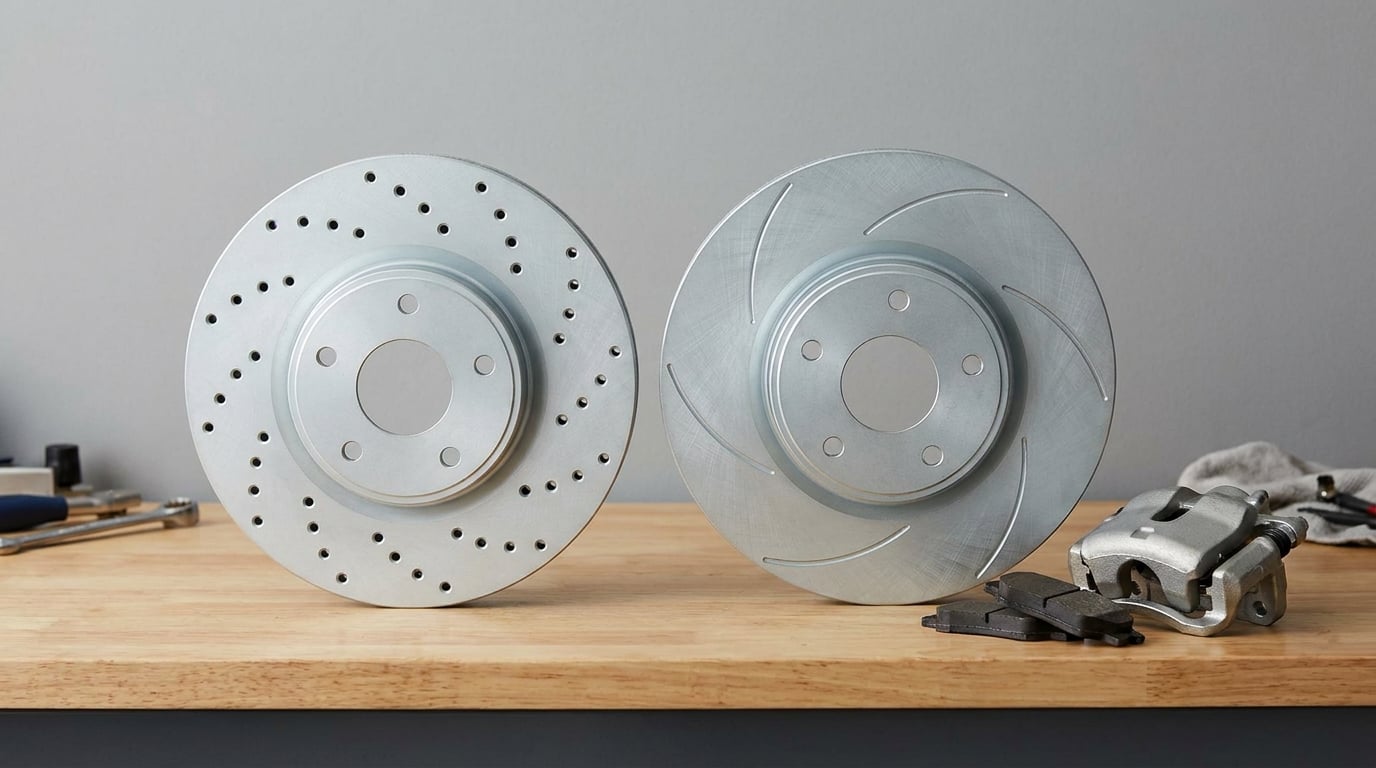
Drilled vs slotted rotors are both brake discs with a pattern machined into the friction face: drilled rotors get a grid of round holes, slotted rotors get curved grooves. Both patterns exist to vent gases and pad debris, and for most everyday drivers neither one is worth the extra money over a good plain rotor.
I have pulled rotors off enough cars to know where the argument actually lands. The face pattern is one small variable, and it sits well below rotor mass, pad compound, brake fluid and how clean your hub is when the wheel goes back on.
Updated for 2026, this guide compares the two on braking feel, heat, noise, pad wear, cracking and wet weather, then maps each design to the kind of driving that actually justifies it.
Table of Contents
- Drilled vs Slotted Rotors at a Glance
- What Are Drilled and Slotted Rotors?
- How Does Drilled vs Slotted Rotor Braking Feel?
- Drilled vs Slotted Rotors for Wet Weather
- Which Design Handles Heat Better?
- Do Drilled or Slotted Rotors Make More Noise?
- Drilled vs Slotted Rotors: Dust, Cracks, and Maintenance
- Which Should You Choose?
- Frequently Asked Questions
- Final Verdict
Drilled vs Slotted Rotors at a Glance
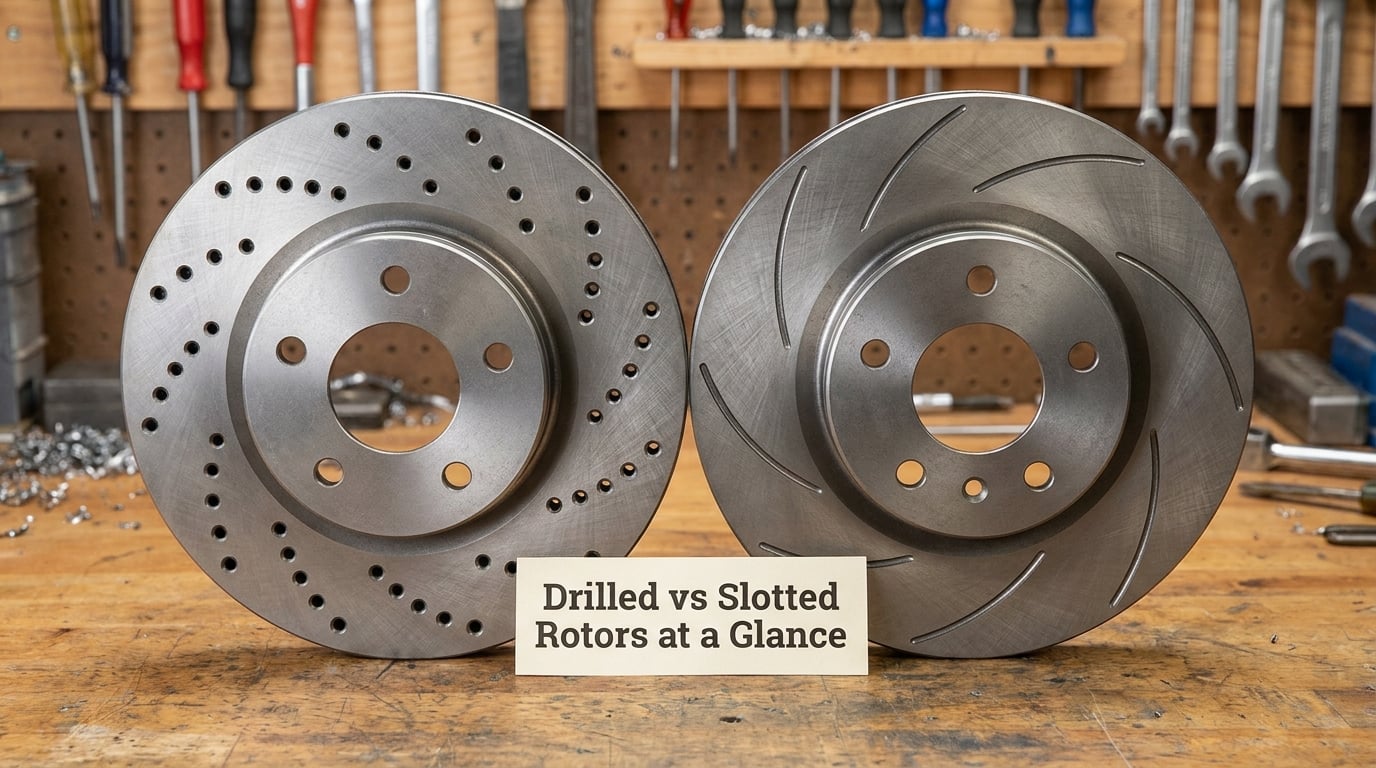
The short version: slotted rotors keep more mass and structurally sound structure, drilled rotors clear debris faster but create stress risers in the iron. Everything below expands on that.
| Criterion | Drilled rotors | Slotted rotors | Plain rotors |
|---|---|---|---|
| Wet weather grip | Good, holes sweep water and grit from the pad face | Good, slots wipe the pad face as the rotor turns | Fine once the pad is warm and rolling |
| Braking consistency | Very consistent while the iron is sound | Very consistent, with a self-cleaning face | Consistent, and the least to go wrong |
| Heat dissipation | Less braking surface and less mass to soak up heat | More mass retained than drilling removes | Highest surface area, best plain-road cooling |
| Brake dust | Normal, collects around hole edges | Normal, packs into slot ends | Normal, wipes off easiest |
| Noise at light braking | Can whoosh with factory pads | Can hum, often with a directional whoosh | Quietest with a matched pad |
| Crack risk | Higher, cracks start at hole edges | Lower, no machined stress risers | Lowest, unless badly heat-cycled |
| Pad wear | Faster, sharp hole edges abrade the pad | Faster, slot edges act like a rasp | Gentlest on friction material |
| Rust in salt and low use | Hides in the holes | Hides at slot ends | Single flat surface, easy to see |
| Relative cost | Highest of the three | Moderate | Lowest |
| Suited to | Repeated hard braking, competition use | Mountain roads, towing, mixed pad choices | Commuting, towing, OEM replacement |
Read the table as tendencies, not guarantees. A badly made rotor with a premium pattern will still fade and crack; a well-made plain rotor will not be rescued by drilling.
What Are Drilled and Slotted Rotors?
A rotor is a flat cast iron disc that clamps between the brake pads on both faces. The friction ring is the grey band the pads touch, and the pattern is machined only into that ring, never into the hat or the mounting face.
Drilled rotors have holes bored through the friction surface in a pattern, usually a grid or a ring of smaller holes around a larger centre hole. Slotted rotors have curved grooves cut into the face that sweep around as the disc turns. A rotor with both is drilled and slotted, and that combination gives you the strengths and the weaknesses of each.
These are face patterns, and it is easy to confuse them with construction terms. Plain rotors are blank cast surfaces. Vented or internally vented rotors have curved vanes between the two faces that pump air through the middle. One-piece and two-piece describes how the hat is joined to the friction ring, and if that split is new to you, our two piece rotors vs one piece rotors guide covers the trade-offs.
So when you read drilled vs slotted rotors, you are comparing a hole pattern against a groove pattern. Everything else about the rotor, its diameter, thickness, vane design, carbon content and coating, is a separate choice.
How Does Drilled vs Slotted Rotor Braking Feel?
On a cold morning, both patterns feel solid under normal pressure, and neither one will shorten your stop. Once the pads are hot, the pad’s friction material releases gases and binding resins that collect in a thin boundary layer between pad and rotor. That layer acts like a lubricant, and it is the main cause of brake fade.
Holes and slots give those gases and pad debris an exit, and slots have the extra trick of wiping debris off the pad face as the rotor turns. That is the honest mechanical case for both designs, and it is real but modest.
Pedal feel and initial bite
You will rarely feel the difference on the first stop. What changes is what happens on the fourth and fifth hard stop, when a slotted rotor has been clearing its own face and a drilled rotor has been shedding gas through its holes. On a cool, dry road with good tires, plain rotors deliver the same bite with nothing to go wrong.
What actually decides how your brakes feel
Pad compound, rotor mass, fluid boiling point, tire grip, vehicle weight and the temperature of everything. On a BMW, for example, the factory pad compound is tuned to a smooth, quiet, low-dust rotor face, and pairing it with an aggressive pattern rotor is a mismatch that shows up as noise and faster pad wear. Our regenerative braking explained for beginners guide covers why modern cars make so little of this energy go into the friction brakes at all.
Drilled vs Slotted Rotors for Wet Weather
Both patterns help in rain, and neither one is a substitute for decent tires. Drilled holes act like tiny pumps that fling water and grit away from the pad’s contact patch, while slots wipe the face clean each revolution. On a lightly loaded car in a shower, both leave the pads drier and cleaner than a plain rotor does.
Braking in standing water is decided by tire condition, water depth, speed and how much heat is in the brakes already. Cold brakes on a cold, soaked road have almost no thermal capacity to help them, and no face pattern changes that. Standing water is also where lockup and understeer live.
Neither drilled nor slotted rotors makes a wet road safe, and anyone who told you otherwise was selling something. If your car repeatedly shudders or pulls when braking in the rain, the cause is usually a warped or corroded rotor rather than a missing hole pattern.
Which Design Handles Heat Better?
Neither pattern is a heat upgrade on its own, and this is where most marketing goes sideways. Drilling removes iron, which means less surface area for the pads to touch and less metal mass to soak up heat before the temperature climbs. Slotted rotors keep more mass than drilled ones but still lose a strip of surface to the slots.
Thermal capacity comes from the mass of the friction ring, its vane design and how well air moves through it. A heavy, well-vaned plain rotor on a tow truck holds temperature better than a lightweight drilled rotor on the same vehicle. If heat is your real problem, look at how to clean new brake rotors before install and at cooling ducting and fluid choice before you look at patterns.
For repeated hard braking under track conditions, the drilling-versus-sloting trade gets clearer. Drilling does vent gases aggressively, and that genuinely helps sustained high-energy stops. The cost is a rotor that is more likely to crack, and on a track car that is a part you inspect after every session anyway.
The failure signs are the same for both patterns. Blueing is the giveaway that you cooked the pads and rotor, glazing is a glassy layer on the pad face that kills friction, and thermal cycling over months is what opens hairline cracks in the iron.
Do Drilled or Slotted Rotors Make More Noise?
Rotors with holes and slots are not inherently louder, and most brake noise has nothing to do with the face. Owners on Bimmerforum describe pattern rotors as noisy on cars whose factory calipers and pads were designed around a plain surface, which tells you the noise is a pairing problem more than a pattern problem.
The usual culprits sit elsewhere. Pad compound is first on the list, a soft everyday pad will squeal where a performance pad stays quiet. Rotor runout from a dirty or corroded hub, uneven pad wear, and dried or ungreased caliper slides all produce hum, groan and shim chatter. Builders on the Grassroots Motorsports forum keep pointing at caliper slide lubrication as the real fix for most complaints, and they are usually right.
On light to medium braking, a curved or directional slot can add a faint whoosh as it passes the pad. That is geometry, not damage, and it disappears when you back off to firm pressure.
Drilled vs Slotted Rotors: Dust, Cracks, and Maintenance
Brake dust comes off the pad material whether the rotor has a pattern or not. What changes is where it collects. Holes and slot ends create pockets that a wiper blade does not reach, so road salt and moisture sit in them and the first sign of life is brown speckling around the pattern instead of an even film over the face. That matters most for low-mileage drivers and EVs, where the pads barely touch the rotor and everything else rusts.
Why drilled rotors crack
Each hole is a machined edge in brittle cast iron, and under repeated thermal cycling it behaves like a stress riser. Cracks start at those hole edges. On the Dieselplace forum, owners put it more bluntly and describe rotors that crack period, with surface cracks that hopefully never open up. On the Corvette forum, the same pattern shows up as cracks already forming around the holes before a car has finished a season.
The rule most experienced track owners use, from the CarTrackDays forum, is that a rotor is finished when the cracks open and extend to the outer edge. Fine radial hairlines that do not reach the edge are usually surface checking, common on any rotor that has been hot. Replace anything that has propagated, and never go out on a rotor you are relying on to stop at the end of a session.
How drilled vs slotted rotors wear your pads
Sharp hole and slot edges abrade the pad face like a cheese grater, so pad wear goes up on both patterns compared with a plain rotor. Slotted rotors with directional slots also need to face the correct direction, meaning the curve of the groove has to sweep the same way on each side of the vehicle, usually marked with an arrow. Mounting one backwards undoes the wiping action it is designed for.
Any new rotor needs a bedding procedure. Several firm stops from moderate speed to build an even transfer layer, then a cool-down period, and no dragging the brake to a stop on the new pads. If the hardware resists machining, plan for it early, because pattern rotors are harder to service later than plain ones.
Which Should You Choose?
Match the rotor to the driving, not to the packaging. For most people, the honest answer is a good quality plain coated rotor at factory dimensions, which is cheaper, quieter, gentler on pads and has no pockets to trap salt.
- Daily commuting and OEM replacement: a quality plain coated rotor. You get the quietest, most pad-friendly surface and the easiest future service.
- Mountain roads, canyon driving and towing: slotted rotors make sense, mostly because they shed debris and keep the face clean, and they are structurally sounder than drilled. Pair them with a pad compound approved for slotted rotors.
- Track days and autocross: drilled or drilled and slotted, with cracked-in monitoring as a routine item. Nothing else on a street car gives you the gas evacuation under repeated hard stops.
- Repeated heat-related shaking: a pattern rotor is the wrong fix. Clean the hub, verify runout, check thickness variation and fluid before spending money on holes.
For BMW owners, read the tire marking on the sidewall for an M Compound or M Sport code. That tells you the factory system expects a quiet, low-dust pad on a plain rotor, which is the setup to keep unless your driving genuinely demands more thermal margin. When you do replace, measure the installed rotor thickness including the minimum service limit, check hat height and center bore against the manual, and follow the bedding procedure before normal driving.
Frequently Asked Questions
Are drilled or slotted rotors better in the rain?
Both help in rain, and by different routes. Drilled holes push water and grit away from the pad contact patch, while slots wipe debris off the pad face as the rotor turns. Neither pattern changes how your tires grip standing water, so tire condition, speed and brake temperature still decide the outcome. Neither one makes a wet road safe to drive faster on.
Do drilled rotors make brakes worse when cold?
No, not in any meaningful way. On a cold first stop, a plain, drilled or slotted rotor all feel the same because the pads have not heated up enough to out-gas. If a car brakes worse cold, suspect a contaminated pad face, a sticking caliper or a wheel bearing instead of the hole pattern.
Can I use slotted rotors with factory BMW brake pads?
They fit and they work, but factory BMW pads are chosen for quiet, low-dust braking on a plain rotor face. Slot edges abrade the pad, so expect a shorter pad life and some light humming at medium pressure. If the tire sidewall shows an M code, match the pads to that system or pick a slotted rotor made and approved for that compound.
Why are my drilled or slotted rotors cracking?
Heat is the usual reason. Every drilled hole is a machined edge in brittle cast iron, so repeated thermal cycling starts hairline cracks there, and cracks that reach the outer edge mean the rotor is finished. Slots cut much less material and create fewer stress risers, which is why slotted rotors generally crack less than drilled ones.
Can I mix drilled and slotted rotors on the same car?
It is mechanically fine, plenty of cars run a plain rotor on one axle and a pattern rotor on the other. Balance matters more than matching, so match the diameters, thickness, vane layout and thermal capacity across the axle and keep the pattern consistent. For a daily driver, mixing is one more reason to keep all four plain.
Are drilled and slotted rotors interchangeable?
Not as a rule. The correct rotor is the one built to your axle, meaning the diameter, thickness, center bore, hat height, offset and caliper type all have to match, and the two sides of a two-piece rotor are sometimes different part numbers. A slotted and a drilled version of the same base rotor are often interchangeable within one brand line, but verify the part number against your year, model and brake package.
Final Verdict
For most drivers, drilled vs slotted rotors is a question that barely matters, and a good quality plain coated rotor is the better buy. Slotted rotors earn their place on mountain roads, in tow work and on cars running mixed pad choices, because they clear debris and stay structurally sounder. Drilled rotors belong on cars doing repeated hard braking, where gas evacuation is worth the crack risk you have to inspect for.
Start with the fitment and the driving, not the pattern. Match the rotor to your axle specs, pad compound and the load the car actually carries, then check installed thickness against the minimum service limit and complete the bedding procedure before driving normally. If the pedal shakes on a descent, clean the hub and check runout before you go shopping for holes.