
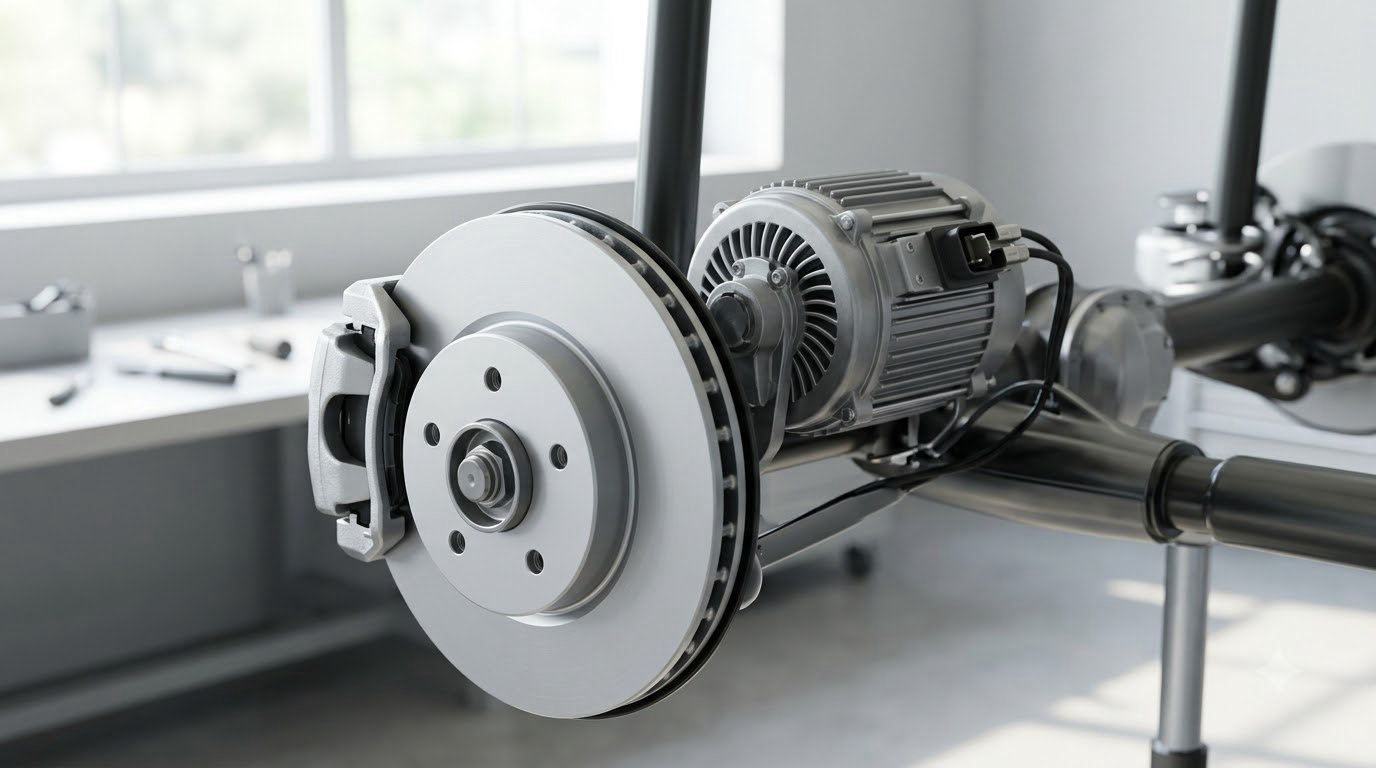
Hybrid brakes last longer because regenerative braking handles most of the slowing down. The electric motor runs backward as a generator, sending energy back to the battery instead of turning it into heat through the pads and rotors. Your friction brakes only step in when regen cannot do the job alone.
That is the short version, and it is why so many owners reach high mileage before their first brake pad change. It is also the whole reason, which is worth saying plainly: there is no hidden trick in the pads, no special coating, no maintenance schedule that fakes it. The motor does the braking, and the friction brakes are there for the last 20 percent of the stop.
Lifespan still varies a lot by driving style, vehicle, battery state, and climate, so I will get into the caveats below. First, the mechanism.
Table of Contents
- Why Hybrid Brakes Last Longer Than Conventional Brakes
- How Regenerative Braking Reduces Brake Wear
- What Happens When the Battery Is Full or Cold?
- How Friction Brakes Still Work in a Hybrid
- Why Hybrid Brake Components Can Still Wear or Corrode
- How to Make Hybrid Brakes Last Longer
- Frequently Asked Questions
- How long do hybrid brakes usually last?
- Do hybrid brake pads need to be replaced if regen braking works?
- Why do my hybrid brakes make a grinding or squealing noise?
- Does regenerative braking eliminate the need for brake fluid service?
- Can a hybrid brake rotor get stuck or rust if the car is driven slowly?
- Are all hybrids the same, or do some wear conventional brakes faster?
- Bottom Line
Why Hybrid Brakes Last Longer Than Conventional Brakes
On a conventional car, slowing down means squeezing a friction material against a spinning disc until the motion turns into heat. That heat is thrown out through the vents and lost. The pads wear down, the rotor surface gets scored, brake dust ends up on your wheels, and the whole system cycles through heat over and over.
A hybrid adds a second braking path ahead of that one. The traction motor becomes a generator, the recovered current goes into the high-voltage battery, and the friction brakes carry a much smaller share of the deceleration. Less friction material consumed, less heat cycling, and pads and rotors that routinely go far past the 20,000 to 75,000 mile range typical of a gas car.
How much longer, in miles?
Real owner reports, not marketing copy, run from about 60,000 miles to well past 150,000. A 2016 RAV4 Hybrid owner on r/Rav4 reported 90,000 miles with pads that may never have been replaced, last changed around 30,000. A RAV4world poster has put 295,000 miles on a hybrid and says the brakes lasted a long time by braking conservatively and leaning on regen.
Those are the extremes, though. Salt-belt driving, towing, and lots of highway braking pull the average down, and a full EV that never touches its friction brakes except for emergencies sits at the other end. The table below is a reasonable spread, not a promise.
| Powertrain | Typical front pad life | Typical rotor life | Energy recovered on a typical stop |
|---|---|---|---|
| Conventional gas car | 25,000 to 60,000 miles | Often replaced with pads | None |
| Full hybrid | 100,000 miles and up | 100,000 miles and up | A portion of each stop, commonly cited up to about 70 percent |
| Plug-in hybrid | Ranges widely, charging habits matter | Ranges widely | Varies by how often it runs on the battery |
| Full battery EV | Often 150,000 miles or more | Rarely replaced | Highest recovery of the group, with some offering one-pedal deceleration |
One thing that figure of up to 70 percent usually means: the share of a stop’s kinetic energy the system can capture under favorable conditions. It is not an average across every drive, and it does not apply to the final moments of every stop.
How Regenerative Braking Reduces Brake Wear
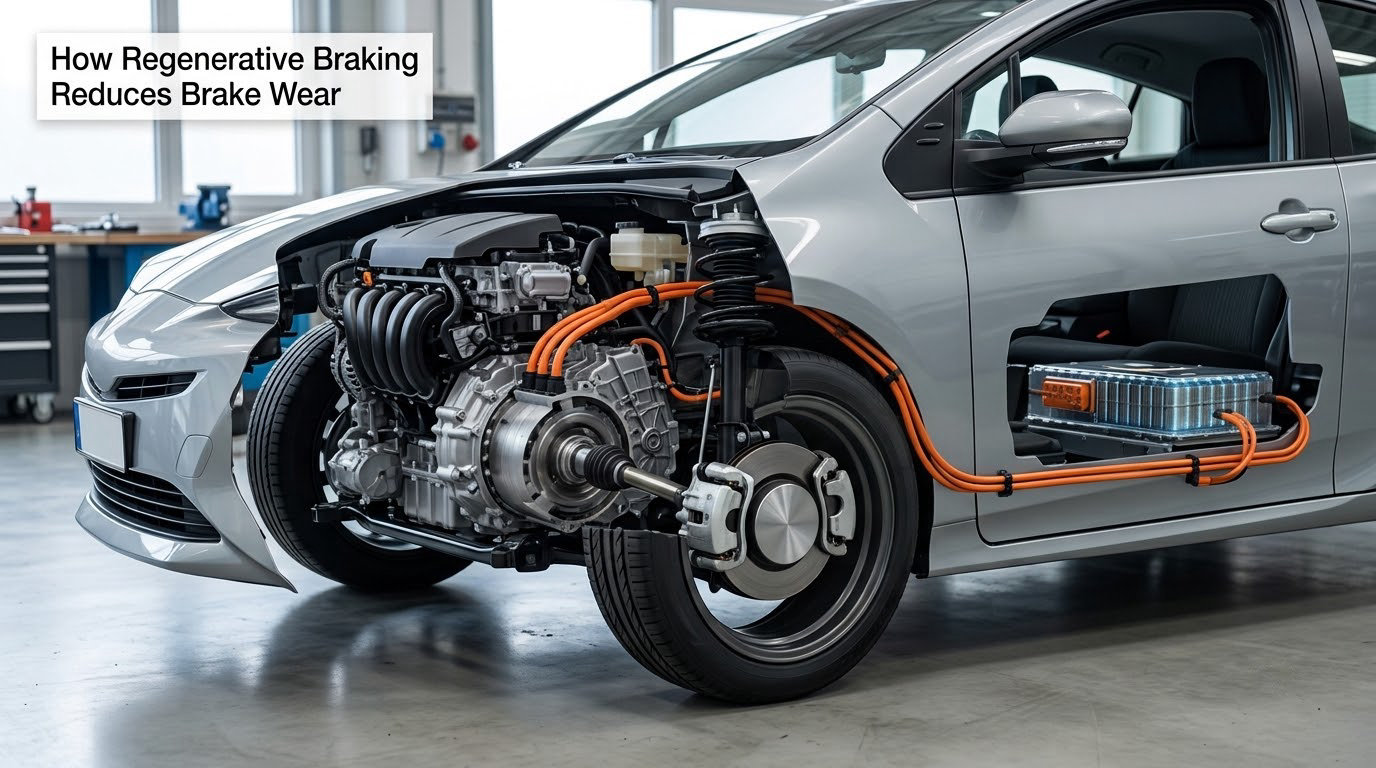
Regenerative braking is an energy recovery system. Instead of discarding the momentum, it converts it. The motor spins backward, the magnetic fields create drag, and that drag becomes current. The wiring routes it to the battery, and the car slows while its charge state rises.
The regen sequence, step by step
Here is the chain of events most drivers have already felt without naming it.
- You lift off the accelerator. The controller stops requesting torque from the motor and the motor winds down in a controlled way.
- The motor spins up as a generator. Turning the same shaft that drove the car now pushes current instead, and the magnetic drag resists the wheels turning forward.
- Energy routes to the battery. Recovered current charges the traction pack, which is why a hybrid often gains a little charge on a downhill stretch.
- Regen strength is trimmed by the brake pedal. A light press asks for more motor drag and almost no friction braking. A harder press asks for more of both, and the pedal feel is a blend the driver never controls directly.
- At low speed the motor cannot take more, so the friction brakes blend in. This is the point where the pads finally touch the rotors, and it is the only part of the stop that wears them.
- Heat management takes over. If the friction brakes are asked for too much too fast, or the regen is already maxed, the pedal goes firm and the pedal pulsation that hybrids are known for appears.
What blended braking means
Blended braking is simply steps four and five happening together. The car is dividing the same deceleration between the motor and the friction brakes, in a ratio set by speed, pedal travel, temperature, and battery charge.
The wear saving comes from that ratio. Every mile of gentle city stop-and-go shifts a share of the braking work away from the friction material, and the friction material is the thing that actually wears out. Less friction braking also means less brake dust, since dust is just pad material that has worn away and stuck to your wheels.
What Happens When the Battery Is Full or Cold?
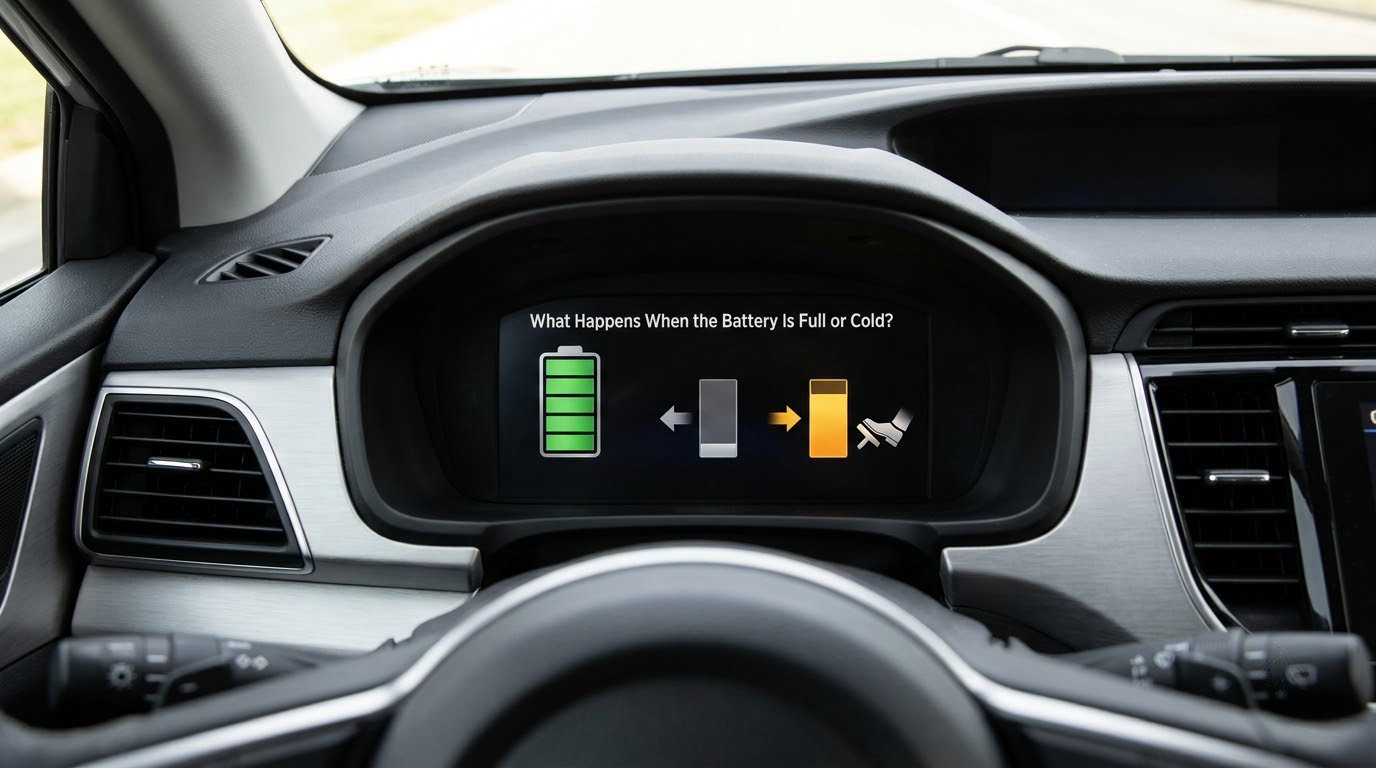
Regenerative braking weakens when the traction battery is full, very cold, or limited, because the battery has less room or less willingness to accept charge. A full pack cannot take the current the motor is trying to send, so the controller cuts regen and the friction brakes pick up the slack.
That is not a fault and it does not mean regen has switched off. It scales back. On a long downhill after a full charge, you will feel the pedal get firmer as the car leans harder on the friction brakes, and on a cold morning the first few minutes are the same story in reverse.
Cold packs are usually limited on two counts at once. They accept charge poorly, and the engine may be running more often to make heat, which means more time in a mode where regen is restricted. Owners in northern winters often see noticeably shorter pad life than the same model in a mild climate, and the same car can wear differently in August than in January.
A third limit is deliberate. Some drivers notice the car pulls the most regen at moderate speed and then steps it back near walking pace, because the motor is at its most efficient as a generator in a narrower band. That is the same low-speed handoff you feel in every hybrid, and it is where pad wear happens.
How Friction Brakes Still Work in a Hybrid
Hybrids still ship with the full hydraulic friction system: pads, calipers, rotors, brake fluid, and a parking brake. A hybrid with no friction brakes is not something you can buy, and no manufacturer builds one. What changes is how little of the job those parts are asked to do.
They take over in a handful of situations. The last part of every stop below the handoff speed. Hard braking and emergency stops, where you need deceleration the motor alone cannot deliver. A full, cold, or overheating battery. Towing, where the load and the grade can exceed what regen can absorb. And the very first stop after the car has been sitting, before the brake system has warmed.
Rear brakes deserve their own mention, because owners get confused about which axle goes first. On many hybrids the front axle does the majority of regen work and the rears handle more of the low-speed friction braking than they would on a comparable gas car, so a rear pad set can reach the end of its life sooner than the front. ClubLexus members point out that rear life on a hybrid depends heavily on whether the caliper slide pins have been cleaned and greased so the caliper retracts properly.
Why the pedal feels different on the first stop
The most common complaint is pedal feel, not wear. A hybrid’s first stop often feels softer or less responsive than a gas car’s because the pedal is asking the motor for deceleration that is capped by speed and battery state. A 2025 ToyotaNation thread about a new Camry Hybrid braking worse than a 2014 Camry LE ran on exactly this: responders explained that the car stays in regen until low speed, then hands over to the hydraulic brakes unless you brake hard.
It is a real change, and it catches people out. It is also not a wear problem, and a shop cannot grind it away with new pads.
Why Hybrid Brake Components Can Still Wear or Corrode
Low use is its own kind of damage. The rotor surface on a normal car gets wiped clean by pad contact several times a day. On a hybrid that rarely happens, so overnight moisture and road salt sit on the disc until the next time the pads happen to sweep it. r/KiaNiro users describe the moment clearly: a 2017 Niro at 78,000 miles with a shop reporting heavily rusted pads at 50 percent capacity, while the owner and a passenger both said the braking felt exactly the same as at 56,000 miles.
That gap between the inspection sheet and the driving experience is where the anxiety comes from. Young owners get quoted a full brake job for what is often cosmetic surface corrosion, and they have no way to check.
There is a real counter-example too. Tesla Online owners of a Model 3 reported needing more brake maintenance than a Camry, with corrosion the suspected cause after about 11 months. Long brake life is a tendency, not a guarantee.
Surface rust or real damage?
| What you see | Usual cause | Can you keep driving? | What to do |
|---|---|---|---|
| Even brown or orange film on the rotor edge and face | Moisture sitting on a rotor the pads rarely touch | Yes, in most cases | Ask the shop to check pad thickness, then take a short drive and see if the surface cleans up |
| One or two deep grooves worn into the disc face | Real pad wear, or a scored rotor from a past brake job | Yes, but it is a replacement item | Measure rotor thickness against the minimum spec; a rotor below minimum cannot be resurfaced |
| Rust ring around the outer edge, center face clean | Pads rarely reach the swept band at the edge | Yes | Usually cosmetic on a hybrid, worth mentioning at the service visit |
| Squeal, grinding, or a pulsing pedal through firm pressure | Glazing, worn hardware, or a warped rotor | Get it checked promptly | Book an inspection, and stop riding the brakes if the pedal feels vague |
| Visible pad material at or near the limit, or a grinding noise | Actual wear through, often on an axle people forget | Arrange the replacement | Replace pads, and inspect rotors at the same time |
The self-check takes two minutes. With the car off and on level ground, look through the wheel spokes at the rotor edge and find the caliper. Many people can see the pad backing plate and judge roughly how much material is left; the caliper slide pins and the rotor lip are visible too. What you cannot judge is thickness below spec, so a measurement is the part only a shop should do.
Other things shorten hybrid brake life without anything being wrong with the system. Short trips where the pads barely settle into the rotor. Long highway stretches with light braking, which leaves surface moisture on the disc. Repeated hard stops, which cook the friction material. Salt-heavy winters, which attack the caliper hardware and the rotor edge. And storage: a car that sits for months in a humid spot will show surface rust the first time it is used.
How to Make Hybrid Brakes Last Longer
Most of what you can do is habit, and the habits are small. Use the modes the car gives you, keep the friction system moving, and keep the fluid honest.
Driving habits that squeeze out more regen
Look for the stronger regen settings on your specific model. Toyota hybrids use B and L positions on the shifter, and many other hybrids use paddles or a one-pedal drive mode. Selecting stronger regen means the motor does more of the stopping and the pads do less, and it is the single biggest lever you have.
Anticipate the stop. Lifting off the accelerator well before the light is fully regen braking; stabbing the brake at the last moment is a friction request. Learn where the pedal transitions from regen to hydraulic on your own car, because the handoff point moves with speed, temperature, and charge.
Drive the car regularly and take it out of the city. A vehicle that only ever sees three-mile errands never gets the pads and discs working together, and a car that does a long highway run on a cold morning dries the rotor surface in a way short trips never will.
Use the friction brakes occasionally on purpose where it is safe and legal. A longer, slower deceleration on a lightly trafficked road at a steady moderate pressure is enough to keep the pads and the swept band clean, and it keeps the calipers retracting normally.
Do not trail the brake pedal at a stop light for long stretches. Light, constant pedal pressure keeps the caliper partially clamped, which holds a thin pad against a warm rotor and produces the exact wear and heat you are trying to avoid.
What still needs servicing on a hybrid
Long-lived friction parts do not mean the rest of the system is maintenance free.
- Brake fluid. It is hygroscopic, so it absorbs moisture over time whether or not you drive much. Most manufacturers call for a change around 30,000 miles, and it matters more on a hybrid because fluid condition is part of what makes pedal feel consistent.
- Caliper slide pins. Cleaned and greased at service visits so the caliper retracts fully. A sticky caliper drags a pad, and dragging wears pads fast on any car.
- Rotor surface condition. Not the friction material, but the swept band. On low-mileage friction brakes it can collect surface rust faster than it gets wiped.
- Parking brake. Rarely used on a car that stops so often through regen, and therefore easy to forget.
- The annual brake inspection. The reason a shop can catch a low pad or a scored rotor before either becomes a problem.
Follow the maintenance schedule in your owner’s manual rather than a generic interval from a forum post. Models differ, and the fluid interval is one of the items most likely to vary between manufacturers.
Frequently Asked Questions
How long do hybrid brakes usually last?
Typically much longer than a conventional car. Owners commonly report 100,000 miles or more before a first pad replacement, and gas cars on the same roads usually need pads between 25,000 and 60,000 miles. Driving style and climate pull that number around a lot, so treat the high figures as what is possible rather than what is guaranteed.
Do hybrid brake pads need to be replaced if regen braking works?
Regen reduces how much work the friction brakes do; it does not remove them. The pads still wear from low-speed stops, hard braking and any time the battery is too full, cold or hot to take charge, and the fluid and caliper hardware still need service on a schedule. An annual inspection is the right habit.
Why do my hybrid brakes make a grinding or squealing noise?
Surface rust on a rarely used rotor is the most common culprit and it usually clears after a few firm stops. Squeal that persists usually means glazing or a sticky caliper, and grinding means pad material is low. If the noise comes with a pulsing pedal under firm pressure, have the rotor thickness measured rather than guessing.
Does regenerative braking eliminate the need for brake fluid service?
No. Brake fluid absorbs moisture over time regardless of how the car is driven, and most manufacturers schedule a change around 30,000 miles. On a hybrid it arguably matters more, since inconsistent pedal feel is a common complaint and fluid condition is part of what keeps that feel predictable.
Can a hybrid brake rotor get stuck or rust if the car is driven slowly?
Rotor rust is normal on a hybrid precisely because the pads rarely touch the disc. A car used only for short, slow trips will show surface corrosion sooner than one driven regularly, and a car that sits for months in humid air will too. The film usually wipes off with a few moderate stops. Deep grooves, or rust on the caliper hardware, are a different problem and need a technician.
Are all hybrids the same, or do some wear conventional brakes faster?
The principle is the same everywhere, but the results are not. A plug-in hybrid that spends most of its time on the battery behaves closer to a full EV, while one driven constantly in cold weather leans on the engine and the friction brakes more. Full hybrids with stronger regen modes, and one-pedal capable EVs, extract the most benefit from the system.
Bottom Line
Regenerative braking puts an electric generator ahead of your friction brakes, so the pads and rotors do a fraction of the work and last a fraction of the wear. The trade is that a lightly used rotor collects surface rust, and the pedal feels different on the first stop than it does in a gas car.
Keep braking normally, follow the fluid and inspection intervals in your owner’s manual, and use the stronger regen modes the car already gives you. If a shop tells you your hybrid brakes are badly rusted, ask for the measured pad thickness and rotor thickness in writing, then compare it against the minimum spec before agreeing to the work.