
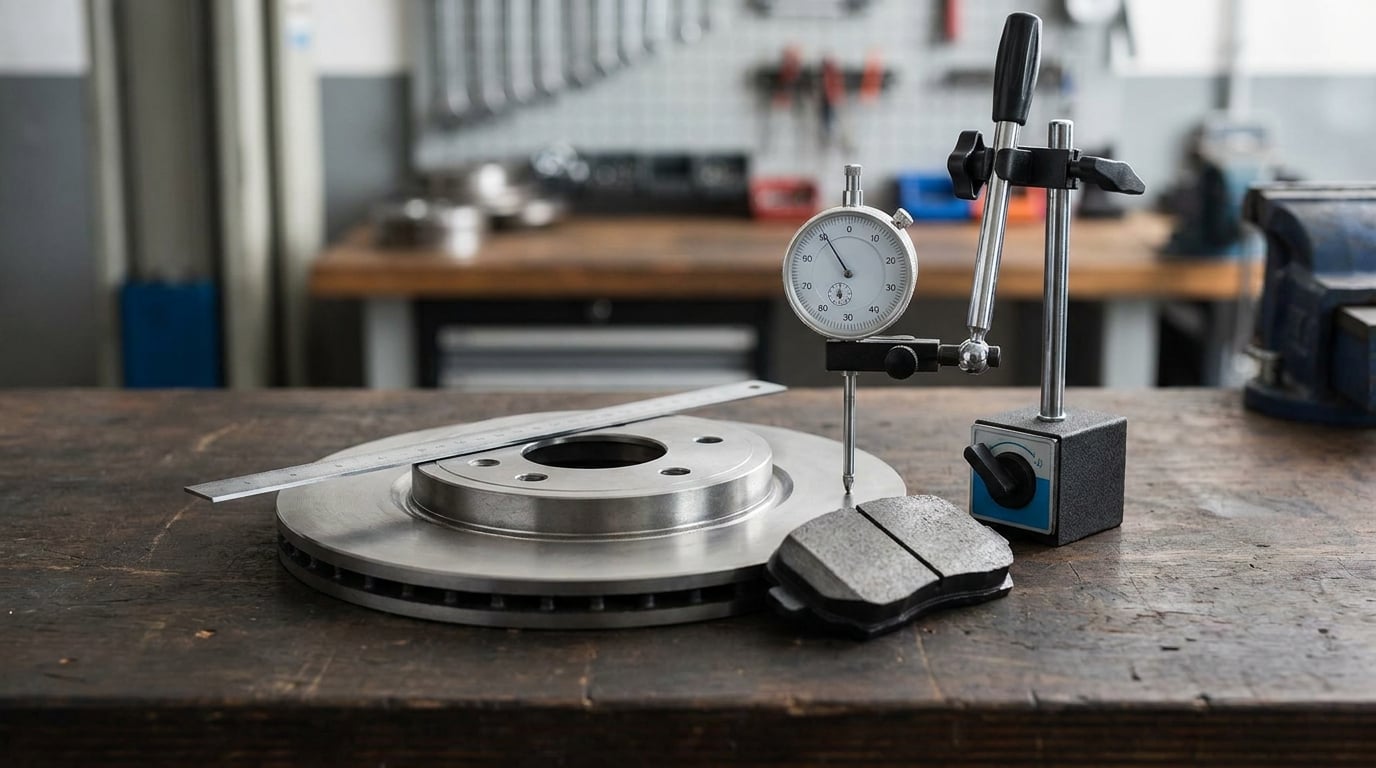
Warped brake rotors symptoms and causes come down to one thing: a disc that is no longer perfectly flat, so the pads grab and release as the wheel turns and the car shakes under braking. The usual clues are a shudder in the steering wheel, a pulse through the brake pedal, and vibration through the seat that appears only when you slow down.
If the shake is there at highway cruise and vanishes when you brake, your rotors are probably innocent. If it arrives the moment you touch the pads, this guide will help you sort the real cause from the usual suspects: pad deposits, a dragging caliper, a bad wheel bearing, or a rotor that was never seated properly.
I have pulled enough warped discs off daily drivers to know that most owners arrive with the same question and the same missing piece of information, which is how much variation is actually too much. Below is the diagnostic sequence I use, plus the fix and prevention logic that keeps a set of rotors from going out of shape again. Last reviewed for 2026.
Table of Contents
- What Are Warped Brake Rotors?
- What Are the Symptoms of Warped Brake Rotors?
- What Causes Brake Rotor Warping?
- How Can You Tell If a Rotor Is Warped?
- Can You Fix a Warped Brake Rotor?
- How to Prevent Warped Brake Rotors
- When to Replace All Four Brake Rotors?
- Frequently Asked Questions
- Can warped brake rotors be repaired instead of replaced?
- Is it safe to drive with warped brake rotors?
- Why does my steering wheel shake only when I brake?
- Do I need to replace brake pads when I replace warped rotors?
- How thick can a brake rotor get before it must be replaced?
- Why are my BMW brake rotors vibrating after they were replaced?
- What to Do First
What Are Warped Brake Rotors?
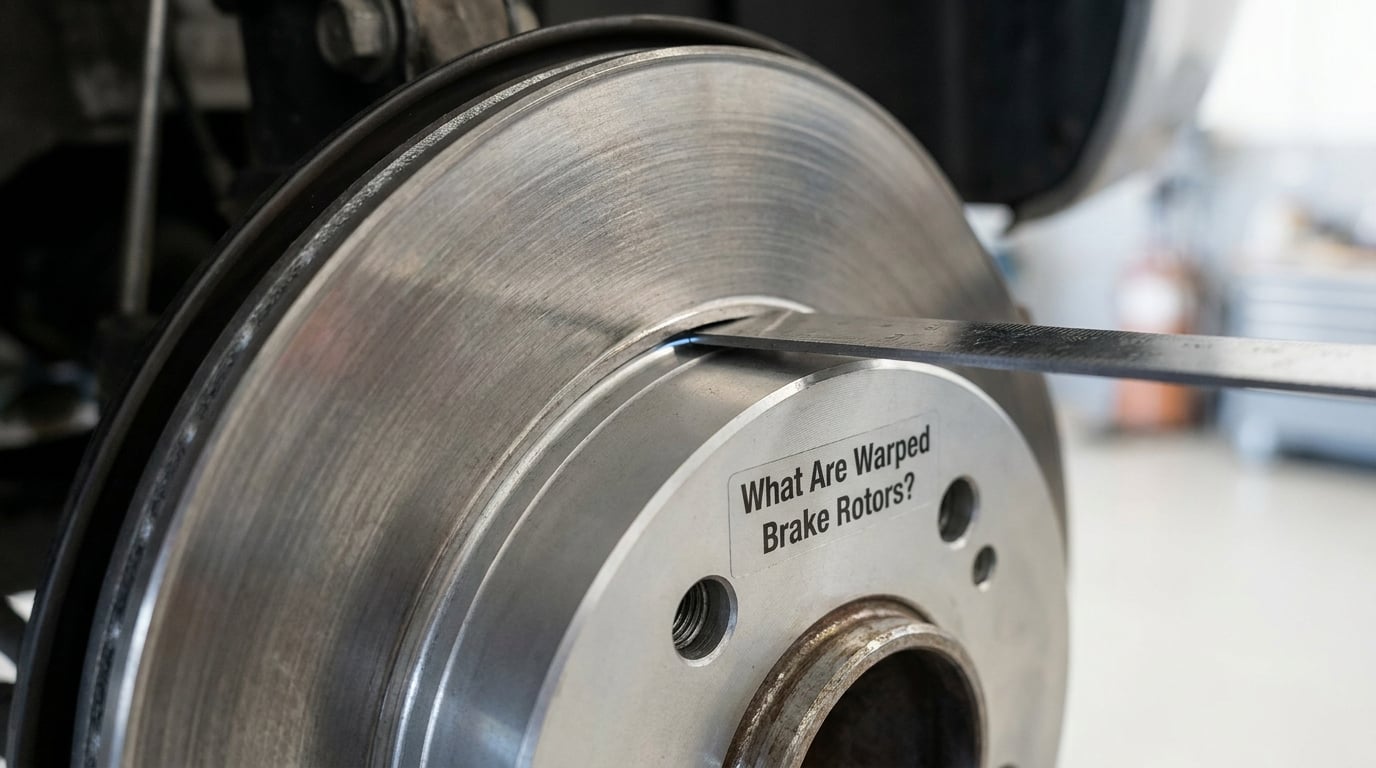
A warped brake rotor is one that has lost its flat surface, not one that is bent out of shape. The disc is a piece of cast iron or steel that must spin dead flat so the pads clamp evenly across the whole face.
Braking turns motion into heat, and heat that is not spread evenly leaves the metal with alternating high and low spots. The pads ride up onto a high spot, get pushed away on the low spot, and repeat several times per revolution. That repeated push and release is what you feel.
Three related conditions get lumped in with warping but need different fixes:
- Thickness variation is the real defect, and the word you will hear in a shop. It is the difference between the thickest and thinnest point on the rotor face.
- Lateral runout is how far the face wobbles side to side when measured. A slight amount is normal; more than a few hundredths of a millimeter is enough to feel.
- Heat cracks, deep scoring, and heavy surface rust are wear conditions, not warpage, and machining may not rescue a disc with any of them.
Worth knowing before you buy anything: a rotor that is contaminated with oil, coolant, or a heavy layer of grease will not brake properly no matter how flat it is, and that is a seal or leak problem rather than a disc problem.
What Are the Symptoms of Warped Brake Rotors?
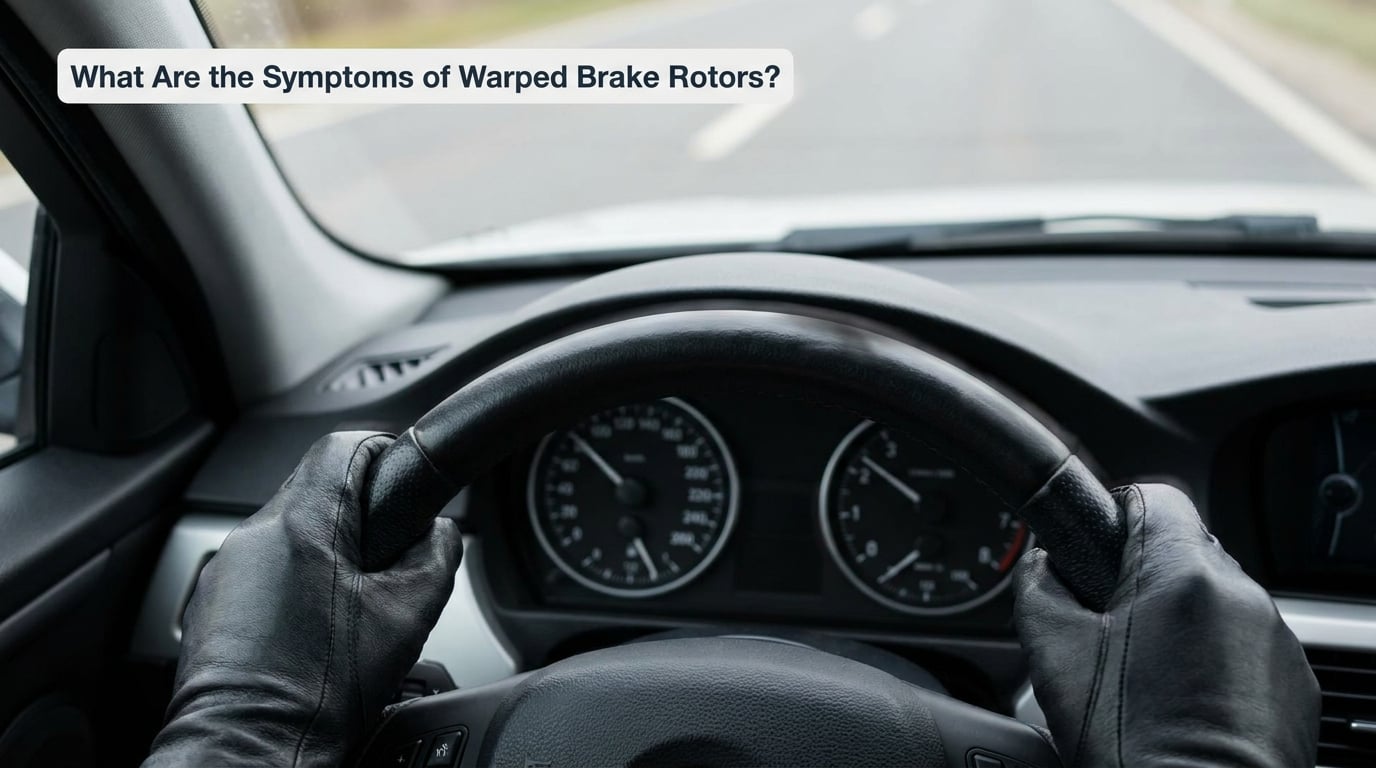
The signature symptom is a shake that only shows up when the brakes are applied, and it gets stronger the harder or faster you slow down. Here is what are the symptoms of warped brake rotors, roughly in the order drivers notice them.
- Shudder in the steering wheel under braking. Most felt between 35 and 55 mph during a moderate stop from highway speed. Below walking pace it usually disappears, which is normal.
- Pulsation through the brake pedal. A rhythmic push-back that comes up every time the pedal is held at a steady pressure. The pedal may feel like it is bouncing rather than firm.
- Vibration through the seat or floor. Rear rotors do not reach the steering wheel through the rack, so a rear warp usually shows up in the body instead. Front rotors hit both.
- Shake that changes with pedal pressure. Light pressure can feel smooth while a firmer squeeze feels worse, because more clamping force means more pad deflection over each high spot.
- Judder at low speed, near walking pace. Slow, repetitive shuddering as you come to a stop. If the discs have worn past the point where the pads still cover them, this can also be a pad-to-rotor contact problem.
- A blue or heat-blued rotor face. A faint blue-grey tint on the braking surface means the disc has been running hotter than it should, often from towing, hill descents, or a long stop-and-go commute.
- Grinding or squealing that changes with braking. Grinding under load can mean the pad material has transferred onto the rotor. Squealing that shows up on light stops and quietens under pressure often points to brake pad glazing rather than a bent disc.
- Longer stopping distances than you are used to. A modest loss, not a dramatic one. If the pedal feels vague or the car takes noticeably more pressure to stop, that is worth a shop visit rather than another month of driving.
Two things that feel like brake problems but are not: a hum or whine that rises with speed usually means a wheel bearing, and a vibration present at cruise that stops when you brake usually means a tire or wheel balance issue.
Where you feel it, and what it usually means
| Symptom | Most likely cause | Where you feel it | How urgent |
|---|---|---|---|
| Shudder in the steering wheel only when braking | Front rotor thickness variation | Steering wheel, hands | Book a check within days |
| Pulse in the brake pedal at steady pressure | Rotor thickness variation, either axle | Foot on the pedal | Book a check within days |
| Vibration through the seat with no pedal pulse | Rear rotor variation or wheel imbalance | Seat, floor, headrest | Book a check within days |
| Judder near walking pace, discs near pad wear limit | Pad contact patch transfer | Pedal and steering wheel | Plan pads and rotors together |
| Grinding under braking, no shake | Pad transfer deposits or glazed pads | Audible, front or rear | Prompt, but driveable |
| Pull to one side when braking | Caliper drag, seized guide pins, or a sticking slide pin | Car tracks to one side | Do not drive hard until checked |
| Heat-blued face, smell of hot metal after a stop | Overheating, dragging brake, wrong pad compound | Smell and smoke at the wheel | Stop and inspect soon |
| Whine or hum rising with road speed, no brake input | Wheel bearing | Ears, sometimes the wheel | Watch closely, replace soon |
What Causes Brake Rotor Warping?
Heat is the root cause behind most warping, but heat alone is rarely the whole story. Something has to break the even cooling pattern, and that is usually a second fault.
- Repeated hard braking. Every firm stop dumps energy into the disc. Over thousands of stops, uneven expansion and contraction leaves the face slightly out of parallel with the hub.
- Thermal shock. Stopping at highway speed and driving straight through a puddle or rain shower quenches a disc that is several hundred degrees. The sudden, uneven cooling is what permanently changes the shape.
- Stop-and-go city traffic. Low-speed driving never gets the disc hot enough to shed its own stress, so small distortions accumulate instead of cycling away.
- Towing, hill descents, and heavy loads. A trailer or a mountain road holds the brakes applied far longer than normal. Sustained heat without a cool-down period is the fastest route to a set of warped discs.
- Worn brake pads. Fresh pads have more material to absorb heat. Once they are near the end of their life, less of that heat goes into the pad and more into the disc.
- A caliper that drags. A seized slide pin, corroded guide, or a sticking caliper keeps one pad lightly clamped all the time. That constant light rub creates a hot spot on one side of the disc only. On BMWs and other cars with sliding calipers, it is worth checking the calipers for leaks at the same time.
- Road salt and coastal air. Corrosion pits the surface and, on a car that sits outside, rust builds on the pad contact area overnight. The first firm stop of the morning then peels the rust off and grabs the pads.
- Over-torqued or unevenly torqued lug nuts. This one gets blamed for more shakes than heat does, and it is worth taking seriously. Over-tightening clamps the rotor hat, deforms it slightly, and leaves the disc sitting off-parallel on the spindle. The disc itself never bent; it is just mounted crooked. Technicians on enthusiast forums call this out constantly because it is invisible unless someone measures it.
- Hub runout or a rotor not fully seated. A hub that is not running true, or a rotor that was installed cocked on the studs, produces a wobble that shows up the moment you touch the brakes.
- Road impact and potholes. A hard hit can bend a hub or crack a hat, which tilts the disc and shows up as pulsation under braking.
How Can You Tell If a Rotor Is Warped?
Work through it in order. The first two steps cost nothing and rule out most of what you might be imagining.
Checks you can do in your driveway
- Reproduce the shake on a quiet road. Accelerate to around 45 mph, apply the brake firmly and steadily, and note whether the wheel or the pedal is where you feel it. A vibration that never appears under braking is not a rotor.
- Look at the disc face. With the wheel off, look for a blue tint, a rust ring, a lip at the outer edge, cracks radiating from the surface, and grooves deeper than the pad material can absorb.
- Spin the wheel by hand and watch the face. A warped disc does not spin flat. Watch a fixed reference point such as a valve stem and see whether the rotor face rocks toward and away from it as the wheel turns.
- Compare one side with the other. Park the car, then look at all four wheels. One wheel covered in brake dust while its twin is clean points at a dragging caliper on the dustier side.
- Check the tire tread. A car that pulls to one side under braking, or feathering across the road, is more likely telling you about a caliper or a wheel alignment than about a disc.
The measurements a brake shop takes
A dial indicator and a micrometer settle the argument, and they are the only way to get a real number instead of an opinion.
- Thickness variation (DTV) is the thickest point minus the thinnest point on the friction face. As a rough guide, anything above about 0.05 to 0.08 mm is where most drivers start feeling it, and more than that is a solid reason to machine or replace.
- Lateral runout is measured with a dial indicator pressed against the face while the wheel is turned. The same few hundredths of a millimeter is the practical limit.
- Total thickness is checked against the minimum rotor thickness specification stamped on the hat or listed in the service information. A disc already at the minimum cannot be machined at all.
Ask for the measurements in writing. It takes two minutes and it is the fastest way to know whether a shop found a real problem or a convenient one. If the numbers are fine, the shake is coming from somewhere else and you have saved yourself a parts order.
Can You Fix a Warped Brake Rotor?
Sometimes. A disc with a light variation and plenty of thickness left can be returned to flat on a brake lathe, and that is a legitimate repair rather than a compromise. A disc that is heat-cracked, deeply scored, badly blued, or already down to its minimum thickness is finished, and machining it wastes time and money.
Two rules decide it. First, thickness: the disc must stay above the manufacturer minimum after machining, with enough margin for the variation you are correcting. Second, cause: if a dragging caliper, over-torqued lugs, or an unbalanced rotor set-up is still in place, the newly machined disc will go out of shape again within a few thousand miles.
What belongs in the same visit:
- Pads. New pads sit slightly proud and need to transfer an even layer of material onto the disc. Old pads carry a baked-in transfer layer that will not work on a freshly machined face. Always change them together.
- Caliper service. Clean and lubricated slide pins, new hardware where fitted, and a look at whether the caliper is drawing both pads equally.
- Brake fluid. Absorbs moisture, and the moisture corrodes the caliper bore that causes the drag in the first place. A fluid flush is cheap while the wheels are already off.
- Hoses and lines. Checked for swelling or perishing, particularly on older cars.
- Suspension and wheel components. Worn ball joints, tie rod ends, and tired wheel bearings can mimic a brake shudder and will bring the complaint back if skipped.
Resurfacing is worth asking about, and so is keeping the existing rotor if the numbers are good. The wrong choice here is machining a disc below minimum or machining without replacing the pads, which guarantees the same complaint in a month.
How to Prevent Warped Brake Rotors
Prevention is mostly about heat management and correct assembly, and most of it is habit rather than money.
- Give the brakes less to do. Leave a little more following distance in city traffic and start braking earlier from highway speed. Fewer heat cycles means fewer chances for a distortion event.
- Do not park on hot pads. After a long descent or a hard braking run, drive gently for a while or pull over and let the discs cool before setting the parking brake. Parking while the pads are hot locks the heat into the pad and bakes a transfer layer onto the disc.
- Avoid sustained downhill braking. Drop a gear and let the engine slow the car instead of riding the brakes through a long grade.
- Watch for drag. If a wheel stays noticeably warm after a normal drive, or the car pulls when you brake, get the caliper looked at before it cooks a disc.
- Torque the wheel studs evenly to the manufacturer specification, in a star pattern. This one is free to do right and expensive to do wrong, and it is the fix for a surprising share of post-installation shakes. Check the torque with a torque wrench, not an impact gun on a rattle gun setting, and never reuse a wheel on a car with an aluminum wheel without following that manufacturer procedure.
- Bed the new pads in properly. Around ten firm stops from moderate speed, following a cool-down period between them, transfers an even layer of pad material onto the disc and reduces early-life judder.
- Follow the service schedule in the owner’s manual for rotor inspection, pad thickness, and fluid changes rather than going by mileage alone.
When to Replace All Four Brake Rotors?
Replacing one rotor on an axle is how you end up back at the shop. The sensible default is to replace both rotors on the affected axle, and both axles if the driving pattern says both are affected.
Replace rather than machine when any of these are true:
- The measured thickness is at or below the minimum rotor thickness spec on the hat, with no room left to cut.
- There are heat cracks running across the friction surface, or the disc is cracked around the cooling vanes or the hat.
- Scoring is deep enough that the pad material sits in the valleys rather than on the peaks.
- The face is blue or heat-blued, blistered, or visibly discoloured in a way that does not come off with braking.
- There is a pronounced lip at the outer or inner edge from uneven wear.
- One rotor is measurably out of spec with the other, which means the set is out of balance and will keep fighting itself.
Direction matters too. Front rotors do most of the work on most cars, so they warp first. If the front pair is at the end of its life, look at the rear at the same time, and vice versa on a car that tows a lot.
The owner’s manual and the service information always win over any general rule, including the figures in this article. Many cars also use a floating brake rotor with a separate hat and friction ring, and those need their own check because a bent hat and a warped friction ring are different faults with different fixes.
Frequently Asked Questions
Can warped brake rotors be repaired instead of replaced?
A disc with light thickness variation and enough material left can be machined flat on a brake lathe and will then work normally for many thousands of miles. It cannot be saved if it is heat-cracked, deeply scored, badly blued, or already at the minimum rotor thickness stamped on the hat. Check the thickness first: if machining would take it below the manufacturer minimum, replacement is the only correct option.
Is it safe to drive with warped brake rotors?
A mildly warped rotor usually will not stop you, but the pads grab and release as the disc turns, which makes braking less consistent and can lengthen stopping distance. Drive gently and avoid hard stops. Do not keep driving if you also have grinding, a pull to one side, a hot smell at the wheel, or a pedal that feels vague, because those point to a separate fault that can fail without warning. Get a measurement rather than guessing.
Why does my steering wheel shake only when I brake?
Because the shaking is produced by the pads clamping a disc that is not flat, and the steering wheel is only connected to the front brakes through the rack. If the wheel shakes at highway cruise and stops when you brake, the rotors are not the cause. That pattern points to a tire or wheel imbalance instead, and it is worth having the wheels checked first since it is the cheaper test.
Do I need to replace brake pads when I replace warped rotors?
Yes, always replace the pads with the rotors, and on the same axle. Fresh pads sit slightly proud and transfer an even layer of material onto a new disc, while old pads carry a baked-in transfer layer that will not lay down properly on a machined or new surface. New pads also need a bedding-in period, so expect a slightly different pedal feel for the first few days.
How thick can a brake rotor get before it must be replaced?
Rotors are thickness-limited rather than age-limited. The limit is the minimum rotor thickness specification stamped on the hat or listed in the service information, and a disc that is already at that number cannot be machined at all. As a rough guide, most rotors on a daily driver last somewhere around 40,000 to 80,000 miles, but towing, hill driving, and heavy stop-and-go traffic can end that much sooner.
Why are my BMW brake rotors vibrating after they were replaced?
Fresh rotor shake usually points to something other than the rotor surface. Common culprits are skipped bedding-in, over-torqued or unevenly torqued wheel studs clamping the hat so the disc sits off-parallel, a hub that is not running true, or an old dragging caliper still on the car. Measure the lateral runout on both front rotors before accepting the job, and check the torque on the studs while the wheel is still off.
What to Do First
Start with the cheapest test: note whether the shake is in the wheel, the pedal, or the seat, and whether it exists only under braking. That one observation separates rotor problems from tires, bearings, and suspension before you spend anything.
If it is a brake-only shake, get the thickness, thickness variation, and lateral runout measured on both front rotors, and check the lug torque while the wheels are off. Those four numbers tell you whether machining is fair, whether replacement is due, and whether the real problem is a caliper or a hub that never got looked at.
Check the owner’s manual for the minimum rotor thickness and the wheel torque specification, and treat both as the final word. Where warped brake rotors symptoms and causes are clear and the disc has thickness left, a machined rotor with new pads on the same axle fixes the problem properly. Anything below minimum thickness is finished, and replacing both rotors on that axle is the only way the job sticks.