
Prices checked in October 2026. All figures are typical US ranges from independent shops, not quotes.
How much does a brake job cost at a shop? Most drivers pay $180 to $300 per axle for brake pads and $330 to $580 per axle for pads plus rotors, which puts a full four-wheel job somewhere between $700 and $1,100 at an independent shop. A dealership will usually run 30% to 50% more for the identical work.
What your specific car costs depends on wheel size, parts tier and how much labor the shop thinks the job needs. Those numbers are typical US ranges, they vary by region, and they change over time, so treat them as a yardstick rather than a promise.
Table of Contents
- Shop Brake Job Costs by Vehicle and Service
- What Affects the Price
- Frequently Asked Questions
- What is the cheapest legitimate brake job at a shop?
- Do brake rotors always need to be replaced with the pads?
- Why does a four-wheel brake job cost more than replacing the front pads?
- Can a shop do the labor if I buy the brake parts myself?
- Is it safe to drive the car while waiting for brake service?
- What does a $99 or $149 brake special really include?
- Conclusion: What to Do First
Shop Brake Job Costs by Vehicle and Service
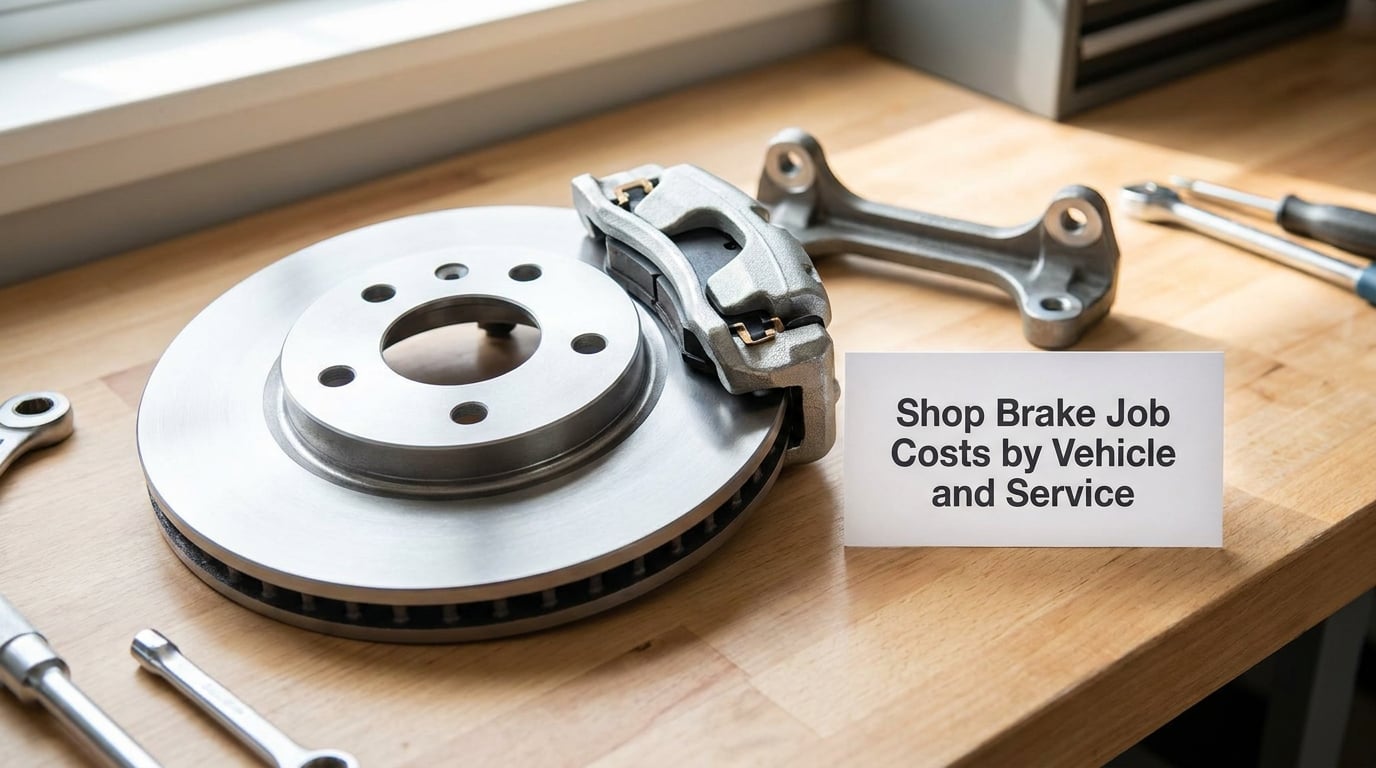
One detail explains most of the quote confusion: a set of brake pads is priced per axle, meaning one set covers two wheels, and brake rotors are sold one at a time. So a single-axle job is really one pad set, two rotors and a small hardware kit, then labor on top of that.
| Service performed | Independent shop | Dealership |
|---|---|---|
| Brake pads, one axle (parts and labor) | $180 – $300 | $280 – $450 |
| Brake pads and rotors, one axle | $330 – $580 | $500 – $800 |
| Brake pads and rotors, all four corners | $700 – $1,100 | $1,050 – $1,600 |
| Pads, rotors and one caliper, one axle | $550 – $1,100 | $850 – $1,700 |
| Rear axle with electronic parking brake | $330 – $650 | $500 – $900 |
| Brake fluid flush | $80 – $160 | $120 – $220 |
Labor on a normal front or rear axle runs about 1.0 to 1.8 hours. It stretches past that when a wheel has rusted onto the studs, when hardware is seized, or when a rear electronic parking brake has to be put into service mode with a scan tool before the caliper will come off.
Rear axles used to be the cheap end of the job. On 2018-and-newer vehicles with an electronic parking brake, the rear can legitimately cost more than the front, because the caliper has to be retracted electronically and put back and rearmed afterwards. Shops with the right scan tool treat that as routine; shops without it either skip it or charge extra.
That is the whole price range, stated plainly. A $99 pad special is not a different service at a different price, it is a marketing number that assumes the cheapest possible parts and a car that needs nothing else.
How Much Does a Brake Job Cost at a Shop for Common Vehicles?
Vehicle class moves the number more than almost anything else a shop controls. Bigger wheels mean bigger rotors and heavier calipers, and trucks and luxury cars add caliper hardware, sensors and programming steps.
| Vehicle class | Pads only, per axle | Pads and rotors, per axle |
|---|---|---|
| Compact or economy car | $160 – $250 | $300 – $450 |
| Mid-size sedan or hatchback | $180 – $300 | $330 – $580 |
| SUV or crossover | $220 – $360 | $400 – $700 |
| Pickup truck or tow vehicle | $240 – $400 | $450 – $800 |
| European luxury, for example BMW, Audi, Mercedes | $300 – $500 | $550 – $950 |
European cars carry more per axle for three reasons that have little to do with the shop. The pads themselves cost more, the rotors are often vented and drilled designs that run well above aftermarket pricing, and the labor is longer because hardware is designed for a torque wrench and a scan tool rather than an impact gun.
A forum example that fits the table: an owner on r/Subaru_Outback was quoted near $450 per axle for pads only at a dealership, while independent shops quoted far less for the same car. That gap is normal, not a scam in either direction.
What Affects the Price
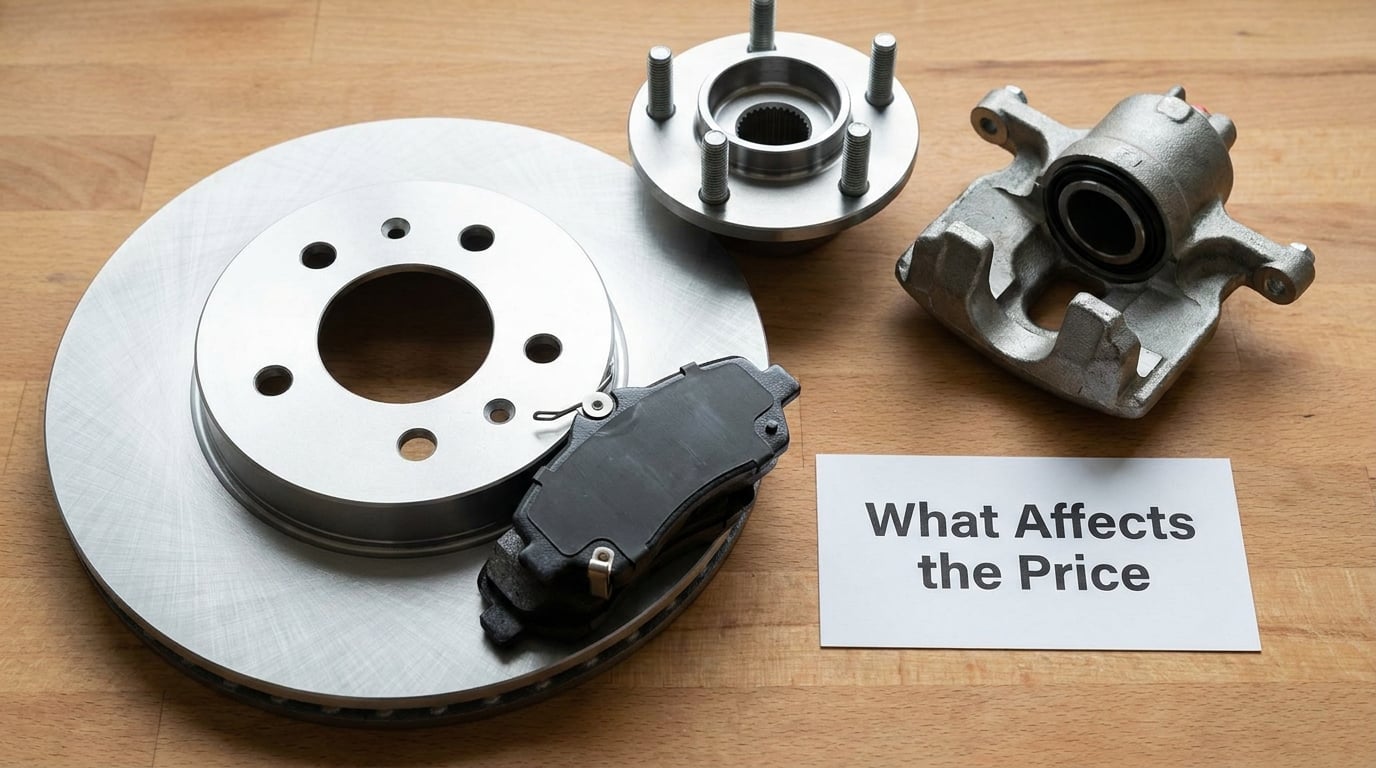
Once you know the per-axle math, a quote is easy to check line by line. Here is what actually moves the number, roughly in order of how often it changes a ticket.
- Whether the rotors are being replaced. Pads wear a rotor’s surface, so a rotor that is already near its minimum thickness cannot last a pad change. Minimum thickness is stamped on the rotor, and a good shop measures it and shows you.
- Parts tier. Economy aftermarket pads and rotors sit at the bottom, OEM and premium brands at the top. A pad set for the same axle can range from roughly $40 to $180 depending on which one the shop installs.
- Axle count. One axle is the standard unit. Doing all four costs close to double, which is why most shops quote per axle rather than per car.
- Labor rate. Independent shops commonly run $90 to $160 per hour, dealerships $130 to $220. That single rate difference is most of the dealer premium.
- Vehicle size and wheel size. Larger rotors and heavier calipers take longer on and off, and staggered front and rear sizes mean parts cannot be swapped axle to axle.
- European hardware and electronic parking brakes. Service mode, scan tool time and torque-to-spec reassembly add labor hours rather than parts cost.
- Condition surprises. Rust on the wheel hub, seized slide pins, a frozen caliper, or brake fluid that has absorbed water all add time. See our guide on how to test brake fluid with a moisture tester before you pay for a flush you may not need.
- Tax, shop supplies and disposal fees. These usually add several percent on top of the parts line and are not always shown separately.
| Line item | Typical range |
|---|---|
| Brake pad set, one axle, economy to premium | $40 – $180 |
| Two brake rotors, one axle | $70 – $300 |
| Hardware kit, shims and clips and lubricant | $15 – $30 |
| Caliper, if replacement is needed | $150 – $450 part only |
| Labor, per axle | 1.0 – 1.8 hours |
| Independent shop labor rate | $90 – $160 per hour |
| Dealership labor rate | $130 – $220 per hour |
Do that math on a mid-size sedan. About $60 for pads, $150 for two rotors and $20 for the hardware kit gives roughly $230 in parts. Add 1.5 hours at a $130 independent rate and you land near $425 before tax and shop fees. A quote in that neighborhood is doing nothing wrong.
If you have been comparing a shop quote against an online estimator and the two do not agree, that is usually the gap. Estimator sites like RepairPal and Kelley Blue Book average across regions and part brands, often assume OEM parts, and lean toward the higher-cost branch of the decision. A local independent shop working on your car, with parts you can name, will often land lower.
One more thing that gets skipped: whether the rotors can be resurfaced. Most modern rotors are thin, and by the time a rotor is worn enough to need machining it is often closer to the cost of a new one once you add the lathe labor. That is why you will rarely see machining on an estimate today. A shop offering it is not upselling you, but it is rarely the cheaper option.
How to Compare a Shop’s Estimate
Two quotes can differ by hundreds of dollars and both be honest, because you are not always being quoted the same job. Ask each shop for the same five things in writing before you compare anything.
- Which axle or axles. Front, rear or all four, in those words.
- Pad part numbers and brand tier. Not just “pads,” but the actual line and whether they are economy, aftermarket or OEM.
- Rotor status. Replaced, resurfaced, or left alone, with the measured thickness and the minimum stamped on the rotor if they are replacing them.
- Hardware. New shims, clips, slide-pin lubricant and a hardware kit. The absence of a hardware line is a small warning sign.
- Labor, split from parts. Hours per axle and the hourly rate, rather than one blended number.
Then set the rule in writing: ask the shop to call you before doing anything beyond the estimate, and get your okay on the phone. Many states already require written authorization for work past the estimate, and it is a reasonable request anywhere. The highest-engagement thread on r/MechanicAdvice is exactly this story, a written quote near $280 that turned into $1,065 of work the owner had never approved.
What a quote should not include is just as telling. A brake fluid flush you did not ask about, a rotor replacement with no measurement behind it, daily storage fees, or parts upgraded to premium tier with no explanation of who chose them.
Ways to Save on a Brake Job
The cheapest brake job is the one done at the right time, by the right shop, with the work you actually need.
- Get three written quotes. Two independents and one dealer. The dealer number is useful even if you never go there, because it anchors what the job costs in your area.
- Time the job before you need it. A rough memory aid owners use is to inspect every 30,000 miles and never let any pad go much under 3 mm of friction material, roughly 30% of what a new pad starts with. Check the minimum for your car, because it varies.
- Pay for labor only after buying parts yourself. Plenty of shops will install customer-supplied pads and rotors. Owners on r/AskMechanics report spending around $350 on parts plus a short alignment visit and coming out well ahead of the shop quote for the same work.
- Skip the flush unless the fluid is old or contaminated. If a low fluid warning light has been nagging at you, what causes a low brake fluid warning light is usually a level or a sensor issue rather than a fluid change.
- Do one axle only when that is genuinely all you need. Just confirm the other axle is not close to the same wear, because a matched pair usually lasts longer than doing the second axle six months later.
- Skip the $99 special framing. It is priced on the assumption that nothing else is wrong. If your rotors are at minimum thickness, you will pay for rotors either way, and the special simply moves that cost to the counter.
Buying your own parts only makes sense if the car is safe to drive there, the parts match what the shop expects, and you are comfortable holding the parts warranty yourself. If pads are worn to the metal, a rotor is cracked, a caliper is leaking or you are hearing grinding, have a shop look at it first.
Frequently Asked Questions
What is the cheapest legitimate brake job at a shop?
The cheapest honest brake job is pads on one axle at an independent shop, roughly $180 to $300 including labor, using economy aftermarket parts. Spend less than that and you are usually looking at a coupon special that assumes nothing else needs replacing, or a quote missing the hardware and shim line. If the shop will not name the pad brand, the labor hours and the hourly rate, ask another shop.
Do brake rotors always need to be replaced with the pads?
No, not always, but they often need replacing at the same time. Rotors have a minimum thickness stamped on them, and once a pad has worn the surface down near that limit, new pads would only last weeks. A good shop measures the rotor and tells you the number. If yours are comfortably above minimum and not scored or warped, replacing just the pads is legitimate.
Why does a four-wheel brake job cost more than replacing the front pads?
Because a four-wheel job is two axles of parts and roughly double the labor. Front brakes do about 70% of the stopping work, so they wear first and often get done alone. When you do all four at once you pay for four pad sets, four rotors and twice the hours, which is why the total lands near $700 to $1,100 at an independent shop. A rear axle with an electronic parking brake can cost more than the front.
Can a shop do the labor if I buy the brake parts myself?
Most independent shops will, though some charge a bit more for the parts warranty, and a few refuse warranty on customer-supplied components. Give them the exact part numbers before you buy so they can confirm the hardware kit and any shims you still need. Labor-only quotes typically run $200 to $350 per axle. The arrangement is only worth it when the car is safe to drive to the shop.
Is it safe to drive the car while waiting for brake service?
Sometimes, and the deciding factor is how much friction material is left. A grinding noise means metal on metal, which is not safe to drive on. If pads are above roughly 3 mm and the pedal feels normal, a short drive to a shop is usually fine. A soft pedal, a pedal that sinks to the floor, brake fluid on the ground or a lit brake warning light means the car gets towed.
What does a $99 or $149 brake special really include?
It usually covers pads on one axle, labor, and economy aftermarket parts, and it assumes the rotors are fine. Advertised specials exclude shop supplies, disposal fees and tax, and they frequently leave out the hardware kit. Once the wheel is off and a rotor measures near minimum thickness, the ticket moves to $330 to $580 for that axle. The coupon is marketing, not a discount on the same job.
Conclusion: What to Do First
Do not pick a shop by the lowest number. Confirm which axle or axles actually need work, decide on the rotors using a measurement rather than a sales pitch, and get two or three itemized quotes at the per-axle figures above.
If you are hearing grinding, feeling a pedal that travels too far, or looking at a quote you cannot explain line by line, put the car on a lift before you decide anything. Paying a shop to confirm what is wrong is cheaper than authorizing a job you did not need.