
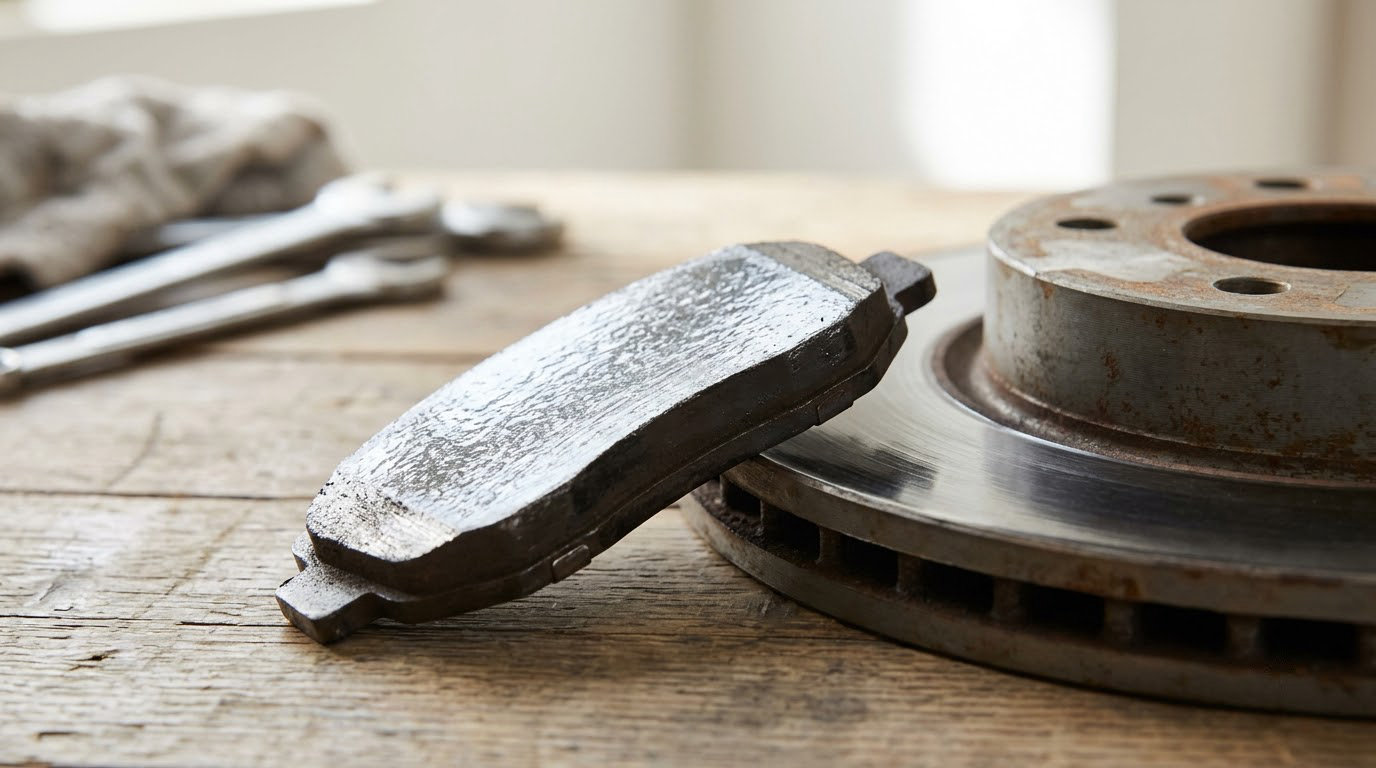
Brake pad glazing is what happens when a brake pad gets hot enough that its friction surface melts, transfers onto the rotor as a film, and hardens again into a smooth, shiny, glassy layer. That layer grips the rotor far worse than the abrasive surface underneath it, so you get less bite, more noise, and longer stopping distances. It is heat damage, not a manufacturing defect, and it is worth understanding because the fix is not always the one people expect.
The confusing part is that a glazed pad is not always obviously broken. The car still stops. Sometimes it even stops fine, right up until the day it does not. So the question is rarely “is this an emergency” — it is “what is actually happening to the friction surface, and is it going to keep happening.”
Below is a straightforward breakdown: what the mechanism is, how to recognize it on your own car, what causes it in the first place, and when a clean and re-bed is enough versus when the parts have to come off. If you would rather start from the noise, go straight to the symptoms section below.
Table of Contents
- What Is Brake Pad Glazing and Why Does It Happen?
- What Does Glazed Brake Pad Wear Look Like?
- What Causes Brake Pads to Glaze?
- Brake Pad Glazing by Brake Type and Driving Condition
- How Do You Inspect Glazed Brake Pads Safely?
- Can You Fix Glazed Brake Pads, or Do They Need Replacement?
- Frequently Asked Questions
- Can brake pad glazing be fixed by sanding the pads?
- Is glazed brake pad wear dangerous if the car still stops?
- Why do my brake pads glaze after highway driving?
- Should I keep driving if the brake pedal vibrates or the pads squeal?
- Do glazed brake pads always require replacement?
- Can brake pad glazing damage the brake rotor?
- Conclusion
What Is Brake Pad Glazing and Why Does It Happen?
Braking turns motion into heat. A healthy pad is an abrasive material designed to shed heat and bite into the cast iron rotor. Glaze is the name for what happens when that material gets hot enough to change shape.
Here is the mechanism, and it is more specific than most explanations give. The friction material in a pad is held together by a resin binder. Under extreme heat that binder softens and melts. It transfers onto the rotor as a thin film. When the pad cools, the binder recrystallizes on the pad face as a hard, smooth glaze. The pad and the rotor both come out of it with a glassy surface, which is why fixing only one of the two parts often means the problem returns within weeks.
Glaze is not the same as cracking, chunking, or ordinary wear. Ordinary wear thins the pad evenly. Chunking is the pad material breaking away in pieces, and on an organic pad it is a warning sign of overheating that can progress to more serious failure. Glaze is a surface chemistry change: the pad may look nearly full and still have almost no friction left in it.
Once the surface is glazed, it is also less able to shed heat, so it runs hotter. That feedback loop is the reason glaze tends to be a symptom of something else, like a dragging caliper, rather than an isolated event.
What Does Glazed Brake Pad Wear Look Like?
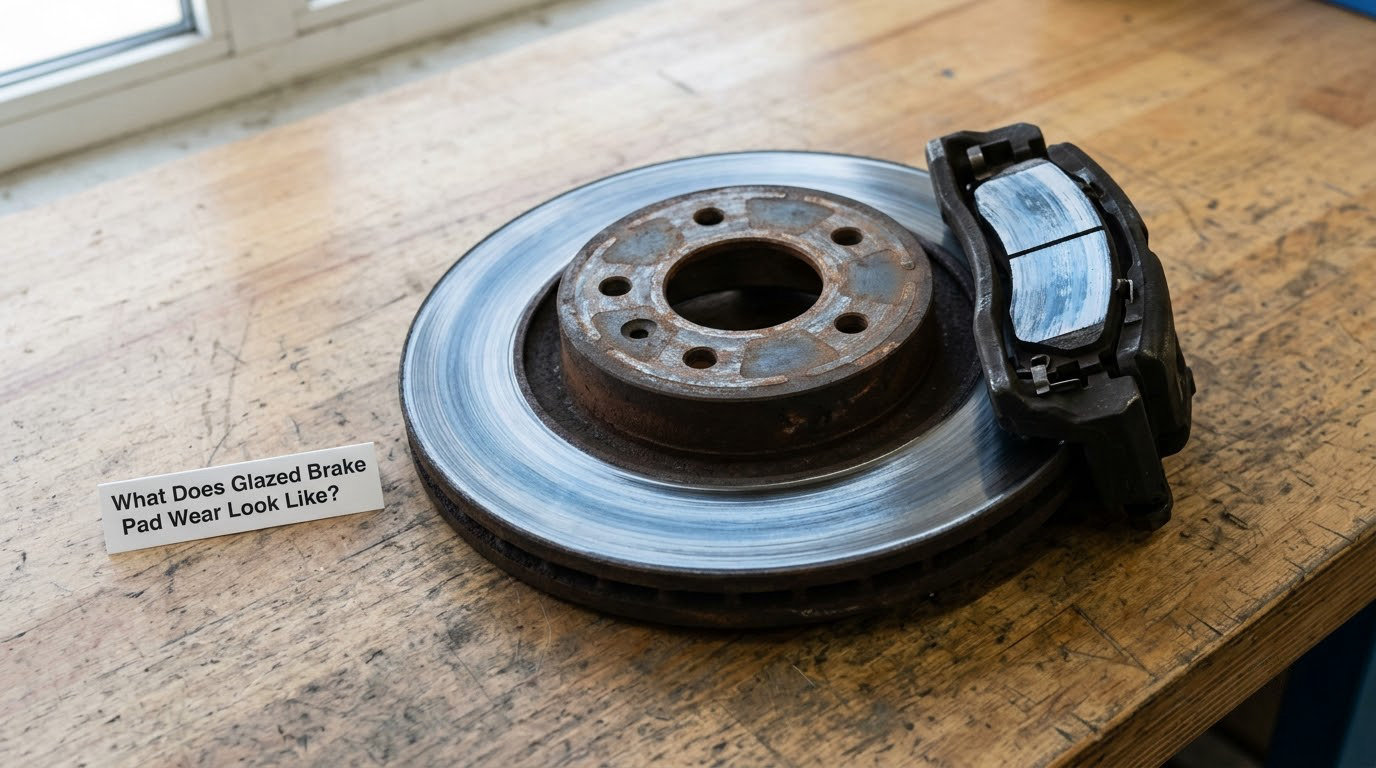
The single clearest sign is on the part itself. Lift a glazed pad out and the face that should look matte, grainy and grey will look smooth, hard and slightly blue-grey or silver, like a piece of ceramic or worn glass. The rotor track often carries a matching hard layer instead of a clean matte grey sweep.
From the driver’s seat, the signs usually show up in this order:
- Squealing that changes with speed or temperature. A high-pitched squeal at low speed after a long highway run is a classic glaze signature, because the pad is hot and hard when it first touches the rotor.
- A pedal that feels soft or weak when hot. People often call this brake fade, and it can happen while the rotor is still fine, because the friction coefficient has dropped away.
- Longer stopping distances for the same pedal pressure. Not dramatic, but enough that you notice you are pressing harder than you used to.
- Vibration through the pedal or steering wheel. This one points more toward rotor thickness variation or runout, and a glazed pad can be the reason the rotor never bedded in properly.
- Grinding or a harsh rasping noise. That is a worn pad reaching the rotor, not glaze, and it is a different job.
Glazing is frequently confused with two other conditions that look similar at a glance. This is the single most confused point in the DIY brake world, so it is worth separating them.
| Condition | What caused it | What you see and feel | What fixes it |
|---|---|---|---|
| Glazing | Repeated high heat from braking | Hard, smooth, shiny blue-grey film on the pad face and rotor; less bite; squeal that changes with heat | Clean the rotor, sand or replace the pad, re-bed; fix the cause of the heat |
| Fluid or oil contamination | A brake fluid leak, seized caliper piston, or oil and chain lube on the pad | Dark, greasy, wet-looking pad that never improves; heavy smell; no amount of cleaning lasts | Find and fix the leak, replace the caliper seals, fit new pads and rotors |
| Surface rust on the rotor | Standing moisture overnight | Brown speckle across the rotor that rubs off on a finger; light grind on the first stop of the day | Several firm stops in a straight line at low speed to clear it |
The quick test is simple. Rust wipes off. Contamination smells and feels greasy. Glaze is dry, hard and uniform, and it does not wipe off — it has to be sanded or machined away.
What Causes Brake Pads to Glaze?
Heat is always the mechanism, but something is almost always putting the heat there. People who swap the pads and the rotors, drive away, and get the same glazing back two months later usually have a cause nobody looked for. Each of the common causes has its own tell.
Repeated hard braking and riding the pedal
Long descents, towing, stop-and-go city traffic, and track days all load the pads hard. Holding the pedal partway down on a hill is the version people do not realise they are doing — the pad is still generating heat, just very slowly, and slow heat is exactly what forms an even, hard glaze.
A sticking caliper or pedal drag
This is the hidden one. A sticky caliper piston or a seized guide pin keeps the pad lightly touching the rotor after you have lifted off the pedal, and the pad cooks itself on a normal day of commuting. If the pistons were sticky, the pad never fully disengages when you are off the brakes, which overheats it with no hard driving at all. The tell is heat on the rotor face you cannot account for, or a car that has been warm to the touch on one side after a short trip.
Worn pads and worn rotors
A pad near the end of its life has less material to absorb heat and less surface left to bed in. A thin or uneven rotor concentrates the load into small patches, which get hot enough to glaze while the rest of the track stays fine. If the vibration showed up alongside the squeal, suspect the rotor too.
Contamination from fluid, oil or road dust
Brake fluid, hydraulic oil, chain lube, or a leaking wheel cylinder saturates the friction material and drops the melting point, so the pad glazes far more easily than the driving style would explain. Road dust works the other way: the glaze is largely aluminium oxide worn off the brake track and mixed with road debris, and that abrasive grit is what gets pressed into the pad face.
New pads that were never bedded in
New pads need a bedding procedure — a controlled series of stops from moderate speed that lays an even transfer film. Skip it, ride hard immediately, and the pads can glaze before they have properly seated. This one is entirely avoidable and it is why the fix section below spends time on it.
Brake Pad Glazing by Brake Type and Driving Condition
Different pad compounds tolerate heat very differently, and the right choice for your driving is the cheapest way to reduce how often this comes back.
Which pad compound resists brake pad glazing longest
Organic pads are quiet and cheap and cope fine with everyday commuting, but they are the first to glaze and the first to chunk when they get too hot. Semi-metallic pads handle heavier loads and long descents far better, at the cost of more noise cold. Ceramic pads run cooler and resist glazing well in normal road use, and they are expensive. Sintered pads, common on motorcycles and performance applications, have the highest heat tolerance of all. Match the compound to the work: a car that tows a boat uphill every weekend wants more heat capacity than a city runaround.
How driving conditions change the heat load
City stop-and-go traffic gives repeated moderate heat with no chance to cool down. Highway driving gives sustained high speed with the pads barely used, then one or two very hard stops at the end — which is why a car can feel fine for an hour and then glaze. Long mountain descents are the classic case, particularly with a loaded vehicle or a bike and trailer. Winter adds its own pattern: cold, damp pads and a lightly corroded rotor make the first stop of the day feel like grinding, and repeated hard braking to make up for it pushes heat in early.
How Do You Inspect Glazed Brake Pads Safely?
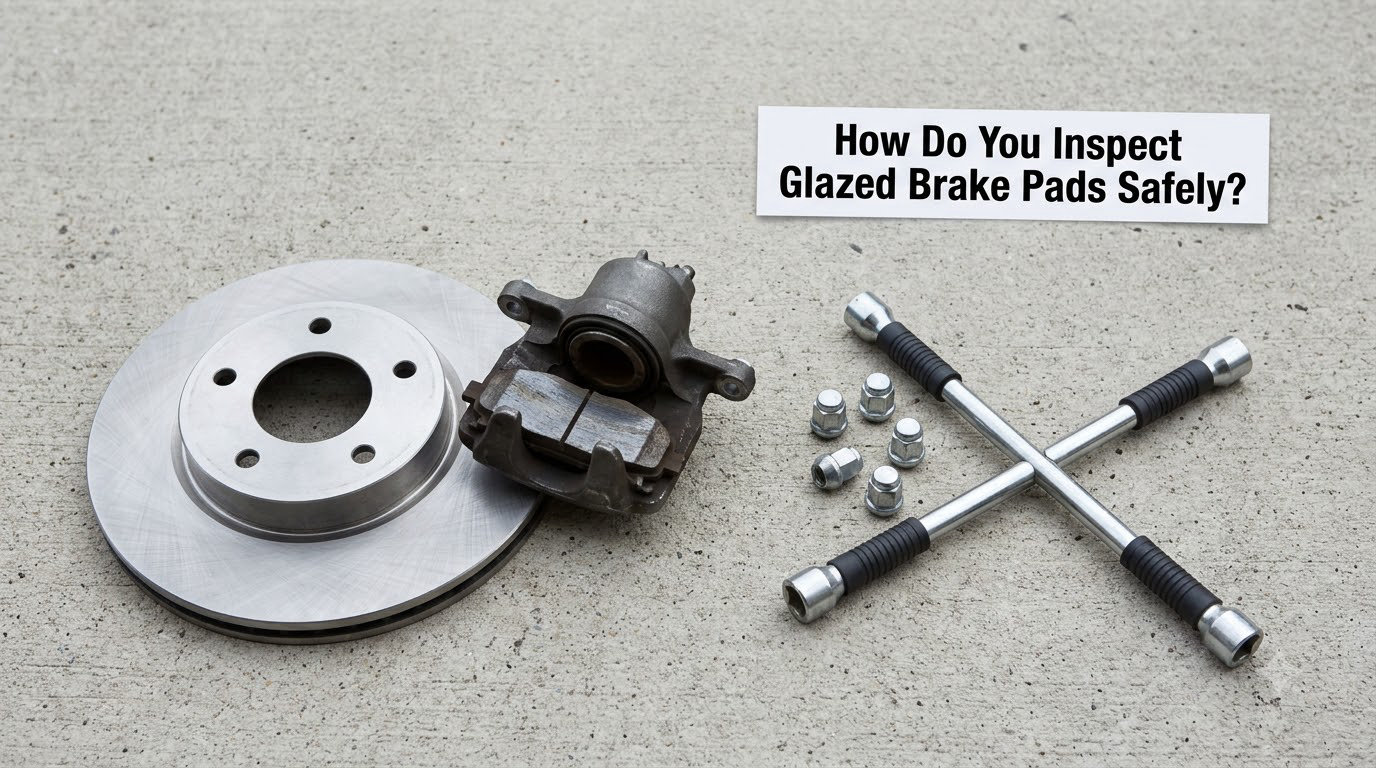
You can check a lot without taking anything apart. Park on level ground, in gear, with the parking brake on and the engine off. If the car needs lifting, use a jack with wheel chocks behind a remaining wheel and axle stands under the proper points — never work under a car held only by a jack.
At the wheel, look through the spokes and the caliper window for:
- Pad thickness. Read it against the caliper or the pad wear indicator groove, not by eye at the friction surface. Thin friction material is a replacement on its own, glazed or not.
- The rotor face. Uniform grey sweep means healthy. Hard, shiny, unevenly coloured patches or a lipped edge mean the rotor has been affected too.
- A hot wheel. After a short drive, an obviously warm hub or disc on one side points at drag rather than hard braking.
- Evidence of a leak. Wetness, staining, or a film around the caliper, and fluid at the bottom of the caliper body, are not something to clean and forget.
There is one more check that needs no tools: after a drive, note whether the pedal rests closer to the floor than usual. Sustained pedal drag is the strongest clue that a caliper is sticking, and it is the cause you want to rule out first, because replacing pads without fixing it means doing the job twice.
Beyond that, brake work means the vehicle service manual, correct fasteners, and a clean brake cleaner and fluid rather than a household degreaser. If removing a wheel or a caliper is outside what you have done before, that is the point to hand it to a shop.
Can You Fix Glazed Brake Pads, or Do They Need Replacement?
Both answers are correct, which is why people argue about it. The decision comes down to how much friction material is left, how deep the glaze is, and what the rotor is doing.
Light surface glaze on a pad with plenty of material left can often be brought back. Degrease the pad face and the rotor with a dedicated brake cleaner, take the shine off the pad face with a fine abrasive used for brakes, clean the rotor track thoroughly, and then bed the pads in properly. Motorcycle and bicycle riders do this routinely — a scotch-brite pad on the rotor and a light sand on the pad, then re-bed — and it holds up on a road bike or a bike that sees mountain descents.
Deep glaze, a pad near minimum thickness, or a pad contaminated with fluid is a replacement. Once the binder has recrystallised through the friction material, sanding only removes the top layer and the pad returns to its old state. The opposite view is just as common: once a pad has been glazed it cannot be repaired and it needs replacing. Both positions are honest, because they are describing different severity.
The rule I would use: if the pad is worn, the friction material has taken in fluid, or the glaze came with heavy heat and a dragging caliper, replace the pads. Do not sand a pad and drive on it hoping.
Rotors are decided separately. If the rotor has been glazed, it is usually because it has worn below the smooth thickness the pad needs, so machining it back is often the correct answer. Once machined, the disc thickness spec printed on the rotor becomes the limit, along with the vehicle service manual and the manufacturer minimum — below that, the rotor gets replaced rather than resurfaced. Replacing pads and leaving a glazed rotor in place is the single most common reason this problem comes back, so the rotor track has to be cleaned or machined in the same job.
Bedding in is what stops the cycle. With the car loaded as you normally carry it, make about ten controlled stops from moderate speed to near walking pace, without ever coming to a hard stop, then let the brakes cool before driving hard. This lays an even transfer film instead of a patchy one, and it is the step most often skipped right after fitting new pads.
Whatever you do, do not put oil, chain lube, or WD-40 anywhere near the friction surface to quiet a squeal. It works for a while, it contaminates the pad, and the fix then becomes pads and possibly rotors on top of whatever you started with.
Frequently Asked Questions
Can brake pad glazing be fixed by sanding the pads?
Sometimes. If the pad still has plenty of friction material left and the glaze is a thin surface layer, cleaning the pad and rotor, taking the shine off the pad face with a fine abrasive, and re-bedding the pads will restore useful friction. If the pad is worn near its minimum thickness, the glaze is deep, or the material has taken in brake fluid or oil, sanding only removes the surface and the pad stays compromised. Replace it instead.
Is glazed brake pad wear dangerous if the car still stops?
It is a reduced safety margin rather than an immediate failure, and that margin shrinks every time you use the brakes. A glazed pad delivers less friction, so stopping distances lengthen, and a hot glazed pad cannot shed heat as well, so the condition can progress on a drive that felt fine. Treat a soft pedal, longer stopping distance, or vibration as a reason to have the brakes inspected rather than a reason to keep driving as normal.
Why do my brake pads glaze after highway driving?
Sustained high speed barely touches the pads, so the friction material never gets a chance to shed heat, then one or two firm stops at the end of the motorway lay down a concentrated layer of transfer film. A drag from a sticking caliper makes this much worse because the pads are lightly rubbing the whole way. If the pedal also sits lower than it used to, the caliper is the first thing to have checked.
Should I keep driving if the brake pedal vibrates or the pads squeal?
Short trips gently, but arrange an inspection rather than putting it off. Vibration usually points at rotor thickness variation or runout, and a squeal that changes with heat is a common glaze symptom, so the two often appear together and both mean the friction surface needs looking at. Do not drive if the pedal goes soft, the car pulls to one side under braking, the rotor is badly scored, or the friction material is close to the wear limit.
Do glazed brake pads always require replacement?
No, but replacement is the right call in most cases on a car. Bicycle and motorcycle pads with material to spare are routinely cleaned and lightly abraded, then re-bed. Car pads that are worn, deeply glazed, or contaminated are scrap in practice, because the friction material has already changed all the way through. Whatever you reuse has to be re-bedded, and the underlying cause of the heat has to be fixed or the same thing happens again.
Can brake pad glazing damage the brake rotor?
Yes, and it is the reason a pad-only repair often fails. The melted binder transfers onto the rotor track and hardens there too, so the rotor develops the same hard, smooth surface. A glazed rotor also means the pad never beds in evenly, which can leave low spots that warp the disc as it heats. Pads and rotors normally need doing in the same job, and the rotor is machined back only while it stays above its minimum thickness.
Conclusion
Glazed brake pads are a heat problem, and the shine you can see is only the evidence. Ease off repeated hard braking, arrange a proper brake inspection, and make sure someone looks for the cause — a dragging caliper, a worn rotor, a leak, or a skipped bed-in — instead of only cleaning the surface. Replace or machine the parts to the manufacturer’s specifications, and bed the new ones in properly so the problem does not come back on the same mountain road.