
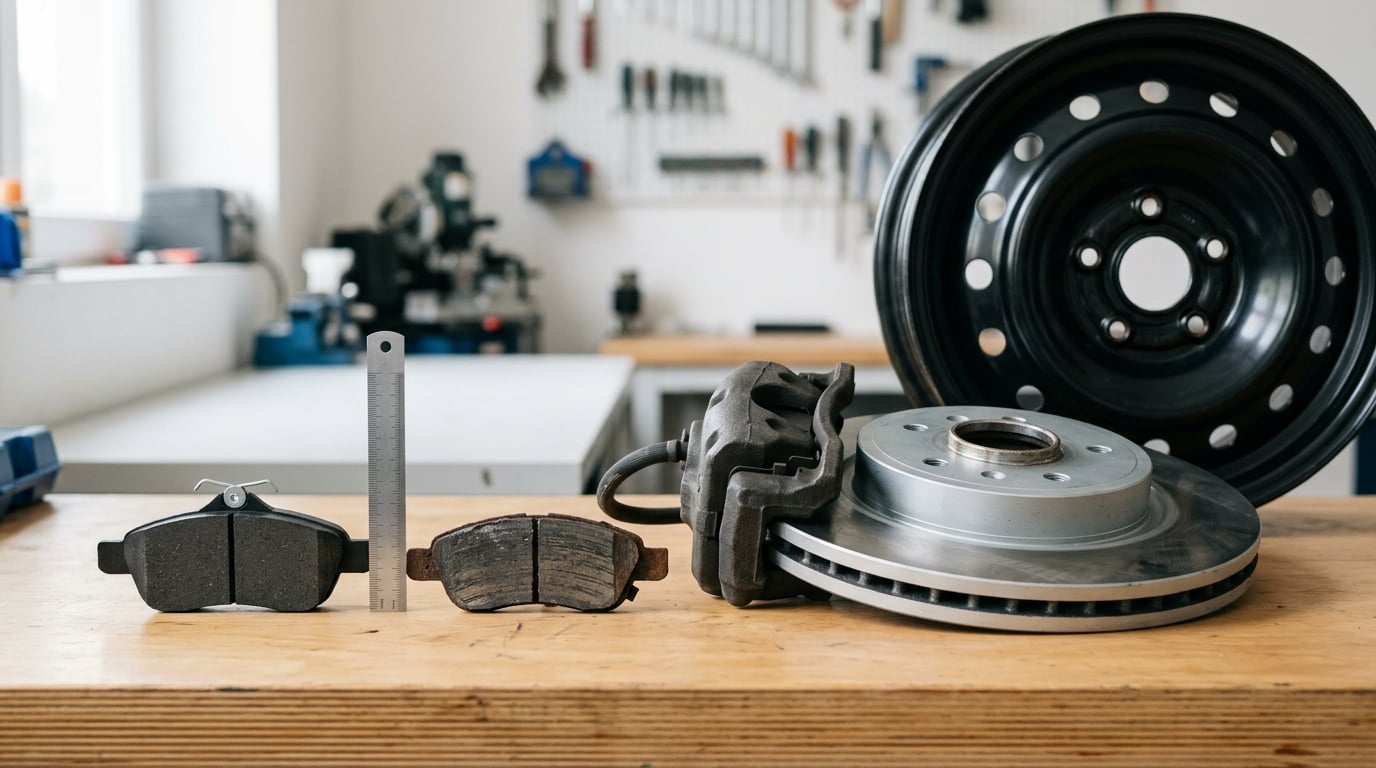
Brake pads on a typical passenger car last 25,000 to 65,000 miles (40,000 to 105,000 km), or roughly three to six years at normal annual mileage. Heavy city driving and towing can strip a set in under 20,000 miles, while light highway use can push them past 80,000 miles.
Most of the variation comes down to how much heat the brakes absorb, how heavy the vehicle is, and whether the caliper hardware was serviced when the last set went on. Mileage is a planning estimate, not a schedule. The condition of the pad decides, and you check that with a ruler, not an odometer.
This guide is for everyday drivers and for owners of heavier cars who keep hearing that their pads are supposed to last longer than they do. Updated for 2026.
Table of Contents
- How Long Do Brake Pads Last?
- What Is the Average Mileage on Brake Pads?
- Why Do Some Brake Pads Wear Faster?
- What Are the Signs That Brake Pads Need Replacement?
- How Can You Check Brake Pad Thickness?
- How Do Driving Habits Affect Brake Pad Life?
- Do You Need to Replace Pads and Rotors Together?
- How to Extend the Life of Your Brake Pads
- Frequently Asked Questions
- Conclusion
How Long Do Brake Pads Last?
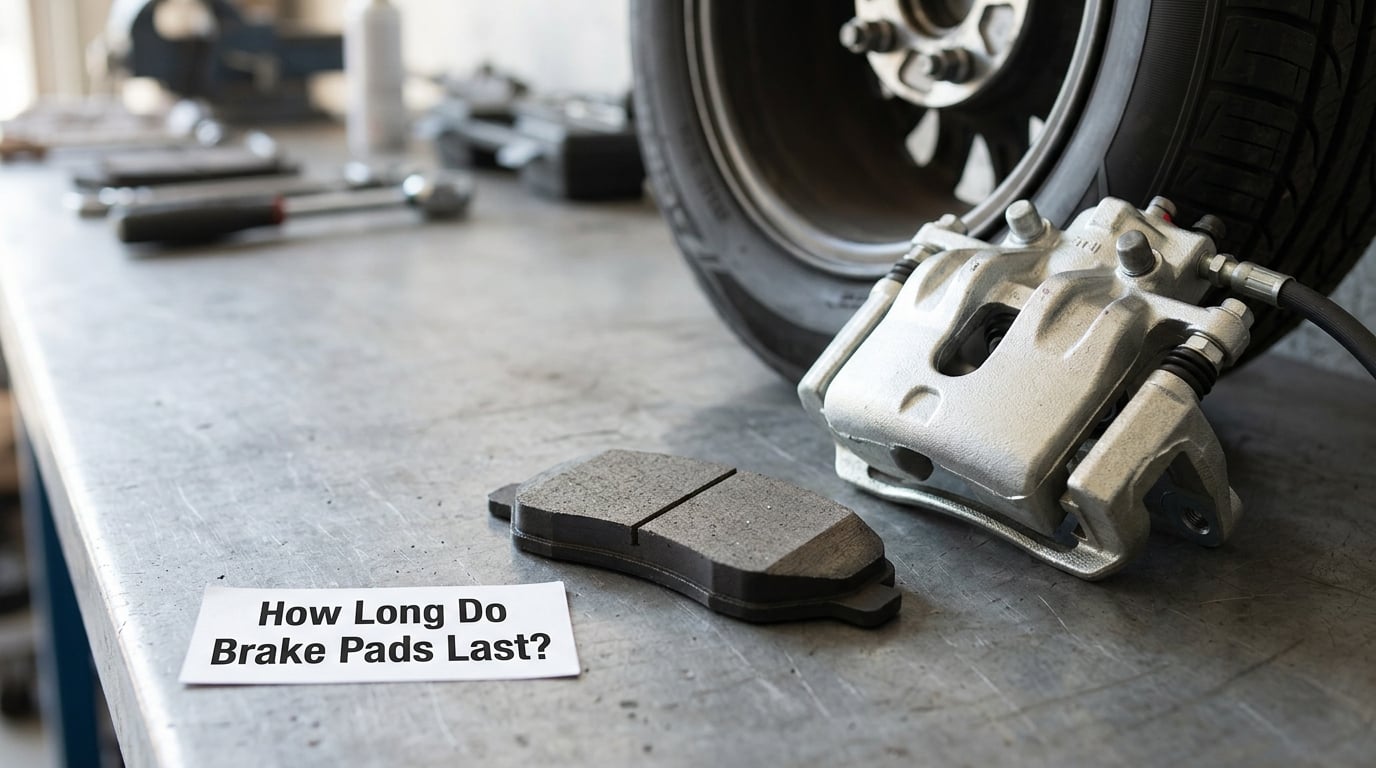
A pad is two parts: a steel backing plate and a sacrificial layer of friction material bonded to it. Braking converts motion into heat, and the friction material is what wears away in the process. When the pad is new, that layer is usually about 10 to 12 mm thick on a common passenger car, with the manufacturer minimum somewhere around a quarter inch to a third of an inch.
So the honest answer to how long do brake pads last is: until roughly 3 mm of friction material remains, minus whatever your owner’s manual says. Everything between new and that number is consumed by the way you drive.
What Is the Average Mileage on Brake Pads?
Here is the range most owners see, by vehicle type and duty. Treat it as a starting point for budgeting, not a promise.
| Vehicle type and duty | Typical pad life | What drives it |
|---|---|---|
| Compact sedan, city commute | 25,000 to 40,000 miles | Constant stop-and-go heat cycling |
| Mid-size sedan, mixed driving | 40,000 to 65,000 miles | Balanced city and highway use |
| SUV or light truck, mixed driving | 30,000 to 55,000 miles | More weight on the rotors, more brake torque |
| Full-size truck or SUV, towing | 15,000 to 30,000 miles | Loaded braking duty, sustained downhill grades |
| Light highway commuter | 65,000 to 80,000 miles | Few stops, low heat per event |
| Track or autocross car | Under 10,000 miles | Repeated near-maximum stops at high temperature |
Dealer and parts pages often quote 30,000 to 70,000 miles, and that number is not wrong, it is just a midpoint for light-to-moderate use. I use 25,000 to 65,000 as the working range because it covers more of what people actually drive.
If you want to convert miles to years, your annual mileage is the only variable that matters:
| Miles driven per year | At 30,000 miles | At 50,000 miles | At 65,000 miles |
|---|---|---|---|
| 5,000 | 6 years | 10 years | 13 years |
| 10,000 | 3 years | 5 years | 6.5 years |
| 15,000 | 2 years | 3.3 years | 4.3 years |
| 20,000 | 1.5 years | 2.5 years | 3.3 years |
That table answers the “do brake pads last three years” question better than any single number. Someone averaging 10,000 miles a year is right in the middle of the range; someone averaging 20,000 is going to be replacing them constantly.
Why Do Some Brake Pads Wear Faster?
Four factors do most of the work. Driving habits come first, then the vehicle’s weight, then the friction material, then hardware condition.
Stop-and-go city traffic: every stop dumps a large share of your vehicle’s kinetic energy into the rotor. A commuter doing 40 such stops a day generates far more heat per mile than someone cruising a highway at a steady speed, and the pads pay for it.
Vehicle weight and load: a heavier vehicle needs more brake torque to stop. Roof racks, a full back seat, a bed of gravel, or a trailer all increase the energy the friction pair has to absorb.
Heat and repeated hard braking: sustained mountain descents, driving with the brake lightly held, or a track day will glaze and thin the friction material far faster than the odometer suggests.
Towing: a tow vehicle brakes with a trailer attached, which multiplies both the mass and the heat. This is the single biggest reason truck and RV pads die early.
Caliper and guide pin condition: if a caliper slide pin is seized, the piston does not fully retract and one pad drags continuously against the rotor. That one pad wears out while its partner on the same corner still looks nearly new. This is the classic early failure and it is worth reading in more detail on why one brake pad wears faster than the other.
Idling and creeping: light brake pressure at a standstill keeps the pads lightly loaded against the rotor and slowly grinds them down without doing any useful braking.
Pad and rotor spec mismatch: fitting pads designed for a different rotor diameter or compound leads to partial contact, uneven wear, and a noise problem the whole way through.
Brake fluid moisture: fluid absorbs water over time and loses its boiling point. Spongy or faded pedal feel on a vehicle that has never had the fluid serviced is a real cause of early pad consumption, and it is one of the few maintenance items that genuinely shortens pad life.
Contaminated friction material: oil, brake cleaner overspray, or coolant on the pad surface stops it working. Pads will not bed in properly until the contamination is cleaned off or the pad is replaced.
What Are the Signs That Brake Pads Need Replacement?
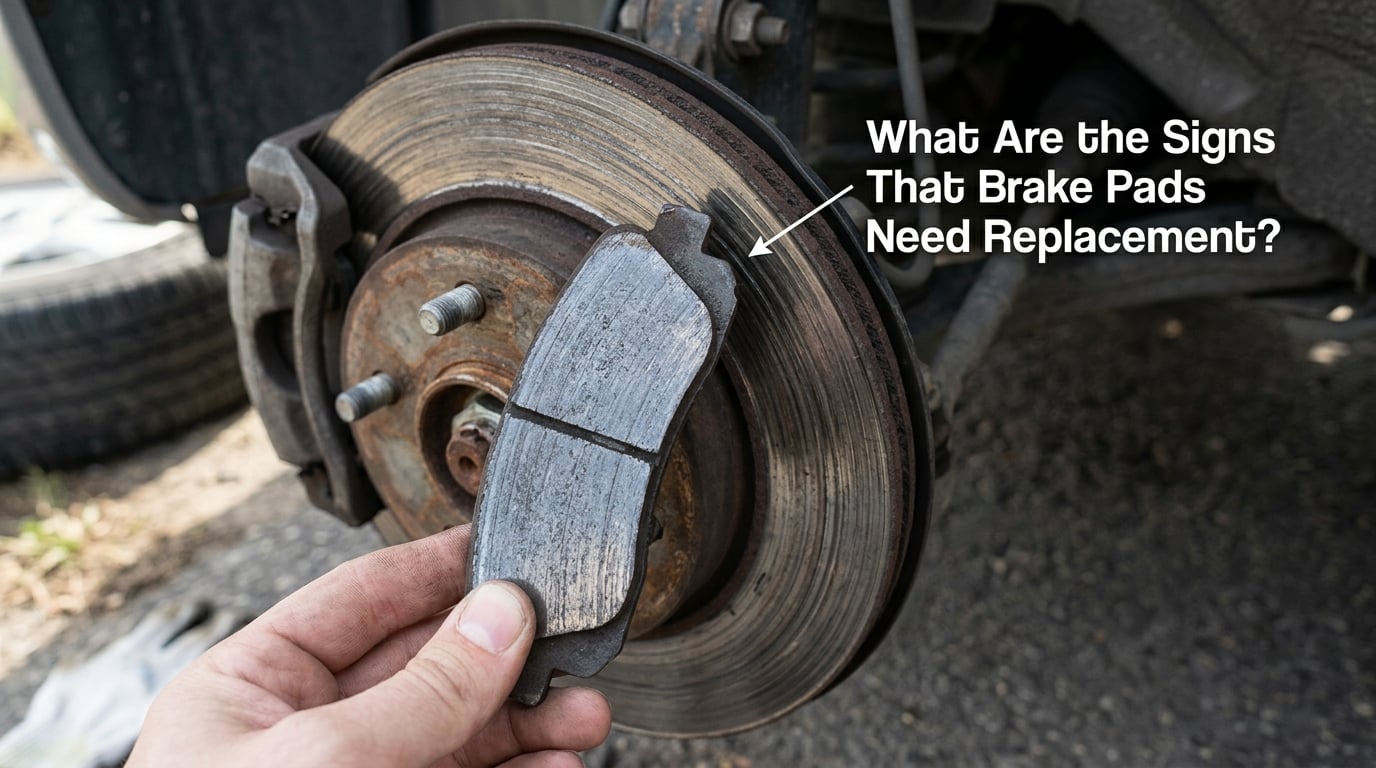
Order these by urgency, because the first few are a warning and the last one is an emergency.
- Squealing or chirping under light braking: usually the wear indicator shim, the small springy strip in the pad, touching the rotor. It means the pad is getting low.
- Visible pad material through the wheel spokes: if you can see the steel backing plate, replace now.
- Vibration through the pedal: often a worn rotor rather than a worn pad, but it means the corner needs an inspection.
- Longer pedal travel or a softer pedal: air in the system, fluid that has absorbed moisture, or pads worn past minimum.
- Grinding: the backing plate is already on the rotor. Every mile from this point damages the rotor and can damage the caliper. Slow down, drive gently, and get it looked at.
- Dashboard pad warning light: most cars have a low-pad sensor on the circuit, and some have a thicker sensor strip built into the pad. Either way, treat the light as a service-now prompt.
- Uneven wear across the pad face or a visibly worn pad at 12 months: something is dragging or the alignment is off. Early failure is a symptom, not bad luck.
Two noises get misread as worn pads when they are not. A brief screech on the first stop after rain is surface rust on the rotor being wiped off, and it goes away in a mile or two. A low chatter on a cold morning that disappears after the brakes warm up is usually a pad design feature, not metal-to-metal contact. Neither one means you need a new set today.
What does mean urgency is a noise that follows you uphill, a noise at every stop, or a noise that gets worse the faster you drive.
How Can You Check Brake Pad Thickness?
You can do this on your own driveway in about ten minutes, and you only need a flashlight and a ruler or a small brake pad gauge. The visual check through the wheel spokes is free and takes seconds; the full check needs the wheel off.
- Park level, in gear or in park, with the handbrake set. The vehicle must be supported properly before you remove a wheel. Never rely on a jack alone; use rated jack stands or a proper ramp on level ground.
- Look through the spokes at each corner in turn with a flashlight. The caliper sits inside the wheel hub, and the pad is the dark block sitting against the rotor face.
- Measure the friction material only, not the steel backing plate. A cheap pad gauge gives a running depth; a ruler works, but measure carefully.
- Look for the wear indicator shim. On many pads it is a curved metal strip bonded to the friction material, and when it starts touching the rotor it makes that chirping sound.
- With the wheel off, check both pads on the corner, not just the one you can see. Also run a finger along the rotor face to feel grooves, and check the rotor edge for rust or a lip.
- Compare your measurement to the ladder below, then check the thickness printed in your owner’s manual. The manual wins if the two disagree.
| Friction material thickness | What it means |
|---|---|
| 10 to 12 mm | New pad, nothing to do |
| 6 mm | Healthy, keep checking |
| 4 mm | Half gone, book an inspection at your next oil change |
| 3 mm | Service soon, plan for replacement within a few thousand miles |
| Under 1.5 to 3 mm | Replace now |
| Under 1.5 mm with cracks or heat stress marks | Replace now regardless of thickness |
You will see 1/4 inch, 3 mm, 2 mm, and 1.5 mm quoted as the limit, and the reason is that manufacturers genuinely differ. Some makers allow 3 mm; Subaru specifies 1.5 mm. If you are near the line, the figure in your owner’s manual is the one that counts.
If you have 4 mm left and nothing else is wrong, you have some time, not a lot. At a typical city rate of wear, that is somewhere in the few-thousand-miles range before you want to be under 3 mm.
How Long Do BMW Brake Pads Last?
BMW owners ask this more than almost any other group, and the honest answer is that a BMW’s pad life is not meaningfully shorter than a sedan’s, but the spread between best and worst case is wider. A rear-drive model on light highway use can run a long time; an xDrive or M car that carries real weight, sits on big factory wheels, and gets driven hard in city traffic will go through a set much sooner.
Two things drive that spread more than the badge. First, mass and drivetrain layout change the brake torque. Second, factory brake packages vary hugely within one model range, and the calipers and compound fitted to the car you own are not always the same as the ones on the brochure. Track days, autocross, or spirited mountain driving will wear the pads in a single season regardless of what the manual lists as a service interval. If your car is a daily driver and you never drive it hard, a normal 30,000 to 60,000 mile range is reasonable to plan around.
How Do Driving Habits Affect Brake Pad Life?
Same car, same pads, two owners, wildly different results. Here is how the common habits stack up.
Gentle cruising: the best case. One stop every 30 miles, plenty of air between events, rotor never gets hot enough to glaze. Pads here can reach the top of the range or beyond.
Mixed commuting: a few stops per mile on the way in and an easy highway run home. This is where most drivers land, and it is the scenario the standard 25,000 to 65,000 mile range assumes.
Heavy stop-and-go: the worst everyday case. Every red light and every intersection is a full energy dump, and the friction material never gets a chance to shed heat. Expect the low end of the range or below.
Aggressive braking: late braking and firm pedal pressure transfer more energy to the pads. The same road driven calmly wears pads noticeably slower than the same road driven impatiently.
Towing and mountain descents: repeated sustained braking heats the rotor far past what a single stop can, and heat is what drives both pad wear and pad fade. A trailer up a long grade is close to the hardest duty a road car sees.
Resting your foot on the pedal: this one sneaks up on people. Light pressure while stopped grinds the pads without braking, and it is a common cause of pads that look new at 15,000 miles and ruined at 30,000.
There is a physical reason all of this matters. A rotor needs airflow and time to shed heat, and every hard stop dumps energy into a solid disc that has to cool back down. Drive the same routes twice, once calmly and once aggressively, and you are running two different wear rates in the same week.
Do You Need to Replace Pads and Rotors Together?
Not automatically, and this is where owners get talked into work they do not need. Pads and rotors are a friction pair and they should be evaluated together, because a worn rotor will destroy a new pad quickly. But the rotors do not have to be replaced simply because the pads are going on.
A rotor is usually fine to keep if it is above the minimum thickness stamped on its hat, has no deep grooves, no cracks, no visible blue or heat spotting, and does not have a lip at the outer edge. A rotor that can still be machined, or that sits comfortably above minimum, is serviceable. A rotor that is thin, scored past the point where the pads can sit flat, or cracked has to go, and putting fresh pads on it guarantees a second job.
Measure the rotor thickness at several points around the disc, including mid-way between the hat and the outer edge. Also measure disc thickness variation, the difference between the highest and lowest point, which is what causes pedal pulsation. A machine shop can measure both for you.
Two common situations: if your last brake job was recent and the rotors were machined or replaced, pads-only is normal. If the rotors are pitted, warped, or you do not know their history, replacing them with the pads is cheaper than doing the job twice.
One exception is worth knowing. On many rear-wheel-drive cars, the rear brakes handle only a fraction of the stopping force, and their pads can go 50,000 to 75,000 miles while the fronts are on their second set. That asymmetry is normal, and it is the same one-sided problem described in why one brake pad wears faster than the other.
How to Extend the Life of Your Brake Pads
Most of what shortens pad life is not a driving habit you cannot control. It is a service that got skipped.
Inspect on a schedule: once a year or every 12,000 miles, whichever comes first. That is enough to catch a dragging caliper before it eats a set of pads.
Get the caliper hardware serviced at installation: clean and lubricate the slide pins and guide pins, lubricate the caliper contact points with the right product, and make sure the pistons fully retract when the brake is released. This is the step most often skipped, and it is the step that decides whether the next set lasts. New pads on a seized caliper will be destroyed on the drive home from the shop.
Bed the new pads in: after fitting, drive at moderate speed and make a series of gentle stops from roughly highway speed, around ten to fifteen of them over the first few miles. This lays an even transfer layer of friction material onto the rotor. Skipping it causes either a soft initial bite or hot spots and uneven wear.
Never touch the friction surface: hold the pad by the backing plate. Skin oils on the friction material are enough to prevent bedding.
Change the brake fluid on the manufacturer’s interval: often every two years. Fluid that has absorbed moisture gives a longer, vaguer pedal, which means the driver brakes harder to get the same deceleration.
Reduce unnecessary harsh braking: leave a little more following distance, and use engine braking on descents where the vehicle allows it. On a low-speed drag or a long grade, that is the difference between the pads and the transmission taking the hit.
Let the brakes cool after repeated hard use: if you have just come off the track or spent minutes descending a mountain, park on level ground, in park, and leave it. Parking on a hot rotor next to dry grass is how people lose cars, and the pads are not worth it.
Fix glazed or uneven pads properly: if the surface of the pad is smooth and hard or the rotor is scorched, a bedding and deglazing procedure on the rotor can rescue both parts. When that is not enough, replace them. Our explainer on brake pad glazing covers the cases where surface work is enough and where it is not.
Frequently Asked Questions
How often should brake pads be replaced?
Measure, do not guess. Most pads go roughly 25,000 to 65,000 miles, and the safe trigger is 3 mm of friction material remaining, or whatever minimum your owner’s manual states. Inspect once a year or every 12,000 miles. Replace the pads on a corner as a set, never one at a time, and check the rotor condition while the wheel is off.
Do brake pads last 3 years?
It depends entirely on how much you drive. At 10,000 miles a year, a typical 25,000 to 65,000 mile lifespan works out to between two and a half and six years, so three years is right in the middle. At 20,000 miles a year you would be replacing them every 18 months or so, and at 5,000 miles a year the same pads could sit far longer.
At what brake pad thickness should they be replaced?
Replace at 3 mm of friction material as a default, and never below 1.5 mm. Manufacturers differ, so check the number printed in your owner’s manual, which is the authority for your car. Replace immediately regardless of thickness if you see cracking, heat stress marks, or metal-to-metal scoring on the friction material.
Why would new brake pads wear out in under a year?
A seized caliper slide pin or a sticky piston is the most common cause, because the pad drags continuously instead of retracting. Worn or scored rotors are next, since new pads cannot sit flat on them. Other causes include a caliper that was never lubricated at installation, pad and rotor specs that do not match, wheel misalignment, and overloaded towing duty.
Is it normal for brake pads to wear unevenly?
No. Front and rear axles naturally wear at different rates, since the front brakes do most of the work, but uneven wear on a single corner points at a mechanical fault. A seized guide pin, a piston that will not retract, a pad installed at the wrong angle, or contamination on one pad all produce a clearly one-sided wear pattern.
What is the 30/30/30 rule for brakes?
It is a shorthand maintenance rule rather than a safety standard: inspect your vehicle’s brakes 30,000 miles after the last service, 30,000 miles or more before a major service, and at least once every 30 months. It works as a reminder, but for pads alone an annual or 12,000 mile visual check catches problems much earlier.
Conclusion
Use mileage as a baseline, not a calendar reminder. Look through the wheel spokes once a year, measure the friction material when you get the chance, and treat 3 mm as your booking threshold. Most pad problems that shorten a set’s life are mechanical, and they show up in the wear pattern long before the noise starts. Check the rotor while you are in there, get the caliper hardware lubricated, and the pads you fit next should actually last the range you expected in 2026.