
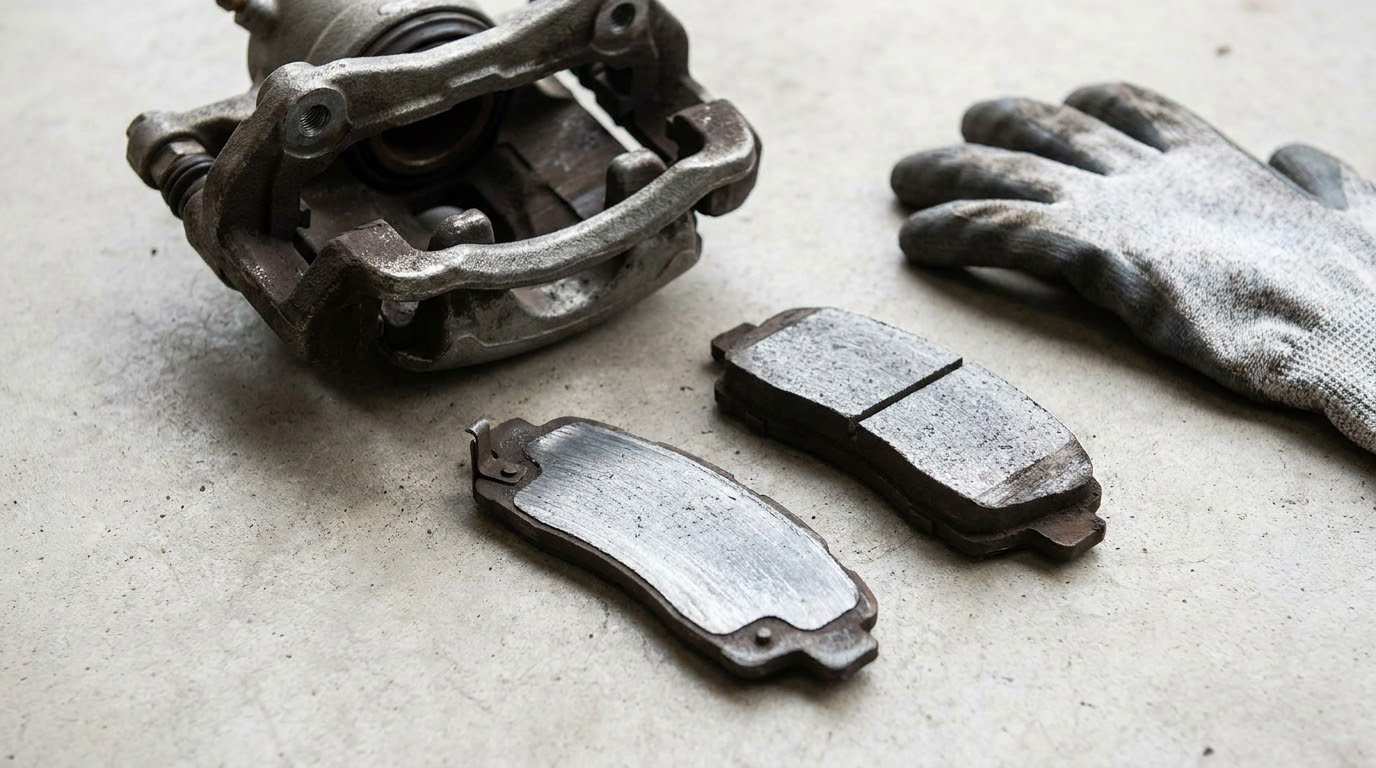
If one brake pad is wearing faster than the other, something on that corner of the car is not releasing properly. The caliper is failing to retract, so that pad keeps light contact with the rotor while you drive, and it grinds away at road speed instead of braking speed. On a BMW, the usual suspects are corroded caliper slide pins, a seized piston, or hardware that was left dry at the last pad change.
I’ve pulled enough wheels on these cars to know that a pad going to bare metal while the other three look nearly new is almost never a pad-quality problem or a rotor problem. It is a drag fault, and it will eat a fresh set of pads and rotors just as fast as the last one.
Table of Contents
- What Causes One Brake Pad to Wear Faster?
- Is It Normal for the Inner and Outer Pads to Wear Unevenly?
- How to Tell Whether the Difference Is Left to Right or Inner to Outer
- Can Wheel Alignment Cause Uneven Brake Pad Wear?
- Can a Sticking or Worn Brake Caliper Cause It?
- What Else Should You Inspect Before Replacing the Pads?
- Is Uneven Brake Pad Wear Dangerous?
- Frequently Asked Questions
- What to Check First
What Causes One Brake Pad to Wear Faster?
The mechanism is the same in nearly every case: one pad stays closer to the rotor than it should, takes a share of the braking work it was never meant to take, and wears down faster than its partner. The causes below are ordered roughly by how often I see them.
- Corroded caliper slide pins. A floating caliper slides on greased pins; once rust freezes the pin in its bore, the caliper stops floating and the outer pad never pulls clear of the rotor.
- A piston that will not retract. Varnish on the piston or a hardened piston seal holds pressure in the cylinder, so the inner pad stays pressed against the disc.
- Dry or missing brake hardware. New pads fitted without abuttment clips, shims, or a fresh hardware kit let the friction material walk out of position and wear on an edge.
- An aged flexible brake hose. The hose itself can collapse internally under pressure and act like a one-way valve, holding the caliper partly applied. Owners rarely suspect this one because the hose looks perfect from the outside.
- Worn guide pin bushings or a bent caliper bracket. A bushing that has lost its lip makes the caliper sit crooked, so the pad contacts the rotor on one side only.
- Alignment and suspension wear. Bent or worn steering and suspension parts change camber and toe, and a wheel sitting at an angle wears its pad at an angle.
- Rotor thickness variation or a warped rotor. A thin or dished disc makes the pad chatter, and a lipped disc wears a tapered pad.
| Cause | Typical wear pattern | What you notice |
|---|---|---|
| Corroded slide pins | Outer pad thin, inner pad nearly full | Hot wheel, faint smell, possible pull |
| Seized piston | Inner pad thin, outer pad nearly full | Pedal stays firm, wheel very hot |
| Missing hardware | One edge of the pad worn, cracks in the friction material | Squeal, ticking, clicking |
| Collapsed brake hose | Fast wear on one corner only, no obvious caliper fault | Pedal feels different after it has been up |
| Alignment or suspension wear | Both pads on one wheel worn at an angle | Car pulls under braking, uneven tire wear |
| Warped or thin rotor | Tapered wear, pad worn toward one edge | Pulsation through the pedal, vibration |
Pad compound and driving style come into it too. A hard, long-life friction material lasts longer but can pick up a wear pattern from a rotor that is not perfectly flat, while a softer compound bites harder and may wear slightly faster on a car driven mostly in traffic. Road salt and a car that sits outside through winter will corrode slide pins far faster than a car kept in a garage.
Is It Normal for the Inner and Outer Pads to Wear Unevenly?
A small difference is normal. On a floating caliper, the inner pad sits on the piston side and the outer pad is pulled in by the caliper body sliding on the pins, and the two do not share the load perfectly. The trade rule is that a gap of about 2 to 3 mm between the inner and outer pad on the same corner is acceptable. Past that, something is wrong.
That is the part most owners get backwards. A rule of thumb that circulates on Bob Is The Oil Guy goes: outer pad worn means the slide pins are binding, inner pad worn means the caliper piston is binding. It is a useful starting point on a typical floating caliper, and it is not universal. Opposed-piston designs, where pistons push from both sides, break the rule entirely, and so do calipers with a single sliding pin on one end only.
So treat inner-versus-outer as a hint, not a verdict. The measurement that matters is how much material is left in millimetres, compared against the minimum wear specification on the edge of the friction material.
How to Tell Whether the Difference Is Left to Right or Inner to Outer
Work corner by corner and measure, do not guess. With the wheels off and the caliper in view, use a caliper or a ruler to record the friction material thickness on all eight pads, including the inner pad and the outer pad at each of the four corners. Note it on paper or your phone. Percentages are useless here; millimetres against the minimum spec is the only honest measurement.
Then read the pattern. If the thin pad is on the same side of the car at both axles, think alignment or a suspension part that has shifted both wheels the same way. If the thin pad is the inner one at one corner only, suspect the piston. If it is the outer one, suspect the slide pins or the caliper’s ability to float. A rear-only problem on a model with electronic brake distribution can be normal, because the system biases rear braking and some cars have a service bulletin for it.
Why Is One Brake Pad Wearing Faster Than the Other?
Here is the sequence I would run on a BMW driveway. Jack the car, support it properly, and remove the wheel on the suspect corner first. Measure both pads and compare them to the minimum wear line. Then look at the rotor face for a bright worn band on one side, a lip on the outer edge, or scoring that stops partway across.
Next, test whether the caliper moves freely. Push the caliper body inward by hand. On a healthy floating caliper it slides in smoothly. If it feels rough, will not move, or springs partway and stops, you have your answer: the slide pins are seized or the bushings are gone. Keep the engine off while you work on the caliper, use a jack stand rather than the jack alone, and if you are unsure at any point, stop and get a qualified shop to look at it.
On a BMW, also check the piston boot and the guide pin bores while the caliper is apart. A torn boot lets fluid and grit into the cylinder, and hardened fluid residue around the pin bore is the visible proof of the freeze that caused the wear.
Can Wheel Alignment Cause Uneven Brake Pad Wear?
Yes, though it is a secondary cause rather than the usual one. Camber, toe and caster set how the wheel sits when you brake, and a wheel that leans inward loads the inner edge of the pad, while a wheel leaning outward loads the outer edge. Wrong rear alignment is a quiet one: the car still stops straight, but the rear pads taper off at an angle and a rear tire wears the same way.
The bigger risk is that the alignment is wrong because a ball joint, tie rod end or control arm bushing is worn. Those parts hold the alignment, and once one fails the geometry changes on its own. If uneven pad wear comes back within a year of a proper pad change and the caliper is free, check the suspension before you replace pads again. Tire wear is worth a look too, since cupping or feathering points the same direction.
Can a Sticking or Worn Brake Caliper Cause It?
This is the number one cause, and it comes in several forms. Seized slide pins are the most common, usually after a winter where road salt got into the bore. A seized piston shows up as varnish on the cylinder wall or a hardened seal. A distorted caliper body or a bent bracket keeps the whole unit off-parallel, so one pad touches the disc across its face and the other only kisses it.
Inside the caliper, the piston boot and the piston seal do different jobs. The boot keeps fluid and grit out of the cylinder, and the seal pulls the piston back when pressure releases. When that seal hardens or the cylinder walls varnish over, retraction stops, which is the fault in a nutshell.
The symptoms are easy to read once you know them. A wheel noticeably hotter than the others after an ordinary drive, a smell of hot rubber, grinding that continues after you stop braking, or a car that pulls toward one side under braking all point at a drag fault. Forum threads are full of owners who paid for a full set of pads and rotors and ended up with one pad at metal while the other three looked new, which is the signature of a caliper that was never freed up.
What Else Should You Inspect Before Replacing the Pads?
Rotor first. Check the thickness against the minimum casting specification stamped on the disc, and check thickness variation, which is the difference between the high spot and the low spot measured a few inches apart. A rotor at or near the limit cannot be machined back, and fitting a new pad onto a rotor that is already at the discard thickness wastes the pad.
Then the pads themselves. Look for delamination, where the friction material has separated from the backing plate, and for a tapered face that lines up with a lipped rotor edge. Cracking, glazing, or lifted edges on the friction material are heat damage from dragging, not wear, and they will return on a new pad set if the drag is not fixed.
Look at the axle hardware, the hoses, and the wheel bearings. A collapsed hose was described on a mechanics forum as the failure nobody expects, and it acts as a one-way valve that holds the caliper partly applied. For wheel bearing play, grab the top of the tire and rock it; any perceptible movement means the bearing goes in before you touch the brakes.
Finally, treat the axle as a set. Pads on the same axle are matched in friction material and thickness on purpose, and a new thin pad opposite an old thick one changes how the car brakes. A brake wear sensor on the BMW will tell you when to change pads, and fitting a fresh sensor with the set is the sensible move.
Is Uneven Brake Pad Wear Dangerous?
Yes, and the mechanism matters. A pad in continuous contact heats the rotor at that spot, which thins the friction material further, which produces more heat. It can glaze the new pad, warp the rotor, and in the worst case cook the fluid in that caliper. Braking force on that side drops away too, so the car pulls under braking and your stopping distance gets longer.
Stop driving and arrange inspection if you see any of these: a pad at or below the minimum wear line, a pad worn to metal or close to it, a rotor with a visible lip or a hot spot, fluid on the rotor or wheel, grinding that continues once you are off the gas, or a pedal that sits low after a stop. Soot on the inside of the wheel is a good sign the caliper is cooking something.
Slow wear on one corner with no heat, no smell, and both pads still above the minimum line is not an emergency. It is still a fault worth finding before the next pad change, but you can drive it to a shop.
Frequently Asked Questions
Is it normal for brake pads on the same axle to wear at different rates?
A small difference is normal. On a floating caliper the inner pad sits on the piston side and the outer is pulled in by the sliding body, so a gap of roughly 2 to 3 mm between them is expected. Beyond that, treat it as a fault and look at the slide pins, the guide pin bushings and the piston seal for retraction problems.
Why is one brake pad much thinner than the other?
Something on that corner is not releasing fully, so the thin pad is dragging against the rotor during ordinary driving. A thin outer pad points at seized slide pins or a bushing that has lost its lip, and a thin inner pad points at a piston or piston seal that will not retract. Collapsed brake hose and bad alignment can produce the same symptom.
Can uneven brake pad wear damage the brake rotor?
Yes, and it usually does before you notice it. A dragging pad heats one section of the rotor, which thins and warps it and creates a lip that then tapers the new pad. Corrosion can also migrate between the friction material and the backing plate, and on a vented rotor the uneven heat can cause cracking. Check thickness and thickness variation before fitting new pads.
Should I replace both brake pads on one axle or all four?
Replace both pads on the axle you are working on, as a matched set, because they are engineered to have the same friction material and thickness. All four is a sensible choice if the other axle is close to the minimum wear line, since you will want to get the wheel off anyway. Fixing one corner only is fine when the other three corners measure comfortably above spec.
How much brake pad wear difference is safe to drive?
A difference of 2 to 3 mm between inner and outer on the same corner is within normal range. More than that, especially with a hot wheel, burning smell, grinding noise, or a car that pulls under braking, means you should not keep driving normally. Do not judge by percentage; measure the friction material in millimetres against the minimum wear line stamped on the pad.
What to Check First
Start with a ruler and a written record of all eight pads, in millimetres. Compare inner against outer at the same corner, then compare the four corners against each other, and remember the 2 to 3 mm baseline. Look at the rotor for a lip, a hot band, or scoring that stops partway across, and check its thickness against the marking on the casting.
Then confirm the caliper actually floats by hand, with the wheel off and the vehicle supported on a jack stand. If it binds, clean and lubricate the slide pins, free the piston back inside its bore, and fit a fresh hardware kit. If the caliper is free and the wear still comes back, the cause is alignment, a worn suspension joint, or a collapsed hose, so chase those next. And fit a matched set on the axle rather than one pad, or the same uneven wear starts again on the next set of tires.