
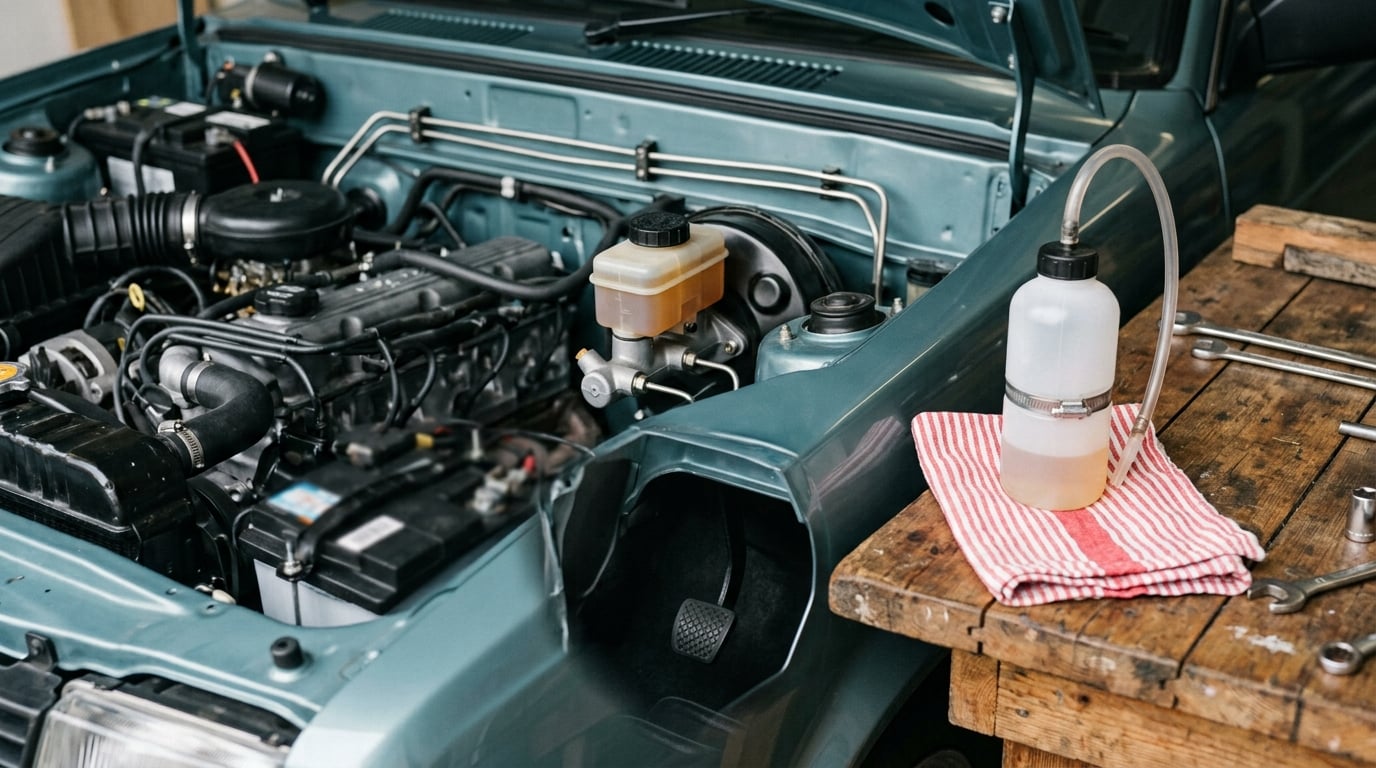
Your brake pedal feels spongy because the hydraulic system that carries your foot pressure to the wheels can no longer transmit force cleanly. Air trapped in the lines, moisture in the fluid, a leak somewhere, or worn internal seals all absorb part of that pressure, so the pedal travels farther before the brakes bite.
That is the short version, and it is worth sitting with for a second. A pedal that used to firm up within an inch or two of the floorboard and now goes halfway down the pedal travel is a change in the system, not a change in your foot.
This guide walks through the causes in the order they actually show up, the checks you can make in a driveway with the car on jack stands, and the point where a bleed stops being a sensible weekend job.
Table of Contents
- What Does a Spongy Brake Pedal Mean?
- Why Does My Brake Pedal Feel Spongy? Common Causes
- How to Tell Whether the Problem Is Air, Moisture, or a Mechanical Issue
- What to Check Before Repairing a Spongy Brake Pedal
- How to Fix a Spongy Brake Pedal Safely
- When Is a Spongy Brake Pedal Unsafe to Drive?
- Frequently Asked Questions
- Can air in the brake lines make the pedal feel spongy?
- How do I know if brake fluid moisture is causing a spongy pedal?
- Should I drive if my brake pedal feels soft?
- Does a spongy brake pedal always mean the master cylinder is bad?
- Why does my BMW brake pedal feel spongy after bleeding?
- Can worn brake pads cause a spongy pedal?
- Conclusion
What Does a Spongy Brake Pedal Mean?
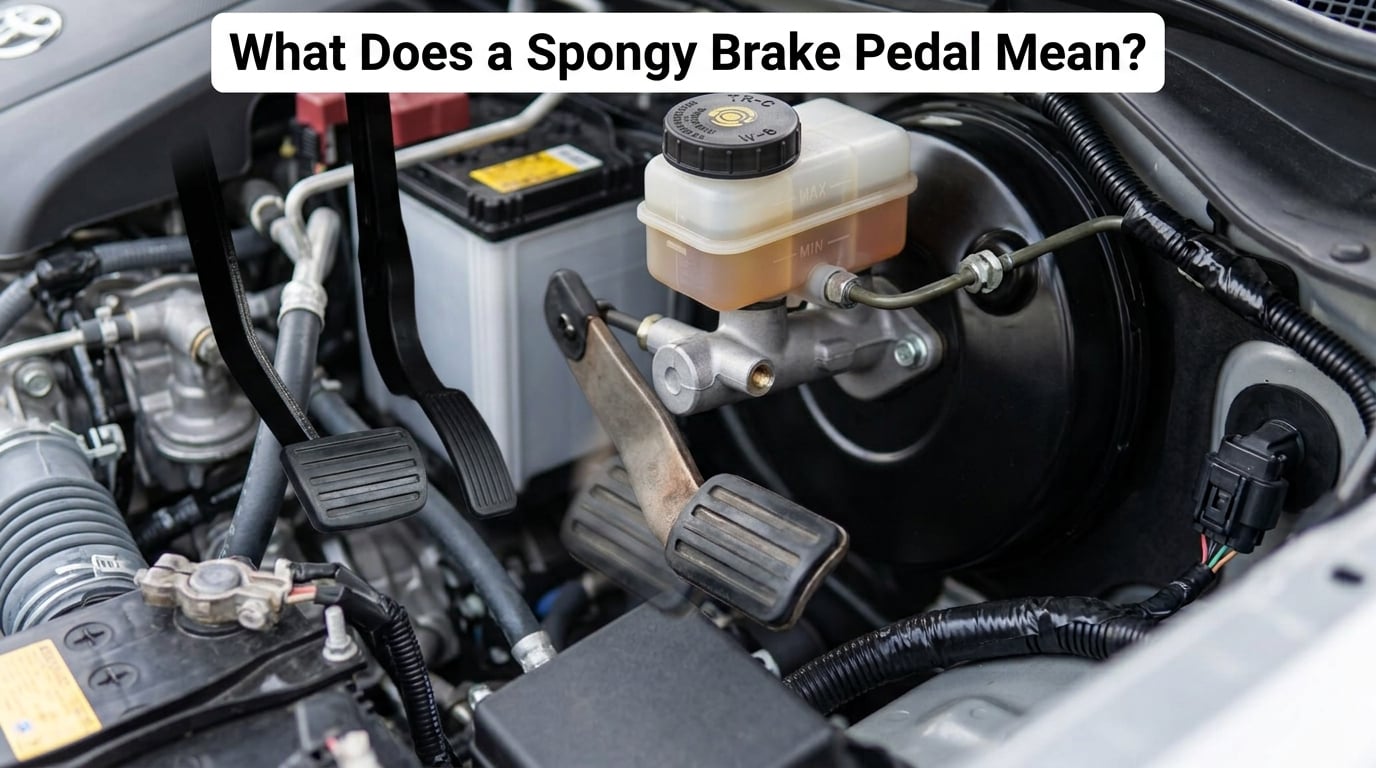
A spongy brake pedal is one that feels springy, vague, or slow to develop pressure. Your foot goes down and the pedal seems to swallow the first half-inch of travel before the brakes engage.
The language people use varies, and the distinctions are useful. A soft pedal travels too far but returns fully. A sinking pedal stays down once you stop applying pressure, often at a light or an idling. A springy pedal pushes back against your foot partway down. All three point at the same system, and the difference between them tells you where to look first.
A healthy pedal in a properly bled system feels firm. It has a small amount of free play at the top, usually under an inch, then resistance builds quickly and predictably as pressure reaches the calipers. The pedal stays where you put it.
Why fluid, air, and seals decide how your pedal feels
Your brakes work on hydraulics. Brake fluid is designed to be essentially incompressible, so pressure you create with your foot transfers straight through the master cylinder, along the steel lines and flexible hoses, into the caliper pistons that squeeze the pads against the rotor.
Air is compressible. A bubble in the line absorbs the first push of your foot and squeezes down instead of pushing fluid, which is exactly the mushy, delayed feel people describe. The same thing happens with water vapor, which is why old fluid can feel fine cold and soft after a hard drive up a mountain grade.
Seals hold the system together. The master cylinder has internal seals that keep pressure from bypassing back toward the pedal, the caliper piston has a seal that rolls it back after release, and the rubber hoses flex with the suspension. When any of them wear, pressure escapes where you cannot see it and the pedal never reaches a hard stop.
Hardware sets the rest of the feel. Brake pads that are worn past the point of holding the caliper piston pushed in, a parking brake that is adjusted too tight, or a seized caliper that never fully releases all change pedal travel. None of them involve air, and a bleed will not fix any of them.
Why Does My Brake Pedal Feel Spongy? Common Causes
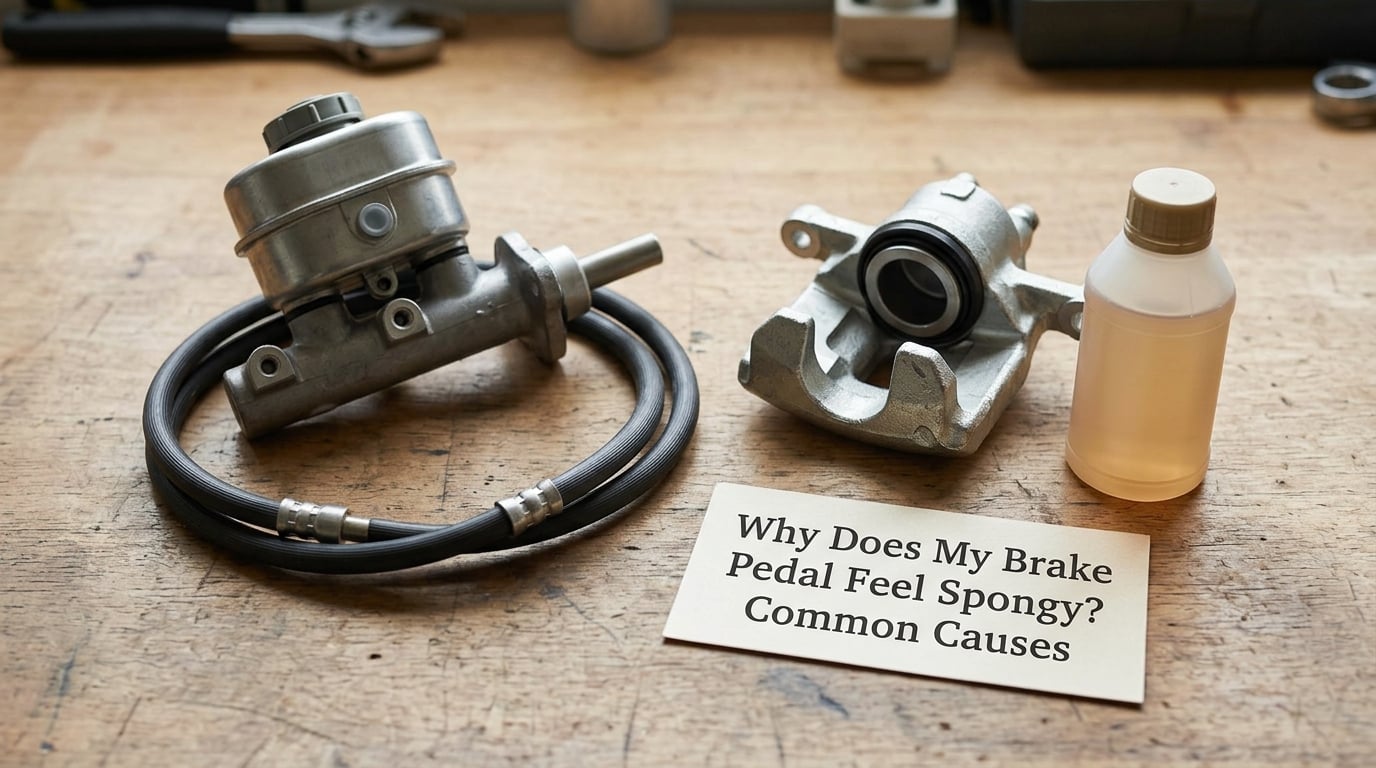
Ranked by how often they turn out to be the answer, here is what actually causes a spongy brake pedal.
Air in the hydraulic lines. Air gets in after a fluid change, a caliper or hose replacement, a low-fluid episode, a brake line repair, or a master cylinder swap that was not bled properly. It is also the most common reason a pedal goes soft right after pad work, when the caliper pistons are pushed fully back and the fluid displaced has nowhere to go until you bleed it out.
Moisture in the brake fluid. Brake fluid is hygroscopic, which just means it pulls moisture out of the air and holds it. DOT 3 fluid absorbs roughly 1 percent water for every 10 percent of its volume, and that water lowers the boiling point. Once the fluid is near its boiling point it turns to vapor, the vapor compresses like air, and the pedal goes soft. This is the reason fluid that looked acceptable when it was cold feels fine on the way to the store and vague on the way home after a long descent.
A leak. Steel lines corrode from the inside, rubber hoses crack at the crimp, caliper fittings weep, wheel cylinders seep, and the master cylinder can fail without a drop on the ground. The tell is a reservoir that creeps down between service intervals without anyone topping it off.
Low or contaminated fluid. A low reservoir exposes the master cylinder port to air. Contamination from coolant, solvent, or the wrong fluid chemistry does the same job more slowly.
A failing master cylinder. The internal seals wear, and pressure slips past them back toward the pedal. Nothing shows outside the car. The pedal is firm for a few minutes after start-up, then sinks, and it is worst at stoplights where you are holding pressure with no forward motion.
Worn pads and seized caliper pistons. Thin pads let the piston travel further in its bore, and if the piston does not roll back cleanly the caliper drags. Some cars also have a free play adjuster or a parking brake adjustment that has backed out, adding slack that feels like a soft pedal.
ABS or electronic issues. A failing ABS modulator, a stuck solenoid, or a low brake fluid level that trips the fluid-level switch can hold a valve open or cut pressure. If the ABS light is on, the hydraulic side is not the first place to look.
How to Tell Whether the Problem Is Air, Moisture, or a Mechanical Issue
You can narrow a spongy pedal down with a few observations, and the useful part is that each test separates a different cause.
Start with the engine off. Press the pedal. If it goes to the floor and firms up over three or four pumps, that is textbook air. The pump pushes the bubble past the master cylinder, pressure catches up, and you feel the difference. Do it with the engine running and repeat the test; if the pedal firms up noticeably more with the engine running, the booster and check valve are working and you are looking at air rather than a booster fault.
Then compare engine off to engine on. A pedal that is firm with the engine off and soft once it starts points at the vacuum-operated brake booster, its check valve, or a vacuum hose that came off. It is a strange symptom because nothing about the pedal itself changes, only what the engine is doing while you press it.
Look at the reservoir with the car cold and level. Fluid between the minimum and maximum lines is normal. Below minimum, or a level that dropped since last month, means fluid is leaving the system somewhere. Dark fluid with a waterline, a layer of clear liquid at the bottom of a translucent reservoir, or fluid that smells sharp or feels oily are all signs of contamination worth fixing regardless of pedal feel.
Check when the pedal changes character. A pedal that only goes soft after sustained hard braking, towing, or a track day points at moisture boiling rather than a leak. A pedal that is suddenly soft one morning with no service history behind it points at a sudden fluid loss. A pedal that went soft the day after pad and rotor work points at air introduced during the job.
Finally, count warning lights. A brake fluid level light, a red brake system warning, or an ABS light each remove a whole branch of possibilities before you take anything apart. If the level light is what got your attention in the first place, What Causes a Low Brake Fluid Warning Light? covers the usual suspects.
| What you notice | Most likely cause | What to check | DIY or shop |
|---|---|---|---|
| Pedal to the floor, firms up after 3-4 pumps | Air in the lines | Reservoir level, recent brake work, bleed procedure | DIY bleed if the car has no ABS or you have the right kit |
| Pedal sinks and stays down at a stoplight | Failed master cylinder internal seal | Fluid level trend, no external leak, pedal after start-up | Shop |
| Reservoir level dropping slowly | Leak at a hose, line, caliper, or wheel cylinder | Wetness on the hose, at each wheel, under the car | Find the leak, then shop unless it is a hose swap |
| Firm engine off, soft engine running | Booster check valve or vacuum hose | Booster hose routing and condition, check valve | Shop |
| Soft only after long or hard braking | Moisture in the fluid boiling to vapor | Fluid age, whether it was ever flushed | DIY flush with the correct fluid |
| Soft right after pad or rotor work | Pistons pushed fully in, air not bled out | Whether anyone bled the system after reassembly | DIY bleed |
| Pedal feels fine but the car pulls and the pedal is sticky | Seized caliper piston or dragging parking brake | Wheel hub temperature after driving, pad retraction | Shop |
| Pedal feels soft with the ABS light on | ABS module or fluid level sensor fault | ABS light history, code read, fluid level | Shop |
What to Check Before Repairing a Spongy Brake Pedal
Before you buy fluid or schedule a bleed, do these checks in the driveway. They take twenty minutes and they rule out the expensive causes for free.
Check the reservoir level and the condition of the fluid. Open the hood on level ground with the engine cold, look at the reservoir against its markings, and note the reading so you can compare it in a month.
Inspect the visible lines and hoses. Follow the rigid steel lines from the master cylinder to each corner and run your hand along them looking for rust blooms, dents, or a bulge in a rubber hose. A bulge means the carcass is failing even if it has not split yet.
Look for wetness at every corner. A thin film of clear fluid around a caliper, a wet patch on the inside of a wheel rim, or fresh fluid on a fender liner all point at that corner. A slow leak at a caliper bleeder often shows as dampness on the underside of the caliper rather than a puddle.
Feel the hub after a drive of fifteen minutes. A wheel noticeably warmer than the others points at a dragging caliper or a parking brake that is not fully releasing. This is a different problem from a spongy pedal, and it is worth separating the two.
Check the parking brake travel. On a manual-handle car it should hold the car on a modest incline when fully applied and fully release when the handle returns to its stop. An adjustment that was never returned to spec after rear brake work adds pedal travel and gets blamed on the hydraulics.
Read your owner manual for two things: the required fluid specification and the replacement interval. Most manufacturers specify DOT 3 or DOT 4, while a few specify low-viscosity fluid for electronic stability systems, and mixing specifications can cause real problems. If the manual calls for a specific standard, use that one rather than whatever is on the shelf. It also helps to know How Long Does Brake Fluid Last in the Bottle? before you decide between a top-up and a flush.
How to Fix a Spongy Brake Pedal Safely
Brake work is safety-critical, and the fix depends entirely on what you found. Match the repair to the cause.
A complete bleed removes air. This is the right fix for air introduced by brake work, a low-fluid episode, or a fluid change. With the car on jack stands and the reservoir topped up, work the bleeder valves in the order your service manual specifies. Pump the pedal until it is firm, close each valve as fluid comes out, and keep the reservoir above the minimum line the whole time. Never let the reservoir run dry while a bleeder is open; pulling air through an empty master cylinder means starting over.
A fluid flush replaces contaminated fluid. If the fluid is old, water-laden, or the wrong specification, a flush removes moisture and the additives that have broken down. This is often the whole fix when the pedal softens only after hard braking.
A hose, caliper, or line repair addresses a leak. A cracked flexible hose is a common and relatively contained job. A corroded steel line means the section gets cut and joined with a properly flared fitting, and that is shop territory unless you have a flare tool and the patience to get it right.
A master cylinder replacement fixes an internal seal failure. This is rarely a DIY job, because the cylinder has to be bench-bled or properly primed before it goes in, and a mistake shows up as a pedal that never firms.
Pad and caliper work needs a bleed afterward. If the pistons were pushed fully in during a pad change, the fluid level at the reservoir rises and the pedal grows soft. That is normal and it is fixable with a bleed, not a sign of damage.
ABS problems need a code read. If the ABS light is on, find out what the module is reporting before replacing hydraulic parts. Fluid level, a wheel speed sensor, and a solenoid all produce symptoms a driver can feel but a scanner can name.
Two habits make brake work safer. Use only fluid that meets the specification printed on the reservoir cap or in the manual, and use a bleed bottle or funnel with a screen so you do not spill fluid on the paint. Brake fluid strips paint fast and it is a miserable cleanup job.
When Is a Spongy Brake Pedal Unsafe to Drive?
A soft pedal is a warning, not a comfort issue. It means your stopping distance has grown, and the growth is uneven. Sometimes you stop on the first try and sometimes it takes more pressure than you have left.
Stop driving and arrange inspection if any of these show up.
A pedal that sinks to the floor and stays there, especially at a stoplight, is the clearest sign of internal failure. The brake fluid warning light or a red brake system warning means the system has already told you it is low on fluid or has a major fault. Fluid dripping under the car after it has been parked is a leak you can see, and wetness at a wheel is a leak you can feel.
Do not drive on a soft pedal if the ABS or stability light is on and you have no diagnosis. Pulling, grinding, dragging, or a hot pedal after a short drive points at a mechanical problem, not a fluid one. And if the pedal goes soft and stays soft after a hard stop, treat the car as undrivable.
Minimizing the drive home to get proper help is a reasonable judgment call. Cross-town at low speed with light traffic is one thing; highway speed, a mountain descent, or a full car of people is another.
Frequently Asked Questions
Can air in the brake lines make the pedal feel spongy?
Yes, and it is the single most common cause. Air is compressible, so a bubble in the line absorbs the first part of your foot pressure instead of pushing fluid to the caliper. The tell is a pedal that drops toward the floor and then firms up over three or four pumps. A bleed clears it, provided the reservoir never runs dry.
How do I know if brake fluid moisture is causing a spongy pedal?
Moisture shows up as a pedal that is firm when cold and soft after sustained hard braking, towing, or a long descent. Water lowers the fluid boiling point, and vapor compresses like air. Translucent reservoirs show a separate layer of liquid at the bottom, and the fluid often darkens over time. Most manufacturers set a two to three year replacement interval for this reason.
Should I drive if my brake pedal feels soft?
Treat a soft pedal as a reason to stop driving, not a reason to drive carefully. Stopping distance has grown and the response is uneven. It is reasonable to drive a short distance at low speed to reach a shop, but do not drive if the pedal sinks and stays down, if a brake warning light is on, if you see fluid on the ground, or if the pedal went soft after a hard stop. Those mean arrange a tow.
Does a spongy brake pedal always mean the master cylinder is bad?
No. Air in the lines, old fluid, a leak, a booster check valve, or a seized caliper can all produce the same symptom. The master cylinder is suspected when there is no visible leak, the reservoir level holds steady, and the pedal is firm right after starting but sinks the longer the car idles. Confirm the diagnosis before anyone replaces the cylinder.
Why does my BMW brake pedal feel spongy after bleeding?
On a BMW, electronic stability control and the brake booster mean a bleed is not just about pushing fluid through four corners in sequence. A cheap one-port bleed at the master cylinder often leaves air trapped in the ABS modulator, so the pedal stays soft. The service procedure includes specified bleed points and a fluid pre-fill, and a scan for ABS fault codes is worth doing before you assume the master cylinder failed.
Can worn brake pads cause a spongy pedal?
They can contribute, though not the way most people expect. Worn pads let the caliper piston travel further into its bore, and a piston that does not retract cleanly leaves the caliper slightly dragging, which changes pedal feel and adds travel. The bigger clue is that the pedal is soft but brakes normally once engaged. A piston that seized fully back is a different and more serious fault, and it usually shows up as heat at one wheel.
Conclusion
A pedal that has gone soft is not something to adjust around. Start where this guide starts: check the reservoir level and the condition of the fluid, look for wetness at the hoses and each corner, and note whether pumping the pedal or starting the engine changes the feel.
Those three observations usually point at one cause. If it is air or old fluid, a bleed or flush using the specification in your owner manual is the honest next step. If the pedal sinks and stays down, or the fluid level keeps dropping, stop driving and have a qualified brake technician find the leak or the failed seal.
Whatever you do, do not let a bleed become the answer by default. A second bleed that changes nothing is a symptom of a cause nobody looked for yet.