
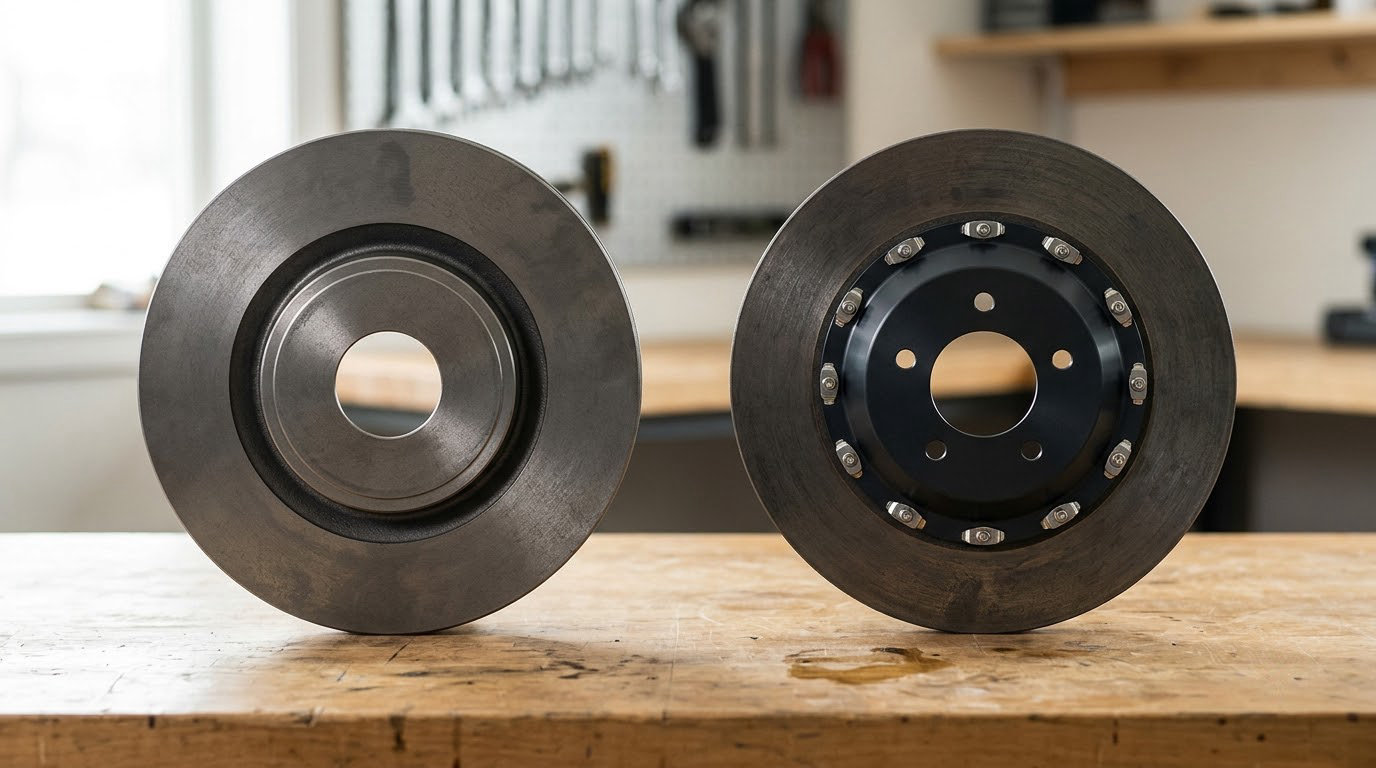
If you are shopping brake rotors and keep hearing about two-piece designs, the short version is this: a one-piece rotor is cast as a single solid iron piece, while a two-piece rotor splits the design into an outer iron friction ring and a lightweight aluminum center hat. For most street-driven cars the one-piece rotor is the right call, and the two-piece only earns its extra complexity on a car that runs repeated hard stops or carries serious weight.
That answer covers the average case. The interesting part is why the two-piece exists, what it actually does for you once heat is involved, and where the marketing leaves out the caveats. I’ve worked through the engineering with the manufacturers and forum communities that argue about it most, and here is the honest version.
Table of Contents
- Two Piece Rotors vs One Piece Rotors at a Glance
- How Two Piece Rotors vs One Piece Rotors Are Built
- Heat Management and Cooling Differences
- Weight and Unsprung Mass
- Braking Feel, Noise, and Pedal Consistency
- Corrosion, Maintenance, and Repairability
- OEM, Sport, and Aftermarket Applications
- Which Should You Choose?
- Frequently Asked Questions
- Are two-piece rotors always better than one-piece rotors?
- Are two-piece rotors better for daily driving?
- Do two-piece rotors stop a car in a shorter distance?
- What is the difference between a two-piece rotor and a slotted rotor?
- Is an OE two-piece rotor automatically better than an aftermarket one-piece rotor?
- Conclusion
Two Piece Rotors vs One Piece Rotors at a Glance
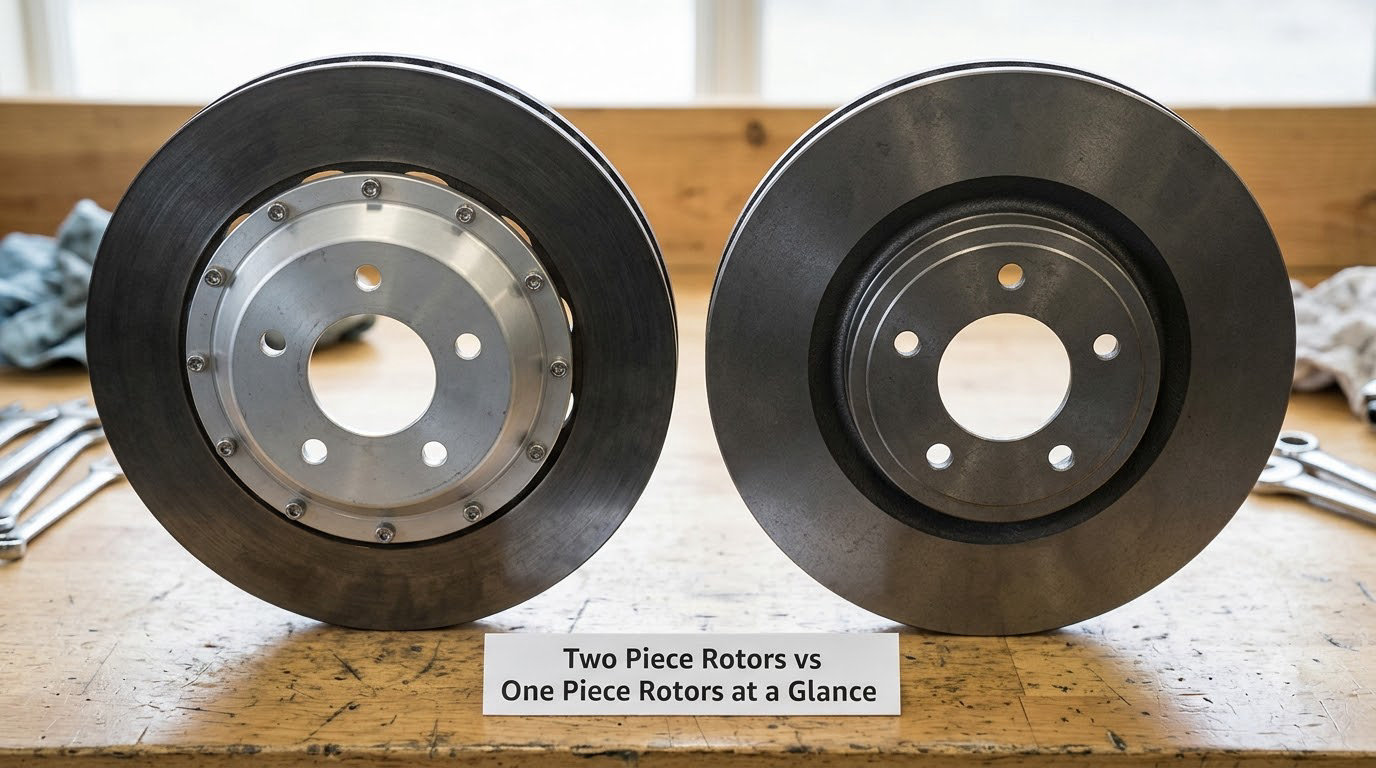
Choose the one-piece rotor for routine street driving, budget-minded repairs, and any car that never sees sustained hard braking. Choose the two-piece when heat soak into the hub is a real concern, when unsprung and rotational mass matter to how the car responds, or when the vehicle’s factory specification already called for one.
| Attribute | One-piece cast iron rotor | Two-piece floating rotor |
|---|---|---|
| Construction | Hat and friction ring cast as one iron unit | Iron friction ring joined to a cast or forged aluminum hat |
| Typical weight | Heavier, especially on larger front diameters | Typically 3 to 7 pounds lighter per corner, roughly 15 to 20 percent |
| Heat path to hub | Heat conducts straight from the friction face into hat, hub and wheel bearings | Aluminum hat acts as a thermal barrier and partial heat sink, so far less heat reaches the hub |
| Thermal expansion | Whole disc expands together; heavy cycling can dish or warp the face | Floating mount lets the iron ring grow radially without fighting a cooler center section |
| Pedal pulsation under hard use | More prone to coning and pulsing if run hot | Resists coning because the ring stays flat as it heats |
| Resurfacing | Can usually be machined down to the discard thickness if above minimum | Generally cannot be machined without destroying the floating relationship |
| Low-speed noise | Quieter, because there is no floating hardware | Drive pins and retainers can click, rattle or ping as they expand and contract |
| Relative up-front cost | Considerably cheaper to buy | Noticeably more expensive, sometimes approaching double |
| Long-term cost | Replace the whole unit when worn out | Reusable hat can survive several friction ring changes |
| Best suited to | Daily drivers, small and light cars, cold-climate street use | Heavy cars driven hard, track days, autocross, time attack, towing |
Four of those rows are where the decision actually gets made, and they are worth stating plainly before the detail:
- Weight. Two-piece rotors shed unsprung and rotational mass, usually 3 to 7 pounds per corner, and that shows up in steering response and acceleration. The catch is that the saving is real only if the rest of the corner is built to match.
- Heat and warping. The aluminum hat blocks most of the heat before it reaches the hub and wheel bearings, and the floating mount lets the iron ring expand freely, so warping and pedal pulsation are less likely. The catch is a thin friction ring with a small wear margin on some applications.
- Cost and replacement. Two-piece rotors cost meaningfully more up front, and they are usually sold as a matched hat and ring assembly. The catch is offset a little by the ability to replace just the iron ring and keep the hat.
- Noise. The floating hardware on a two-piece rotor can produce clicking, rattling or pinging at low speed as the parts expand and contract. The catch is that it is usually harmless, and a one-piece rotor of comparable quality is quieter.
How Two Piece Rotors vs One Piece Rotors Are Built
A one-piece rotor starts as a single casting of grey cast iron. The center bell and the outer friction ring are one continuous piece of metal, machined flat and turned to final diameter. Nothing between the friction face and the hub interrupts the flow of heat, which is exactly why these rotors pass heat straight into the wheel hub and the wheel bearing.
A two-piece rotor separates those jobs. The outer ring that the pads clamp is still cast iron, because iron is what tolerates repeated friction heat. The center section is aluminum, lighter and less thermally conductive than iron in the direction that matters here, and the two are joined either by fasteners and drive pins or by a cast-together process that bonds them into a single unit while still allowing controlled movement.
Fixed two-piece versus full-floating two-piece
This is the distinction that causes most of the confusion, and it is worth sorting out before comparing anything else. A fixed two-piece rotor has an iron ring bonded to its aluminum hat with no intentional movement between them. It saves weight relative to a one-piece casting, but it does not get the thermal isolation benefits of a true floating design.
A full-floating two-piece rotor uses drive pins, a backplate and threaded retainers to mount the iron ring to the hat. The ring is not bolted rigidly; it can move radially by a small amount. Cast iron and aluminum expand at different rates, and disc temperatures on a hard-driven car can exceed 1100 degrees Fahrenheit. That radial float is what lets the ring grow without being distorted, and it is the mechanical reason a two-piece rotor resists coning and pedal pulsation where a solid rotor does not.
When someone says “two-piece rotor,” they may mean either design. Only the full-floating version delivers the thermal behavior the type is known for.
Can you machine a two-piece rotor?
Usually not. Resurfacing a one-piece rotor means removing a fraction of an inch of iron and checking the result against the minimum thickness, which is how a worn but serviceable rotor gets a second life. A floating two-piece rotor cannot be machined in a way that preserves the relationship between ring and hat, so the resurface trick is simply off the table.
This matters more than most buyers expect because the friction ring on a two-piece rotor is thin to begin with. On the Cadillac CTS-V J56 brake package, the front rotor allows only about 2 millimeters of wear before it drops below its discard measurement. That is the whole service life. A one-piece rotor with a thicker section gives you considerably more margin.
The abandoned composite rotor
Worth knowing, because it explains some old advice you will run into online. In the late 1990s, a handful of manufacturers offered composite rotors with a stamped steel hat cast into the iron. They were light, but they were prone to runout and to installation error. Automakers dropped the design in the early 2000s, and the modern aluminum-hat two-piece rotor is a different animal entirely.
Heat Management and Cooling Differences
Braking converts motion into heat, and the rotor’s job is to give the pads a friction surface and then shed what it absorbs into the air. The two-piece design helps in two ways at once. The aluminum hat slows the heat moving inward toward the hub, wheel bearing, and the grease inside them, and the open iron ring around it has less mass to store heat in the first place.
That is the real reason to run a two-piece on a heavy car. Heat soak into a wheel bearing is the kind of failure that ends a trip, and protecting the bearing grease and the hub flange is worth a lot on a vehicle that tows or runs hard stops repeatedly.
But be honest about the limits. The gap between the two designs is smaller than marketing implies, and in this comparison of two piece rotors vs one piece rotors, cooling is not the simple win it sounds like. Actual cooling depends heavily on airflow past the rotor, whether the wheel and its spokes are ducting air to the disc, the internal vane design, brake pad compound, and how much repeated-stop driving the car actually sees.
Internal geometry matters here. Straight-vane discs move air outward. Curved vanes act as a centrifugal pump, pulling air through the disc. Brands like DBA and Brembo spend real engineering effort on that geometry, and DBA’s patented Kangaroo Paw vane shape is a good example of a design that raises internal surface area while keeping structural strength. Direction-specific discs exist because the pump direction has to match the rotation of the wheel.
A two-piece rotor with a poor vane design and a wheel that blocks airflow can cool worse than a well-vented one-piece disc on an open-spoke wheel. Construction is one variable among several, not a verdict.
Weight and Unsprung Mass
Two-piece rotors are commonly quoted as 3 to 7 pounds lighter per corner than an equivalent one-piece casting, which works out to roughly 15 to 20 percent. The reason is the aluminum hat. Cast iron is heavy, and on a large front rotor the hat is a substantial share of the total mass.
It helps to separate two ideas that get mixed together. Unsprung mass is the weight hanging below the springs, and reducing it makes the suspension follow the road better and the steering feel quicker. Rotational mass is the weight the engine has to spin up every time you accelerate, and reducing it noticeably improves how a car accelerates off a corner exit.
Lighter is not automatically better, though. A rotor that is too light for the car can contribute to a harsher ride, and a two-piece rotor is not a substitute for a complete corner balance. If you are chasing the weight saving, think about what else is on the corner, because the rotor is one component of the rotating assembly and the wheel and tire may dwarf it.
One more thing matters more than any of the above. If the two-piece rotor uses dedicated drive pins, retainers and a specific tightening procedure, follow the manufacturer’s assembly torque specifications exactly. These rotors are not designed to be torqued like a plain cast iron disc, and getting it wrong shows up as noise and premature wear rather than a dramatic failure.
Braking Feel, Noise, and Pedal Consistency
Here is the part where a lot of buyers are disappointed. A two-piece design does not guarantee shorter stops. Stopping distance is a function of tire grip, brake line pressure, pad friction material, total rotating mass, and the condition of the hydraulic system. Construction influences the equation, but it does not override it.
What the two-piece design does tend to deliver is consistency over repeated hard braking, because the ring stays flatter as it heats. On a one-piece rotor that gets hammered, the face can dish slightly, and you feel that as pedal pulsation through the steering wheel. On a floating two-piece, the radial float absorbs the differential expansion, so the face stays truer and the pedal stays quieter under abuse.
Why two-piece rotors click at low speed
Clicking, pinging or rattling on a slow-speed apply is the most common complaint about floating rotors, and the diagnosis is usually straightforward. The drive pins, the retainers and the aluminum hat expand at different rates as the disc goes from cold to warm and back, and the parts move a few thousandths of an inch against each other. That movement makes a noise. A rotor that clicks briefly, then goes quiet as soon as the disc warms up, is behaving normally.
What is not normal is a grinding sound, a clunk that follows every stop regardless of temperature, or a rotor that is visibly cracked or scored. If you hear one of those, the rotor is finished and should come off for inspection.
Brake fade is the other thing people expect the two-piece to solve. It helps at the margin, mainly through thermal isolation and lower stored mass, but the real limits on repeated-stop performance are the pad compound and the brake fluid. A fluid that has absorbed water will lose its boiling point long before the rotor gives up.
Corrosion, Maintenance, and Repairability
One-piece cast iron is not immune to rust, but it is a single uniform material, and surface rust on a one-piece rotor is largely a cosmetic issue. It can, however, cause problems in cold or salty conditions: a light film that forms overnight can interfere with pad contact, and heavier corrosion can effectively jam a rotor against the hub or the parking brake, which is exactly the situation where the pad friction material ends up dragging on the disc every time you pull away.
Two-piece rotors have two different metals to consider. The aluminum hat resists rust naturally but can suffer galvanic corrosion where dissimilar metals and salty water meet, and the iron ring is thinner than a one-piece casting, so a given amount of material loss is a larger percentage of the total. On a car that lives on salted winter roads, that combination is worth considering before buying the more expensive option.
Maintenance is straightforward if you keep two terms straight. Minimum thickness is the thinnest the friction material is allowed to get while the rotor remains usable. Discard measurement is the thickness at which the manufacturer says throw it out, and it is normally thicker than the minimum. The gap between those two numbers is your remaining service life, and on a thin-ring two-piece rotor it is small.
On service, follow the brake manufacturer’s instructions. Use approved fasteners and approved friction material, replace the specified hardware when required, and have a qualified technician deal with seized fasteners or damaged threads, which are a common consequence of a rotor that has not been removed in years. If you are also refreshing the rest of the brake system, stainless steel lines and high-quality fluid are the two cheapest improvements you can make to how the pedal feels.
OEM, Sport, and Aftermarket Applications
One-piece rotors are the default on the overwhelming majority of cars, vans and light trucks on the road, and for most of them a quality one-piece rotor is all the brake system needs. Two-piece designs show up where engineers decided the heat, weight or durability problem was worth solving: large brakes on heavy performance cars, some front-axle applications on trucks, and a handful of European marques.
Manufacturers that have used two-piece rotors in OE applications include Cadillac on the CTS-V with the J56 brake package, Chevrolet on the Camaro ZL1, Chevrolet on the Corvette, and Maserati and Mercedes-Benz on certain European models.
| Vehicle and application | Why the two-piece design was specified | Thing to watch |
|---|---|---|
| Cadillac CTS-V, J56 brake package | Heavy car, repeated hard stops, heat protection for the hub and bearing | Only about 2 millimeters of wear before discard measurement |
| Chevrolet Camaro ZL1 | Front brakes sized for high-speed stopping demand | Check that the OE ring-and-hat combination matches the caliper and ABS tone ring |
| Chevrolet Corvette | High-speed, high-temperature use with a light vehicle | Fitment is model-year specific; later revisions use different designs |
| Maserati and Mercedes-Benz (various) | Heat isolation and weight on heavier, faster cars | Availability may be OE or OE-equivalent only in some markets |
None of that settles the argument for you. The category a rotor belongs to tells you nothing about its quality, and a cheap one-piece rotor with a poor vane design and thin iron is a worse brake than a well-made two-piece. The things that matter are exact fit to the vehicle, the specified diameter, thickness and offsets, the materials, the cooling design, and whether the manufacturer stands behind the part. An OEM or aftermarket label on the box is not a specification.
Which Should You Choose?
Here is the decision, by use case:
- Daily driver, commuting, mostly light braking. One-piece, OEM-quality. You will not use the capability you would be paying for, and you will spend less and service it more easily.
- Spirited backroad and canyon driving. Either is defensible, but this is where the two-piece weight saving starts to show up in the car. If the car is heavy, lean two-piece.
- Autocross. Rotational mass matters more here than raw heat capacity, so a lighter two-piece rotor is a reasonable choice. The community consensus is still that pad compound matters more than rotor design.
- HPDE track days and time attack. Two-piece, with the correct pad compound and fluid. Heat soak and repeated-stop consistency are the whole point here.
- Drag strip. Two-piece, mainly for the hub and bearing protection during long deceleration runs.
- Towing heavy loads in winter and salt. One-piece is the simpler, cheaper choice, with fewer dissimilar metals exposed.
Before you buy anything, run through this checklist:
- Confirm the OE part number for your exact year, model, trim, and brake package. Fitment is where most mistakes happen.
- Verify diameter, thickness, offsets, bolt pattern, and the center bore against your hub, and confirm caliper clearance for any larger rotor.
- Check the minimum thickness and discard measurement in the manufacturer’s documentation, and compare that margin against how you drive.
- Match the friction material to the duty. A rotor cannot deliver more than the pad compound allows.
- If it is a floating design, use the specified hardware and torque procedure, and have the assembly checked after the first road test.
- Compare total cost, not purchase cost. If the ring is replaceable separately and your driving will use up the thickness on a one-piece rotor first, that difference narrows quickly.
Two supporting items make a big difference on either rotor: bedding the pads in according to the pad manufacturer’s procedure so the friction material lays down evenly, and keeping the fluid fresh. Old fluid is the most common reason a brake system feels worse than the hardware deserves.
Frequently Asked Questions
Are two-piece rotors always better than one-piece rotors?
No. Two-piece rotors are better suited to hard, repeated braking on heavy or performance vehicles, where lower unsprung mass and less heat reaching the hub matter. For a daily-driven commuter or a small lightweight car, a quality one-piece cast iron rotor is lighter on the wallet, easier to resurface, and quieter. The label tells you the construction, not the quality.
Are two-piece rotors better for daily driving?
Usually not better for ordinary commuting. They cost more, they generally cannot be resurfaced, and their floating hardware can click or rattle at low speed. A one-piece rotor is quieter, cheaper, and has more usable thickness. Two-piece makes sense on a street car only if the car is heavy and you genuinely drive it hard enough to care about heat soak.
Do two-piece rotors stop a car in a shorter distance?
No, not reliably. Stopping distance is driven by tire grip, brake pressure, pad friction material, fluid condition, and total rotating mass, not by rotor construction. A two-piece rotor mainly improves how consistently the brake performs over repeated hard stops, so the pedal stays firm and the face stays flat as everything heats up.
What is the difference between a two-piece rotor and a slotted rotor?
They describe different things. Two-piece refers to construction: an iron friction ring joined to an aluminum center hat, either fastened with drive pins or bonded. Slotted refers to the friction surface itself: grooves cut into the face to help clear gas and debris. A one-piece rotor can be slotted, and a two-piece rotor can be plain, so the two terms are independent.
Is an OE two-piece rotor automatically better than an aftermarket one-piece rotor?
Not automatically. Judge each rotor on exact fitment, diameter and thickness, materials, vane and cooling design, minimum and discard measurements, and warranty support. An OE two-piece is the design the vehicle was engineered around, which counts for a lot on a car driven hard. An aftermarket one-piece from a reputable manufacturer can be the better choice if it matches the required dimensions and fits your driving.
Conclusion
The best rotor is the one engineered and approved for your car and the way you drive, not the one with the more interesting construction. One-piece cast iron wins on cost, serviceability, thickness margin, and quietness for the majority of cars on the road. Two-piece designs win on weight and thermal isolation, which only matters when you are stopping hard, often, and carrying real mass.
Start by confirming the OE part number, the required dimensions, the minimum and discard thickness, and the manufacturer’s installation procedure. Once those are pinned down, the choice between the two types usually makes itself. This guide was updated in 2026, and the underlying principles have not changed in a long time.