
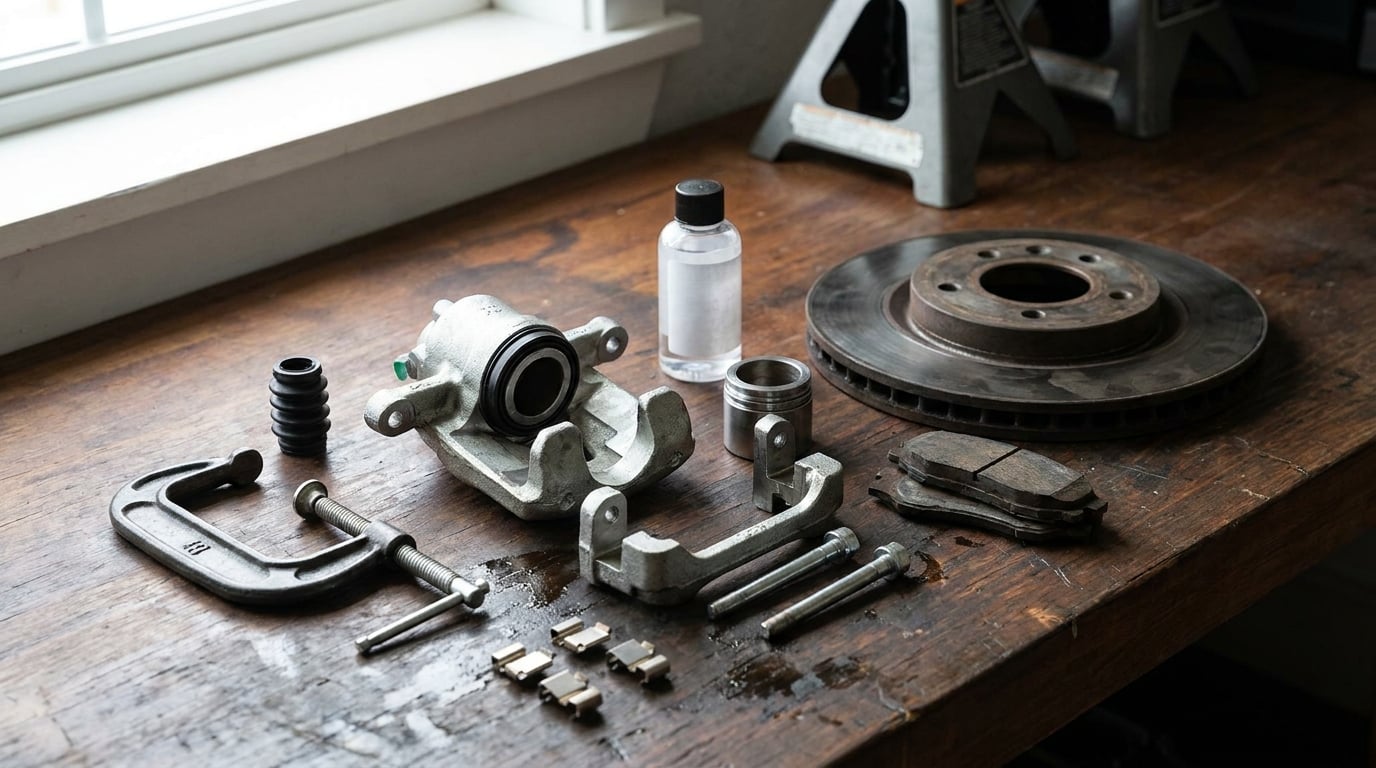
A brake caliper sticks when its piston or its slide pins fail to retract after you release the pedal, so the pad stays pressed against the rotor and drags every time the wheel turns. Brake caliper sticking symptoms and fixes start with confirming the drag at low speed, then checking four separate things: the pads, the rotor, the sliding pins, and the piston seals. Most cases are freeable with a C-clamp, penetrating oil, and a silicone brake lubricant in an afternoon on a BMW with jack stands and the right tools.
On a BMW the caliper is usually a single-piston floating design, which means it has both a piston and two slide pins. Only one of them is seized on a car that has been parked for months, and fixing the wrong one means pulling the whole corner apart again. Owners on r/MechanicAdvice and r/AskAMechanic constantly swap the diagnosis between a seized piston and a seized slide pin, and the two look identical from the driver’s seat.
Get the car on stands before you buy parts. A dragging caliper gets hot enough to burn your hands and it will cook the wheel if you keep driving.
Table of Contents
- What You Need to Fix Brake Caliper Sticking Symptoms
- Step-by-Step: Diagnose and Fix a Sticking Brake Caliper
- Common Mistakes When Fixing a Sticking Caliper
- When to Replace the Caliper Instead of Cleaning It
- Frequently Asked Questions
- Can a sticking brake caliper be fixed?
- Can I spray WD-40 on a brake caliper piston or slide pin?
- Is it safe to drive with one brake caliper sticking?
- How do I tell if the piston is stuck or the slide pins are?
- Should I use anti-seize or silicone brake grease on caliper slide pins?
- Do I have to bleed the brakes after freeing a caliper?
- Conclusion
What You Need to Fix Brake Caliper Sticking Symptoms
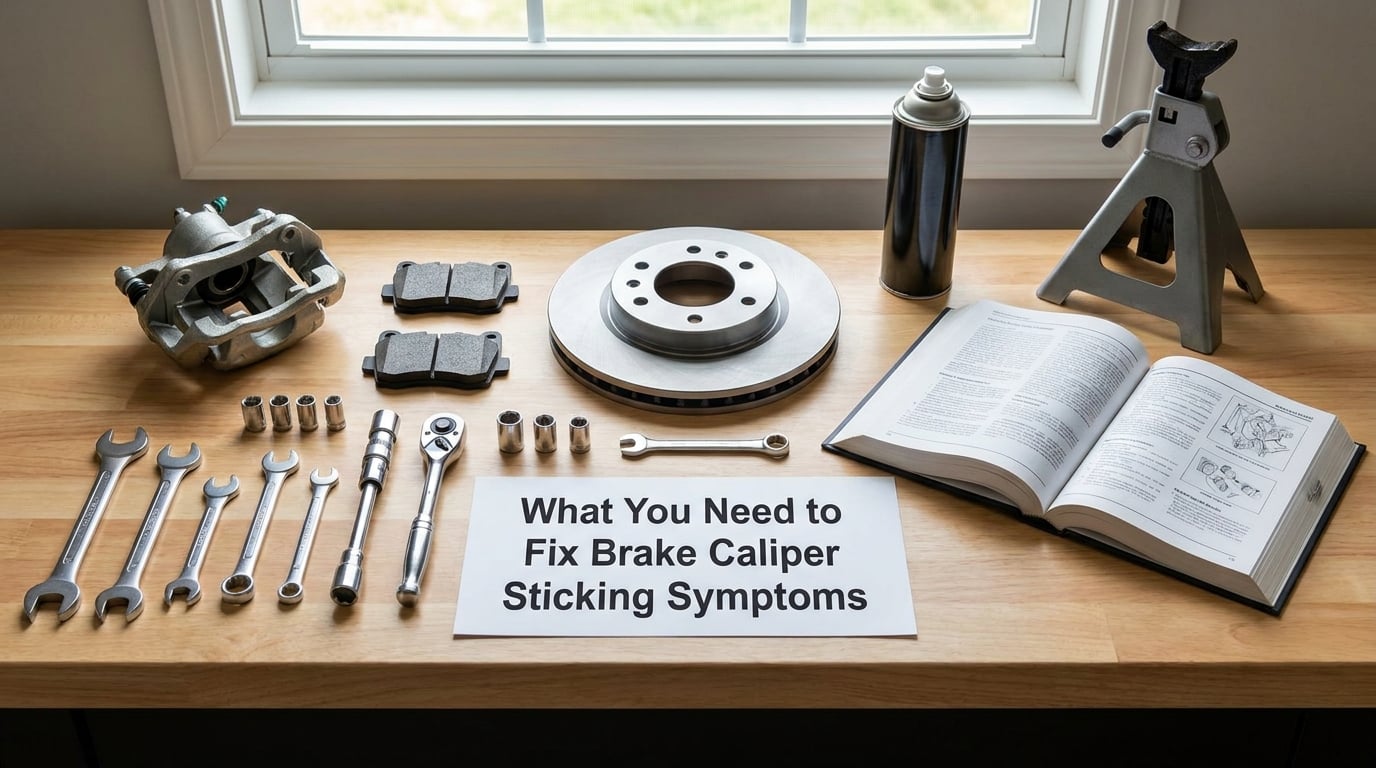
Most of the diagnostic value comes from tools you already own. A flat-head screwdriver or a small pry bar, a flashlight, and a 13 mm socket cover the majority of the diagnosis on a BMW.
- Safety gear first: a floor jack plus at least two properly rated jack stands, wheel chocks, and gloves. Never work under a car held up by the jack alone.
- Hand tools: socket set, ratchet, extension, open-end wrenches, a flat screwdriver or pick, and a small hammer or drift punch for stubborn hardware.
- Brake-specific tools: a C-clamp large enough to straddle the caliper and push the piston back into its bore, a brake caliper wind-back or piston rewind tool for BMWs that need the piston pushed fully home, and a brake pad hanger to keep the hose off.
- Fluids and lube: penetrating oil, aerosol brake cleaner, a silicone-based brake lubricant or high-temperature brake grease for the slide pins, and clean DOT 4 brake fluid if you open the hydraulic system.
- Inspection aids: an infrared thermometer or a dial thermometer for the wheel test, plus calipers or a micrometer if you want to confirm rotor thickness before machining.
- Parts to have on hand: slide pins, a dust boot or pin boot, a caliper rebuild kit with piston seals, and a bleed kit. How to check brake calipers for leaks covers what a weeping piston seal looks like from the outside.
Your BMW’s service manual is worth printing before you start. Torque figures for the caliper carrier bolts vary by model, and guessing at them is how threads get stripped.
Step-by-Step: Diagnose and Fix a Sticking Brake Caliper
1. Confirm That the Brake Caliper Is Actually Sticking
Do the coast-down test first, because it costs nothing. Drive at a steady low speed, come off the throttle, and note which wheel slows the car more than the others. A dragging caliper makes that side audibly hum and the car pull toward the other side as it decelerates.
Then park on level ground and touch each wheel at the 3 and 9 o’clock positions. A wheel that is hot in the middle and cool at the outer rim is giving you mixed signals, so take a temperature reading with an infrared gun instead of trusting your palm. After ten minutes of slow driving a seized corner will be clearly warmer than the rest.
On a BMW with a center-lock wheel, back the wheel off with the socket only after loosening the lug bolts while the car is still on the ground, so you do not have the wheel partly supported by the spline while torque is applied.
2. Inspect the Pads, Rotor, and Caliper
With the caliper off, pull the pads and look at the wear pattern. A pad worn at an angle, with a groove on one edge, is the classic sign that the caliper is not retracting evenly. Pads that are paper-thin on one end and full thickness on the other point straight at a slide pin that is not moving.
Run a fingernail or a coin along the rotor face. Deep grooves, a step at the edge, or a surface that has turned brown and flaked means surface rust is binding the pads. If the rotor is scored more than about a millimeter deep or shows blueing, glazing, or a crack, it needs machining or replacement before the caliper work matters. More on that in what a floating brake rotor is, and if the pad itself looks melted or glassy, brake pad glazing explains why.
Look for brake fluid on the dust boot, the piston face, or inside the rim. A wet area means the piston seal has failed and the whole caliper is a rebuild or replacement.
3. Check the Caliper Slides and Guide Pins
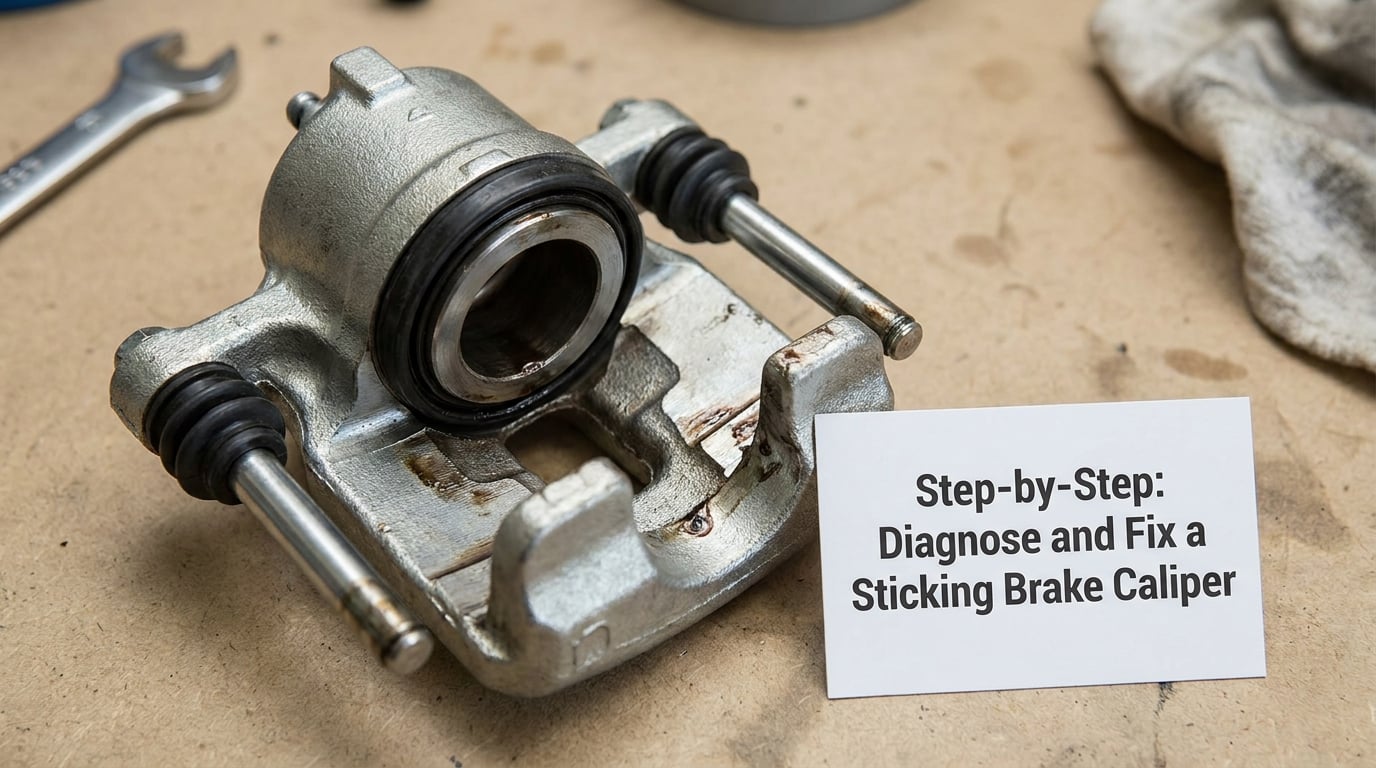
Slide pins are the most common culprit on a floating caliper. Each pin slides in a bore in the caliper carrier and carries a rubber dust boot; when the boot tears, road salt and brake dust grind into the bore and the pin stops sliding.
On a car that sat for months or lives somewhere wet, spray penetrating oil into the bore, leave it for ten minutes, then work the pin back and forth with the pry bar. Mechanics on the forums recommend a drill with a Scotch-Brite pad or a rotary tool with a wire cup to scrub pitted pins back to clean metal, and a little heat on the bore is a reasonable last step. If the pin will not move, it has to come out and either be cleaned or replaced.
Removing them is where people break things. Soak the bore again, use penetrating oil that creeps rather than a water-based spray, and tap the bolt head with a drift punch alternating with tightening. Never put a wrench on the pin itself and try to lever the bolt out of an offset head.
If the pin bore is pitted badly enough that a new pin drops in and is immediately loose, or the pin gets sucked straight down into the bore, the carrier needs replacing, not the pin. That is the failure a poster on r/MechanicAdvice described as a new pin being swallowed by the hole.
4. Check the Piston Seals and Brake Fluid
The reason a caliper retracts at all is a square-cut piston seal inside the bore. As the piston pushes out under hydraulic pressure the seal twists roughly a tenth of a millimeter, and that slight drag rolls the piston back when pressure drops. There is no return spring doing the work, which is why corrosion or a torn seal can leave the piston extended with no pressure at all.
Fit the C-clamp over the caliper and squeeze slowly. If the piston retracts smoothly, it was corrosion or debris, and you are done once you clean and lubricate. If it moves a few millimeters then stops, the bore is pitted or the piston is scored. Do not keep cramming it; a hydraulic ram or the threaded wind-back tool gives even pressure and is much kinder to the seal.
Pull the piston out at this point and check the bore wall under a light. A ring of light brown rust comes off with brake cleaner. Scoring, a step, or a groove means the caliper needs a rebuild kit or replacement, not another coat of cleaner. If the piston feels gritty when you push it back in by hand, treat it as worn.
Fluid condition matters on older cars. Dark fluid with a burnt smell, or fluid that has been sitting open in a humid climate, absorbs water and corrodes from the inside out. Many BMWs are due a fluid change every two to three years, and if the fluid has never been changed on a high-mileage car, flush it while the caliper is open.
5. Reassemble, Bed the Brakes, and Verify the Repair
Put the slide pins back with new boots if the old ones are cracked, coat the pins and bores with silicone-based brake lubricant, and torque the caliper carrier bolts to your manual’s figure. Keep every trace of grease off the pads, the rotor face, and the pad contact surfaces on the bracket.
If you opened the hydraulic system, you do need to bleed. Let it settle, top the reservoir up, and bleed the farthest caliper first working back to the one nearest the master cylinder. Pump the pedal while you crack the bleeder, and don’t let the reservoir run dry.
Before bolting the wheel back on, spin the hub by hand and watch the pad. It should move back away from the rotor with a light push and stay there. That is the whole test, and it catches a caliper that is still dragging before you drive out of the driveway.
Reinstall the wheel, torque the bolts in a star pattern, and stay on private property for the first check. Drive gently forward and backward a short distance at walking pace, then try the coast-down again. If the hum is gone and the temperature reading is even with the other corners, the repair held. Bed the pads properly with about ten firm stops from highway speed over the following few hundred miles, because bedding is what gives you an even friction surface.
Common Mistakes When Fixing a Sticking Caliper
Forcing a seized piston. Hammering a C-clamp against a piston that will not move rounds the bore and can snap the seal. Use even hydraulic pressure and accept that a scored bore means a rebuild kit.
Lubricating the wrong surfaces. Grease and oil belong on the slide pins and the pad backing contact points. On the friction surfaces they are poison, and the forum consensus is emphatic about this. This includes the outer face of the rotor, the pad material, and the caliper bracket’s pad contact areas.
Spraying WD-40 on a caliper and calling it fixed. Owners keep asking whether it is safe, and the honest answer is no, not as a permanent fix. WD-40 is a light petroleum oil, not a long-lasting grease, and it will wash off or burn off with heat. On the piston bore or the pins it works as a temporary freeing agent, which is exactly why it keeps getting recommended. On a rotor face or pad it contaminates the friction material and kills braking. If you have already sprayed it, clean the rotor properly with brake cleaner and brake pads on both sides, or the pads need replacing.
Using copper anti-seize on the pins. The debate is live on r/MechanicAdvice and Mechanics.SE, so here is the reasoning. Anti-seize is designed for threaded fasteners to prevent galling, and a copper-based compound does not stay put the way a silicone brake grease does. The part of the slide pin inside the caliper bore is not a thread, so the anti-seize has no job there. The people who use it and get away with it usually live somewhere dry. Plenty of mechanics still do it, and a copper anti-seize on a slide pin is not an instant failure, but a high-temperature silicone brake grease is the correct product for that bore. Never, under any circumstances, put anti-seize on the pad contact surfaces.
Skipping the pad and rotor inspection. If the pads are worn at an angle and the rotor is scored, freeing the caliper only gets you back to the same uneven braking and the same drag in a few hundred miles.
Keeping driving with a hot brake. A dragging caliper generates heat with no braking input. The pads cook, the rotor distorts, fluid in the caliper boils, the wheel hub takes heat it was never designed for, and in a bad case the tire and wheel can ignite. Owners describe exactly this, a wheel burning hot enough to need twenty minutes of rest between stops. If one wheel is running hot, stop driving until it is fixed. If you must reach a shop, the distance should be the shortest possible and it should be flat ground, and get the corner elevated the moment you arrive. If the brake pedal goes soft or the pedal travel gets longer, the fluid is boiling and you should stop entirely.
Confusing drag with a warped rotor. Vibration through the pedal is usually uneven pad transfer and thickness variation, not a bend. Calipers that never retract and pads wearing on one edge are a different problem entirely.
When to Replace the Caliper Instead of Cleaning It
Cleaning works when the damage is surface rust or corrosion and the underlying metal is sound. There is a clear list where cleaning stops making sense and a replacement caliper is the honest answer.
- Cracked housing: any fracture in the caliper body, especially around the mounting ears, means it goes. Structural cracks do not fill.
- Damaged piston seals with a scored bore: a new seal on a pitted bore will leak within weeks, and the rebuild kit will cost nearly as much as a new caliper.
- Collapsed or scored piston: if the piston moves sluggishly by hand, has a groove, or has pitted around the edge, it is not going to seal again.
- Damaged threads in the carrier bore: a stripped slide pin hole that will not hold a new pin tight means the carrier is scrap, and a stuck pin that snapped off during removal is another version of the same problem.
- A persistent leak: weeping at the piston seal, at the bleed screw, or at the fluid inlet, especially where a new rubber hose seats better than the factory one.
- Repeated failures: a caliper that seizes again within a few thousand miles has an underlying cause. The forum is full of owners blaming a new part for failing to retract, and the real culprits are usually dry or contaminated fluid, ungreased pins, or a pin bore that was never cleaned during the last repair.
Replace calipers on one axle together, not one at a time. The new one needs a matching new one so both sides of the axle clamp and release identically, and single-piston floating calipers rarely come with the slide pins and boots, so buy those as a kit. If one end of a caliper is a remanufactured unit and the other is your old cleaned original, the new one will usually be the better of the pair, which is another reason to do both.
Frequently Asked Questions
Can a sticking brake caliper be fixed?
Most of the time, yes. If the piston and bore are just corroded, a C-clamp or wind-back tool plus brake cleaner will free it, and seized slide pins come back with penetrating oil, a wire cup on a drill, and silicone brake grease. You need a rebuild kit or a new caliper when the bore is scored, the piston seal is failed, or the carrier threads are damaged. Never force a piston that will not move, and always replace calipers on an axle in pairs.
Can I spray WD-40 on a brake caliper piston or slide pin?
As a temporary freeing agent, it will work. WD-40 is a light oil, not a durable grease, so it washes off or burns away and the caliper will stick again soon. Keep it away from the rotor face and the pads, where it contaminates the friction material and destroys braking. Once the caliper is free, clean everything with brake cleaner and lubricate the pins properly with high-temperature silicone brake grease.
Is it safe to drive with one brake caliper sticking?
Not really. A dragging caliper makes heat with no braking input, which glazes and wears the pads, distorts the rotor, and can boil the brake fluid in that corner, which shows up as a soft or spongy pedal. Heat also reaches the wheel hub and the tire. If a wheel is running hot, get the car elevated and fixed rather than driving it, and stop immediately if the pedal goes soft or the travel grows.
How do I tell if the piston is stuck or the slide pins are?
The symptom is the same either way, so test the components directly. Remove the caliper and try to push the piston back with a C-clamp. If it retracts, the piston is fine and the slide pins are the problem, which you will confirm by finding them pitted, rusted, or unable to slide in the bore. If the piston will not move at all even with a wind-back tool, the piston or bore is seized. Pads worn at an angle on one edge point at the slide pins.
Should I use anti-seize or silicone brake grease on caliper slide pins?
Use a high-temperature silicone-based brake lubricant on the slide pins and in the carrier bores. Anti-seize is a fastener compound that prevents galling on threads, and the part of the pin inside the bore is not a thread, so it does not belong there. Some mechanics use copper anti-seize and get away with it in dry climates, but it is not the specified product. Anti-seize on the pad contact surfaces or rotor is never acceptable.
Do I have to bleed the brakes after freeing a caliper?
Only if you opened the hydraulic system. If the caliper stayed on the car and you only freed the slide pins, no bleed is needed. If you removed the caliper, pushed the piston back with a wind-back tool, or opened a hose or fitting, air can get into the line and you do need to bleed, working from the farthest caliper back to the one nearest the master cylinder while keeping the reservoir topped up.
Conclusion
Confirm the drag at low speed before you touch anything, then work through it in order: pads and rotor, slide pins, piston seals, fluid. That sequence is what stops you replacing a caliper when all you needed was grease on a pin. Lift the car, free the component, lubricate the pins properly, keep every oily film off the friction surfaces, and verify with a hand spin of the hub and a coast-down test before you drive away. If the bore is scored or the carrier threads are gone, replace the caliper and do the other one on that axle with it.