
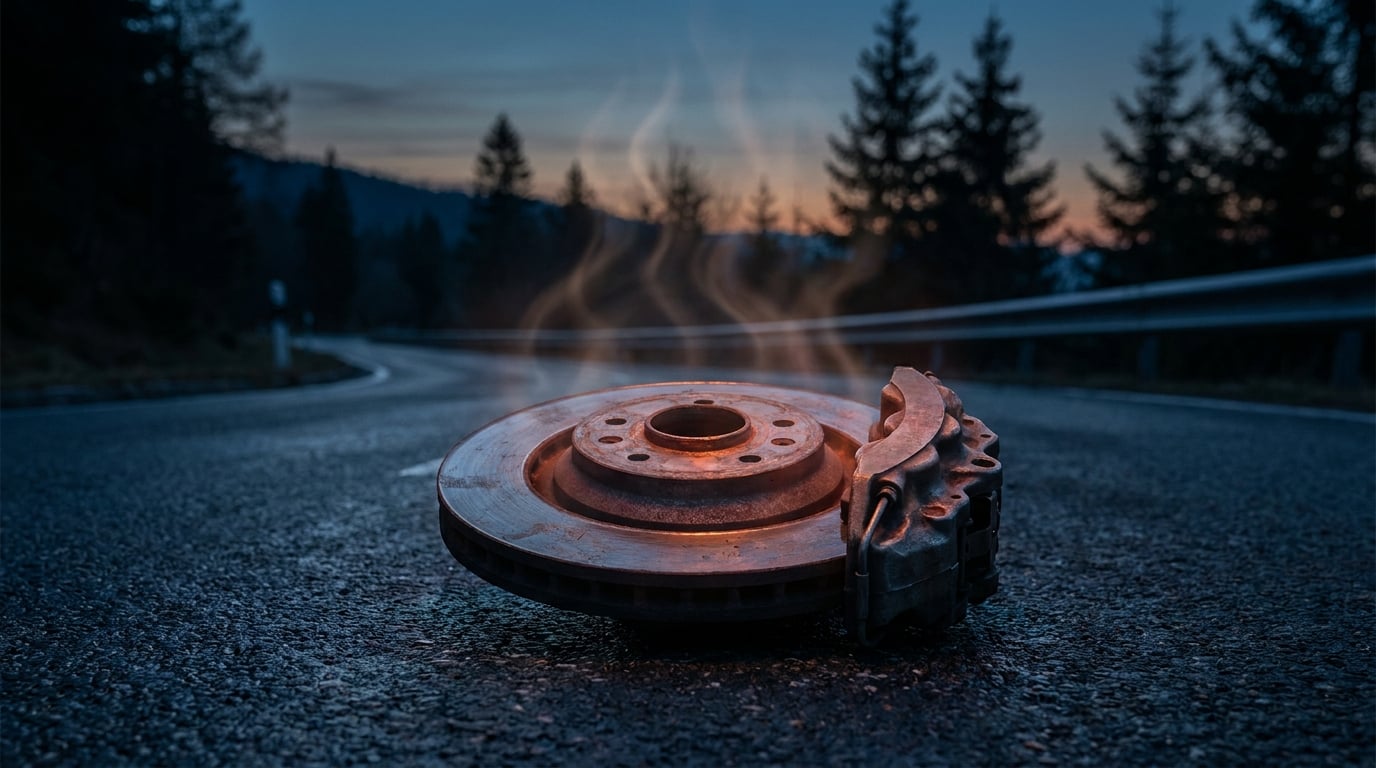
Brakes overheat on long downhill grades because gravity keeps pumping energy into a moving vehicle faster than the friction brakes can shed it as heat. On a steady descent, the car’s kinetic energy turns into thermal energy at the rotors, and once heat input outruns cooling, pads glaze, fluid starts to boil and the pedal goes soft. The fix is almost never better pads. It is a lower gear, chosen before the grade starts.
Nothing about this has changed in 2026. It is the same physics, and the same advice in every owner’s manual: put the transmission in a gear that lets the engine slow the vehicle down, and save the friction brakes for the turns that actually need them. Below is the reasoning, the signs, and the technique.
Table of Contents
- Why Do Brakes Overheat on Long Downhill Grades?
- How Brake Heat Is Created and Removed
- What Causes Brakes to Overheat on a Downhill?
- How Can You Tell That Brakes Are Overheating?
- How to Descend a Long Grade Without Overheating Brakes
- What to Do If Brakes Overheat During the Descent
- How to Prevent Downhill Brake Overheating
- When Should Brakes Be Inspected After Overheating?
- Frequently Asked Questions
- Conclusion: What to Do First
Why Do Brakes Overheat on Long Downhill Grades?
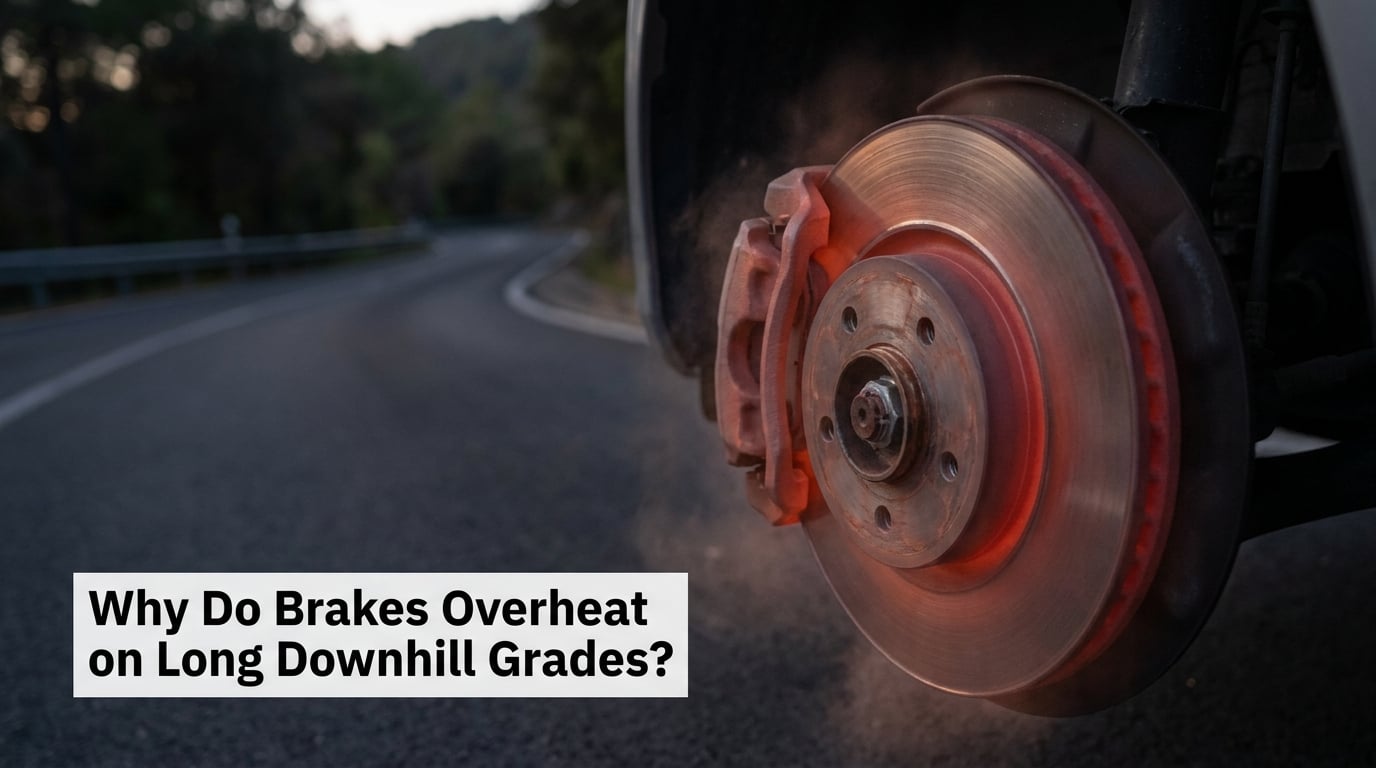
A 6% grade pulls downhill with roughly 6% of the vehicle’s weight. A 4,000 lb SUV on that grade has about 240 lb of gravity force trying to accelerate it at every instant, and only three things can absorb that: the friction brakes, the engine, and aerodynamic drag.
Run the numbers and it gets stark. Losing 3,000 vertical feet in that vehicle releases about 12 million foot-pounds of potential energy. A single panic stop from 55 mph gives up roughly 400,000 of the same. So a long descent hands the vehicle the equivalent of around thirty hard stops, delivered continuously, with no stops in between to let anything cool down.
Flat, stop-and-go driving is gentler on brakes than people think. Each stop dumps a few seconds’ worth of energy and then the car sits still while the rotor sheds heat through convection and airflow. A grade removes that recovery time entirely.
Three variables decide whether a descent is comfortable or destructive: how much mass you carry, how steep the grade is, and how much of the deceleration you route through the engine instead of the brakes. Mass matters most, because stored energy scales directly with it. Double the weight and you double the heat for the same descent.
Cooling is the other half of the equation, and it is limited. A cast iron rotor sheds heat by convection off its faces and edges, by radiation, by air pushed through the wheel spokes, and by the vanes between a vented rotor’s two friction faces. All four work better at speed than standing still, but none of them can keep up with a hard pedal applied for ten straight minutes.
How Brake Heat Is Created and Removed
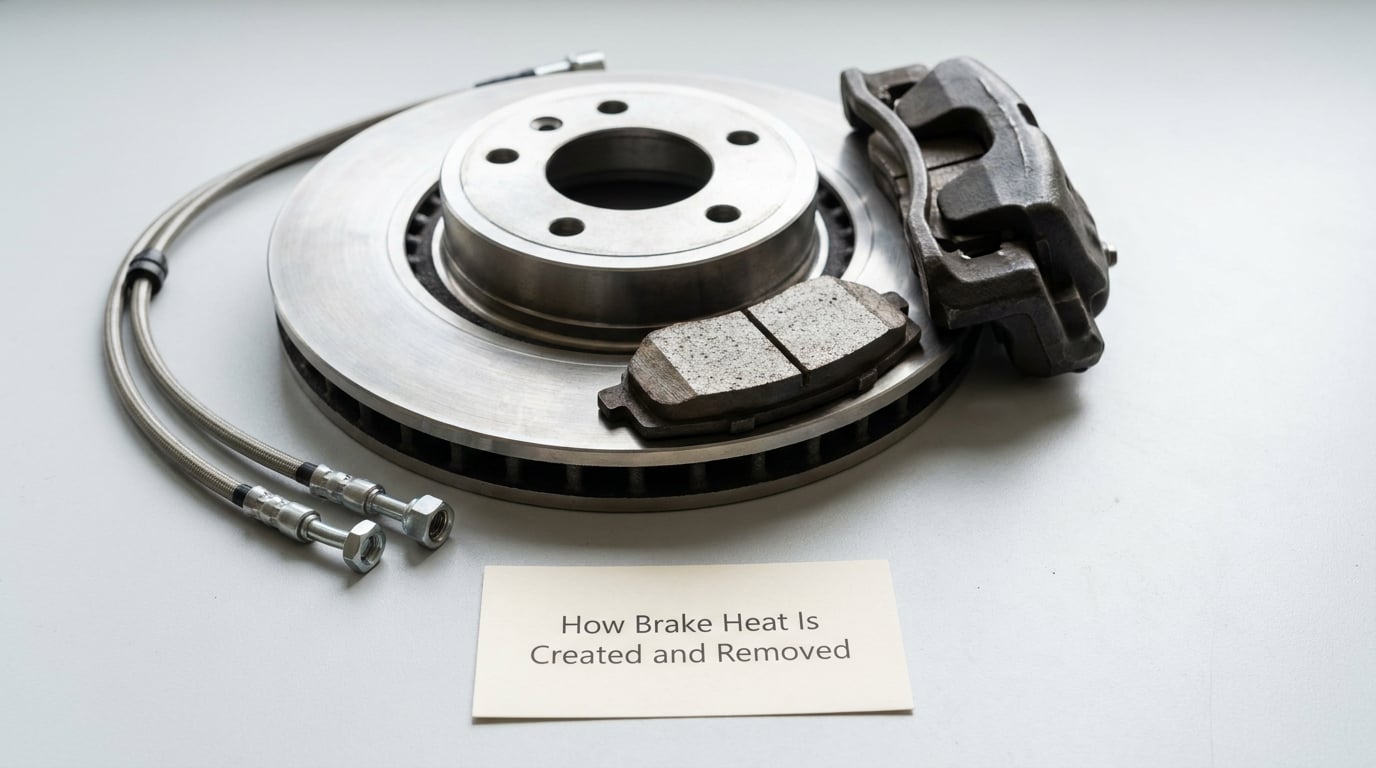
Heat only enters the brakes through friction, and it leaves through the hub and wheel, through the air in the rotor and wheel, and through the brake fluid inside the caliper. The faster you generate heat, the narrower the window you have to move it out.
Each part of the assembly has a job in that transfer:
- Pads and rotor — the friction pair. The rotor is the heat sink, and its mass and surface area decide how much energy it can absorb before it has to start shedding it.
- Caliper — squeezes the pads, and floats on pins or slides in its carrier. It also bleeds heat into the fluid, which is why fluid condition matters on a long descent.
- Brake fluid — carries heat out of the caliper. Boil it and it turns into compressible vapour, the pedal goes soft, and the pedal-to-floor failure that everybody dreads starts.
- Vented rotor vanes — pump air from the hub outward between the two faces. Vented rotors hold a lot more heat than solid ones for that reason.
- Wheel design — open spokes move air across the rotor. Heavier, more closed wheel styles quietly reduce cooling on exactly the vehicles that need it most.
Engine braking puts the heat somewhere survivable: inside the engine, where oil, coolant and metal can carry it away. That is the entire argument for downshifting. A compression release brake on a diesel goes further and dumps the energy out the exhaust stack.
Aerodynamic drag does a real share of the work on a long descent, more than most drivers expect. It cannot rescue a bad gear choice, though, because it only starts to bite noticeably at highway speeds and higher.
What Causes Brakes to Overheat on a Downhill?
Causes split cleanly into what the driver does and what the vehicle brings with it. Both end in the same place, but the fixes are completely different.
Driving demands that generate too much heat
- Continuous light pedal pressure. The most common cause by a distance. A feather-light, constant press is the worst possible pattern for a rotor because the heat arrives steadily and the pads never get a break to shed it.
- Entering the descent too fast, then catching up. Gravity wins in 30 seconds, the driver reacts late, and the whole grade gets braked hard in the back half.
- Staying in too high a gear. The engine cannot hold the speed, so the pedal has to make up the difference on every metre.
- Carrying more than the vehicle was rated for. Trailers, roof boxes, a full load of passengers. More mass means more energy with nowhere else to go.
- Stop-and-go traffic on the grade itself. Crawling downhill with the brake applied releases heat and dumps energy in short bursts, which is harder on pads than one long steady pull.
- Coasting in neutral. Often described as “saving the brakes.” It saves them right up until the vehicle accelerates past the point where the next stop is a problem.
Vehicle conditions that make overheating happen sooner
- Worn pads. Less friction material means the whole load transfers into the steel backing plate, which conducts heat straight into the caliper and the fluid.
- Glazed or contaminated pads. Glassy friction material, oil or fluid on the rotor, or a thin pad against a hard rotor. The pad stops gripping, the pedal goes long, and the driver compensates with more pressure.
- A dragging caliper or a parking brake that is not fully released. One rotor quietly rubbing builds heat with no pedal input at all. It shows up as a wheel that stays hot long after you park, which is also the rust question every parked car eventually raises.
- Old, contaminated or low brake fluid. Fluid absorbs heat, ages by absorbing moisture, and boils before the pads ever reach a fade point.
- Thin or undersized rotors, or the wrong rotor size. Fewer and smaller friction faces means less material to hold the heat.
- Oversized wheels and low-profile tyres. They give more grip and give the caliper less room, and a rubbing caliper is a heat source.
- Hybrid and electric regeneration limits. Regenerative braking gives back a portion of the descent, but on a sustained grade most of the deceleration still has to come from the friction brakes. The regen and care basics for hybrids explain why these cars still need a cold, correctly sized brake.
- Cruise control left on downhill. Many systems hold speed with brief brake applications you never feel, which quietly runs the same load through the same pads.
How Can You Tell That Brakes Are Overheating?
The signs arrive in a fairly consistent order, and the early ones are easy to mistake for something else. Here is roughly how the escalation feels from behind the wheel:
- The pedal gets longer. More travel, more pressure, the same stopping distance. This is usually the first sign, and the one most drivers ignore.
- A hot pedal. The pedal itself becomes uncomfortable under your foot through the floor.
- A burning smell. Not an unpleasant friction smell, but a sharp chemical one. That is friction material, sometimes brake fluid, sometimes both.
- Fading. Firm pressure, less deceleration. This is the point where brake fade is no longer a theory.
- Pulsation, noise, or a pull to one side. Warped or unevenly heated rotor, pads glazed in patches, or a caliper that seized on one corner.
- Smoke, or a wheel that glows. Rare, and not something to watch happen from the driver’s seat.
Approximate guideposts, since most drivers have no thermometer on the pedal box:
- Under roughly 300°F — ordinary working range. Comfortable to touch, no smell, no change in pedal feel.
- 300 to 450°F — hot working range for sustained descent. A disc this hot is normal, and a faint smell at a long grade is not a failure by itself.
- 450 to 600°F — pads begin glazing and fluid is working hard. Visible smoke and a definite pedal change are now plausible.
- 600°F and above — the range where brake fade becomes likely and fluid can start boiling. Plan to stop and cool rather than continue.
That middle band is where a well-managed descent settles out. Heavy vehicles get there the same way: a low gear held for the whole grade, engine speed high enough that the engine is genuinely doing the slowing, and occasional firm brake taps for the tighter corners instead of one continuous press. Ride the grade passively and you drift into the bottom band, and the pedal is where you notice it.
If a disc is warm to the touch after a grade, that is expected. If there is smoke, severe fade, a visible crack, a glowing wheel, or a pedal that feels wrong, pull over somewhere away from traffic and away from dry vegetation, and let it cool. Smoke off a hot rotor is mostly dust and pad residue, but it is not something to stand next to and watch.
How to Descend a Long Grade Without Overheating Brakes
Six steps, in order. The order matters more than any single step.
- Slow down before the grade, not on it. Match the speed you would climb it at, or lower. Speeding up on the way down and bleeding it off in the first minute is the classic way to cook pads.
- Select the lower gear before the descent starts. Manual: one or two gears down, released gently, and keep revs in a comfortable band rather than lugging. The golden rule experienced mountain drivers repeat is that you should not descend faster than you would climb.
- Use engine braking as the primary control. Throttle closed, transmission in gear, and the engine doing the slowing. You should be trimming and easing, not braking.
- Use the brake pedal in short, firm applications rather than a continuous press. Firm pressure clears water and residue off the rotor and builds pressure evenly, which is exactly the opposite of what a light, constant press does.
- Keep speed steady. Small corrections, not repeated heavy braking. Every heavy application is heat you have to remove later.
- Keep more distance and expect traffic to be slower than you are. On a grade, vehicles behind you may be carrying more mass or more heat than you are.
Manual versus automatic gear selection
With a manual, you pick a gear and stay in it. Downshift one or two steps, let the engine speed settle into a range that pulls hard without hitting the rev limiter, and hold it. Rev-matching on the way down is optional, and on a steep grade most drivers skip it and take the shift shock instead.
With an automatic, use the manufacturer-recommended low range for the vehicle. Depending on the car that is a labeled low gear, second or third position, a tow-haul selector, or manual mode via paddles. Tow-haul mode typically shifts later, holds a lower gear longer and adjusts for grade and load, which is why RV owners consider it useful rather than a replacement for picking the right gear in the first place.
Automatics have one catch worth knowing. Engine braking is only effective when the torque converter is locked up, and a converter that never locks will slip and heat the transmission fluid while the car goes downhill faster than the engine can slow it. A transmission that overheats on a grade has its own failure mode, and transmission fluid temperature is worth watching on a heavy vehicle doing this regularly.
Two more things to avoid: coasting in neutral, and leaving cruise control engaged through a descent. Coast with the transmission in gear and the engine helping, and turn cruise off before the grade.
What to Do If Brakes Overheat During the Descent
Overheating mid-descent is frightening, and the instinct to stamp on the brake makes it worse. Follow this order:
- Keep control first. Do not slam the pedal or swerve. Both lock the wheels, both lose steering authority, and both add heat.
- Select a lower gear immediately, if you have not already, and let the engine take over the deceleration.
- Move to the shoulder or the nearest safe location as soon as one is available. Do not stop in a live lane to cool down.
- Come to a full stop, park, and apply the parking brake. Switch off the engine if it is safe to do so.
- Keep clear of the hot components. Give the wheels and underbody space, keep away from dry grass, and remember that a rotor that just stopped smoking can still be well past the temperature that causes a serious burn.
- Wait for the brakes to cool and then test them gently. Firm pressure at low speed, listening for pull or pulsation, before committing to the rest of the descent.
If pedal feel does not return to normal, if the pull or pulsation is still there once cool, or if the vehicle cannot hold a steady speed on a mild grade without the pedal, stop driving and call roadside assistance. Ask for a flatbed or a tow. Do not drive a vehicle with faded brakes down a mountain to reach a shop.
How to Prevent Downhill Brake Overheating
Most overheating on a descent is technique, and technique is free to fix. The mechanical side is still worth doing, because it decides how much margin you start with.
- Follow the service schedule. Pads, rotors, calipers, fluid, hoses and lines, parking brake adjustment, and the wheel bearings that keep the rotor aligned with the caliper.
- Use the specified fluid and change it on schedule. Fluid is hygroscopic, so it takes on moisture from the air through the rubber lines, and that moisture lowers the boiling point. How long it stays good in the bottle before you open it is covered in how long brake fluid lasts in the bottle; DOT 4 has a higher wet boiling point than DOT 3, and DOT 5.1 is a common choice for vehicles that see sustained descents or towing.
- Keep the load inside the vehicle’s rating. Every extra 100 lb is energy the brakes have to absorb on the way down.
- Choose tyres and wheels that suit the driving. Grip matters more than looks on a wet descent, and the wheel and tyre package has to clear the caliper.
- Upgrade only with a reason. Slotted rotors and higher-temperature pads help with repeated hard stops, and they are a reasonable choice for a driver who lives on mountain roads. They do nothing about a dragging caliper, a pedal technique problem, or a wrong gear.
The uncomfortable truth is that the last two causes on the mechanical list, a caliper that drags and fluid that is old, produce heat with no pedal input at all. If your brakes overheat on a descent you drove carefully, suspect the vehicle before you suspect yourself.
When Should Brakes Be Inspected After Overheating?
Light, brief heat on one long descent with no pedal change usually needs nothing more than a cooling period and a glance at the wheel when you stop.
Inspection is warranted when any of these are true: a burnt smell that lingers after cooling, a pedal that feels longer or spongier than before, smoke, pulsation under braking, a pull to one side, uneven braking between front and rear, or a wheel or rotor that stays hot long after the vehicle is parked. A wheel that is noticeably warmer than the others at a traffic light is a classic dragging-caliper symptom.
A qualified technician will typically measure pad and rotor thickness, check rotor condition for warping and hot spots, verify caliper slide and return, test brake fluid condition and moisture content, inspect hoses and lines, and look for evidence of uneven heating around the rotor. Fluid that has been boiled is usually replaced rather than topped up, because its protective properties are already gone.
After any overheating event, do not drive the vehicle until the brakes test normal. That is the short version of what a professional inspection is for.
Frequently Asked Questions
What is the 30/30/30 rule for brakes?
It is not a brake rule at all. The 30/30/30 rule is a tyre habit: keep cold tyre pressure at or above 30 psi, check it at least 30 times a year, and do it at least 30 minutes before driving so tyres are cold. It is worth following because underinflated tyres generate more heat and lengthen braking distances, but it has nothing to do with brake overheating on a grade.
Does a burning smell mean the brakes are about to fail?
Usually not immediately. A sharp smell on a long descent usually means friction material and pad dust are simply very hot, and a disc that is warm to the touch afterwards is normal. A smell that lingers long after cooling, or that comes with smoke, a soft pedal, or a pedal that stays long, means fluid may have been boiled or a pad is glazed. Stop and have it checked rather than backing off the highway.
Can I drive after my brakes cool down?
Yes, if the pedal feels normal and the brakes stop the vehicle straight and firmly at a gentle pace. A hot rotor is not damaged by being hot, and cooling restores it. If the pedal stays soft, if the vehicle pulls to one side, or if it will not hold a steady speed on a mild grade without pedal pressure, do not drive it. Book a brake inspection and ask for a tow if you have to travel.
Is engine braking really safer than riding the brakes?
It is the correct primary control on a descent, and yes, it is safer in the sense that matters. It moves the heat into the engine, where oil and coolant can carry it away, instead of into a rotor that can only shed heat through airflow and time. It does not replace the brakes: you still need them for corners, for traffic, and for the unexpected. The two work together, and the mistake is using only the brakes.
Do high-performance brake pads stop brakes overheating?
Only if heat is the actual constraint. Higher-temperature pads raise the temperature at which the friction material glazes, so a driver who does repeated hard stops gains margin. They do nothing about riding the brake pedal, staying in too high a gear, carrying too much weight, or a caliper that drags with no pedal input. If your brakes overheat on a descent you drove correctly, the problem is mechanical and no pad compound hides it.
Conclusion: What to Do First
Pick the lower gear before the descent, not during it. Let the engine do most of the slowing, keep the brake pedal for short firm corrections rather than a steady press, and never descend faster than you would climb.
If warning signs appear mid-grade, get to a safe place, stop, and let things cool. And if a brake stays hot, keeps smelling burnt, or feels different after the heat is gone, have a qualified technician look at pad and rotor thickness, caliper operation, and fluid condition before you drive it again. That is the whole answer to why brakes overheat on long downhill grades: energy arrives faster than the brakes can shed it, and the driver’s job is to decide where the heat goes.