
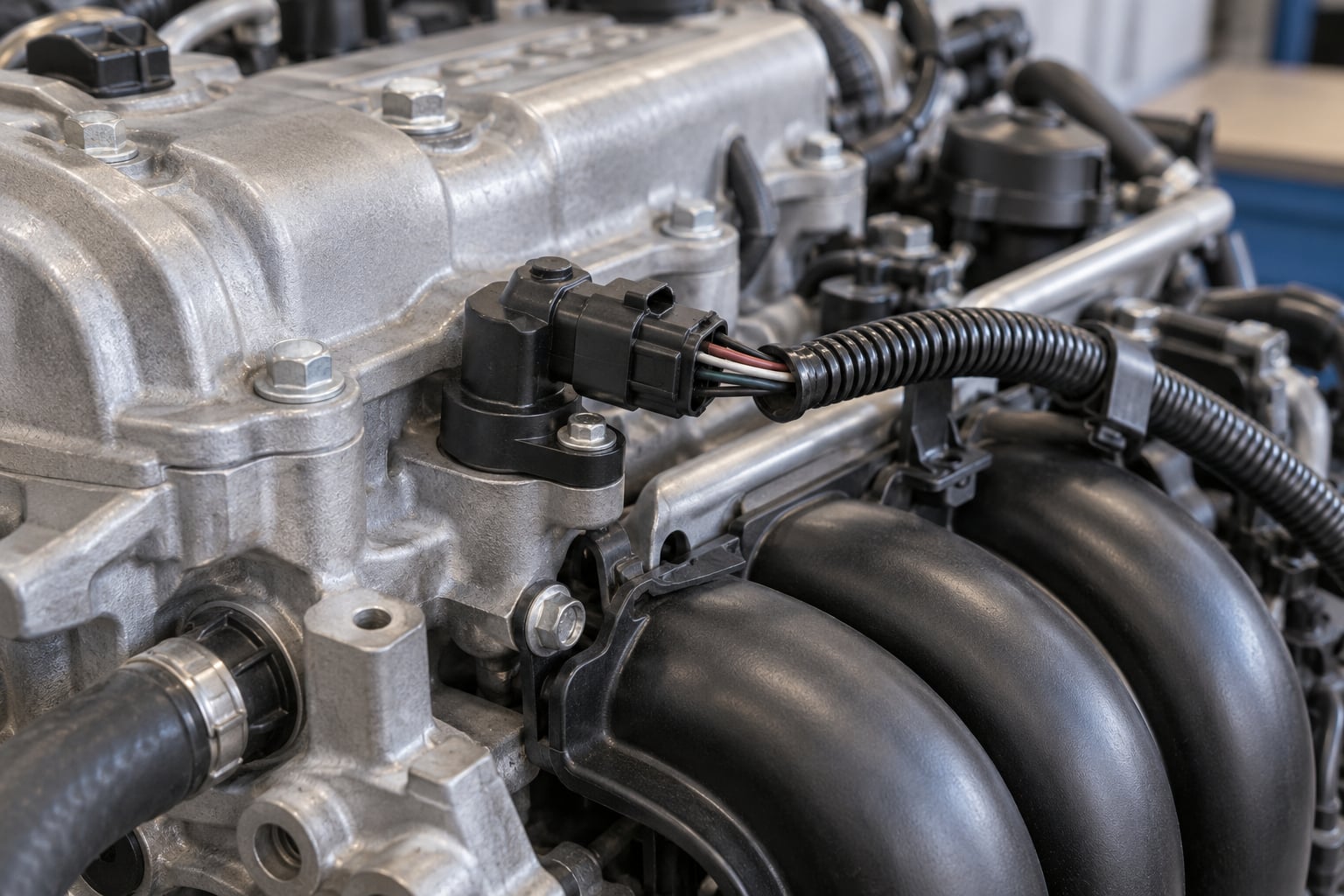
If you’re wondering about the symptoms of a bad camshaft position sensor, expect an illuminated check engine light, trouble starting with extended cranking, and unexpected engine stalling. The sensor reports where the camshaft is turning so the engine control module can time fuel and spark, so when its signal drops the whole engine management strategy goes with it.
I’ve pulled codes on enough BMWs and Japanese Nines to know this fault rarely announces itself cleanly. It shows up first as drivability you can describe but can’t explain, then ends with a car that cranks forever or dies at a stop sign.
Table of Contents
- Symptoms of a Bad Camshaft Position Sensor at a Glance
- What Does a Camshaft Position Sensor Do?
- What Are the Most Common Symptoms of a Bad Camshaft Position Sensor?
- How Can You Tell a Camshaft Sensor Problem From Other Engine Faults?
- Why Does a Bad Camshaft Position Sensor Trigger a Check Engine Light?
- Can You Drive With a Bad Camshaft Position Sensor?
- What Causes a Camshaft Position Sensor to Fail?
- How Is a Camshaft Position Sensor Diagnosed and Replaced?
- Frequently Asked Questions
- How can you tell if your camshaft position sensor is bad?
- What happens if you unplug the camshaft position sensor?
- Can you still drive with a bad camshaft sensor?
- How do you reset a cam position sensor?
- Is a camshaft sensor an easy fix to replace yourself?
- What is the average lifespan of a camshaft position sensor?
- What Should You Do First?
Symptoms of a Bad Camshaft Position Sensor at a Glance
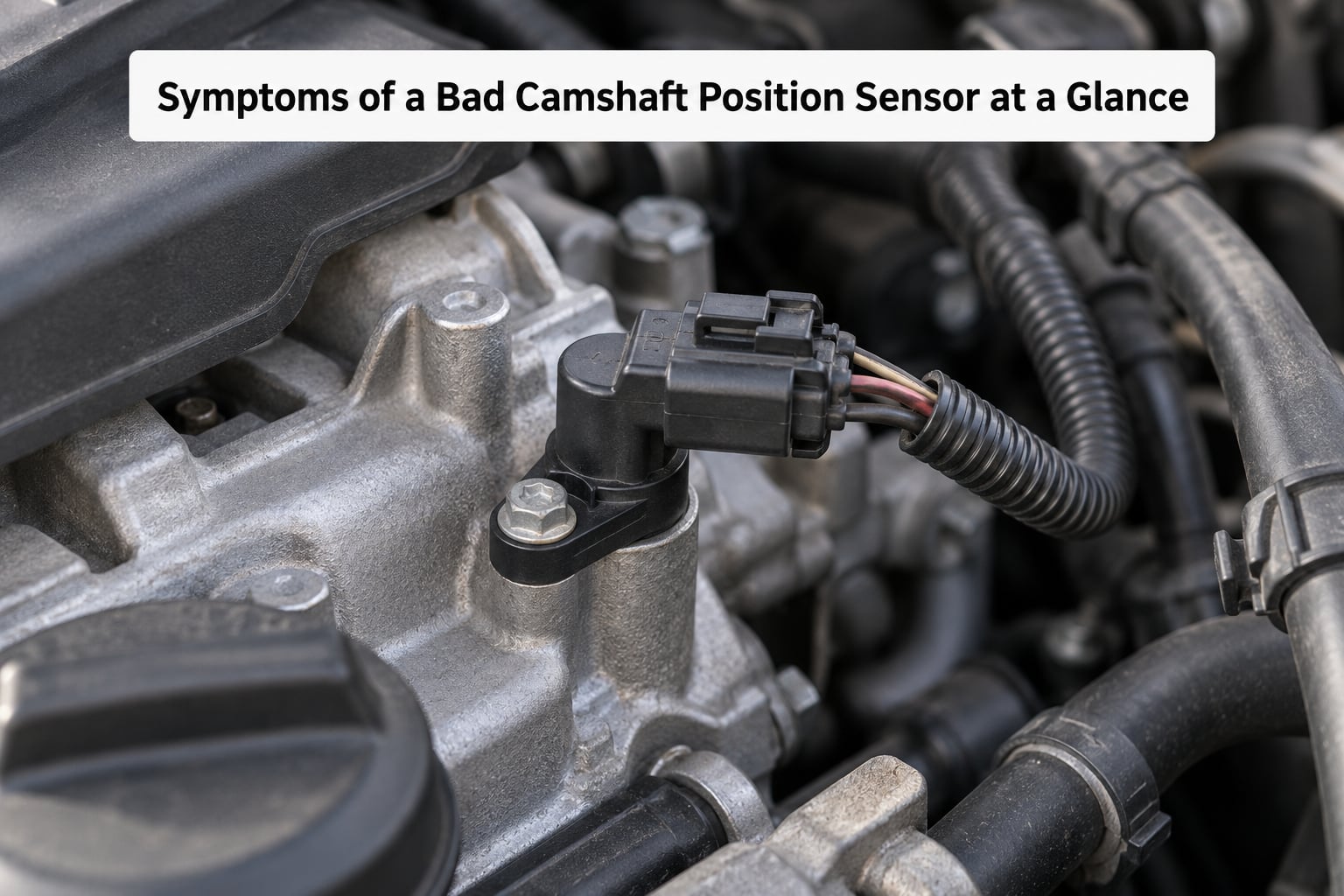
The symptoms of a bad camshaft position sensor range from a nuisance warning light to a car that will not fire at all. This table ranks them by how quickly you need to act.
| Symptom | What you will notice | How urgent |
|---|---|---|
| Check engine light on | Warning lamp stays lit, often with codes in the P0340 to P0349 range | Book a scan this week |
| Extended cranking | Engine cranks 10 to 30 seconds before firing | Diagnose promptly |
| Crank, no fire | Starter turns, engine never catches | Stop driving |
| Sudden stalling | Engine dies at idle, at lights, or mid-drive | Stop driving |
| Rough idle and misfires | Shaky idle, shaking under light throttle, blinkers flicking at idle | Soon |
| Hesitation and lost power | Bogging when you ask for acceleration | Soon |
| Dropped economy | Noticeable jump in fuel use | Monitor |
| Odd transmission shifting | Harsh or late shifts, or transmission warning light | Soon |
What Does a Camshaft Position Sensor Do?
A camshaft position sensor tells the engine control module where the camshaft is rotating and how fast. The module uses that data alongside the crankshaft position sensor to identify which cylinder is on its power stroke.
Without it, the module cannot time the fuel injectors or place the ignition spark, so fuel delivery and spark timing fall back to a fixed strategy. On engines with variable valve timing, the same signal commands the VANOS solenoids, which is why a cam sensor fault often shows up as lost torque rather than a dead engine.
What Are the Most Common Symptoms of a Bad Camshaft Position Sensor?
Eight symptoms cover almost every case I’ve seen, and they usually arrive in that order.
- Check engine light stays on: the module detects an implausible or missing cam signal and stores a diagnostic trouble code, commonly P0340 through P0349.
- Extended cranking before start: the engine may crank 10 to 30 seconds before firing, which is the classic intermittent cam sensor complaint on forums.
- Crank but will not fire: with no cam position the module may not command injection or spark at all, leaving you cranking on compressed air.
- Engine stalls unexpectedly: a marginal sensor can drop out at idle or at low speed, killing the engine at a stop sign or in a parking lot.
- Rough idle and misfires: uneven fuel and spark timing produce a shaky idle, and the exhaust note goes flat or unsteady.
- Hesitation and loss of power: the module falls back to a conservative fuel map, and the car bogs when you press the accelerator.
- Reduced fuel economy: running rich to compensate for an unreliable signal costs you real-world economy even when the light is off.
- Odd transmission shifting: on automatics, the module and the transmission share a common supply, so a cam fault can bring on harsh or delayed shifts.
These are symptoms of a bad camshaft position sensor in general terms. Which ones show up depends heavily on your engine, and a BMW with VANOS will often give up power before it ever lights the dash.
How Can You Tell a Camshaft Sensor Problem From Other Engine Faults?
A camshaft sensor fault usually leaves the engine alive but unhappy, while a crankshaft sensor fault usually kills it outright. That contrast is the fastest way to narrow the field before you buy anything.
| Camshaft position sensor | Crankshaft position sensor | |
|---|---|---|
| Job | Identifies cylinder and cam phase | Measures crank position and speed |
| Typical codes | P0340 to P0349, P0016, P0011, P0014 | P0016, P0017, P0291, P0292 |
| Failure behavior | Stall, rough running, or limp mode | Usually no-start; tach often dead |
| Starting symptom | Long crank, second or third key turn | Crank with no fire at all |
| Tachometer | Usually still reads | Often no RPM reading |
If the tachometer shows no engine speed, suspect the crank sensor first. My longer breakdown of what a bad crankshaft position sensor does covers that side.
Several other faults wear the same mask. A failing VANOS solenoid, a stretched timing chain, a dirty mass airflow sensor, a weak ignition coil, or worn spark plugs can all give you a rough idle and missing power without a single cam-related code. If the stored codes don’t point at the cam sensor, don’t condemn it. More on the BMW side of that below.
Why Does a Bad Camshaft Position Sensor Trigger a Check Engine Light?
The light comes on because the module sees cam data that doesn’t make sense. Either the signal is missing, or it contradicts what the crank sensor reports.
Codes vary by manufacturer, so treat this as a reference rather than a promise for your car.
| Code | Meaning | Matching symptom |
|---|---|---|
| P0011 | Camshaft position timing over advanced | Loss of power, rough idle |
| P0014 | Camshaft position timing over retarded | Limp mode, hesitation |
| P0016 | Crank and cam correlation error | Stalling, no-start |
| P0017 | Crank and cam position correlation | Stalling after warm idle |
| P0340 | Camshaft position sensor circuit, bank 1 | Misfires, stalling |
| P0341 | Range or performance, bank 1 | Intermittent stall |
| P0345 | Camshaft position sensor circuit, bank 2 | Misfires, poor power |
| P0348 | Range or performance, bank 2 | Intermittent stall |
| P0349 | Speed sensor performance | Erratic running |
Note that P0016 and P0017 are correlation codes. They can mean either sensor is wrong, which is why guessing between cam and crank based on a code alone is a coin flip.
Can You Drive With a Bad Camshaft Position Sensor?
You can drive a short distance to a shop, and a fully dead cam sensor often triggers a limp-home mode that limits power and fuel. But stalling at speed is a real possibility, and a lost cam signal on some engines means the car may not restart where you stopped.
Limp mode is the module protecting itself with reduced output. What limp mode is and what causes it is worth reading if the power is capped but the car still runs.
Stop driving and arrange diagnosis if the engine stalls in motion, cranks without firing, or runs rough enough to be hard to control at speed. With family in the car, don’t gamble on it.
What Causes a Camshaft Position Sensor to Fail?
Most failures come down to heat, oil, and vibration rather than a sudden break. The sensor sits close to hot exhaust and an oil-fed cam lobe, and it lives on that stress cycle for years.
Internal element wear and heat soak account for many units dying in older engines. Oil or coolant seeping into the connector from a nearby leak causes a signal that fades as the fluid warms up, which explains the intermittent stalls. Corroded terminals and chafed wiring in the harness are extremely common on older vehicles. A damaged reluctor wheel, an impact, or a bent mounting face from an incorrect prior install can also knock a good sensor out of range.
When a brand-new sensor fails within months, look at the second install. Forum mechanics keep pointing to a worn O-ring seal, oil pushed into the connector during fitting, or a harness bent during the first repair. The sensor was never the problem.
How Is a Camshaft Position Sensor Diagnosed and Replaced?
Diagnosis runs from cheapest test to most invasive: read the codes, look at the sensor and its wiring, then measure the signal. Replace the sensor only once you’ve confirmed the fault.
- Read stored codes and freeze frame. Write down every code, not just the cam one, and note the RPM and load recorded with it. A crank-position failure with a matching P0016 changes your whole plan.
- Inspect the connector and wiring. Unplug it at the engine bay and look for oil, coolant, green corrosion, or a bent pin. Clean and dry, then check the terminals still grip.
- Look at the sensor tip and reluctor wheel. Shine a light into the sensor hole and check for scoring on the trigger wheel or a sensor tip rubbing the cam.
- Watch live data while cranking and idling. The cam RPM value should track crank RPM smoothly. Dropouts that repeat with your symptom are your fault.
- Test the signal properly. A Hall-effect sensor produces an AC pulse; a scope shows the waveform and a clean duty cycle, which catches a failing unit that still passes a voltage check.
- Replace and relearn. Fit the new sensor, clear the codes, then let the module relearn cam-to-crank correlation on most BMWs and other modern vehicles. Skipping the relearn is a common reason codes come straight back.
Symptoms of a Bad Camshaft Position Sensor on BMWs: What to Check First
On BMWs, check the DME for stored faults before touching a part. The cam signal feeds the VANOS solenoids, so a weak sensor shows up as a rattle or loss of torque at low revs that looks like a timing problem. BMW VANOS rattle causes and fixes covers that failure mode in detail.
Location varies by engine family, but on most BMW sixes the cam sensors sit at the front of the cylinder head near the cam pulley, one per bank. Some older M54 and M62 units have the sensor inside the distributor. Follow the wiring, and expect a tight working space on the V8s. Where you can’t get a clean look or a reliable measurement, hand it to a qualified technician with the BMW service manual for your VIN.
Frequently Asked Questions
How can you tell if your camshaft position sensor is bad?
Read the stored codes first. P0340 to P0349 point at the cam sensor circuit, and P0016 or P0017 mean the cam and crank signals disagree. Then inspect the connector for oil or corrosion and watch the cam RPM value in live data while cranking. A signal that drops out at the same moment the engine stalls confirms the fault.
What happens if you unplug the camshaft position sensor?
Most engines will crank but not fire, because the module has no cam phase to time injection and spark. Some BMWs allow a start with a failed sensor by using a preset value, and others immediately drop into limp mode with reduced power. On a few older designs the tachometer also goes dead, which is a clue the crank signal is the real problem.
Can you still drive with a bad camshaft sensor?
A short drive to a shop is usually fine if the engine stays running, since limp mode caps power and fuel. Driving is not fine if the engine stalls in traffic, cranks without firing, or runs rough enough to be hard to control. Stalling at speed is the real danger, and some cars may not restart where they stopped.
How do you reset a cam position sensor?
There is no manual reset. Clear the stored codes with a scan tool after the repair, then let the engine idle and drive through a range of loads so the control module relearns cam-to-crank correlation. Most BMWs and other modern vehicles will also ask for the code to clear naturally, so cycling the ignition a few times before starting helps. Confirm no codes return on the next drive.
Is a camshaft sensor an easy fix to replace yourself?
On an accessible engine it is straightforward work: unplug the connector, remove one bolt, swap the part. On a BMW V8 or a transverse engine the sensor can be buried behind intake runners, and you can break the connector or the harness getting to it. Budget an hour on an easy layout and half a day on a hard one, plus the relearn step afterward.
What is the average lifespan of a camshaft position sensor?
Most last the life of the vehicle, and there is no published service interval. Failures cluster on engines past 100,000 miles, where heat cycling, oil intrusion, and connector corrosion take their toll. A sensor that fails on a low-mileage engine is worth looking at closely for a bent harness or a leaking seal that damaged the new unit too.
What Should You Do First?
Write down when the fault happens, then scan the DME and save every code with its freeze frame. Inspect the sensor, its connector, and the surrounding wiring for oil, coolant, or corrosion before ordering any part.
Confirm the fault with model-specific testing, and only then replace the sensor or repair the circuit. If the codes point somewhere else, you’ll have saved yourself a part and an afternoon.