
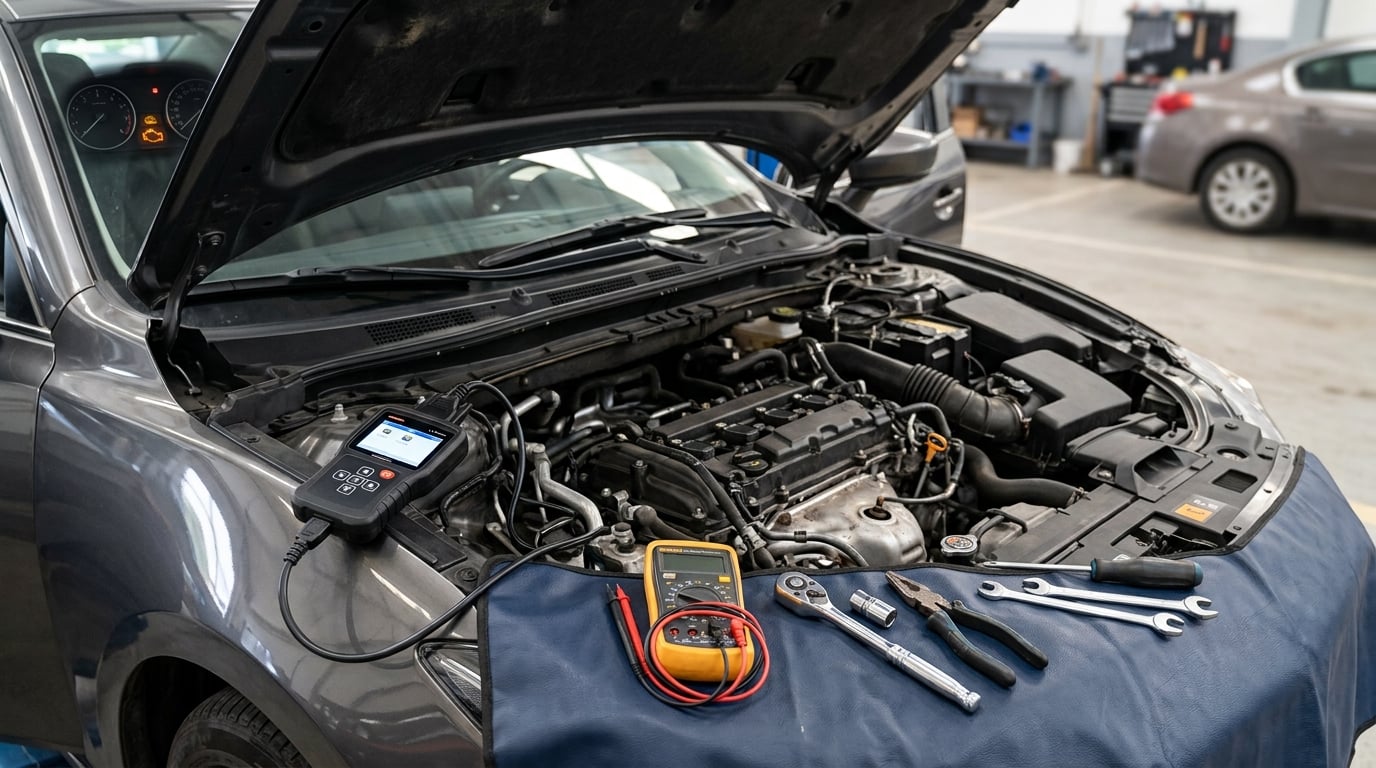
Limp mode is a fail-safe your car’s engine control unit switches on when it detects a fault serious enough to damage the engine, transmission or emissions system. It deliberately cuts power, boost, ignition timing or top speed so the car can still be driven to a shop instead of dying on the roadside. If you want to know what is limp mode and what causes it, the short version is: a sensor, a fuel or ignition fault, a fluid level, or a wiring problem.
- What it is: a reduced-power fail-safe, also called limp home mode, not an engine shutdown.
- Typical limits: revs capped around 2,000-3,000 and a top speed near 30-40 mph, depending on make.
- Usual trigger: a sensor reading outside its expected range, a misfire, overheating, or low fluid.
- It stores a code: a diagnostic trouble code you can read with any OBD-II scanner.
- It is a symptom, not the fault: clearing the code does not repair whatever caused it.
Table of Contents
- What Is Limp Mode and What Causes It?
- What Symptoms Does Limp Mode Cause?
- What Are the Most Common Causes of Limp Mode?
- How Do You Diagnose Limp Mode?
- Can You Fix Limp Mode Yourself?
- When Should You Take the Car to a Mechanic?
- Is It Safe to Drive in Limp Mode?
- Frequently Asked Questions
- What Should You Do First?
What Is Limp Mode and What Causes It?
Limp mode is a protective strategy built into every modern car’s electronics. The engine control unit, or the powertrain control module on some vehicles, watches sensors across the engine, throttle, transmission and exhaust. When a reading falls outside its expected range, the ECU stores a diagnostic trouble code and switches to a fixed, conservative strategy that limits fuel, boost, ignition advance and revs, holds a single transmission gear, caps top speed, and often switches off non-essential loads like the air conditioning.
The logic is straightforward. A misfire dumping unburned fuel into the exhaust, or an engine running lean from a failed mass airflow sensor, can destroy a catalytic converter in a matter of minutes. The manufacturers decided the sensible response is to slow the car down and complain on the dashboard rather than let that happen.
So limp mode is not a broken car and not a shutdown. The engine still runs, the car still moves, and you can usually get it to a workshop. What you have lost is performance, and probably some fuel economy along with it. The car is running on a table of pre-programmed values instead of live sensor data for the failed system, which is why the driving often feels flat and oddly unresponsive rather than simply slow.
What Symptoms Does Limp Mode Cause?
Reduced power is the giveaway, and owners usually notice it as a car that no longer wants to accelerate. The exact numbers vary by manufacturer, but the pattern is consistent across nearly everything built since the mid-1990s.
- Engine power drops noticeably, often described as a “limp” or weak feeling from around half throttle.
- Revolutions per minute are capped near 2,000-3,000, and the car stops accelerating past that.
- Top speed is limited to roughly 30-40 mph on many models.
- The pedal goes soft or unresponsive, and acceleration becomes jerky rather than smooth.
- The transmission holds one gear, refuses to upshift, or shifts late and harshly.
- A message such as “engine power reduced” or “enter service” appears on the dash.
- The air conditioning and sometimes other accessories stop working to shed electrical load.
- On automatic transmissions, the torque converter clutch stops engaging and the car feels like it is dragging.
Not every symptom shows up at once. A transmission fault usually drops top speed and gear changes, while an ignition or fuel fault shows up as a shaking, hesitating engine with a flashing check engine light. A blinking check engine light is different from a steady one and means the fault is severe enough to damage the catalytic converter, which is a stop-driving signal rather than a “limp mode” signal.
What Are the Most Common Causes of Limp Mode?
Sensors and wiring come first by a wide margin, followed by ignition and fuel faults, then transmission faults. Anything that produces an implausible signal, or that actually threatens mechanical damage, can trip the fail-safe. These are the groups worth thinking about.
Sensors and wiring
A mass airflow sensor, throttle position sensor, crank or cam position sensor, or coolant temperature sensor that reports an impossible value will bring the car straight into reduced power. Corroded connectors, chafed wiring near the exhaust, a failed ground, or a connector that was unplugged during a repair produce the same result without any part actually being broken.
Fuel and ignition
A failing fuel pump or weak fuel pressure starves the engine, and the ECU cuts back to protect it. Worn spark plugs, failing ignition coils, or an exhaust leak that pulls unburned oxygen past the oxygen sensor all trigger misfire counts, and enough misfires in a short window will put the car into limp mode with a stored misfire code.
Exhaust and emissions
A failed catalytic converter, a stuck EGR valve, a broken exhaust manifold, or a loose or failed gas cap is enough to upset the emissions controls. On some cars the cap alone will set a code and reduce power.
Transmission
Low or burnt transmission fluid, a faulty transmission range sensor, a sticking solenoid, or a torque converter clutch fault will lock the gearbox into a single gear or refuse to shift. Many people describe this as “the transmission went into limp mode” when it is really the powertrain module protecting the transmission.
Mechanical and electrical
Low engine oil, low coolant, an overheating engine, a weak or failing battery with corroded terminals, a bad alternator, and internal mechanical damage such as low compression are all in this group. Some of these end the drive rather than reduce it.
| Common code | What it usually points to |
|---|---|
| P0300 | Random or multiple cylinder misfire detected |
| P0301-P0304 | Misfire on a specific cylinder, often a coil or plug |
| P0128 | Coolant temperature below regulating range |
| P0171 | System too lean, common on a vacuum or MAF fault |
| P0455 | Large evaporative system leak, frequently a fuel cap |
| P0420 | Catalyst efficiency below threshold |
| P0524 | Engine oil pressure too low |
| P0700 | Transmission control system fault |
| P0740 | Torque converter clutch circuit performance |
| P2135 | Throttle position sensor correlation with pedal |
Codes are clues, not verdicts. The same code can mean a failed sensor on one car and a corroded connector on the next, and any code can be a leftover from months ago. Freeze frame data, which records engine speed, load and temperature at the moment the code was set, is what turns a code into a real diagnosis.
What is limp mode and what causes it only after 20 minutes of driving?
A fault that appears only when the engine is hot points at heat, movement or expansion rather than a dead component. A wiring harness chafing against the exhaust manifold expands and touches metal as things warm up, a marginal sensor drifts out of range once it reaches operating temperature, a cooling fan stops cycling, and a marginal fuel pump or failing alternator only quits under sustained load. This is why so many of these cars pass a shop test drive and come back the same. Ask the shop to log the data on a road test that matches your route, not a ten-minute loop around the block.
Why is my car in limp mode with no check engine light?
It is more common than most people expect. Some manufacturers display reduced power without setting a pending code, some only log a manufacturer-specific code that a generic scanner will not show, and a transmission fault often lights a different warning lamp entirely. A generic OBD-II reader also only shows the powertrain module’s codes, not body, chassis or manufacturer-specific modules. If the car is obviously down on power, read codes with the ignition on before anyone starts replacing parts.
Why does it come back right after a repair or battery disconnect?
Disconnecting the battery clears codes, which is convenient because it also erases the evidence. The fault has not gone anywhere, so it reappears as soon as the condition returns. Repair-related cases are usually an unplugged or partially seated connector, a wire that was pinched during reassembly, a sensor that was installed without cleaning its mating surface, or a new part that has not gone through its learn cycle yet. A brand new code that appears within a few days of paid work is a fair reason to ask the shop to re-check it under warranty.
How Do You Diagnose Limp Mode?
Work in order and stop before you start buying parts. The sequence matters, because most wasted money comes from replacing sensors that were never the problem.
- Record the conditions. Note whether the car was cold or hot, how long it had been running, the weather, the speed, and whether it happened before or after refuelling, a service, or a rainstorm. This is the information a shop needs most.
- Read the codes before you touch anything. Use an OBD-II scanner with a code reader app. Record stored, pending and permanent codes, then photograph the screen before clearing.
- Look at the freeze frame. Most scanners show the engine speed, load, coolant temperature and fuel trim at the moment the code was set. A misfire code set at high load points somewhere quite different from one set while idling cold.
- Check the obvious. Engine oil, coolant, transmission fluid, air filter, battery terminals, and the gas cap. A loose battery terminal is a surprisingly common trigger and costs nothing to rule out.
- Check live data against the codes. Watch the values for the sensor the code names while the engine idles and revs. A temperature sensor reading that never moves, or a throttle angle that does not follow the pedal, tells you the sensor is telling a story rather than reporting.
- Inspect what the code points at. Look at the wiring and connector for that sensor before condemning the sensor itself.
Avoid shotgun diagnosis. Owners have replaced a throttle position sensor, repaired a ground, and fitted a new mass airflow sensor before finding the real cause was a small amount of oil blowing back through a PCV valve into the intake. A code points you at a circuit or a system, and you still have to test it before you trust it.
Can You Fix Limp Mode Yourself?
Some cases are well within reach of an experienced owner working in the driveway with hand tools. A corroded connector cleaned and reseated with dielectric grease, a failed coolant temperature sensor, a loose ground, a dirty mass airflow sensor element, a blocked intake from a neglected air filter, or a broken wire in a harness that has chafed against a bracket are all sensible DIY jobs if you can test with a multimeter and read a wiring diagram.
Diagnosis still comes first. If you replace sensors one at a time until the message disappears, you have fixed nothing, and a part you fitted incorrectly can create a second fault. Read the code, verify the circuit, then change the part.
Leave the transmission, the fuel system, the cooling system under pressure, the brakes, and anything involving the catalytic converter to a workshop. If the car stalls, runs rough with visible smoke, or overheats, stop driving it and put it down.
When Should You Take the Car to a Mechanic?
Book the car in when the code comes back after a clear, when multiple codes appear at once, or when you cannot get a reliable reading from the affected circuit. Recurring faults are the strongest signal, because a code that sets again after the reset has a live cause that a reset will not touch.
- Multiple codes stored together, especially across different systems.
- Any fuel smell, visible leak, or fuel-related misfire code.
- Transmission slipping, harsh shifts, or a locked gear with no fluid level you can check safely.
- Overheating, or any code that returns immediately after a coolant top-up.
- Brake, steering or ABS warning messages alongside reduced power.
- A fault that only appears when hot, since it will not reproduce during a short shop test.
Dealers and shops sometimes describe the condition as “limp mode” without printing the code. Ask for the actual code numbers in writing, and ask whether the car has any open recalls or technical service bulletins for the symptom. Both are free to check with the manufacturer using the VIN.
Is It Safe to Drive in Limp Mode?
Often, yes, for a short distance at moderate speed. It is not a blanket yes, and the honest answer depends on the cause, the code, and how far you need to go. The rule that works is simple: limp mode itself is not the danger, the fault underneath it is.
| Probably fine to drive to a shop | Tow it, or stop driving |
|---|---|
| Reduced power with a steady check engine light and no unusual smell or noise | A flashing or blinking check engine light |
| A capped rev limit with smooth running and normal braking | Overheating, coolant warning, or steam from under the bonnet |
| Transmission holding one gear with fluid at the correct level and no slip | Any fluid leak, especially transmission fluid |
| Low speed, local roads, a trip of a few miles | Motorway driving, heavy traffic, towing a trailer, or a fully loaded car |
| A recently cleared code that has not returned | Brake, steering, ABS or airbag messages, or a fuel smell |
On a motorway a capped rev limit and a top speed limit of 30-40 mph are genuinely dangerous, because merging and lane changes need power you do not have. Do not tow a car that is in reduced power unless the tow is a flatbed, and never tow a car with a fuel or oil leak. Keep the trip short, avoid hard acceleration, and stay alert to a change in the noise or the feel of the car. If the check engine light starts flashing, pull over and stop the engine.
Frequently Asked Questions
What is the most common reason for limp mode?
By a wide margin it is a sensor or wiring fault. A mass airflow, throttle position, crank, cam or coolant temperature sensor sending an implausible signal, or a corroded connector or damaged ground, is the trigger more often than anything mechanical. Ignition and fuel faults such as worn plugs, failing coils or weak fuel pressure are the next most common, followed by transmission fluid and sensor problems.
Does limp mode always turn on the check engine light?
No, and this trips a lot of people up. Some cars display reduced power with only a pending or manufacturer-specific code that a generic scanner will not show, and transmission faults often light a transmission warning instead. A generic OBD-II reader also only covers the powertrain module, so codes from other modules stay hidden. If the car is clearly down on power, read the codes with the ignition on before replacing anything.
Can I clear the codes and get rid of limp mode?
Clearing codes often clears the message, and sometimes the car will drive normally for a while. But you have erased the evidence, not the fault. The code returns as soon as the condition comes back, usually within days or the next long drive. Always photograph the code and freeze frame data first, because once the memory is cleared that information is gone.
Why does my car lose power while driving and then come back?
That pattern usually means an intermittent fault tied to heat or vibration. A wiring harness chafing against the exhaust manifold can touch metal as the engine warms and separate as it cools, a marginal sensor drifts out of range only at operating temperature, and a cooling fan that stops cycling brings the fault in only on long drives. It is also why the car can pass a short test drive at the shop and behave perfectly the rest of the time.
Can limp mode fix itself?
Rarely, and only if the cause is temporary. A loose gas cap, a brief fuel starvation event, or a one-off sensor glitch can clear themselves once the condition passes, which is why some cars drive normally for a week and then drop out again. If the message keeps coming back, the fault is live and nothing about it is self-healing. Treat a repeat fault as a diagnosis job, not something to keep driving on.
Is limp mode expensive to fix?
It ranges from almost nothing to a very large job, and the code is what tells you which end you are at. A corroded connector, a failed coolant temperature sensor or a dirty air filter are simple, cheap repairs with little labour. A weak fuel pump, a catalytic converter, or a transmission fault are a different order of cost entirely. Anyone quoting you before reading the code is guessing, so get the number first.
What Should You Do First?
Write down exactly when it happens before you touch a single tool, because the pattern of the fault tells a mechanic more than the code alone. Then read the stored and pending codes with an OBD-II scanner, photograph them before you clear anything, and check the cheap things: oil, coolant, transmission fluid, air filter, gas cap and battery terminals.
Work from the code to the circuit to the part, not around it. A simple connector, sensor or intake problem is a fair weekend job if you can test it. If the code keeps coming back, if several codes appear together, or if anything smells of fuel or coolant, stop and let a workshop diagnose it properly. On that note, if you are buying a used car, a fast pre-purchase code scan is the cheapest check you will ever make.