

Knowing how to choose the right lug nut seat type comes down to the wheel, not the car. There are four common seat designs: conical (acorn, 60-degree taper), ball (radius or spherical), mag seat (flat with an attached washer), and flat seat. Match your wheel’s design and the nut threads on fine, seats fully, and holds. Get it wrong and it may only ever look tight.
That last part is the trap. A mismatched nut threads smoothly, stops at roughly the expected torque, and gives you no obvious warning while the contact patch shrinks to a fraction of what the wheel was designed for.
Table of Contents
- What Is a Lug Nut Seat Type and Why Does It Matter?
- What Are the Main Lug Nut Seat Types?
- How to Identify Your Wheel and Hub Fitment
- How to Choose the Right Lug Nut Seat Type
- Can You Use the Same Lug Nuts on Different Wheels?
- What Should You Check Before Installing New Lug Nuts?
- Frequently Asked Questions
- Are all 5-lug nuts with the same thread size interchangeable?
- How do I tell if my wheel uses a tapered or ball-seat lug nut?
- Can I use OEM lug nuts on aftermarket wheels?
- Does the lug nut seat type affect wheel torque?
- Should I replace tapered lug nuts when changing wheels?
- What is the correct tightening sequence for lug nuts?
- What to Do First
What Is a Lug Nut Seat Type and Why Does It Matter?
A lug nut seat type is the shape of the surface inside the wheel’s lug hole that the nut’s seating face presses against as you tighten it. That contact patch is what actually clamps the wheel to the hub.
A cone concentrates load into a narrow ring, giving a positive wedge grip. A ball spreads the load across a wider curved area and tolerates small alignment errors. A flat or mag seat relies on a broad washer face. Pair the wrong nut with the wrong wheel and the contact patch shrinks, the nut never fully seats, and vibration walks it loose over a few thousand miles.
| Seat type | Seat shape | Typical applications | Contact behavior | Risk if mismatched |
|---|---|---|---|---|
| Conical (taper, acorn seat) | 60-degree cone | Most GM, Ford and Chrysler trucks and cars; most aftermarket wheels | Narrow ring contact, wedge grip | Nut rocks and sits high; studs can lose preload |
| Ball (radius, spherical) | Rounded dome into a curved recess | Many Honda, Acura, VW, Audi and BMW applications | Wider curved patch, tolerates a few degrees of misalignment | Nut tilts, contact shrinks to an edge, loosening under load |
| Mag seat | Flat face with an integral washer | Many Toyota, Lexus and Mitsubishi applications, especially alloy wheels | Broad flat patch, torque-sensitive | Severe. The wheel simply will not clamp properly |
| Flat seat | Plain flat face, separate washer | Older and some heavy-duty applications | Broad but shallow patch | Same as mag seat, plus possible washer wander |
What Are the Main Lug Nut Seat Types?
Conical (acorn, 60-degree taper) seat
A conical seat is a 60-degree taper machined into the wheel’s lug hole. The nut has a matching cone at its closed end. This is the most common arrangement in North America and the default on most aftermarket wheels, which is why conical nuts are the easiest to match.
Ball (radius or spherical) seat
A ball seat nut has a domed, rounded end that mates with a curved recess machined into the wheel. Instead of a narrow ring, the load spreads over a broader area, and the geometry tolerates roughly two to three degrees of misalignment between nut and wheel. That forgiveness is one reason it suits softer alloy castings.
Mag seat and flat seat
A mag seat nut is flat and wide with a washer incorporated into the nut itself. A plain flat seat nut is narrower and relies on a separate washer. Both clamp across a broad face rather than a point or ring, which makes them unforgiving: a mag nut fitted to a conical hole has almost nothing to seat against. The rule that follows is simple: do not mix mag and conical hardware on the same car.
Why the word acorn tells you nothing about the seat
Acorn describes the overall shape of the nut, a closed dome with an open hex end, not the seat underneath it. A ball-seat acorn nut exists, and plenty of conical nuts are called acorn too. Cone seat, taper seat and acorn seat all get used for the same 60-degree design, while ball, radius and spherical all describe the rounded one. Never infer the seat from a product name. Read the physical nut in your hand before you trust the box it arrived in.
How to Identify Your Wheel and Hub Fitment
The seat type belongs to the wheel, which is why used or swapped wheels trip people up. If the nuts currently on your car came from an earlier wheel swap, they tell you nothing about what you have now.
1. Read the wheel’s own markings
Turn the wheel over or look inside the spokes. Many castings carry the seat type, diameter and pitch stamped or cast near the bolt circle or centerbore, sometimes with a small seat symbol. The maker’s own catalog for that wheel model is the next best source.
2. Check the owner’s manual and OEM parts catalog
Manuals are often silent on seat geometry, but the parts catalog for your exact year, trim and wheel size usually is not. Match by part number rather than by description, and note that some cars changed seat type between model years or between steel and alloy wheels.
3. Measure thread size and pitch with a thread gauge
Common combinations include M12x1.5, M14x1.5 and M14x1.25. A cheap thread gauge set settles this in seconds. Diameter alone is not enough, because an M12 nut will spin freely on an M14 stud and thread partway on the wrong pitch.
4. Compare the nut to the hub face
Set the wheel on the hub without tightening and look at how the nut sits. A conical nut drops in and centers itself in a conical hole. A ball seat nut centers in a curved recess. On mag and flat seats, look for the broad flat washer face and confirm the wheel has a matching flat counterbore.
The paint-transfer test that settles it in ten minutes
Mark the wheel’s lug hole with a paint pen or chalk, back the nut out until it just engages, then tighten it to spec and remove it again. A matching nut leaves a clean ring or patch on the seat. A mismatched nut leaves paint only on the very tip, or a crescent smear where it tilted. It is the fastest way to separate two nuts that look identical from the outside: a conical nut that is nearly right on a ball seat hole marks barely anything, while the correct ball seat nut leaves a substantial patch.
How to Choose the Right Lug Nut Seat Type
Work from the specification outward rather than from the nut you already have. The wheel decides the seat, the hub and studs decide thread size, pitch and length, and the service manual decides torque.
- Confirm the seat on the wheel itself. Stamping, catalog or the paint-transfer test. Treat the vehicle make as a hint, never as the answer.
- Confirm thread diameter and pitch. Gauge the studs. M12x1.5 and M14x1.5 are both very common and not interchangeable.
- Check nut length against stud length. Threads should protrude roughly 1.5 to 2 full threads past the nut. Too short and the stud bottoms out before the nut is tight. Too long and the wheel may not seat against the hub, which is a real issue with spacers and extended studs.
- Check quantity and offset style. Four, five and six lug patterns are separate ecosystems, and ET nuts with a longer shank exist to center the wheel on a hub where the original nuts sat off-center.
- Get the torque figure from the vehicle, not the nut vendor. The service manual lists it for your car and wheel.
Make is a decent starting hint and a poor conclusion. Rounded ball seats are standard across much of the VAG and BMW range, Honda and Acura commonly use ball seat, GM and Ford mostly conical, and Toyota and Lexus fall somewhere in between with conical and mag hardware that varies by wheel. Within a single brand the wheel decides, so you will see ball seat on some Hondas and 45-degree mag seats on many Toyota alloys. If you are swapping tires or sizing a set at the same time, how to choose the right tire size for your car covers the fitment numbers that go with it.
Can You Use the Same Lug Nuts on Different Wheels?
Only when the seat geometry matches. Matching thread size tells you the nut will screw on, nothing more. A conical nut on a ball seat wheel threads to the stop, torques up, and leaves a contact patch sitting on one side of the dome.
Three cases come up constantly. Dual-fitment wheels are machined to accept more than one nut style, and those are the exception worth reading the box for. Mixing hardware mid-set, say conical nuts on three corners and a locking set on the other two, gives mismatched seat geometry and mismatched stretch. And a used OEM wheel brings whatever seat the previous car had, so re-run the identification steps rather than assuming.
The honest answer to whether a mismatch is dangerous is yes, it loosens, and it is not merely cosmetic. You are removing load capacity that the wheel design assumed, and the failure tends to show up as a hum or a vibration long before anything dramatic happens. That noise is your cue to stop and recheck the whole set. If you also carry the right gear for track days, our track day helmet guide covers the other half of that checklist.
What Should You Check Before Installing New Lug Nuts?
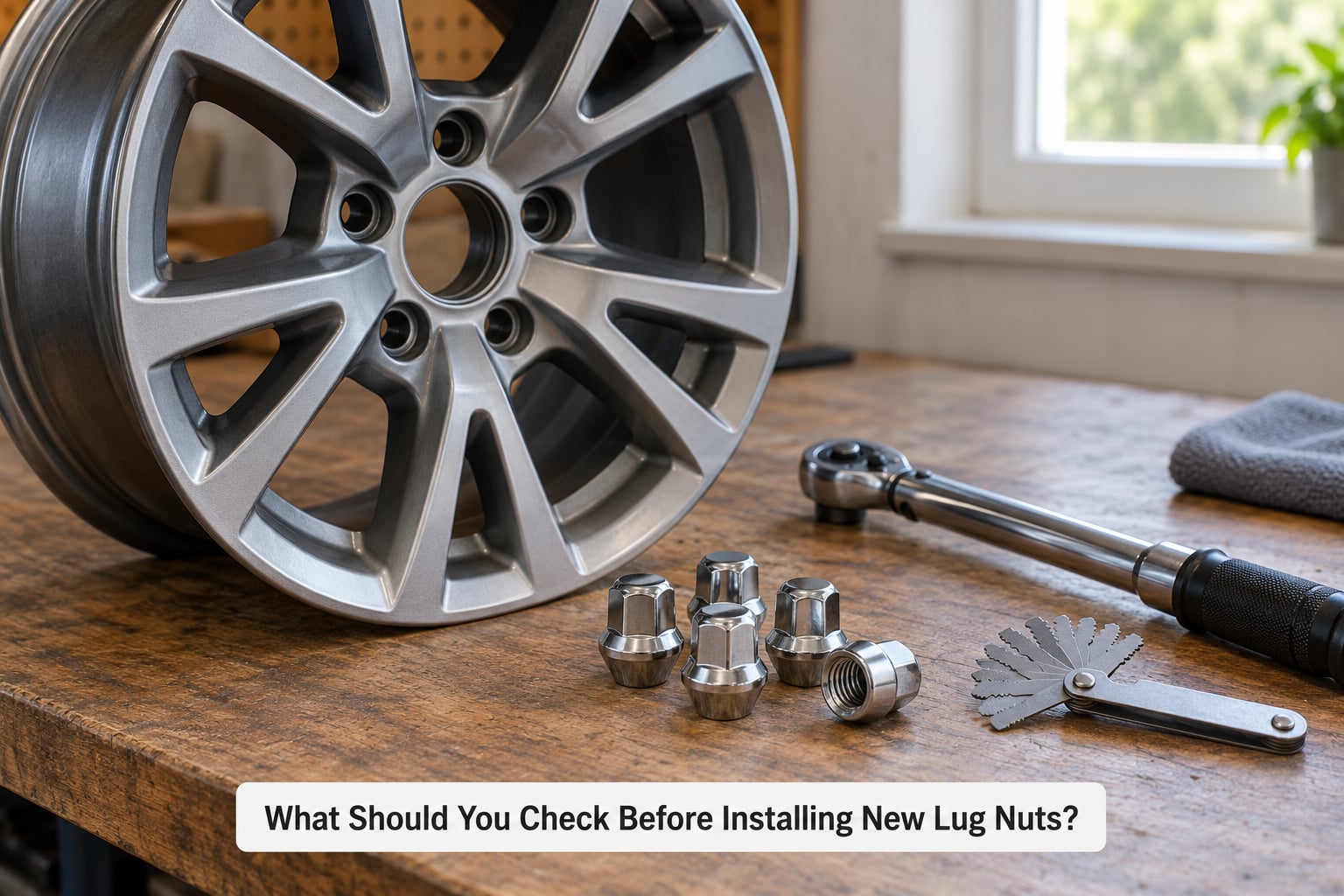
Run this before the wheel goes on, not after a hum appears at highway speed.
- Seating surfaces are clean and free of rust scale, old grease and paint overspray.
- All nuts are the same seat type, size, pitch and length, from the same set.
- Wheel condition: no cracks around the lug holes, no heavy curb damage on the outer lip.
- Centerbore matches the hub and seats fully on its pilot, not riding on the studs.
- Studs are clean, straight and free of stretched or stripped threads.
- Torque wrench is calibrated and covers your spec. A click wrench set to a low value is worse than no wrench.
Tighten in stages: snug first by hand in a star pattern, then torque in the same star order, then a second pass. On some cars a recheck after 50 to 100 km of driving catches the small settling that happens as everything seats. Keep impact tools for break-away only. Never finish a wheel with an impact gun, and stay at or below the manufacturer figure, especially on cast alloy wheels where over-torquing stretches studs and cracks the hub.
Whatever else you change on the car, keep the torque spec and seat type non-negotiable. Routine upkeep like picking the right engine oil viscosity matters, but a wheel fastener is the one place where a wrong answer shows up as a detached wheel.
Frequently Asked Questions
Are all 5-lug nuts with the same thread size interchangeable?
No. Five lug nuts that share M12x1.5 can still differ in seat type, shank length and hex size. Seat type has to match the wheel, shank length has to suit the stud and the wheel has to fully seat on the hub. Buy a complete set matched to the wheel, and do not mix hardware from two different sets.
How do I tell if my wheel uses a tapered or ball-seat lug nut?
Look at the lug hole itself. A tapered hole narrows to a cone and the nut drops in and centres itself. A ball seat hole has a rounded, curved recess. If you cannot tell by eye, mark the seat with a paint pen, tighten a nut to spec, then remove it and check whether the paint transfer is a full ring or a small crescent at one edge.
Can I use OEM lug nuts on aftermarket wheels?
Often yes, because most aftermarket wheels are built for the standard 60-degree conical seat, but check first. European bolt applications and mag seat designs will not accept conical nuts. Confirm the seat, thread size, pitch and length, and remember that a wheel with a larger centerbore may need longer nuts or a centering ring.
Does the lug nut seat type affect wheel torque?
The specified torque is the same number regardless of seat type, but a mismatched seat means that torque is not producing the clamping load it should. A nut sitting on one edge of a ball dome, or a mag nut with nothing flat to clamp against, can be torqued to spec and still hold far less than the wheel design intended.
Should I replace tapered lug nuts when changing wheels?
Replace them whenever the seat type changes, the threads are rusty, pitted or stripped, or the nuts have been mismatched by a previous install. If the new wheel uses the same seat type and the old nuts are clean, undamaged and the right length, reusing them is fine. Replacing all of them as a set is cheaper than a loose wheel.
What is the correct tightening sequence for lug nuts?
Snug every nut lightly by hand first, working in a star or cross pattern so the wheel pulls down evenly. Then torque to the manufacturer figure in the same pattern, usually in two or three passes for a torque wrench with no scale. A recheck after the first 50 to 100 km catches settling. Never use an impact gun for final tightening.
What to Do First
Take one nut off and look at it, then look at the wheel hole it came out of. That comparison, plus a thread gauge on the studs and the torque figure in your service manual, is all you need to pick the right lug nut seat type with confidence. Everything else on the list is a detail check on top of that.