
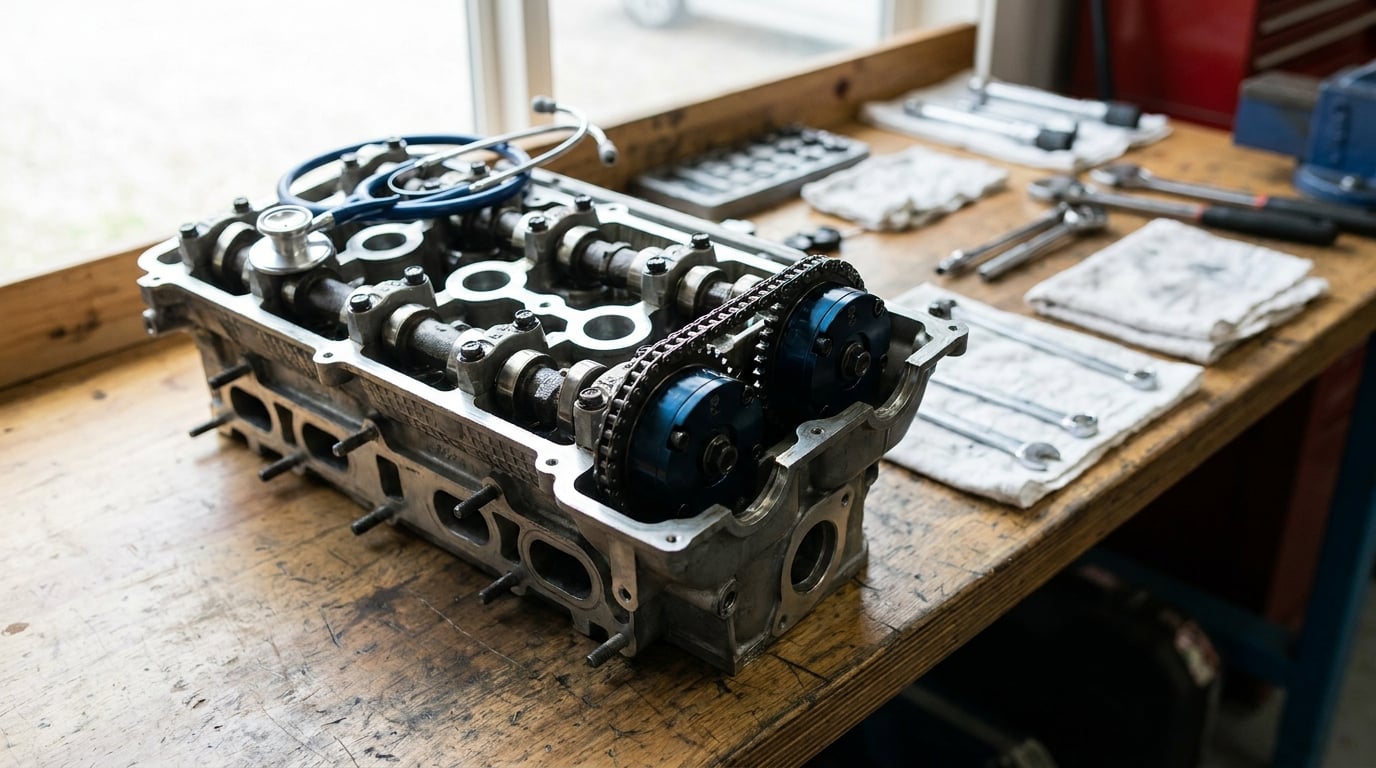
A BMW VANOS rattle comes down to a short list of things: hardened oil seals inside the variable valve timing unit, a clogged or dead VANOS solenoid, worn timing chain guides, a weak chain tensioner, or a camshaft phaser whose helical splines and thrust bearings have worn. Most of it starts as a noise on a cold start that fades after thirty to sixty seconds, which is exactly why so many owners end up replacing seals that were never the problem. This guide walks through how to tell those causes apart before you buy a single part.
Written for owners of older BMWs running M52, M52TU, M54, N52, N53, N54, N55 or S62 engines, typically past 60,000 miles. If you are just starting out, the ninety-second checklist in the next section will tell you whether you have a problem worth opening a valve cover for.
Table of Contents
- What Is a BMW VANOS Rattle?
- BMW VANOS Rattle: What Causes It?
- What Does a VANOS Rattle Sound Like?
- Is It Safe to Drive With a BMW VANOS Rattle?
- How to Diagnose BMW VANOS Rattle Causes
- BMW VANOS Rattle Causes and Fixes: What You Can Do
- How Much Does It Cost to Fix a BMW VANOS Rattle?
- How to Prevent a VANOS Rattle in the Future
- Frequently Asked Questions
- Can I drive my BMW if the VANOS rattles when cold?
- Should I use premium oil to stop a BMW VANOS rattle?
- Is a VANOS rattle the same as a timing-chain rattle?
- What BMW models are most prone to VANOS rattle?
- Does a VANOS solenoid replacement stop the rattle?
- How much does it cost to repair a BMW VANOS rattle?
- Conclusion
What Is a BMW VANOS Rattle?
VANOS is BMW’s variable valve timing system, and a VANOS rattle is the sound it makes when it loses pressurised oil. Oil is metered through a solenoid into a vane-type actuator, which rotates the camshaft phaser to advance or retard cam timing. Because the actuator works against a spring that holds the phaser on its housing, oil pressure is doing the work. When the internal seals harden and shrink, the pressure bleeds away, the phaser gains end play, and the helical splines that link the cam to the phaser start knocking against each other.
That is the mechanical chain behind almost every noise people call a VANOS rattle, and it is also why the noise is loudest when oil pressure is lowest: at key-on, at start, and for the first minute or so after a cold start.
The first diagnostic move is unglamorous. Check the oil level and look at the oil on the dipstick. A VANOS unit that has been chewing on itself leaves metal in the oil, and if you find it, the seal kit is no longer the whole job. Our guide to what metal in engine oil means covers what the different particle types point to.
BMW VANOS Rattle: What Causes It?
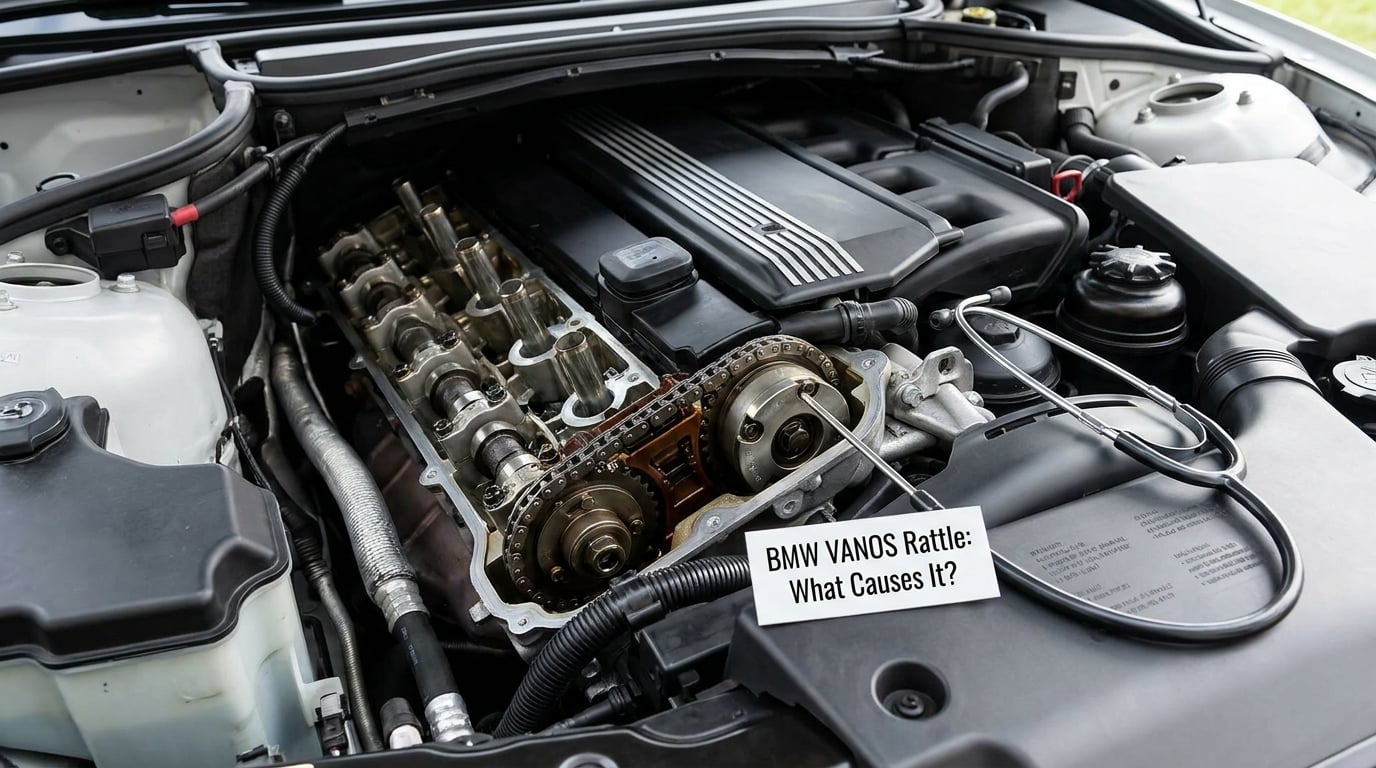
Ordered from cheapest to most serious, here are the five causes that account for nearly every case.
1. Hardened VANOS oil seals
The original seals are nitrile rubber and they harden with heat cycles and time. On a cold start the actuator is slow to fill, the phaser lags, and the splines clatter until oil pressure arrives. Owners who changed the seals and also swapped in anti-rattle rings and pistons frequently report the rattle disappearing along with a noticeable return of low-end torque and a smoother idle, which is often the real confirmation that the repair worked.
2. A clogged or failing VANOS solenoid
The solenoid has a mesh screen that catches debris. Long oil change intervals and the wrong viscosity are the usual culprits, and the symptom pattern is different from seals: stumble or misfire on a warm engine, hesitation off idle, and a fault code for cam position rather than a purely noise-driven complaint. One failure mode worth knowing is the B2 outlet solenoid failing to close or leaking at its O-ring, which lets oil feed back up through the feed hose and starves the unit it is supposed to supply. M5Board threads come up on that one repeatedly.
3. Worn timing chain guides
The plastic guides are sacrificial and they are the expensive cousin of the rattle. When the VANOS loses its holding force, the chain starts to work against the guide, and the guide wears or cracks. Owners who open these engines up often find the exhaust-side guide chewed, which is a good reason to replace both guides whenever you are in there. A chain guide that breaks loose entirely can fall into a cylinder and bend valves.
4. A weak or failed chain tensioner
The tensioner takes up slack in the chain so the guides stay loaded. When its oil feed restricts or its spring relaxes, the chain slaps, and the sound travels forward and sounds like it comes from the VANOS. Forum consensus across the BMW boards is to check the tensioner whenever you replace VANOS seals.
5. Worn helical splines and thrust bearings
This is the one the seals cannot fix. Beisan Systems attributes the underlying noise to a combination of end play in the VANOS thrust bearings and wear in the helical splines that connect the cam to the phaser, a description picked up repeatedly on zroadster and similar boards. When a seal kit does not quieten the engine, this is usually why. It also means the fix is a phaser or unit replacement rather than a gasket job.
What Does a VANOS Rattle Sound Like?
A healthy VANOS is silent. A worn one makes a dry metallic clatter from the top front of the engine, most obvious with the oil filler cap off, that fades within about a minute of warm-up. Some engines also rattle in a band around 1,500 to 2,200 rpm as the actuator hunts for its target angle.
| What you hear | When | Most likely cause |
|---|---|---|
| Dry clatter, front of engine, fades in 30 to 60 seconds | Cold start only | Hardened VANOS seals |
| Rattle in a band around 1,500 to 2,200 rpm | Warm, at steady revs | Phaser end play, actuator hunting |
| Rattle plus stumble, misfire or hesitation | Warm, off idle | Clogged or failed VANOS solenoid |
| Rattle plus loss of low-end torque, no codes | Cold and warm | Seals plus worn chain guide |
| Chattering that gets worse as the car warms | Any | Worn helical splines or thrust bearings |
| Rattling from the front with the engine off and keys turned | Key-on only | Timing chain tensioner |
| Light tick at idle, louder with the engine warm | Warm idle | DISA valves, exhaust heat shields, secondary air injection |
That last row is the misdiagnosis bucket, and it is where most forum threads get stuck. E46Fanatics threads titled along the lines of a rattle persisting after a seal kit list the usual suspects: low engine oil, low power steering oil or a tired pump, the alternator, and broken engine mounts. A heat shield off the exhaust manifold, DISA adjuster plates and a failing water pump all produce noise from the same corner of the engine bay.
Two tricks narrow it fast. Put a mechanic’s stethoscope on the cam cover while the engine idles and again while someone blips the throttle; a stethoscope finds the source of a rattle better than ears do. Then run a dab of oil onto the timing chain cover area at idle and see whether the noise changes when a guide or tensioner is wet.
Is It Safe to Drive With a BMW VANOS Rattle?
A cold-start rattle that fades completely is usually not an emergency, but it is a countdown, not a free pass. Here is the honest split. If the engine starts clean apart from a brief clatter, runs smoothly once warm, holds full oil pressure and shows no stored cam-position codes, you can drive it to a shop and get it looked at properly. If the noise persists warm, comes with misfires, a rough idle, a check engine light or falling power, stop driving it and get it inspected.
The reason to care is what a leaking VANOS does to everything downstream. The chain begins working against a guide that was never designed to take that load, and a guide that breaks loose can drop into a cylinder. That is a head or engine job, not a seal job.
Watch for the milky or foamy residue that comes with a coolant leak into the oil, which points somewhere else entirely and needs attention fast. What milky engine oil means covers that case. And if a rich-running stumble starts throwing unburned fuel, what causes black smoke from the exhaust breaks down that side of the picture.
How to Diagnose BMW VANOS Rattle Causes
Work through these in order. Each step either confirms the noise source or eliminates a cheap cause before you commit to a teardown.
1. Check the oil level and condition. Low or burnt oil is the cheapest cause and the easiest to fix. Look at the colour, feel the texture and check for metal. If the oil is clean, correctly filled and sludge-free, move on.
2. Record exactly when the noise happens. Cold only, warm only, in an rpm band, or all the time. A dash-mounted phone recording twenty seconds of cold start and twenty seconds of warm idle is worth more than any description you can type.
3. Listen at the chain cover. With the engine running, a stethoscope on the timing chain cover versus the cam cover separates the tensioner and guides from the VANOS unit.
4. Inspect for leaks and physical damage. Oil weeping around the valve cover gasket, at the cam sensor, or down the VANOS feed line tells you where the pressure went. Milky residue means coolant, not oil.
5. Read the codes, including pending ones. P0011 for intake cam timing, P0014 for exhaust cam timing, P0016 and P0017 for cam-to-crank correlation, and P1523 for oil pressure or VANOS control are the ones that matter. Scan the whole module set, not just the engine.
6. Test oil pressure and check the solenoid screen. Low hot idle pressure points at the pump or a relief valve rather than the VANOS. A clogged solenoid screen is visible on removal and explains a warm stumble that a cold-start rattle would not.
7. Compression and leak-down test. Do this before you start ordering a VANOS kit. Low compression on a cylinder, or a leak-down reading at the exhaust valve, redirects the whole investigation.
Which engine code you have changes the diagnosis
The M52 in early cars is single VANOS on the intake cam only. The M52TU and the M54 are double VANOS, with phasers on both cams, and double VANOS engines are the ones whose exhaust-side phaser and exhaust guide tend to be the chewed parts. The N52, N53, N54 and N55 are double VANOS too, and the N52 carries a separate history: broken VANOS bolt debris dropping into a cylinder, which owners sometimes mistake for a rattle. On the N52, ask for the VIN checked against the VANOS bolt recall before you blame seals. The S62 in an E46 M3 is a different animal, with its own cam drive wear expectations, so an M3 quote is not an E46 quote.
BMW VANOS Rattle Causes and Fixes: What You Can Do
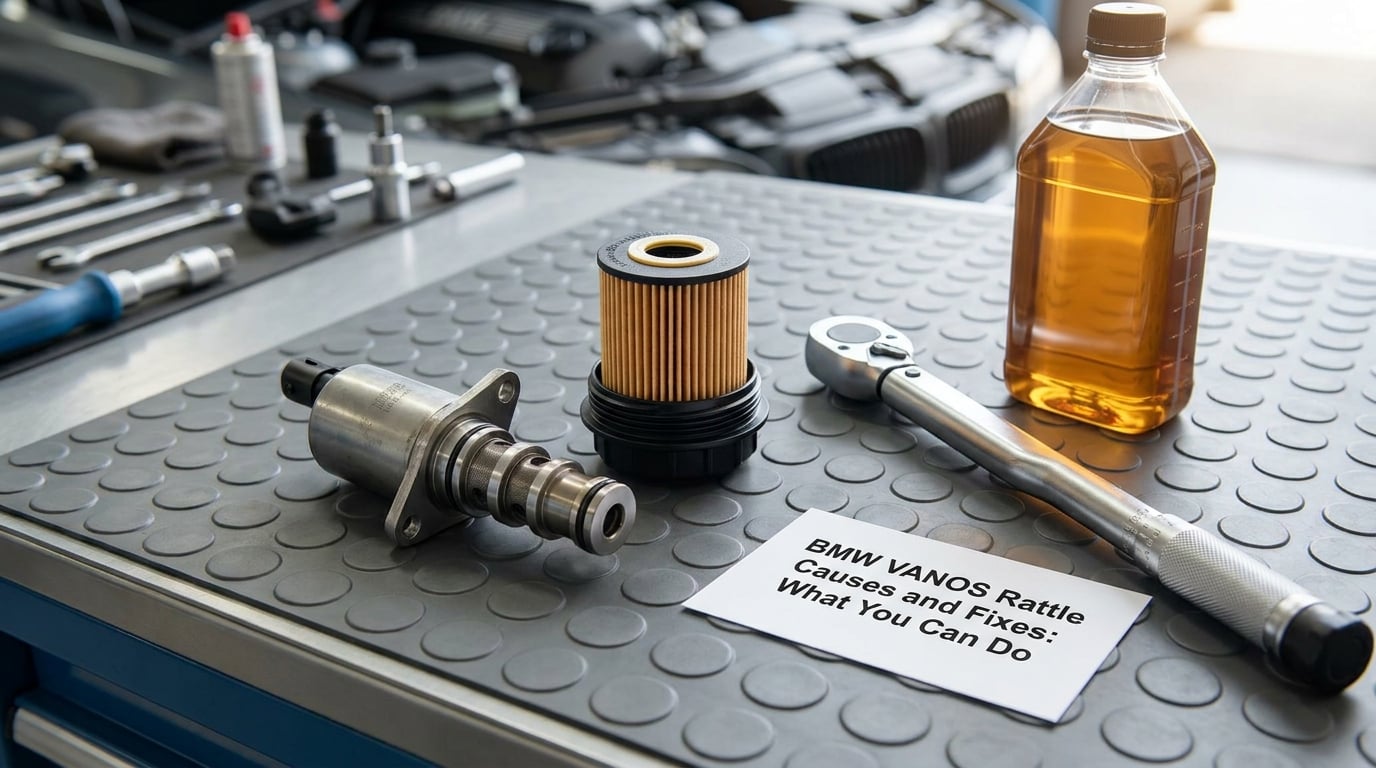
Match the fix to the cause, and know which jobs are honestly DIY.
Oil service and a cleaned solenoid. A correct oil change with the specified viscosity, new drain plug washer, and a solenoid cleaned or replaced is straightforward work and fixes a surprising share of cases. This is the DIY starting point, not a throwaway step.
VANOS seal and anti-rattle kit. Replace the seals, and while the unit is apart fit the anti-rattle rings or pistons. This is the big one, and it is a weekend job for someone comfortable with cam work. The valvetronic step on double VANOS engines is the fussy part: the cam cover comes off, the cams have to be locked in place with an engine-specific locking tool, the phasers come out, and new single-use cam bolts are fitted on the way back in. Get the tooling sorted before you start, because a job that stalls halfway with a camshaft loose is a bad afternoon.
Solenoid replacement. Cheap parts, easy access, no cam locking needed. No programming is required on a BMW VANOS solenoid; fit it with new O-rings, clear the codes, and let the ECU relearn on the next drive cycles.
Chain guides and tensioner. Replace both guides and the tensioner while the cover is off. This is the standard companion work to a seal kit, and skipping it is the single most common reason a rattle comes back.
Cam phaser or VANOS unit replacement. When the helical splines or thrust bearings are worn, new seals will quieten nothing. This needs camshaft removal, so it is shop work or a very well-equipped garage.
Oil pressure faults. A failing pump, a stuck relief valve or a blocked feed needs fixing before any VANOS work will hold.
If the rattle survived a seal kit, walk the decision tree in this order: guides and tensioner next, then the solenoid and its screen, then the phaser and splines, and only then suspect the chain itself. A stretch measurement taken with the engine’s own timing-chain elongation test is the last check, not the first.
How Much Does It Cost to Fix a BMW VANOS Rattle?
These are typical US ranges for parts and labour. Region, model, condition and the shop’s hourly rate move the final quote a long way, and used versus new parts moves it further.
| Job | Parts | Labour |
|---|---|---|
| Diagnostic check and code read | None | 1 to 2 hours |
| Oil service plus cleaned or new solenoid | Low | 1 to 2 hours |
| VANOS seal kit with anti-rattle rings | Moderate, a seal kit is not expensive | 6 to 12 hours |
| Seal kit plus guides and tensioner | Moderate to high | 8 to 16 hours |
| Full VANOS rebuild, phaser or unit replacement | High | 12 to 20 hours |
| E46 M3 S62 rebuild | High | Quoted case by case, well above the rest |
The parts side of a seal job is genuinely modest. Labour is what decides the number, and the eight to twenty hour quotes you see quoted on the boards are real. If a shop quotes a VANOS job in two hours, something is missing from it.
DIY halves the labour line but adds tooling cost, and cam locking tools are engine-specific and not always included in a kit. Some are available through ECS Tuning and similar suppliers; rent them rather than buy the wrong set.
How to Prevent a VANOS Rattle in the Future
Most of this is oil discipline, and the owners who changed oil on schedule with the correct viscosity report markedly fewer VANOS issues than the rest. Stick to the interval the sticker or the manual calls for, run the specified viscosity rather than a thin or a thick substitute, and never stretch the interval because the car feels fine.
Keep an eye on oil consumption. A VANOS unit that starts using oil through its own seals will show rising consumption before the noise gets worse.
Fix external leaks early. Oil weeping at the cam sensor, the valve cover gasket or the feed line is how a healthy seal system turns into a sludge system, and a clogged solenoid screen is the result of sludge and stretch, not bad luck.
Do not normalise a rattle. The thirty-second clatter that seems harmless this month is the ninety-second clatter next year, and the guide wear underneath is the part that ends an engine. If it comes back within a few thousand miles of a repair, get it looked at rather than turning the radio up.
Frequently Asked Questions
Can I drive my BMW if the VANOS rattles when cold?
Yes, if the rattle clears within a minute or two, the engine runs smoothly once warm, and there are no cam-position codes. That pattern is worn seals rather than a failure in progress. Drive it to a shop rather than living with it. Do not drive it if the noise persists warm, comes with misfires, a rough idle or falling power, because that points at a worn chain guide that can break loose.
Should I use premium oil to stop a BMW VANOS rattle?
Use the viscosity BMW specifies for the engine, which is not always the thinnest oil on the shelf. A stuck or clogged VANOS solenoid responds to correct viscosity and a correct oil change interval, and a bad solenoid will not be cured by any oil at all. If consumption rises between changes, treat that as a seal system problem rather than something an oil change will fix.
Is a VANOS rattle the same as a timing-chain rattle?
No, they sound similar and often coexist. A VANOS rattle comes from the phaser and splines inside the valve timing unit and is loudest cold. A chain rattle comes from the chain, guides and tensioner and is affected by engine temperature and oil pressure. A stethoscope on the cam cover versus the timing chain cover separates them, and once the chain is losing tension properly the guides wear much faster.
What BMW models are most prone to VANOS rattle?
Older cars with M52, M52TU, M54, N52, N53, N54, N55 and S62 engines, usually past 60,000 miles, especially where oil changes were stretched or cheap original seals were fitted. On the N52, have the VIN checked against the VANOS bolt recall first, since broken bolt debris can be mistaken for a rattle. The S62 in an E46 M3 is a separate and more expensive repair than an M54 in a sedan.
Does a VANOS solenoid replacement stop the rattle?
Only when the solenoid is the cause. A clogged or dead solenoid shows up as stumble, hesitation and cam timing codes on a warm engine, not as a pure cold-start clatter. A cold-start rattle that fades with no codes is far more likely to be hardened seals. A dirty pump or a stuck relief valve can starve the VANOS just as effectively, so test oil pressure before ordering parts.
How much does it cost to repair a BMW VANOS rattle?
A seal kit with anti-rattle rings is moderate in parts and runs roughly six to twelve hours of labour. Adding chain guides and the tensioner usually brings it to eight to sixteen hours, and a full rebuild with phaser or unit replacement can reach twelve to twenty. Diagnosis is only an hour or two. The number depends heavily on region, model and shop rate, and used parts cut the parts cost sharply.
Conclusion
Start with the oil. Check the level, look at the condition, and record twenty seconds of cold start before you spend anything, because a clogged solenoid and a low oil level account for more cases than a full VANOS rebuild ever will. If the rattle is genuinely from the unit, replace the seals, fit the anti-rattle rings, and do the chain guides and tensioner in the same job so you are not back on the lift next month. And if the noise turns out to be a heat shield, DISA adjuster or a tensioner, you have just saved yourself a weekend.