
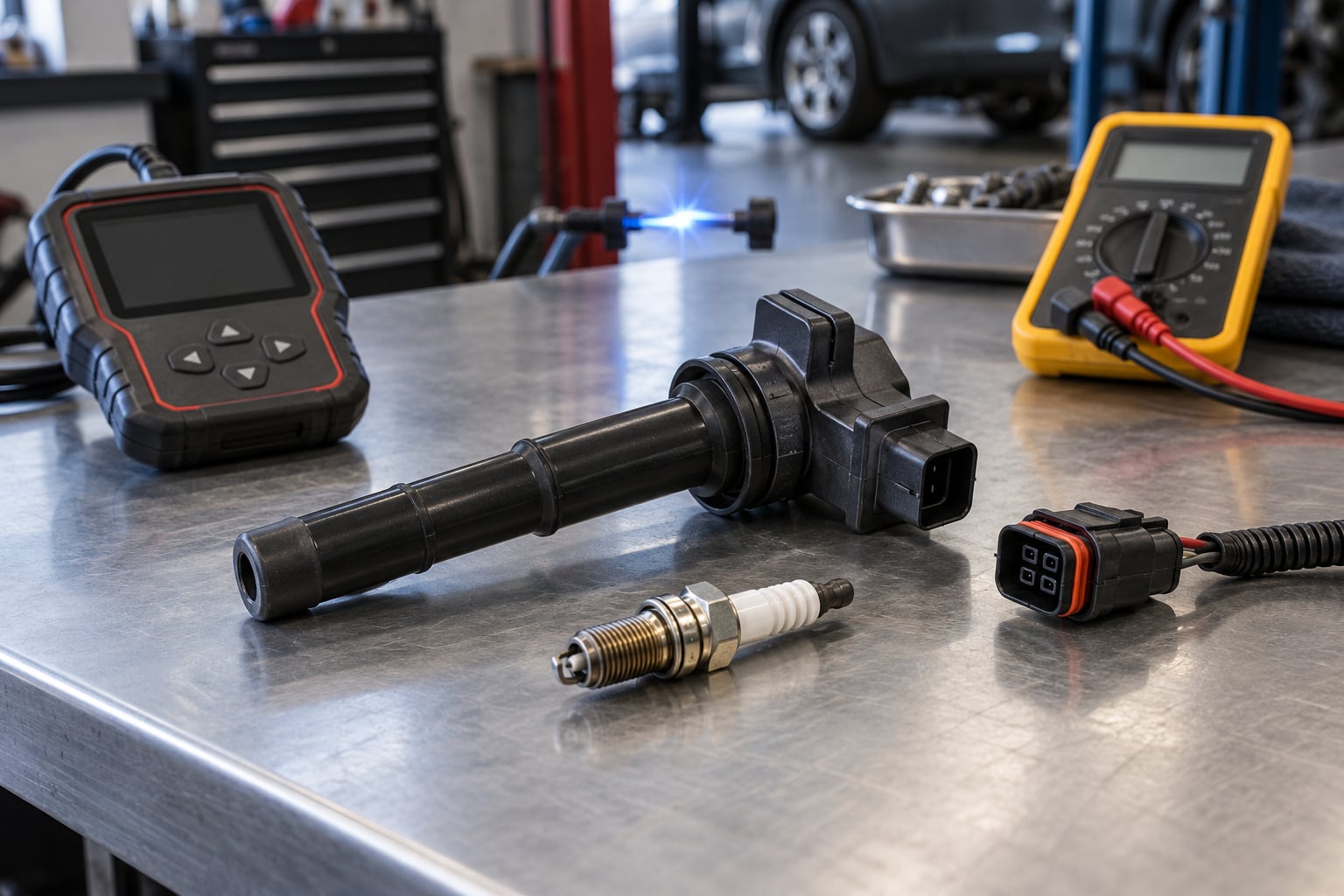
If your engine stumbles, hesitates, or lights the check engine light for no obvious reason, the ignition coil is one of the first components worth suspecting. A weak or failing coil does not always kill the engine outright — it usually shows up as the symptoms of a bad ignition coil: misfires that come and go, a rough idle, a longer crank, a stumble under load, and worse fuel economy than the car used to get.
None of those symptoms belong to a coil alone. Worn spark plugs, a vacuum leak, a weak battery, or an alternator that cannot keep up produce the same clues, so this guide walks through what a coil actually does, the nine signs that point at it, how the symptom changes depending on whether your car uses coil packs or coil-on-plug, how to test a coil before you buy one, and when the diagnosis is better handed to a shop. Nothing here needs more than an OBD-II scanner, a multimeter, and a coil swap test to get you most of the way.
Table of Contents
- What Does a Bad Ignition Coil Do?
- Symptoms of a Bad Ignition Coil
- Which Engine Symptoms Point to an Ignition Coil?
- Symptoms by Ignition-System Type
- What Else Causes These Symptoms?
- How to Test Whether an Ignition Coil Is Bad
- How to Replace an Ignition Coil Safely
- When Should You Replace the Coil or Seek a Mechanic?
- Frequently Asked Questions
- Conclusion
What Does a Bad Ignition Coil Do?
An ignition coil is a step-up transformer. It takes the 12 volts your battery supplies and multiplies them into tens of thousands of volts — typically somewhere in the 40,000 to 60,000 volt range — then fires that voltage down the plug wire or across the gap to the spark plug. The spark ignites the air-fuel mixture in the cylinder, and combustion pushes the piston down. That is the whole job, and every start, every idle, every throttle blip depends on it happening on schedule.
A bad coil is a transformer that has lost part of its output. It may deliver a weak spark, an intermittent spark, or no spark at all. Weak and intermittent are far more common than a dead coil, which is why a car with a bad coil often still starts and still runs, just badly.
A dead coil and a dead ignition system are not the same thing. If the crank-no-start happens, the engine cranks but never fires, and nothing is audible from the exhaust, you are looking at a no-spark condition across all cylinders — a failed coil pack, an ignition switch, a blown fuse, a crank sensor, or an open circuit. One coil going weak is a misfire on one cylinder. That distinction is the first fork in the road, and it tells you whether you are chasing one part or the whole primary circuit.
Symptoms of a Bad Ignition Coil
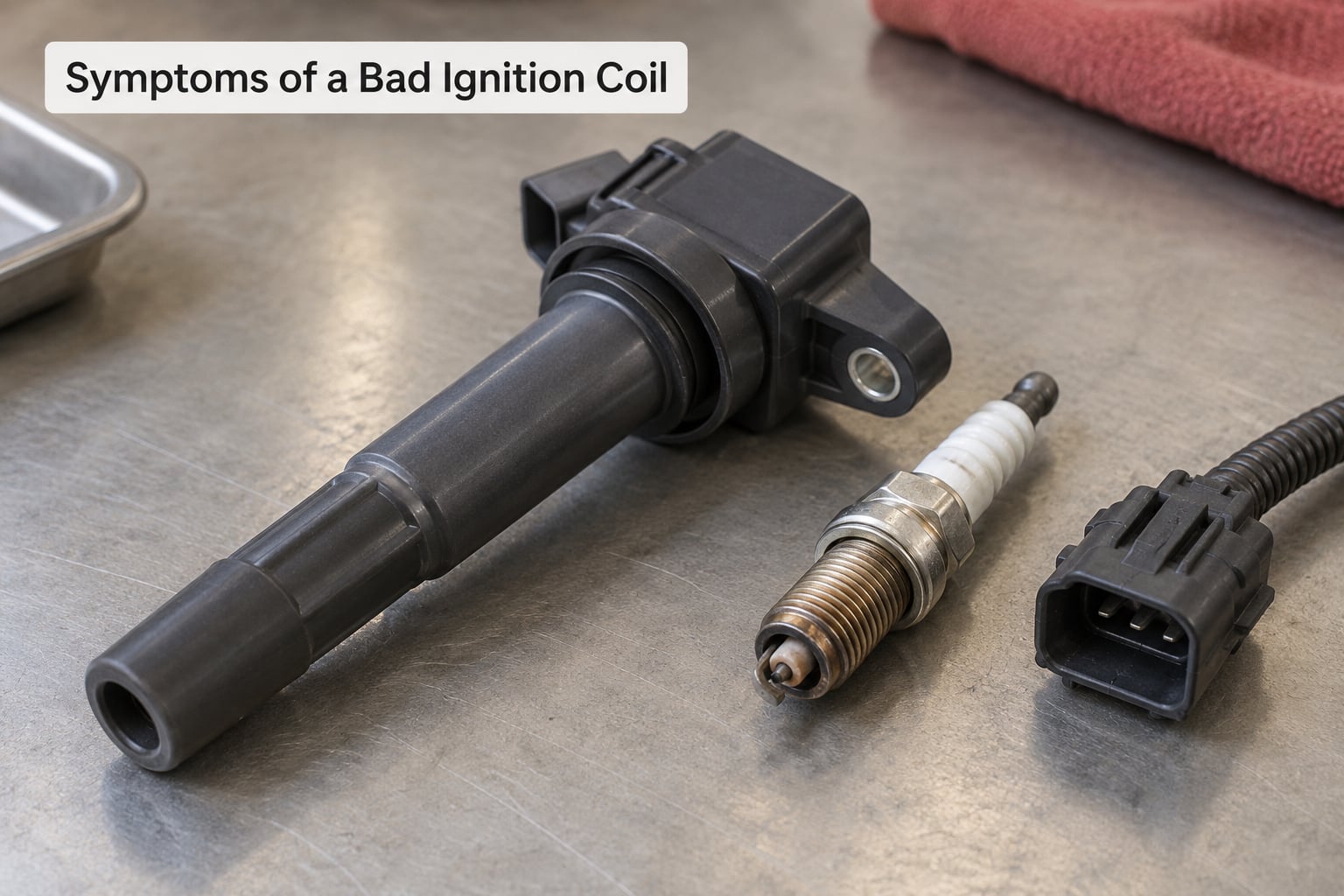
Nine signs cover nearly every case I have seen, and they usually travel together rather than alone:
- Engine misfires. The engine stumbles, shakes, or hiccups, most visibly at idle or during a steady pull up a hill.
- Check engine light on, or flashing. A steady light usually means a stored code; a flashing light means an active misfire that can damage the catalytic converter, so stop driving and diagnose it.
- Rough or unstable idle. RPMs hunt up and down, or drop nearly to zero when you come off the gas.
- Hard starting and long cranks. The starter turns longer before the engine catches, worse when the engine is cold.
- Stalling. The engine dies at a light, after a cold start, or mid-drive with no warning.
- Hesitation and power loss. Sluggish acceleration or a noticeable drop off the power you used to have on tap.
- Worsening fuel economy. Miles per gallon falls off without a change in driving habits, often because unburned fuel is washing through the exhaust.
- Exhaust backfire or popping. Loud bangs or pops out the tailpipe, or a spitting sound under acceleration.
- Burnt smell, smoke, or vibration. A sharp burning smell from the exhaust, black smoke under load, or a shakier steering wheel and seat than usual.
The codes that usually come with those symptoms give you a head start. P0300 is a generic misfire, and P0301 through P0312 name the specific cylinder that is misfiring — that number is the fastest pointer to the coil sitting on top of it. The P0351 through P0362 range flags ignition coil circuits, and P2300-series codes point at an ignition coil secondary circuit on many late models. A scanner that clears codes and watches them come back in real time beats guessing by ear every time.
Which Engine Symptoms Point to an Ignition Coil?
Grouping symptoms by what you feel behind the wheel narrows the list fast. This is how I sort them out.
Misfires That Change With Load or Weather
A coil that fails when hot will idle fine and misfire the moment you ask for torque. So the pattern is usually: smooth at a stoplight, rough on a highway on-ramp, fine again once you settle to a cruise. Owners of big pickups and turbocharged four-cylinder engines report this constantly — misfires in a high gear, uphill, or while towing, with no trouble code stored until the failure repeats enough times to trip the counter.
Moisture makes the same coil behave differently. A boot cracked or a seal gone lets water into the plug well, and the misfire shows up on cold mornings, in rain, or after the car sits overnight in damp air. Intermittent faults that vanish after the car sits for five minutes and reappear under throttle are a classic coil signature, and the reason shop forums get flooded with the same question: the car runs fine until it doesn’t.
Rough or Unstable Idle and Vibration
At idle the engine is barely combusting — very little energy per cycle — so a marginal spark is enough to stumble. That shows up as hunting RPMs, a lopey idle at a light, or a shaking steering wheel and seat while stopped. The shaking is combustion torque variation, not a wheel or tire problem, and it usually disappears the moment you get rolling.
Hard Starting, Long Cranks, and No-Start
If a coil is weak enough, the spark may not cross the plug gap on a cold crank when battery voltage is at its lowest. That gives you a starter that turns for several seconds before the engine catches, often only on the third try. A complete no-start where the crank sounds healthy and normal is more likely a failed coil pack, a blown fuse, or a crank or camshaft sensor than a single coil. Check the codes before you pull anything apart.
Hesitation, Power Loss, and Bad Fuel Economy
Misfiring cylinders still burn some fuel, so the unburned remainder washes past the oxygen sensor, the ECU reads it as an off-condition, and it trims or adds fuel to compensate. The car drinks more gas, delivers less power, and sometimes smells rich. On higher-mileage engines where all the plugs have gone to hard deposits, all four coils can start misfiring under load within a month of each other — a pattern owners describe as failing in pairs around the same mileage.
Symptoms by Ignition-System Type
Where the coil lives changes what you can see, what you can test, and whether one fault takes out a cylinder or the whole engine.
| System | How it works | What a failure looks like |
|---|---|---|
| Traditional (distributor) | One coil feeds a distributor cap that routes spark to each plug | Weak spark on one or more cylinders; cap, rotor, and wires age alongside the coil |
| Coil pack (DIS) | One coil or a 3-4 cylinder pack fires plugs in pairs without a distributor | One weak cylinder misfires and drags the paired plug down with it |
| Coil-on-plug (COP) | One coil per cylinder sits directly on the plug | One cylinder misfires, and the code names it; a failed coil is a 10-minute swap |
On coil-on-plug cars the diagnosis is cleaner: remove the coil for the cylinder the code names, check the plug and the boot, swap the coil to another cylinder, and see whether the misfire follows the part. On a distributor setup, a worn cap or rotor can mimic a bad coil, so inspect those before condemning the coil. Older BMWs with coil-on-plug have their own quirks, which our BMW spark plug and coil replacement walkthrough covers in detail.
What Else Causes These Symptoms?
Plugs and coils are cheap, easy, and adjacent in the engine bay, so they get blamed for everything. Run through the look-alikes before you order parts.
| Fault | Clue that separates it from a coil |
|---|---|
| Worn spark plug | Wider gap over time means the coil works harder; a worn plug can mimic coil weakness. Check plug condition and gap against spec. |
| Cracked plug boot or damaged wire | Visible cracks, tracking marks, oil inside the boot; moisture after rain |
| Weak battery or failing alternator | Slow crank before start, dim lights, codes for voltage or system voltage |
| Fuel-injector or fuel-supply fault | Rich smell, lean codes, symptoms tied to fuel level or warm soak |
| Vacuum leak | Rough idle at a stop but fine under load; hissing noise, possible misfire codes on high-rpm engines |
| Oxygen sensor fault | Steady rich or lean running, bad fuel economy, codes for sensor circuit or performance |
| Low compression or valve timing | Misfire that never clears after a full set of coils and plugs |
| Cooling fault or overheated engine | Heat-soaked coils fail hardest when the engine runs hot — see our thermostat failure symptoms guide |
One more that gets missed: oil in the plug tube from a failed valve cover seal or gasket. Oil ruins a coil in short order, so if you pull the boots and find oil, replacing the coil without fixing the leak just buys you another failure.
How to Test Whether an Ignition Coil Is Bad
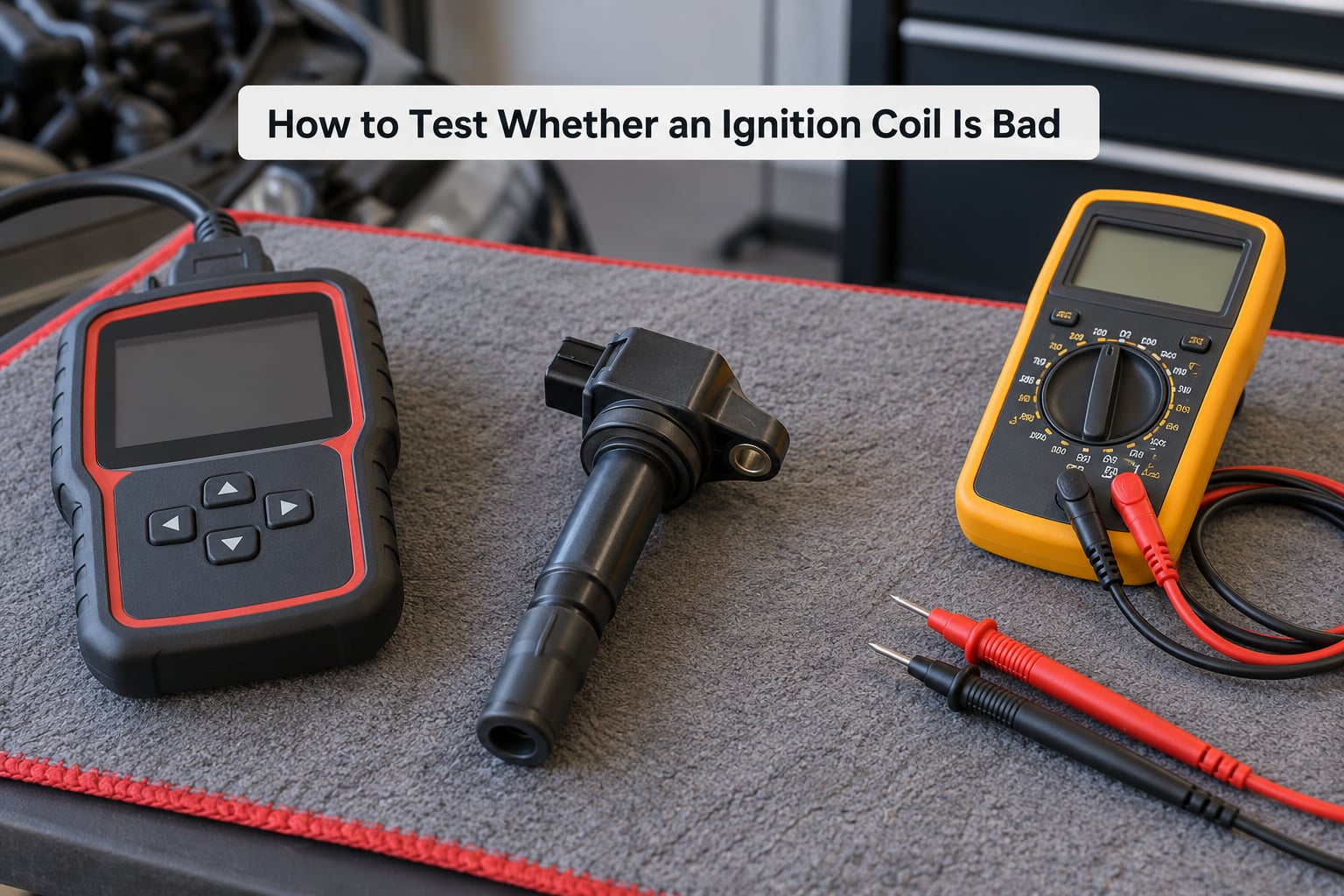
Work in this order and you will avoid most wasted parts. Follow the manufacturer’s procedure for your vehicle, and take the safety warnings seriously — a running ignition system carries enough secondary voltage to give you a serious shock.
- Read and clear codes. Scan with an OBD-II reader, note the misfire count per cylinder and any coil circuit codes, then clear them. Codes that come straight back point at a cylinder; codes that never return point at something conditional.
- Check for pending codes after a drive cycle. A coil that only fails hot often leaves a history code but nothing pending. A drive cycle reproduces the condition, which is how you catch intermittent faults.
- Inspect the coil, boot, and plug. Look for cracks, scorch marks, corrosion on the terminals, oil inside the boot, or a rounded and burned plug electrode. Pull the plug and compare its wear against the others — one dramatically worse plug is your suspect cylinder.
- Swap the coil. Move the coil from the suspect cylinder to another cylinder, clear codes, and drive it. If the misfire moves with the coil, the coil is the fault. If it stays on the same cylinder, the plug, injector, or wiring on that cylinder is at fault. One part, one answer.
- Measure primary resistance. With the coil disconnected from the harness, set a multimeter to ohms and check across the primary terminals, comparing to the service manual spec. Some modern coils cannot be meaningfully tested with a meter alone, so the swap test or an ignition tester matters more there.
- Use an ignition tester if you have one. Clip it to the coil while the engine runs and watch whether the light flickers or drops out under load.
Two hard rules. Never probe a coil, plug wire, or secondary connection while the engine is running, and never leave a coil exposed to a hot exhaust or open flame — the insulation and the oil inside a valve cover are both combustible. Let the engine cool before you start.
Free bench testing at auto parts stores is an option, and it is genuinely useful for a coil that is dead outright. Its limit is intermittency: a coil that fails only when hot and under load will usually pass a cold bench test, so a clean result does not clear it.
How to Replace an Ignition Coil Safely
On a coil-on-plug engine this is a short job. Allow the engine to cool fully, then work through it in order.
- Disconnect the negative battery terminal where the manufacturer’s procedure calls for it. On many modern cars the memory can be lost, so have the radio code and window settings handy.
- Release the electrical connector from the top of the coil. Press the locking tab rather than pulling on the wires, and never twist the connector body to free it — the pins break and then you are chasing an intermittent fault of your own making.
- Pull the coil straight up with a firm, even motion. Pry it with a tool rather than rocking it, because the coil body is bonded to the boot and rough handling cracks the boot seal, which is exactly the leak you are trying to avoid.
- Inspect the plug and the well. Check the plug gap and electrode, look for oil pooling in the tube, and clean or replace the plug as needed. A wet, oily, or badly worn plug will damage the new coil.
- Fit the replacement in the correct cylinder position and push it on until it seats fully and the connector clicks home. Do not pinch the wiring under the connector.
- Reconnect the battery, clear codes, and verify. Run a drive cycle that includes the conditions where the misfire showed up, then re-scan to confirm the codes stay clear.
On a coil pack, expect more care: the pack has to clear the intake or plenum on many engines, all plugs are handled in sequence, and the manufacturer’s torque and order matter more. If a coil fails again within days, the underlying cause is still there — usually plugs, a wet boot, oil in the well, or an alternator putting out excess voltage.
When Should You Replace the Coil or Seek a Mechanic?
One coil, one clear cylinder code, and visible damage to the part: that is a reasonable DIY fix. Three or more coils failing at similar mileage, especially with plugs at the end of their service life, points at aging as the cause, and replacing the whole set plus plugs in one visit is the sensible move rather than chasing failures one month apart.
Hand it to a shop when the misfire never clears after new coils and plugs, when it moves between cylinders, when the engine runs rough with no ignition code at all, when you are chasing an intermittent fault that only appears hot or under load, or when the check engine light is flashing. A flashing light is a running misfire dumping raw fuel into the exhaust, and that heat can melt the catalytic converter substrate — a part that costs far more than the coil that caused the problem. Some engines also enter a reduced-power mode that you can read about in our guide to what limp mode is and what triggers it.
Owner service information takes precedence over anything here, especially for BMWs where the coil is a known service item with specific part numbers and torque figures.
Frequently Asked Questions
Can you drive with a bad ignition coil?
Briefly, yes, but only until you get it fixed. A single cylinder misfire on a light-duty trip usually will not end your drive. A flashing check engine light means an active misfire sending unburned fuel into the exhaust, and that heat can destroy the catalytic converter, so pull over and arrange the repair rather than continuing. Long trips at highway load, towing, and stop-and-go traffic make a marginal coil more likely to fail entirely and strand you.
Will a bad ignition coil throw a code?
Usually yes, but not every time. A steady coil failure stores a misfire or coil circuit code — P0300 for a general misfire, P0301 to P0312 to name the cylinder, P0351 in the coil circuit range, and on many later cars a P2300-series ignition coil code. A coil that only fails under load or when hot can misfire without crossing the reporting threshold, which is why some intermittent faults leave no code at all.
Do ignition coils get weak over time?
They tend to fail rather than fade, but age-related wear is common. Coils on high-mileage engines often fail in pairs or all at once once the plugs have accumulated enough deposits and gaps that the coil has to work harder for the same spark. Heat cycling, vibration, moisture, and oil contamination all speed that up. Replacing plugs on schedule keeps the demand on the coils lower and is the cheapest insurance there is.
What are the two things that most often kill an ignition coil?
Heat and contamination. Oil from a failed valve cover seal or gasket gets into the plug tube and ruins the coil quickly, and an engine running hot from a cooling fault bakes the coil until its insulation fails. Beyond those two, plugs at a worn or incorrect gap force the coil to work harder, and a failing alternator putting out excess voltage overloads the primary side. Corroded terminals and cracked boots let moisture in, which brings back the same failure.
Are ignition coils an easy fix?
On a coil-on-plug engine, yes: unplug one connector, unbolt one coil, swap the plug, refit. It is a 10 to 15 minute job per cylinder and needs only basic hand tools. A coil pack is a different job, since the pack usually sits under the intake and the manufacturer’s removal order and torque figures matter. If the misfire is intermittent or will not clear after the swap, the coil is not the whole answer.
Do I need to replace all the coils if one fails?
Not always. If the other coils are within a reasonable age and running clean, replacing the failed one with a new or known-good plug is fine. But when coils start failing together at the same mileage, or the plugs are old and the engine has misfired enough to foul them, replacing the full set along with the plugs avoids coming back for the same fault in a few months. Never replace a coil without checking the plug it sits on.
Conclusion
Confirm the symptom, read the codes, and let the cylinder number point you at the coil. Inspect that coil, its boot, and its plug, then run a swap test before buying anything — the swap gives you a yes-or-no answer that guessing never will. If the misfire clears on one cylinder and stays gone through a proper drive cycle, the job is finished. If it does not, the cause is somewhere else on the list above, and that is the point to stop and hand it to a shop.