
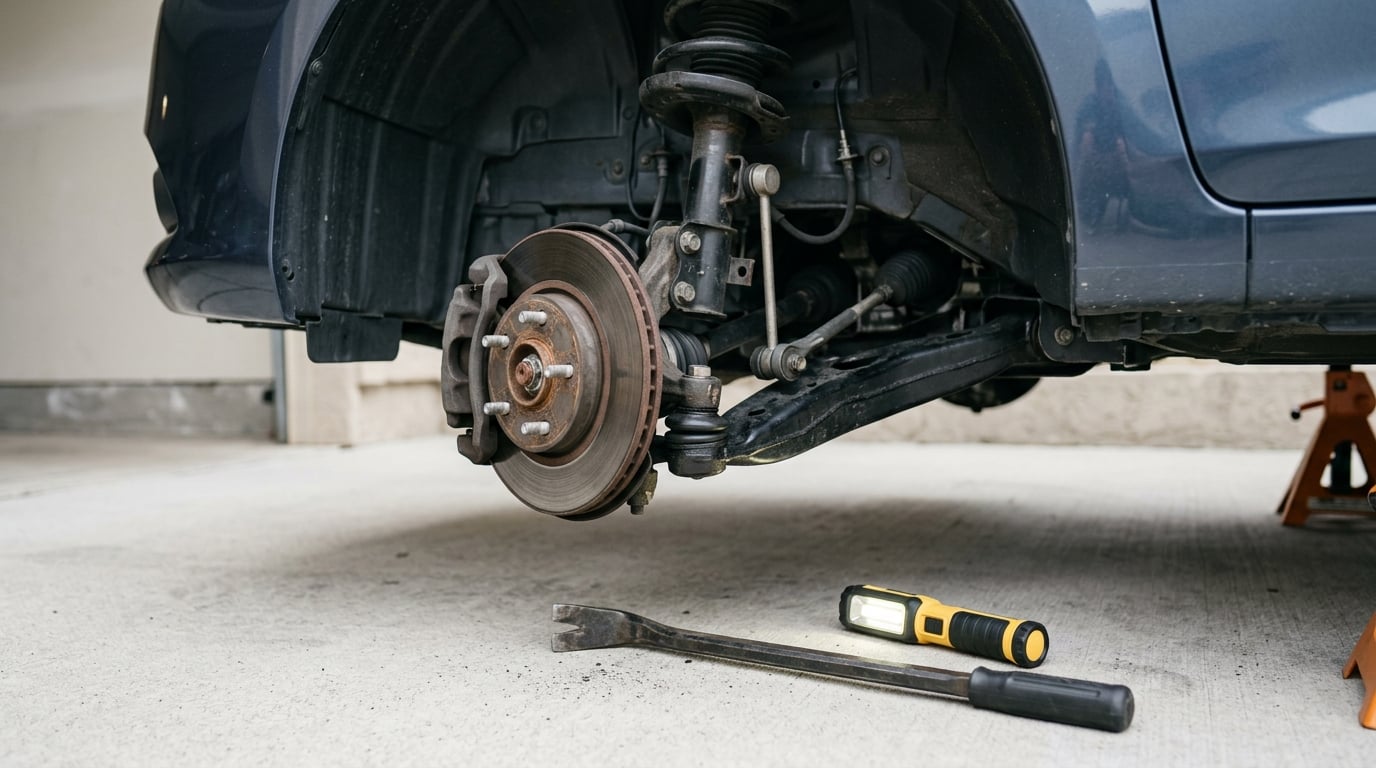
A bad ball joint is one that has lost its tight, zero-clearance fit inside its housing. The ball and stud wear, the grease escapes through a torn dust boot, or corrosion pits the surfaces, and the joint develops play. You check it by loading the joint and looking for movement that should not be there, starting with the wheel hanging free and then prying on it with the suspension loaded.
That play is the whole story. A ball joint that moves at all lets the wheel travel in directions the suspension was never designed to allow, and that is what turns into clunking, wandering steering, and tire wear you can measure.
Table of Contents
- What Is a Ball Joint and What Does a Bad One Do?
- What Are the Warning Signs of a Bad Ball Joint?
- What Causes a Ball Joint to Wear Out?
- How to Check a Ball Joint on Your Car
- What Else Can Cause the Same Noise or Handling Problems?
- When Should a Bad Ball Joint Be Replaced?
- How Is a Ball Joint Replaced, and What Else May Need Service?
- Frequently Asked Questions
- Conclusion
What Is a Ball Joint and What Does a Bad One Do?
A ball joint is a ball-in-socket connection between a control arm and the steering knuckle, the upright that holds the wheel and hub. The ball is studded with threads and captured in a socket; the stud passes up through a mounting point and is clamped down with a nut, so the joint is the pivot that lets the wheel steer and the suspension move up and down while keeping the wheel aligned.
Most independent front suspensions have a lower ball joint and, on double-wishbone designs, an upper one as well. Strut-front cars usually have only a lower joint, because the strut takes the upper position. Rear-wheel-drive and solid-axle cars use different arrangements, but the wear mechanism is the same.
When the joint goes bad, the failure is mechanical rather than electrical. A worn ball and socket stop holding the wheel in one plane, so the contact patch moves around under load. The result is a steering wheel that wanders on a straight road, a shimmy that appears at highway speed, tire wear that no alignment can hold, and a clunk every time the suspension loads over a bump.
The reason this gets urgent is what happens at the end of the road. Ball joints carry the vehicle’s weight and every steering load. If one separates, the corner of the car can collapse and the wheel can fold inboard, which is an immediate loss of steering control. Front-end noise is not something to keep monitoring indefinitely.
What Are the Warning Signs of a Bad Ball Joint?
Listen, feel, and look, because the same bad joint shows up in all three places and none of them alone is conclusive.
Noise: clunks, pops and knocks from the front end
A dull clunk over bumps, expansion joints, and speed humps is the most common complaint. Popping or cracking that shows up at low speed while turning is also common, and it comes from the same play being taken up in a different direction. A noise that changes with throttle or that disappears entirely on a straight road points somewhere other than the ball joint.
Feel: loose, vague or wandering steering
The steering stops feeling connected. It wanders on a straight road and never settles, it pulls, or it develops a vibration or shimmy in the wheel that grows with speed. Signs of excessive play also include a front end that feels like it is floating rather than planted through a corner, and a car that no longer tracks straight after a fresh alignment.
Look: tire wear you can see on the front tires
Uneven wear, feathering on one edge, or a cup that shows up as a diagonal bald patch on the inside of a front tire are the classic signs. If the same car needs a new alignment every few months, the geometry is moving with the joint rather than with the springs and bushings.
| Symptom | What it usually means | Likely the ball joint? |
|---|---|---|
| Clunk over bumps and expansion joints | Play being taken up as the suspension loads | Strong yes |
| Popping or cracking at low speed while turning | Play taken up as the wheel steers through its arc | Yes |
| Steering wanders on a straight road | Lost camber and caster control, or worn steering gear | Possible, not certain |
| Shimmy or vibration in the wheel at highway speed | Wheel bearing, balance, bent rim, loose wheel, or ball joint | One of several |
| Inner-edge or feathering tire wear | Camber is moving, or alignment will not hold | Possible |
| Grease on the control arm or knuckle | Dust boot has failed and the joint is running dry | Yes, replace it |
| Alignment returns within weeks of being set | Geometry is being pulled around by worn suspension | Possible |
None of these symptoms is unique to a ball joint, and that is exactly where most self-diagnosis goes wrong. A clunk can be a sway bar link, a wheel bearing can sound like a shimmy, and a steering box can wander. Use the table as a shortlist, not a verdict, then go check the joint itself.
What Causes a Ball Joint to Wear Out?
Most failures start at the dust boot. That rubber or polyurethane boot keeps grease in and water, dust, and road salt out. Once it tears or cracks, grit works into the joint, the grease that was there gets pumped out or just dries up, and the surfaces that are supposed to roll against each other start wearing metal on metal. A joint that arrives dry from the factory is a genuine early warning, and crusty dried residue under the boot is a recognized tell.
Road shock does the rest. A pothole, a curb strike, or a bad expansion joint can bend the control arm or damage the joint housing outright. A bent arm changes alignment, and the joint then wears fast under a geometry it was never designed for.
Corrosion accelerates everything. In a salt-belt state, a boot that gets flushed with brine every winter fails sooner than the same joint in a dry climate. Gravel and off-road use chew on the same components, and heavy towing loads a rear ball joint that may be closer to the end of its life than the owner expects.
Finally, worn neighbours ruin good joints. A tired control arm bushing changes where the load enters the joint, an aging shock lets the suspension bounce harder than it should, and a bent rim or a previously repaired collision can leave the joint loaded off-axis. Replacing a ball joint in a corner that is still out of spec is a short-lived repair.
How to Check a Ball Joint on Your Car
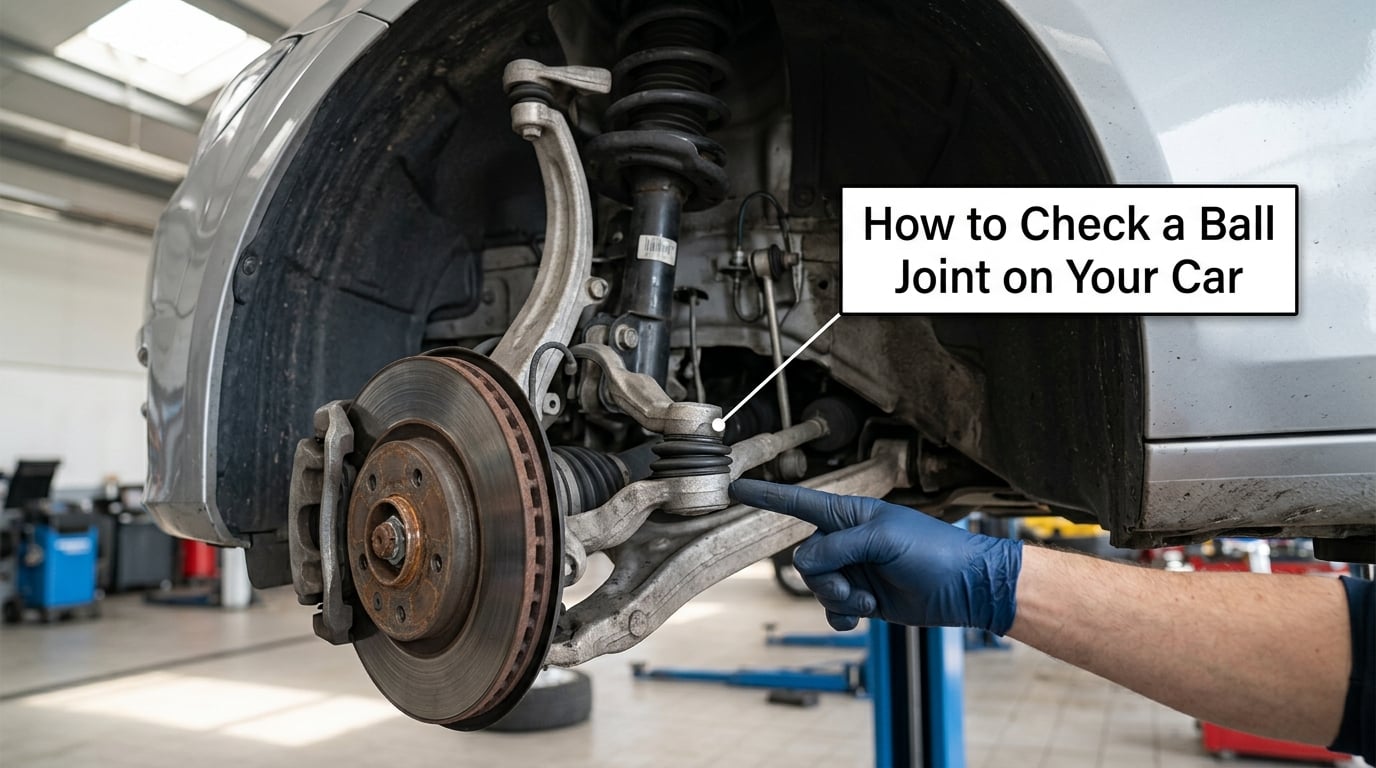
Start with your owner’s manual, because the check varies with suspension design and because the tightening torque for the stud nut is model-specific and worth knowing before you touch anything. Then set up the car properly and work through the checks in order.
You need a floor jack, at least two properly rated jack stands, wheel chocks, a flashlight, a pry bar or breaker bar, and a flat piece of wood to chock the rear wheels. Support the car on stands at the manufacturer-specified points only, chock the wheels that stay on the ground, and never put a hand or any part of your body under a car resting on the jack alone.
There is a lower-cost way to start. Most quick lubes and tire shops have a drive-through inspection lane where a technician can rock your wheels and check the joints in a couple of minutes. That is a sensible first filter before you borrow a jack.
Here is the order I would work in, from free to more involved:
- Look before you touch. With the car on level ground, crouch down and look at the front tires and underneath. Grease streaks, a split or collapsed boot, or a wheel sitting slightly crooked are all visible without a single tool.
- Rock the wheel at 12 and 6 o’clock. Lift the front end until the wheel hangs free, support it on stands, then grip the tire at the top and bottom like a clock face and rock it up and down. Any perceptible vertical movement points at the ball joint or the control arm bushing.
- Rock the wheel at 9 and 3 o’clock. Same position, but push and pull on the sides. This loads the tie rod ends and the wheel bearing more than the ball joint, so it tells you whether the noise might belong somewhere else.
- Run the pry bar test. With the wheel still hanging, wedge a pry bar under the tire near the inside edge and lift. This loads the joint from below, which is the direction it works hardest in real driving, and it is the single most decisive check you can do in a driveway.
- Load the suspension with the jack. On a strut-front car, place the jack under the outer end of the lower control arm close to the ball joint and raise it slowly until the jack takes the weight. Watch the stud where it enters the knuckle. This is the loaded version of step two and it catches joints that feel tight on stands.
- Remove the wheel and inspect the boot. Now look directly at the joint: the rubber boot, the socket, the stud threads, the mounting hardware, and any rust or crusty residue.
- Compare left to right. Rock the same way on the other side of the car. A joint that feels obviously different from its partner is easier to call than a small absolute judgement, and this is the most reliable trick when you cannot decide whether a little movement is normal.
- Get a loaded or pry-bar test from a shop. If the road symptoms are real but the driveway check is ambiguous, ask a technician to load the joint and measure it. This is the point where a second opinion is cheaper than the wrong part.
The acceptance criterion is short and worth repeating: a ball joint should have zero perceptible play, and any visible or audible movement at the joint means it is bad. There is no spec for a thousandth of an inch of slop that is safe on a steering joint. If you can see the stud move in the socket, or you hear a thunk while prying, the question is settled.
| Test | What it loads | What movement means |
|---|---|---|
| 12 and 6 o’clock rock, wheel hanging | Vertical movement, suspension unloaded | Ball joint or control arm bushing |
| 9 and 3 o’clock rock, wheel hanging | Horizontal movement | Tie rod end, wheel bearing, or ball joint |
| Pry bar under the tire | Joint loaded upward, as in real driving | Ball joint, decisively |
| Jack under the lower control arm | Full curb weight through the joint | Ball joint, definitively |
Visual Checks: Look for These Signs of Wear
Take the wheel off and look straight at the joint. A torn, split, or squashed dust boot is the clearest signal there is, and the joint underneath it should be treated as worn even if it still feels tight. Grease on the control arm, the knuckle, or the spring seat means the boot has already failed.
Check the stud where it threads through the knuckle. You are looking for rust, missing threads, shiny wear, or a stud that is not seated square. Look at the socket housing for rust, cracks, or a deformed shape. Look at the mounting nut and the cotter pin, if your car uses one: rust streaks around the nut are a sign the joint has been moving for a long time.
Look at the neighbouring parts while you are there. A control arm bushing with visible cracking or separation, a tie rod end boot that has split, or a brake hose or ABS wire draped over the joint area all change your verdict. And check whether anything has been in contact: a ring of scuffed paint or a polished witness mark on the control arm means the joint has already bottomed out against something.
Physical Checks: Test for Wheel Play and Unusual Movement
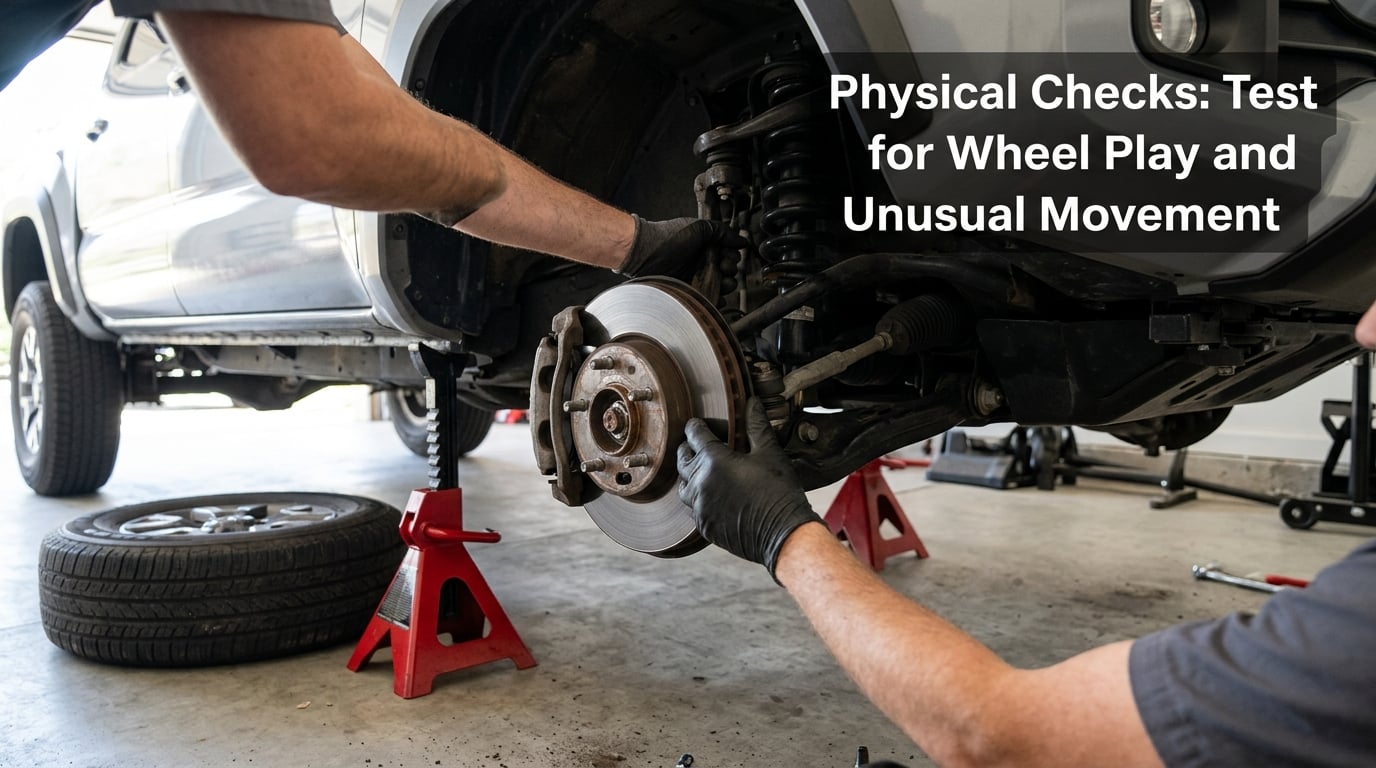
The confusing part of checking a ball joint is that a joint unloaded on stands can feel tighter than it is on the road. The suspension hangs from the joint instead of sitting on it, so much of the normal load is gone and the play closes up. That produces false negatives, and it is why owners on forums insist the pry-bar and jack tests are the ones that count.
There is a useful false-positive trick too. If the 12-and-6 rock shows movement but the 9-and-3 rock shows nothing, the play is almost certainly the ball joint or a bushing. If both directions show movement, disconnect the sway bar end link and repeat; sway bar noise is one of the most common things mistaken for a ball joint, and a disconnected link takes thirty seconds with the right tools and removes it from the picture.
Distinguishing a ball joint from a control arm bushing matters because they are priced and replaced differently. A pry bar under the tire lifts the joint directly, so play there is the joint. Play that shows when you lever the arm fore and aft but not when you lift the wheel is the bushing at the other end of the arm.
On a strut-front car, the lower joint is reachable from underneath with the wheel off. On a double-wishbone car the upper joint sits up inside the wheel well, often behind the brake assembly, and the useful technique is to push and pull the wheel through its full travel while feeling the stud or pressing down on the arm. Upper joints fail less often because they carry no vehicle weight, but they are not exempt from wear.
Do You Need to Remove the Wheel or Use a Jack?
The wheel-rock tests need the corner lifted, but the wheel does not have to come off for them, and that is worth knowing before you plan an afternoon. You can rock a tire with the wheel on and get a usable reading on both the ball joint and the tie rod end.
You do need the wheel off for the visual inspection of the boot, the stud, and the mounting hardware, and for the pry bar test to be maximally useful. The jack test on the lower control arm can be done with the wheel still fitted, which is why it is a quick check a technician can perform from underneath.
For any lifting, the non-negotiables are a jack rated for the vehicle, stands rated above the vehicle’s weight and placed on a firm level surface at the specified points, chocks behind the wheels that stay on the ground, and the transmission in park with the parking brake set. Never work under a vehicle held only by the jack, and never leave a stand partly loaded. If you do not have stands, do not lift the car; take it to a shop instead.
What Else Can Cause the Same Noise or Handling Problems?
Four parts cause most of the false alarms, and telling them apart before you order anything saves a lot of money and a lot of arguing with a parts counter.
- Tie rod ends. A worn tie rod shows up mainly at 9 and 3 o’clock, and the play is felt pushing and pulling on the tire rather than lifting it. It also causes a steering wheel that sits off-center.
- Sway bar end links and sway bar bushings. These clunk over bumps and in slow turns, and they rattle over rough pavement. A disconnected sway bar link is the fastest way to eliminate them as a cause.
- Wheel bearings. A hum that rises with speed and changes when you turn, or a tick that becomes a growl, points at the bearing rather than the ball joint. The wheel play from a bearing is felt through the center of the wheel, not at the top and bottom.
- CV axles and strut mounts. A clicking or grinding that changes with throttle is a CV joint. A knock through the steering column that changes with steering lock, plus a clunk over bumps at full lock, is usually the strut mount.
Control arm bushings are the other big one, and they are easy to confuse because they live on the same arm as the joint. Add a damaged or cracked wheel, low tire pressure, or a wheel that is simply out of balance, and you have a list of realistic candidates that a clunk or a shimmy could be. If you want to know more about how tire pressure and alignment shape wear patterns, what tire feathering is and what causes it breaks down that side of the puzzle. And if you are about to grab tools for the first time, the basic car maintenance tool list is worth a look before the trip to the store.
When Should a Bad Ball Joint Be Replaced?
Replace it when any of these are true, and the first one alone is enough:
- Any perceptible play is visible when the joint is loaded, or the stud visibly moves in the socket.
- A pry bar under the tire produces a thunk or visible travel at the stud.
- The dust boot is torn, split, or missing grease is visible on the arm or knuckle.
- Clunking over bumps, wandering steering, or uneven tire wear traces back to a confirmed loose joint.
A torn boot is a replacement trigger on its own, even with no symptoms at all. The grease that keeps the joint alive is already escaping, and the damage that follows is invisible until the joint is metal on metal. Forum consensus on this point is close to unanimous.
Can you keep driving in the meantime? The honest answer depends on severity, and the table is the honest version of it.
| Severity | What you will notice | What to do |
|---|---|---|
| Mild | Occasional clunk over bad roads, no play felt at the wheel, alignment still holds | Book an inspection. Drive normally in the meantime. |
| Moderate | Clunk on most bumps, steering wanders or pulls, a little play in the tire | Inspect within a few days. Avoid highway speed and rough roads. Get the loaded test done. |
| Severe | Clear play, wheel visibly moves, clunk on every bump, tire wear spreading fast | Stop driving and have it inspected before the next trip. |
| Critical | Any moment where the joint feels about to let go, wheel at an odd angle, grinding or scraping | Do not drive. Tow it. |
One question comes up constantly on high-mileage cars in snow and salt states, and it deserves a direct answer. If you can feel the joint moving, you do not have a part that is going to fail someday, you have one that is already failing. Winter is the worst time to find out, because ice and cold hide vibration and noise. Have it looked at before the season, not during it.
On the question of replacing both sides at once: there is no rule that says so. Judge by condition and by age, and remember that the labor to get in is largely the same once a corner is apart. If the opposite side is close to the same age and mileage, doing both at once is defensible. If it is newer, replacing only the bad side is fine.
How Is a Ball Joint Replaced, and What Else May Need Service?
At a high level, the job is: support the car correctly, remove the wheel, disconnect the sway bar link and any ABS or brake lines that reach the corner, unbolt the control arm from its bushings, separate the ball joint from the steering knuckle, and press or bolt out the old joint. The new one goes in the same way, the stud nut is torqued to your service manual’s specification with a torque wrench, and the ball joint is then adjusted or replaced so the geometry is correct.
Where the work gets hard is the separation step. A press-fit joint needs a ball joint separator and a press, and a stud that has corroded into the knuckle can make the job turn into a control arm replacement. That is the single biggest reason people hand this to a shop, and it is worth getting a quote before you start rather than after you are halfway through with a snapped stud.
Two parts decisions come up. If the ball joint is pressed into the arm and the arm is sound, replacing just the joint is reasonable. If the joint is integrated into a one-piece control arm assembly, forums are nearly unanimous that replacing the whole arm is the better call, because pressing a joint out of a welded arm is not worth the tooling.
Do not skip the alignment afterwards. Ball joints set camber and caster, so a car that was aligned before the repair will pull or wear tires oddly after it. Re-torque fasteners after a short drive as well, and check the boot, the grease fittings on any serviceable joints, and the boots on the tie rod ends while everything is apart.
Whatever you do, do not improvise the torque. Specs differ between a compact car, a midsize sedan, and a truck, and stud nuts that are too loose or too tight cause their own problems. The number is in the service manual for your model, and it is a five-minute lookup that protects the repair you just paid for.
Frequently Asked Questions
Can I drive with a bad ball joint?
It depends on how much play you have. A joint that only clunks over rough roads, with no play at the wheel and an alignment that still holds, is a reason to book an inspection rather than an emergency. Clear play at the stud, a wheel that visibly moves, or a clunk on every bump means you have an inspection booked within days and should stay off the highway. Any grinding, scraping, or a wheel sitting at an odd angle, get it towed.
What does a worn ball joint sound like?
A dull clunk over bumps, expansion joints, and speed humps is the most common sound, and a pop or crack at low speed while turning is the second. Both come from the same play being taken up in different directions as the suspension loads and as the wheel steers. A noise that only appears at highway speed is more likely a balance, a bent rim, or a wheel bearing than a ball joint.
How much play is acceptable in a ball joint?
None. A healthy ball joint should have zero perceptible play, which is the rule most experienced owners and technicians use. If you can see the stud move inside the socket while the joint is loaded, or you hear and feel a thunk when you pry under the tire, the joint has failed. There is no small allowance of slop that is acceptable on a steering joint, and waiting for a measurable number means waiting too long.
Should I replace a ball joint when the rubber boot is torn?
Yes, treat a torn or split dust boot as a replacement trigger on its own, even with no symptoms. The boot exists to keep grease in and water and road salt out, and once it fails the joint is running on contamination and eventually on bare metal. A boot-only repair is possible on a few designs, but it is a temporary fix that requires disassembly, so most owners replace the joint itself.
Do all four ball joints need to be replaced at the same time?
No, there is no rule that they go in pairs. Replace the joints that are actually worn, judged by the loaded play test rather than by noise. That said, if the opposite side is close to the same age and mileage, the labor to access one corner largely covers the other, so doing both at once is reasonable. If the other side is clearly newer, replacing only the failed joint is fine.
Can a bad ball joint cause tire wear or vibration?
Yes, to both. Once the ball and socket wear, the wheel loses a fixed relationship to the road, so camber changes under load and the tire wears unevenly, usually with feathering or an inner-edge pattern. That same movement is a common cause of a steering wheel shimmy that appears and grows with speed. If an alignment will not hold, suspect the suspension geometry rather than repeatedly re-aligning the car.
Conclusion
Do not keep driving past a clunk or a loose-feeling wheel and hope it settles down. Start with the free checks: look for a split boot, grease on the arm, and uneven front tire wear, then rock the wheel at 12 and 6 o’clock and pry under it to feel for play. Any perceptible movement at the stud means the joint is bad, and a torn boot on its own is enough to plan the repair.
Once you have a positive or suspected result, have a qualified technician confirm it with a loaded test before you commit to parts. That is the point where a fifteen-minute inspection saves a wrong part and a second teardown, and it is far cheaper than a wheel folding inboard on the highway.