
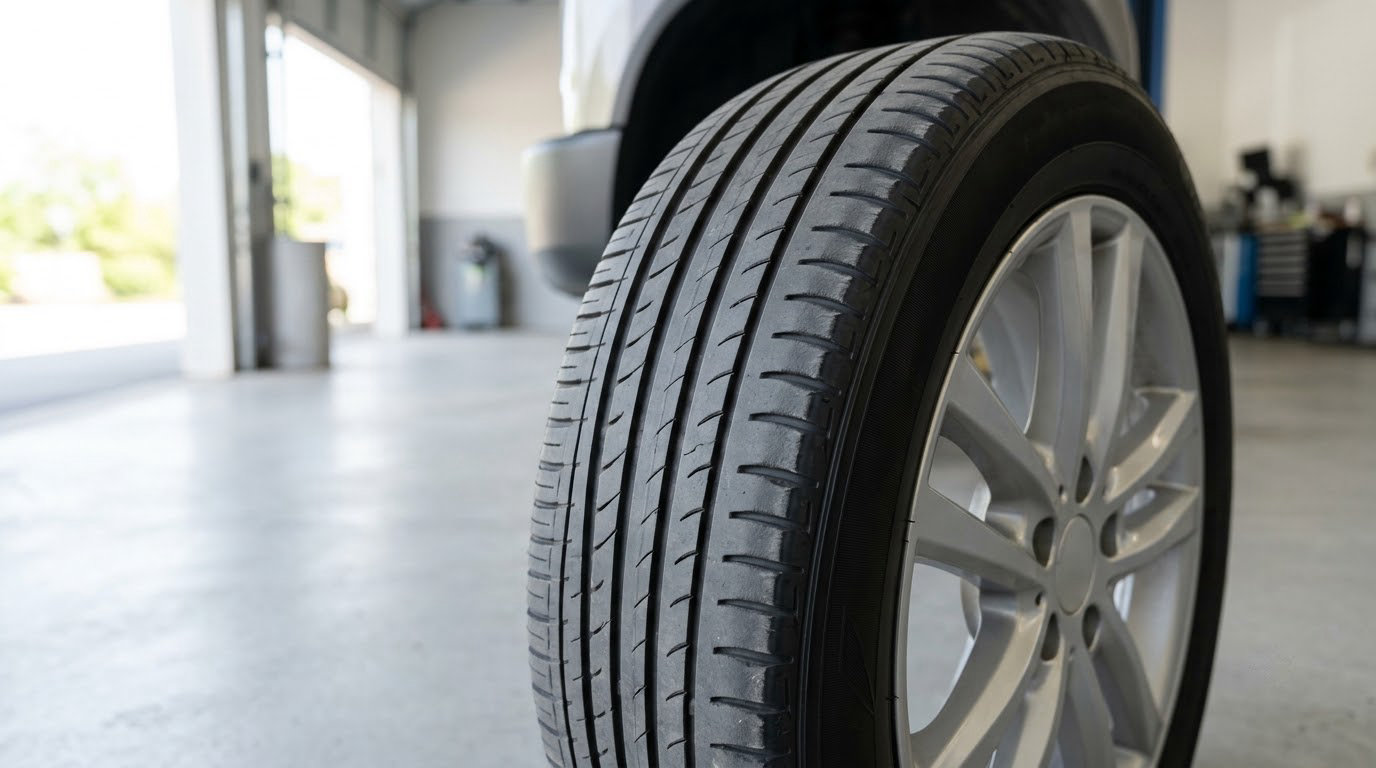
What is tire feathering and what causes it? Tire feathering is uneven tread wear where one edge of each tread block wears down to a sharp edge while the opposite edge stays rounded, so the tread is angled instead of flat across the tire’s width. It happens when a wheel is not tracking straight, usually from a toe angle out of specification or a worn suspension part. Run a fingertip across the tread to feel it.
Last checked: September 2026
Table of Contents
- What Is Tire Feathering?
- How to Recognize Tire Feathering
- What Causes Tire Feathering?
- How a Tire Becomes Feathered Step by Step
- How to Diagnose the Problem Safely
- Can Tire Feathering Be Fixed?
- When Replacement Is the Only Safe Option
- How to Prevent Tire Feathering Returning
- Frequently Asked Questions
- What to Do First
What Is Tire Feathering?
Every tire is supposed to meet the road flat across its full width. The contact patch, the strip of rubber touching pavement, should be parallel to the road surface. When a wheel is angled slightly, that patch lands diagonally, the leading edge of each tread block does all the rubbing, and the trailing edge barely gets touched at all. That is tire feathering, and the angled tread is just the visible record of a wheel that has been scrubbing sideways instead of rolling.
The word covers two related patterns. Feathering is the angled, sawtooth wear across the width of the tread, where one side of every block ends in a knife-like edge. Scalloping is a related but distinct pattern, where the wear steps across the tire from one shoulder to the other in a wave. People use both words loosely, and shops use them interchangeably, so it is worth checking the pattern yourself before paying anyone to diagnose it.
It matters more than it looks. A feathered tire is a symptom, not a disease. It is one of the clearest signals that a wheel alignment, a suspension component, or your tire pressures are off, and it will keep chewing through rubber until the cause is corrected. Left to run, feathering shortens tire life, adds a rumble that climbs with speed, and eats the wet-weather grip you bought the tire for.
How to Recognize Tire Feathering
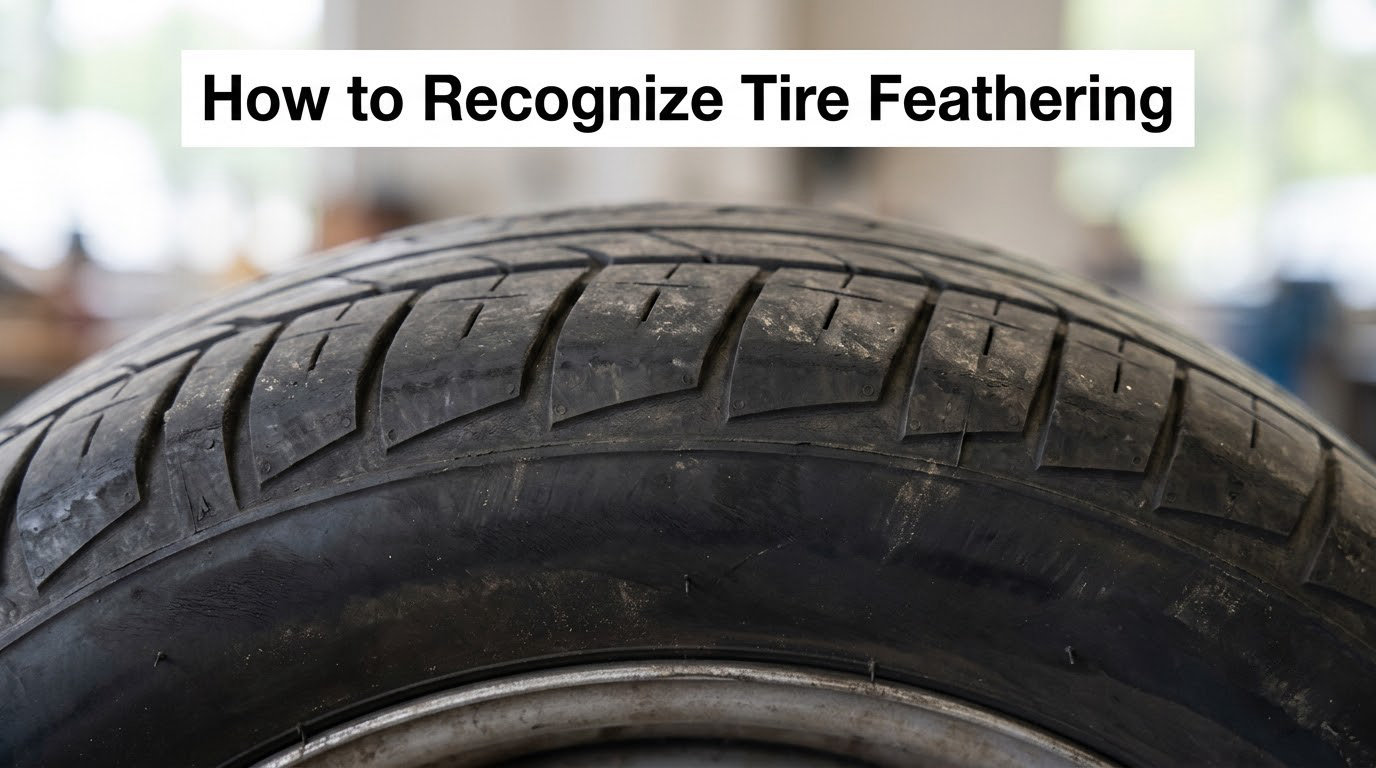
Start with your hand, not your eyes. Run a fingertip across the tread in one direction, then back in the other. A healthy tread feels flat and even both ways. A feathered tire feels like a staircase: sharp going one way, smooth coming back. That one test separates feathering from almost everything else.
Next, work out which edge went sharp, because that tells you the direction of the error. If the sharp edge sits on the inner side of the tire, the wheel is toed in, meaning the front of the wheel points inward. If the sharp edge is on the outer shoulder, the wheel is toed out, pointing outward. This is the single most useful diagnostic fact on this page, and it takes ten seconds with a flashlight.
Then listen. Feathering usually shows up as a hum that rises with speed, a low-speed shimmy or bumpiness while turning, and a vibration through the steering wheel. It can also feel rough on bumps. Owners on tire forums frequently report the rumble being worse while coasting downhill, which confuses people, since no one is driving the wheel at that moment. The tire is still being steered by the vehicle’s own weight and road camber.
Finally, look at all four tires. Feathering usually hits one axle, but comparing all four tells you a lot. If only one tire is feathered, suspect a damaged or poorly mounted wheel. If both tires on one axle are feathered toward the road center, suspect a load, pressure, or geometry issue on that axle. If the pattern is mirrored from front to rear, that is a classic alignment sign. You cannot make a confident call from a single tire.
What Causes Tire Feathering?
The main cause of tire feathering is a wheel that is not aligned, most often an incorrect toe angle. Behind that sit worn shocks and struts, worn bushings and ball joints, bent suspension parts, incorrect tire pressure, uneven loading, and tires that have gone too long without rotation.
| Cause | What you see | Where to look |
|---|---|---|
| Toe-in or toe-out | Sharp edge on the inner or outer side of every tread block, mirrored on both tires of an axle | Alignment printout, front wheels |
| Worn shocks or struts | Feathering plus a floaty or bouncing ride, worse over bumps | Dampness, tire shine on the inner sidewall, strut dust |
| Worn bushings or ball joints | Feathering that returns weeks after a fresh alignment | Control-arm bushings, tie rod ends, sway bar links |
| Bent suspension or wheel parts | Feathering on a single tire, often with a pull to one side | Wheel runout, ride height, recent pothole or curb impact |
| Incorrect tire pressure | Feathering combined with center wear or edge wear | Placard pressure versus sidewall maximum |
| Uneven loading or overload | Inner-edge wear on both tires of one axle, more on a loaded truck or trailer | Payload, tire load rating, axle loading |
| Skipped rotations | One tire much lower than the others with wear concentrated on one shoulder | Tread depth across all four corners |
| Tire no longer structurally sound | Feathering plus cracking, bulges, exposed belts or cords | Sidewalls, tread edges, tire age |
The reason this matters is ordering. A new tire mounted on a wheel with bad geometry will feather again in a few thousand miles, and you will have paid for four tires to learn the same lesson. Correcting the cause first, then fitting the rubber, is the only sequence that works.
What causes tire feathering in practice?
In practice, the wear pattern tells you which system to suspect, and the symptoms tell you how urgent it is. A steering wheel that pulls to one side, a brake pedal that feels inconsistent, or a vibration that shows up at highway speed all point to a geometry or component problem rather than the tire itself. So does a tire that wears down on only one edge while its twin on the same axle looks fine.
But symptoms cannot identify the faulty part. A worn bushing, a bent control arm, and a shifted alignment can produce a steering pull that feels identical from the driver’s seat. That is why diagnosis starts with the tires and wheels, then moves to the suspension, then to the alignment readings. Working in the other direction wastes money and, more than once, owners have told shop forums they paid for three rebalances before anyone measured a wheel angle.
How a Tire Becomes Feathered Step by Step
It starts small and ends obvious. A shock settles, a bushing dries out, or a wheel gets nudged out of spec during a tire change or a bump. The toe angle on that wheel now points slightly inward or outward instead of straight ahead.
As the tire rolls, the wheel tries to follow the direction it is pointed while the vehicle insists on a straight path. Something has to give, and it gives in the rubber. The contact patch lands on an angle, with its leading edge digging in and its trailing edge lifting.
Now the leading edge does most of the work while the trailing edge takes almost none. Every rotation shaves a little more off the leading side of each tread block and leaves the other side intact. A few thousand miles of that builds a sawtooth edge running across the tread. The sharper it gets, the more it scuffs, and the faster the whole cycle repeats. What started as a fraction of a degree becomes a visibly ruined tire.
How to Diagnose the Problem Safely
Work through this order and stop before the steps that need a lift or a rack.
- Check pressures cold. Compare each tire against the pressure on the door jamb placard, not the sidewall maximum, and set them while the tires are cold.
- Run the fingertip test on all four tires. Note which side is sharp on each one and whether the pattern is mirrored across an axle.
- Measure tread depth in three places per tire across the width and around the circumference, not just the center rib.
- Inspect the sidewalls and tread edges for cuts, bulges, cracking, exposed belts or cords, and any cords showing through the rubber.
- Check the wheels and fasteners for visible dents, corrosion around the lug nuts, and anything bent enough to throw the wheel out of true.
- Look at all four corners together and compare the wear pattern axle by axle before drawing a conclusion.
Beyond this point you are into work that needs the manufacturer’s procedures, a floor jack, a torque wrench, and sometimes a four-post alignment rack. Ride height, suspension geometry, and wheel alignment should follow the vehicle manufacturer’s specifications and be handled by a qualified shop. Get on a jack only on level ground with wheel chocks, and never work under a vehicle supported by a jack alone.
Can Tire Feathering Be Fixed?
Feathering can be stopped but not reversed. The rubber that has already worn off does not grow back, and no shop can shave a feathered block flat without cutting into the tire’s structure. What a correction does is remove the cause, so the remaining tread wears evenly from that point forward.
That leaves two outcomes. If you catch mild feathering early, with plenty of tread left and no sidewall damage, correcting the cause lets you keep the tire. Once a tire is badly feathered, badly cupped, or down near the wear limit, no alignment will bring the tread back and replacement is the honest answer.
The order of operations matters, and it is the part most people get wrong:
- Inspect the suspension and steering components, then replace anything worn, bent, or worn out before touching any alignment angle.
- Set camber and caster to specification. Both are measured first because changing them moves the toe value.
- Set toe last, to specification and to the front tire pattern the manufacturer calls for.
- Reset every tire to placard pressure and check the load rating against the vehicle’s actual load.
- Rotate tires where the manufacturer specifies it, and rebalance the wheels.
- Verify with a road test and a follow-up printout, then re-check wear on the corrected tires later.
That last-order rule is why a good alignment can still leave feathering behind. If camber or caster is adjusted after toe, or if ride height changes after the work is done, the toe you measured is no longer the toe on the road.
When Replacement Is the Only Safe Option
Replace the tire rather than argue about it when you find any of these:
- Cracks running across the tread or down the sidewall, or rubber that has gone hard and glazed.
- Bulges, blisters, or a visible shift in the sidewall shape.
- Cords or belts visible in the worn surface, or a flat spot on the shoulder.
- Tread near the legal and manufacturer wear limits, or uneven wear severe enough that the low points reach that limit before the high points do.
- A damaged tire next to a good one of the same size, or a tire whose damage or repair history you cannot confirm.
- Any doubt about whether the tire was ever hit hard enough to compromise it internally.
On a driven axle, replace in pairs at minimum. One tire of a matched pair is not a matched pair.
How to Prevent Tire Feathering Returning
Most recurrence comes from ignoring a small number of habits.
- Follow the placard, not the sidewall. The sidewall number is a maximum, not a target, and running at it wears the center of the tread.
- Stay inside the vehicle’s load limits. Overloading an axle biases wear toward the inner edge and shortens shock and bushing life.
- Rotate on schedule. Every 6,000 to 8,000 miles works for most passenger cars, sooner on a truck or trailer that carries weight or tows.
- Get an alignment check after an impact or whenever tires show a new uneven pattern, even if the car still drives straight.
- Do not mix incompatible sizes or types unless the manufacturer explicitly allows it. Mismatched tires on the same axle feather by design.
- Watch the pattern, not the odometer. A tire that wears one edge in a few thousand miles has told you something the mileage never will.
Frequently Asked Questions
Can a feathered tire be fixed without replacing it?
Sometimes, yes. If the tread still has good depth, the sidewall is clean, and the damage is purely angled wear, correcting the alignment or replacing the worn suspension part will stop the pattern from getting worse. The existing wear stays, though, because tire feathering cannot be reversed. Once the blocks are visibly sharp or a low point nears the wear limit, replacement is the only safe answer.
Is tire feathering the same as uneven tread wear?
It is one form of uneven tread wear, but not the only one. Feathering means the tread blocks are worn diagonally, sharp on one side and rounded on the other, usually from an angled contact patch. Other uneven wear looks different: cupping is a series of dips, center wear means over-inflation, and one-shoulder wear means under-inflation or camber. What is tire feathering, in short, is angled, not wavy or flat.
How much tire tread can be lost before feathering is dangerous?
The danger comes from the low points, not the high ones. Feathering eats the trailing edge of each block, so a tire that looks deep down the center can be close to the limit at its edges. Measure in several places across the width and around the circumference. Well under 2/32 of an inch anywhere on a tire is worn out; a feathered tire already near that mark should be replaced rather than corrected.
Does tire feathering always mean the wheel alignment is bad?
Usually, but not always. Worn shocks and struts, dried-out control arm bushings, loose or worn ball joints, and a bent suspension part all let a wheel fall out of specification, so fixing the alignment alone does not hold. Skipped rotations and chronic under- or over-inflation can also produce angled wear on their own. A tire that feathers again within a few thousand miles of a fresh alignment is the clue that something behind the alignment needs work.
Should I replace all four tires if only one is feathered?
Not automatically. Start with the one tire and compare it against the other three. If a single tire is feathered, the wheel, its fasteners, or a bent suspension part on that corner is the likely culprit, and the other three may have thousands of miles left. On a driven axle, still replace in pairs so the two tires behave the same way through water and in braking. Check tire age and size before mixing anything new in.
What to Do First
Check the pressure on all four tires cold and set them to the placard, then run the fingertip test on each one and note which edge is sharp. Compare all four patterns before deciding anything, and take a photo of the wear so you can show a shop what you are describing.
Get the alignment and suspension checked before you buy a replacement tire. A tire that still has usable tread will wear flat once the cause is fixed, and you avoid paying twice for the same mistake.