
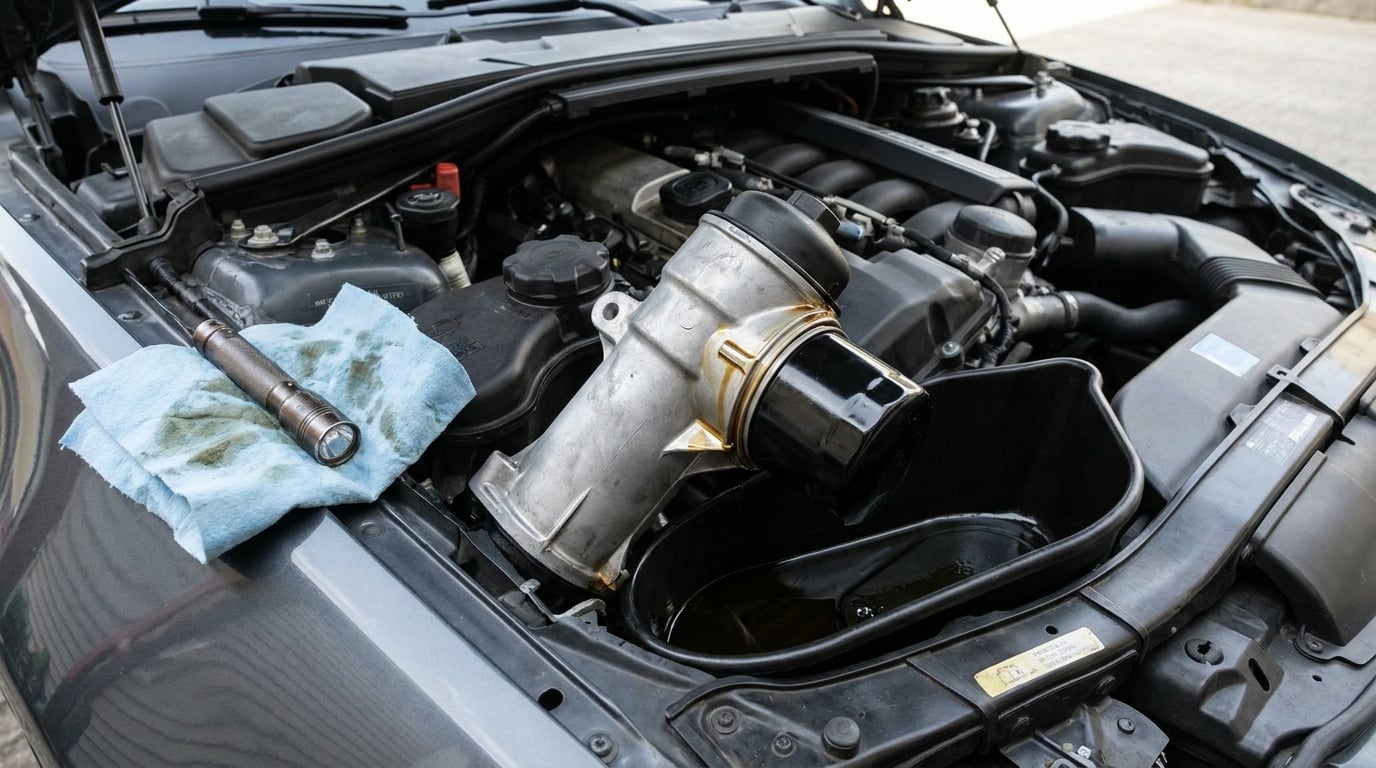
Fresh oil pooling around the front of a BMW engine, a burning smell after a drive, and a dipstick that keeps reading lower between services are the classic BMW oil filter housing gasket leak symptoms. The gasket is the rubber or composite seal between the oil filter housing and the engine block, and once it hardens or is torqued unevenly, engine oil weeps out, runs down the front of the engine, and often pools along the oil pan seam, which is why so many owners blame the wrong part.
Below is how to tell a failed housing gasket apart from a loose filter, a cracked cap, an oil pan leak, or a valve cover problem before you order anything or take the housing apart. If you want the shortest possible path, check the oil level first, then clean the area and look for the freshest oil on the housing seam rather than the lowest drip on the car. This guide was updated for 2026.
Table of Contents
- BMW Oil Filter Housing Gasket Leak Symptoms at a Glance
- What Does an Oil Filter Housing Gasket Leak Look Like?
- Where Does the Oil Usually Collect?
- What Causes the Gasket to Leak?
- Is It the Gasket, Filter, Housing, or Engine?
- How to Fix a BMW Oil Filter Housing Gasket Leak
- When Should You Stop Driving and See a Mechanic?
- Frequently Asked Questions
- Does an oil filter housing gasket leak mean the engine is damaged?
- Why is my BMW leaking oil only after an oil change?
- How much oil can a filter housing gasket leak before it becomes serious?
- Should I replace the oil filter housing gasket if the engine is still cold?
- Can I clean the oil filter housing instead of replacing the gasket?
- What BMW models are most likely to show oil filter housing gasket leaks?
- What to Check First
BMW Oil Filter Housing Gasket Leak Symptoms at a Glance
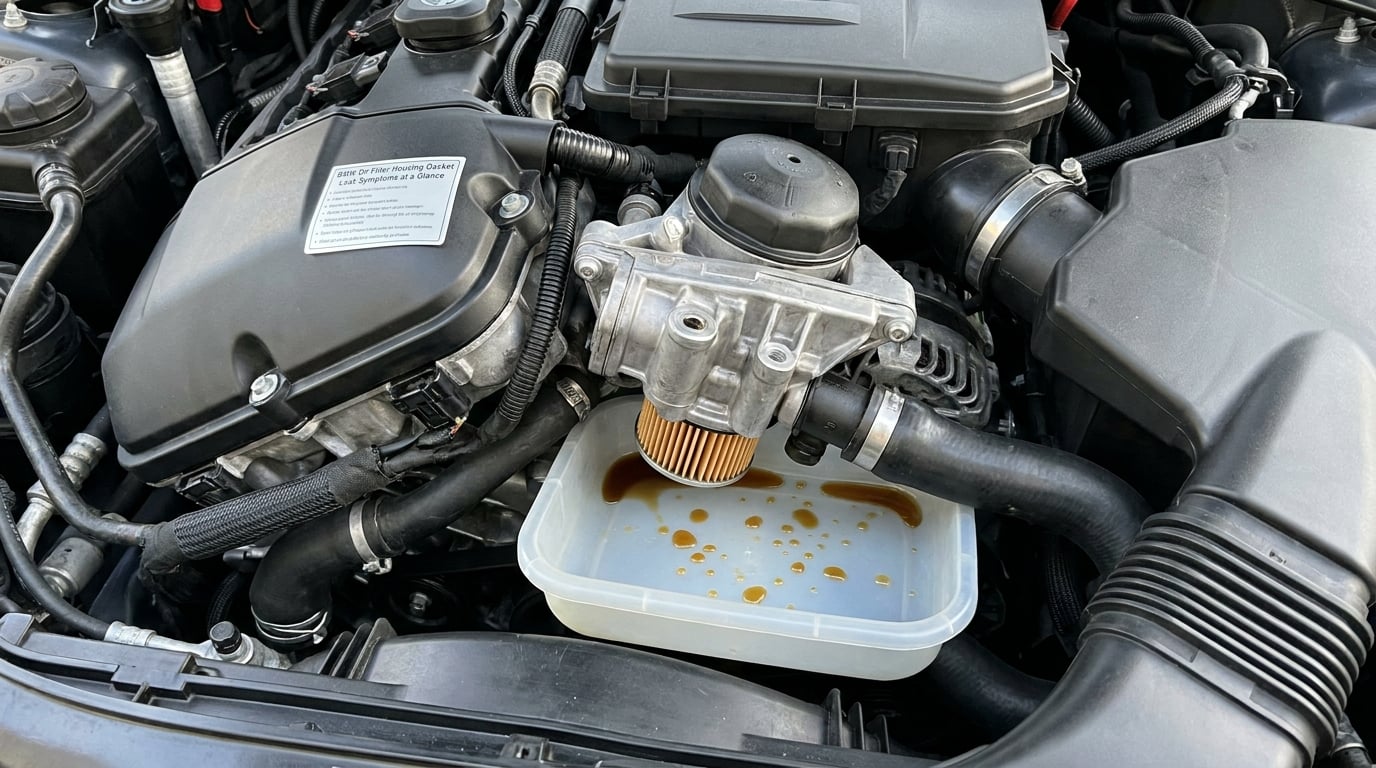
A filter housing gasket leak is confirmed when fresh oil appears at the seam between the housing and the engine block, or where the housing’s own oil cooler bolts on, and the oil is wet, glossy and recent rather than a dry crust. The table below maps the signs most owners notice to where the oil actually shows up and how quickly it needs attention.
| Sign | Where you see it | Urgency |
|---|---|---|
| Fresh oil at the housing seam | Front of the block, filter housing edge, near the dipstick tube | Repair soon |
| Oil pooled under the car | Undertray, driveway, in front of the front wheel | Depends on drip rate |
| Oil film or residue on the filter | Top of the cartridge, around the filter seat | Usually filter or cap |
| Burning oil smell after driving | Cabin on a hot day, engine bay after a trip | Urgent if smoke is visible |
| Oil level dropping between services | Dipstick check, oil level warning on the dash | Urgent |
| Oil on the serpentine belt or pulleys | Belt, tensioner, alternator face | Urgent, stop driving soon |
| Stale residue with no fresh oil | Around the housing after a completed oil change | Not an active leak |
Two details in that table cause most of the confusion. A pool under the car does not mean the leak is at the bottom of the engine, and residue with no fresh oil usually means the last oil change made a mess rather than that a gasket is currently failing.
What Does an Oil Filter Housing Gasket Leak Look Like?
Wet oil beads at the joint and runs downward under gravity, leaving a slow trail. Damp residue is a thin film that darkens the metal or plastic around the seam without dripping. Crusting is old oil that has oxidised into a brown or black skin, which usually means the leak is not active right now but happened earlier. An oily film spreads further than you expect, following casting ribs, bolt bosses and wiring looms rather than falling straight down.
On most BMW inline-sixes the housing sits at the front of the engine, so the oil travels down toward the driver’s side front of the engine block and ends up on or near the oil pan seam. From underneath, that looks exactly like a pan gasket failure, which is why clean, trace and confirm beats guessing from a driveway photo.
Leaks often look worse right after an oil change. The housing and cap get disturbed, fresh oil is plentiful, and everything that was hidden by an old crust gets exposed. Then the flow slows to a seep you barely notice. If you have how to find an oil leak with UV dye in your toolkit, this is the situation it was made for.
How to Confirm a BMW Oil Filter Housing Gasket Leak
Work cold, on level ground, with the engine off. Never reach into a hot engine bay with a light source near moving or hot parts.
- Read the oil level first. Warm the engine, shut it off, wait a few minutes on level ground, then pull the dipstick and record the level. This is your baseline for how fast oil is leaving.
- Remove the engine cover and any undertray or splash shield that hides the front of the engine. You need line of sight to the housing seam and the oil pan seam separately.
- Clean everything. Degreaser or brake cleaner on a rag, wiped over the housing, the block, the belt and the pan area. A dirty engine hides a slow leak completely.
- Add fresh oil to the level the manufacturer specifies so there is a clean, obvious source of new oil to trace.
- Run the engine until warm, then park it and leave it for a while, ideally overnight.
- Inspect without touching first. The highest and freshest point of oil is the failure point. Oil that has travelled far down the block tells you where it ended up, not where it started.
- Check the belt, tensioner and alternator for fresh oil. Contamination there changes the repair from a gasket job into a belt job.
- Re-read the dipstick. A measurable drop between the first reading and this one tells you the leak is active, not historical.
UV dye added to the fresh oil turns any escaping oil bright green under a blacklight, which is the fastest way to find a source hidden behind the housing. If the dye shows at the housing seam and nowhere else, you have your answer.
Where Does the Oil Usually Collect?
Oil leaves the failing gasket at the highest available point, then follows gravity and whatever surface is in front of it. The filter housing seam is the first place to look, and oil usually beads along the top edge of the housing or the joint between the housing and the block.
From there it runs down the front of the engine, coating the block, the timing chain cover area and the wiring loom on its way past. Many owners find oil pooled on the oil pan seam, which is a symptom of a housing leak, not a pan gasket failure. If the oil pan seam is dripping directly with a gap at the pan rail, that is a different repair.
Underneath the car, oil collects in the undertray or splash shield first, and only reaches the ground once that fills. In a wet climate or after rain, the drip can look worse than it is. On turbocharged four-cylinder engines, the housing sits lower and closer to the oil pan, so the two sources are much harder to separate by eye alone.
Our guide to removing a stuck oil filter covers the awkward part of reaching the cartridge on engines where access is tight.
What Causes the Gasket to Leak?
Age and heat are the usual story. The seal is a rubber or composite ring that spends its life squeezed between a cast housing and an aluminium block, cycling from cold soak to full operating temperature thousands of times. It hardens, loses elasticity and takes a compression set, then it stops pushing back against the joint.
Overtorqued housing bolts are the second common cause. A housing cover tightened beyond specification can bow the housing or crush the gasket unevenly at one corner, producing a gap that a small seep at the opposite side will confirm. Getting the sequence wrong does the same thing. If you want to know what over-torquing does in general, what happens when you overtighten a bolt is worth two minutes.
Contamination and damage account for the rest. Old oil and coolant residue left on the sealing face during a previous repair prevent the new gasket from seating. A scratched sealing surface, a housing cover that is warped or cracked, a cartridge or filter cap that was fitted incorrectly, or a gasket that is the wrong part for the housing will all leak. High crankcase pressure from a failing crankcase ventilation system can also force oil past a seal that is already tired.
Torque-to-yield fasteners complicate repairs on some engines because those bolts are single use. A reused bolt reaches its yield point at a lower torque than a new one, and it will not clamp the joint properly again.
Is It the Gasket, Filter, Housing, or Engine?
Compare the evidence rather than the drip location. Each of these failures puts oil in roughly the same place on the lower front of the engine, so the deciding factor is which surface the fresh oil is sitting on.
| Suspect | Where the fresh oil is | What confirms it |
|---|---|---|
| Filter housing gasket | Beading along the housing-to-block seam, above the filter | Oil visible at the joint itself after cleaning |
| Oil filter or cartridge not seated | Evenly around the top of the filter, often a circle | Filter comes out loose or the O-ring is missing |
| Filter cap O-ring | Around the cap on top of the housing | Drips while the engine sits, cap seal is hardened |
| Cracked housing or cap | Along a visible crack line in the plastic or metal | Crack is visible or the cap threads are stripped |
| Oil pan gasket | Directly at the pan rail, evenly along the bottom | Oil on the pan flange, not above it |
| Valve cover gasket | Top of the engine, down the intake side, in plug wells | Oil in the spark plug tubes, oil cap held too tight |
| Engine block or front cover crack | Runs from a seam inside the engine area | Leak-down or pressure test finds the loss |
A pressure or leak-down test by a shop is the right tool when the evidence is ambiguous, when oil appears with no external cause, or when a leak continues after the gasket has been replaced. A smoke test can also show a cracked housing or a warped sealing face that no visual check will reveal.
How to Fix a BMW Oil Filter Housing Gasket Leak
Torque values, access and procedures vary a lot between engines. The service manual and the owner’s manual for your exact model take precedence over anything written here.
- Confirm the source using the clean, trace and inspect method above before removing anything.
- Let the engine cool completely. Hot housing bolts and hot oil make this job unpleasant and unsafe.
- Drain the oil as the manual directs and expect to refill afterwards. Plan on doing an oil and filter service at the same time, because the oil will be out.
- Remove the access parts your engine requires. On several BMW four-cylinder engines the intake manifold has to come off to reach the housing bolts, which turns a short job into a long one.
- Remove the housing or housing cover and lift it straight away from the block without prying against the sealing face.
- Inspect the gasket and both sealing surfaces. Look for flatness, cracks, corrosion and old gasket material stuck to the metal. Replace the gasket even if it looks acceptable, and replace any single-use bolts your engine specifies.
- Install the correct replacement gasket. Fitment depends on the VIN, the production date and which side of the engine the housing sits on, so verify the part against your vehicle before the housing is apart.
- Tighten to the manufacturer specification in the specified sequence, using a torque wrench. Over-tightening causes the exact leak you are fixing.
- Replace the filter and any seals disturbed during the job, such as the cap O-ring or the oil cooler seals if the intake came off.
- Refill with the specified oil and grade, prime the system as the manual describes, then bleed the coolant properly if a cooler or heat exchanger was disturbed.
- Check for leaks again after a warm drive and a short sit, and re-read the oil level. Monitor it electronically on models with that function so the reading is accurate.
When Should You Stop Driving and See a Mechanic?
Stop driving and arrange diagnosis now if oil is dripping onto hot exhaust parts or the underside of the car while you watch it. Smoke from the engine bay, an oil pressure warning, or a sudden large drop in the oil level between checks are all reasons to shut the engine off and get help.
Oil on the serpentine belt is urgent. A contaminated belt can slip, glaze and fail, and oil on the alternator can damage the diode pack. Oil reaching connectors and looms risks short circuits.
Do not keep topping the oil up to hide a suspected leak. That treats the symptom, hides the evidence you need to trace, and on some engines lets oil enter the coolant, which can clog the radiator and lead to overheating.
If you suspect an internal failure, watch the coolant. Milky residue in the expansion tank, a rising oil level in the coolant, or brown coolant are signs to stop driving and have the engine checked, because that points to oil entering the cooling system rather than a simple external seep.
Frequently Asked Questions
Does an oil filter housing gasket leak mean the engine is damaged?
Usually not. On most BMWs the gasket fails as a maintenance item, not a sign of internal engine damage, and the oil that escaped is still circulating normally inside the engine. The concern is what the escaped oil touches, such as the belt, alternator or wiring, and how long you keep driving with a low level. If oil is in the coolant, the level keeps dropping fast, or a pressure test finds a loss, that is a different situation and needs a shop.
Why is my BMW leaking oil only after an oil change?
Two reasons. The oil change disturbed the housing, cap and filter, so a marginal gasket that had been quietly weeping started to show, and fresh oil makes a slow leak visible straight away. Second, the mechanic or owner may have left a thin spill or a loose filter drip after filling. Wipe the area clean, drive briefly, and check again. Oil that returns to the same seam is a gasket, oil that stays wet in one spot is a spill.
How much oil can a filter housing gasket leak before it becomes serious?
The rate matters more than the total. A slow seep that leaves a film and a few drops under the tray after a long drive can run for weeks without harm, provided you keep the level correct. A fast drip that pools under the car within minutes, or any oil on the belt, hot exhaust or alternator, can strip the level in a single drive. Check the dipstick on level ground every few hundred miles until the source is fixed.
Should I replace the oil filter housing gasket if the engine is still cold?
Replace it regardless of engine temperature. A cold engine only means the oil is not dripping yet, and a cold gasket can look perfect while it is fully hardened and out of shape. The temperature that matters is the sealing face during installation. Work with the engine cold and clean, because that lets you inspect the surface properly, but do not treat a cold engine as a reason to skip the replacement.
Can I clean the oil filter housing instead of replacing the gasket?
Cleaning the housing is part of the job, not a substitute for the gasket. Degrease the sealing face and remove every trace of the old gasket before the new one goes on, because leftover material creates a gap that leaks just as well as a failed seal. A hardened gasket that has lost its shape will not recover from cleaning, and reusing it is why some leaks return within a few months of a repair.
What BMW models are most likely to show oil filter housing gasket leaks?
Failure shows up most on six-cylinder and turbocharged four-cylinder models, where the housing sits high at the front of the engine and is exposed to heat cycles. Owners commonly report it on N52 and N55 powered 3 Series, X3 and X5, on M54 driven X5 3.0, and on later B58 models. Common mileage reports for the failure fall roughly between 50,000 and 110,000 miles, but any BMW with a dry rating of over 100,000 miles is a reasonable candidate.
What to Check First
Read the dipstick on level ground, write the level down, then degrease the front of the engine and take the undertray off. The freshest oil on the highest surface is the answer, and on most cars that surface is the filter housing seam rather than the oil pan rail where the oil ended up.
If the seam is clean, look at the filter, the cap O-ring, the valve cover and the pan in that order, and check the belt for contamination while you are there. Get BMW-specific service information for your engine before ordering a gasket, because fitment depends on the VIN and production date, not just the model year. If the evidence stays ambiguous or the leak returns after a repair, have a shop run a pressure or smoke test rather than replacing parts twice. Confirming BMW oil filter housing gasket leak symptoms properly the first time saves the belt, the alternator and a second repair.