
The E39 is a mechanically strong 1995-2003 5 Series that most owners end up spending roughly USD 1,500 to 3,000 a year on once it passes 150,000 miles, with a handful of jobs accounting for most of that. A full cooling system refresh on a six-cylinder car lands near USD 700 to 1,400 all in, front suspension work near USD 400 to 900, and a neglected cooling failure can turn that first figure into a head-gasket bill of USD 1,500 to 3,000. There is no factory warranty, no corrosion cover, and no statutory cover left on a car this age, so what you learn about the failure list before you buy decides whether the car is cheap or endless.
What follows is built for US owners and shoppers: symptom first, then a realistic parts-and-labor range, then whether you can do it yourself. All figures are typical US ranges for 2026, assembled from published US and European specialist-shop pricing, and they move with your region, labor rate and the parts brand you choose.
Table of Contents
BMW E39 Common Problems and Repair Costs at a Glance
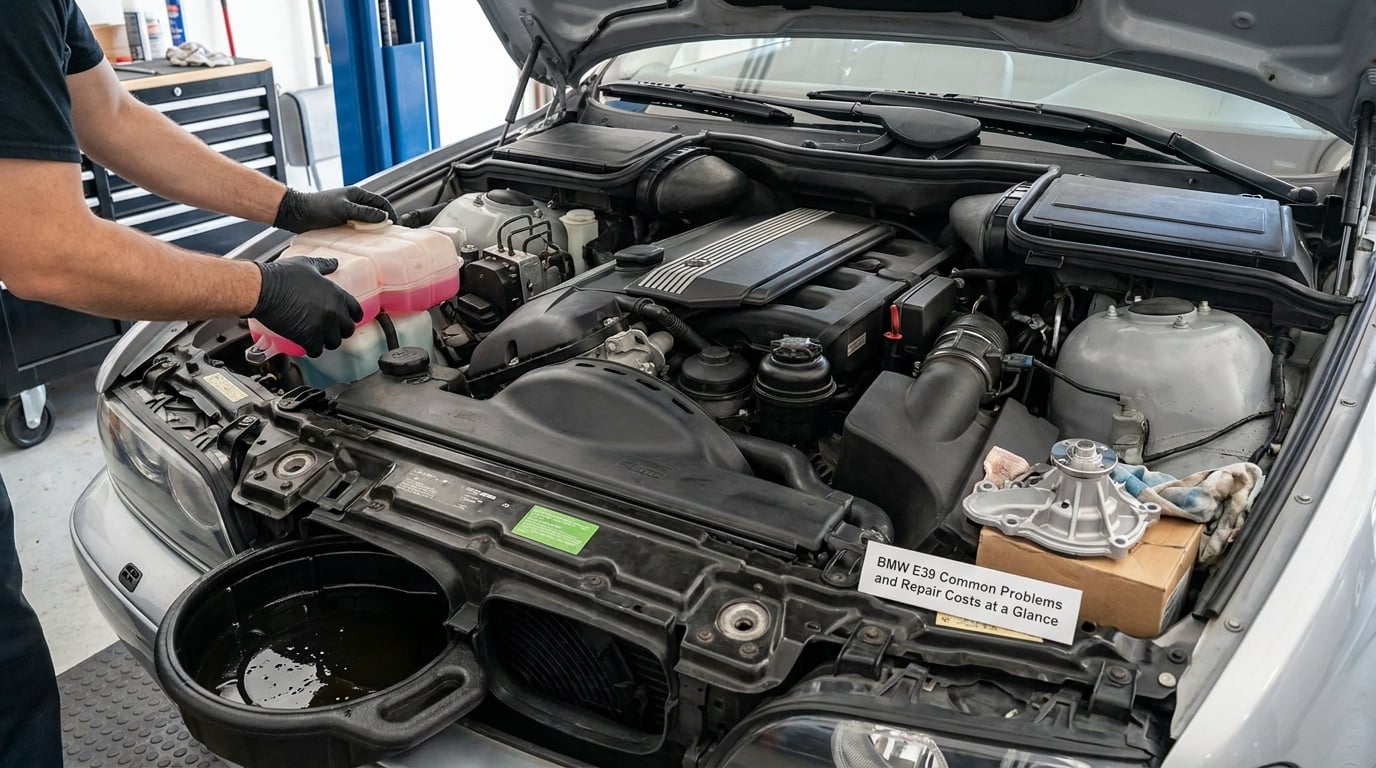
The most common E39 problems are cooling system failures, oil leaks, front suspension bushings, worn steering joints, brake wear, and rust at the jacking points, and the ones that cost the most are rust, cooling failures, VANOS and the M5’s rear subframe. Here is the short version of what each one costs before we go into detail.
All ranges below are typical US estimates for 2026 in US dollars, combining parts and labor at an independent BMW specialist. They vary by region and change over time, so treat them as a planning range rather than a quote.
| Problem | Warning signs | DIY difficulty | Typical US cost (parts and labor) | How urgent |
|---|---|---|---|---|
| Cooling system (expansion tank, water pump, thermostat, radiator, heater valve) | Overheating, rising needle, sweet smell, puddle under the car, heater blowing warm | Moderate to hard | USD 700 to 1,400 for a full refresh | Immediate. Overheating becomes an engine job fast |
| Oil leaks (valve cover gasket, oil filter housing gasket, oil pan) | Oil film down the block, spot under the car, low oil warning, burnt smell on a 540i | Moderate to hard | USD 150 to 450 for one gasket; up to 1,200 if access requires removing the intake | Soon. Watch the level, not the stain |
| Front suspension (thrust arm bushing, control arms, ball joints) | Shimmy at 80 to 110 km/h, wandering on bumps, clunk over expansion joints, uneven tire wear | Easy to moderate | USD 200 to 450 per corner, 600 to 1,100 all four corners | Plan it. Tire destruction is what forces the issue |
| Steering joints and strut mounts (tie rods, sway bar links, top mounts) | Clunk over bumps, wandering on ruts, tire cupping, rattle from the corner | Easy | USD 100 to 200 per part plus alignment | Plan it |
| Brakes (pads, rotors, parking brake shoes, hard pedal) | Squeal, pedal travel, pedal goes to the floor, parking brake slack | Easy to moderate | USD 250 to 450 pads and rotors, 500 to 1,400 for a master cylinder or booster | Immediate if the pedal goes soft |
| Rust at sills, jacking points, wheel arches, trunk floor | Bubbling paint, soft metal under a plastic cover, brake fluid leak into the sill | Not a DIY job | USD 400 to 1,200 per area; a full structural repair runs well past 3,000 | Buy decision. This ends the conversation |
| VANOS seals and DISA adjuster (M52TU, M54, M62TU) | Oil in the intake, cold-start rattle that fades, rough idle, throttle response that wanders | Hard | USD 500 to 1,200 for VANOS, 200 to 500 for a DISA adjuster | Schedule it. Untreated it can go to a head job |
| Timing chain guides and tensioner (chain-driven sixes) | Rattling that sounds like marbles in a can on cold start, worse with worn oil | Very hard | USD 900 to 2,000 | Soon, once it is genuinely rattling |
| Instrument cluster pixels, window regulators, blower motor resistor | Segments of the display dropped out, window drops and stops, blower only works on some speeds | Easy to moderate | USD 80 to 150 resistor, 150 to 300 regulator, 200 to 450 cluster repair | Whenever. Cheap and annoying |
| Transmission fluid and service (5-speed ZF automatic, Getrag manual) | Harsh shift, slip on launch, fluid that has never been changed | Easy for a fluid service | USD 200 to 400 fluid and filter, 900 to 2,500 for a rebuild | Preventive. Do the service, not the rebuild |
What breaks at what mileage
Age matters more than mileage here, so treat this as a rough map rather than a schedule. A car with 90,000 miles and a full documented history is in better shape than a 140,000-mile car nobody has touched.
| Mileage | What usually deserves attention |
|---|---|
| 60,000 to 90,000 | Front control arm bushings and tie rods, sway bar links, brakes, spark plugs, and the first sign of a tired cooling system |
| 90,000 to 130,000 | Thrust arm bushings, strut top mounts, oil filter housing gasket, window regulators, cluster pixel dropout, subframe cracking on an M5 |
| 130,000 to 160,000 | VANOS seals, DISA adjuster, cooling system full refresh, rear bushings, differential and transmission fluid, M5 rod bearing noise |
| 160,000 to 200,000 and beyond | Timing chain guides, head gasket consequences, subframe reinforcement, more cooling plastic, wiring loom and final-control-unit oddities |
Cooling System and Overheating Repairs
A full cooling system refresh runs about USD 700 to 1,400 in parts and labor on a six-cylinder E39, and it is the single most useful job you can do to a car of this age. The plastic expansion tank, water pump housing, thermostat and radiator all age out on a calendar rather than a mileage, and the cheap way to diagnose is a cold-pressure test of the system plus a visual look at the expansion tank for a green stain or a weeping seam.
The signs are hard to ignore once you know them. A temperature needle that climbs on a long climb, a heater that blows warm instead of hot, a sweet coolant smell in the cabin, or a puddle under the car that is not condensation all point the same way. Owners on the E39 forums repeat the same warning: a plastic part that fails without warning takes the head with it, and that is the difference between a USD 700 job and a USD 1,500 to 3,000 one.
Individual line items help you judge a quote. A water pump and thermostat alone is usually USD 300 to 600 including labor. An expansion tank is USD 120 to 250 fitted. A radiator is USD 350 to 700 fitted once labor and coolant are included. A heater control valve or a stuck heater core is USD 250 to 600. Doing them all at once, with a pressure test and a fresh coolant fill, is the sensible version of the job.
Coolant choice matters more than owners expect. E39s are specified for blue coolant, and mixing in a universal green coolant is a cheap way to end up with corrosion inside the block. Use the BMW-specified coolant, and bleed the system properly after filling. If a garage cannot tell you which coolant went in last time, that is worth knowing.
If the car has already overheated badly, do not buy a gasket job sight unseen. Have the head machined and pressure tested first. That single check regularly saves a second gasket.
Engine, M62, and M54 Problems
Oil leaks are the most common engine complaint on these cars, and a single gasket runs USD 150 to 450 depending on where it sits. The oil filter housing gasket is the usual first one, then the valve cover gasket, then the oil pan. On the M54 and the M62, access is what drives the price rather than the part, and a job that needs the intake manifold out can reach USD 1,200 for what is a simple seal.
The 530i’s M54 is generally regarded as the most reliable engine in the range. It is a chain-driven straight six, and a timing chain guide and tensioner replacement runs USD 900 to 2,000 once everything is opened up. Do that job with a fresh oil change, and use a quality oil filter gasket and the specified oil weight while you are in there.
VANOS is the engine issue most owners plan around. On the M52TU, M54 and M62TU, worn VANOS seals let oil into the intake and produce a rattle on cold start that fades as the oil heats, plus a rough idle and a throttle that feels vague. A VANOS job runs USD 500 to 1,200 depending on the engine, and on the DISA-equipped versions a failed adjuster adds USD 200 to 500 and its own rattle on startup.
On early M52 engines, look for evidence of a Nikasil bore job if the car has the bore coating, which was common on European-spec blocks in the mid-1990s. A car that was properly bored and sleeved is a completely different proposition from one where the rebuild was skipped. Compression test and a proper inspection tell you more than the paperwork does.
The M5’s S62 V8 is a different car to own. Individual throttle bodies, the rear subframe mounting points and rod bearing noise are the three things to look at, and owners report a 20- to 30-hour job when the rod bearings come due, typically somewhere in the 130,000 to 160,000 mile window. Budget around USD 4,000 to 7,000 for that, and treat a subframe crack as a structural repair with a reinforcement kit rather than a cosmetic weld.
Diesels get their own list. The 530d’s M57 is robust but expensive to service, and injectors, turbocharger work and cooling system items run far higher than the petrol cars. If you are shopping a diesel, price in the possibility of a much larger single bill.
Suspension, Steering, and Wheel Problems
Front suspension wear is the most common thing on an E39, and it usually shows up as a shimmy at highway speed rather than as a clunk. The hydraulic thrust arm bushings on the older front axle are a good example: a worn bushing lets the thrust angle change under braking, which gives you a vibration that only appears when you brake at speed. Replacing the bushings is a good weekend job for most people and runs USD 200 to 450 per corner including the control arm.
Tie rods, sway bar links and strut top mounts are cheaper and easier. Budget USD 100 to 200 per part with an alignment afterwards, and count on doing more than one at the same time on a high-mileage car. Strut top mounts in particular tend to go around the same time as the tie rods, and doing them together saves the alignment.
Wheel bearings show up as a hum that changes pitch with road speed, and rear wheel bearings on these cars are a common high-mileage item at USD 200 to 400 per side. Check that the wheel has no free play in it before you accept the diagnosis. A stripped wheel-stud or lug thread is a different problem again, and it is fixable in the garage if you know how to retap a stripped thread.
On inspection, the checks that pay off are simple. Put the car on a rack, look for rubber that has split away from its metal, check for uneven tire wear across the tread, and look for shiny underbody parts. Then take a long enough road test to reach full operating temperature, because a shimmy that is not there when the car is cold is a different fault from one that is always there.
Brake and Drivetrain Repairs
Brakes on an E39 are simple to do and straightforward to price, and skipping them because the pedal still feels normal is a mistake. Pads and rotors across the car run USD 250 to 450, the rear brake shoes and the parking brake actuator add USD 150 to 350, and a soft pedal that slowly sinks means a master cylinder or booster at USD 500 to 1,400.
Drivetrain work depends on which gearbox the car has. A fluid and filter service on the 5-speed automatic runs USD 200 to 400 and is the single best thing you can do for longevity. The old lifetime-fill claim is where owner arguments start, and most specialists now treat that fluid as a changeable service because nobody knows how old it is. A full rebuild, if one ever comes, runs USD 900 to 2,500 and is a reason to walk away from a car.
On the manual cars, the clutch takes a lot of abuse from city driving, and a replacement runs USD 900 to 1,800 depending on whether the dual-mass flywheel goes with it. Check the gearbox mount and the differential fluid at the same time, both cheap relative to the rest of the drivetrain. A worn center support mount is a common source of a shudder under acceleration and costs a few hundred dollars.
What Affects the Price
The ranges in this guide are typical US estimates for 2026. Your local labor rate, your region, the parts brand the shop uses and how much diagnostic time the job needs can move any of them by a wide margin, and prices change over time. A shop quoting a third more than the range here is not necessarily wrong.
Here is where the money actually goes.
| Factor | What it changes |
|---|---|
| Mileage and service history | A car with 130,000 documented miles is a cheaper version of the same car than one with 130,000 unaccounted miles |
| Model year and engine | An M5 subframe job and a 530i strut job are not comparable bills, and the M57 diesel has its own cost profile |
| Parts quality | OEM-quality cooling parts and good seals cost more up front and much less on the second visit |
| Labor tier | The same job can differ by a factor of two or more between a dealer and an independent specialist |
| Region | Labor rates vary widely by metro area, and parts shipping adds to the remote regions |
| Diagnostic time | An undiagnosed cooling or electrical fault can add an hour or two before any parts are ordered |
| Related failures found during the job | Opening a strut reveals the spring seat; a head off reveals the deck. Budget for what gets uncovered |
Labor tier is the biggest lever most owners control. An independent BMW specialist is the default I would use for almost everything on these cars, and the gap versus a dealer is where a large share of the total saving comes from.
| Job type | DIY | Independent specialist | BMW dealer |
|---|---|---|---|
| Oil and filter change | Parts cost only, under an hour | USD 100 to 180 | USD 200 to 350 |
| Brake pads and rotors, all four | Parts cost, most of a weekend | USD 300 to 500 | USD 550 to 900 |
| Cooling system refresh | Not recommended for most people | USD 700 to 1,400 | USD 1,300 to 2,200 |
| Front control arm bushing, per corner | Achievable with a jack and a ball joint press | USD 250 to 450 | USD 500 to 750 |
| Transmission fluid service | Simple if you have a pan and a level surface | USD 200 to 400 | USD 350 to 550 |
| Diagnostic hour | Not possible without a scanner | USD 120 to 180 | USD 180 to 300 |
Budgeting an annual figure is more useful than a single repair. Most owners of a well-run 150,000-mile E39 land somewhere around USD 1,500 to 3,000 a year, and the europremiumparts guide for the harder-to-own M5 puts routine maintenance and wear closer to USD 2,000 to 3,500. Forum owners report the same shape: one BimmerFest member bought a 530i and spent most of the following money on predictable items like tires and timing chain guides rather than surprises, and a recurring figure of about USD 2,000 a year comes up often on the E39 boards.
| Annual line | Typical amount per year | Fixed or variable |
|---|---|---|
| Oil, filter, fluids, brake inspection | USD 200 to 400 | Fixed |
| Insurance, registration, taxes | Varies entirely by state and driver | Fixed |
| Tires, brakes, routine wear | USD 400 to 800 | Semi-variable |
| Unplanned repair buffer | USD 700 to 1,800 | Variable |
| Fuel, consumables, misc | Depends entirely on how you drive | Variable |
Depreciation is the item owners rarely price in. A sound E39 is worth a low four-figure sum to a private buyer, and once outstanding work lands on the books, that number drops fast. One buyer was advised that a 2001 530i at 198,000 km is only worth pursuing well under four figures, and a clean 2003 540i with 130,000 miles and 20-plus service records was listed around USD 6,300.
Ways to Save
Inspect before you buy, and spend the inspection money. A pre-purchase inspection that costs a couple of hundred dollars routinely saves a buyer a cooling system, a subframe or a rust repair, and no diagnostic shop will find rust and hidden leaks as reliably as a person with a flashlight and a pry bar.
Do the cooling system before it does it for you. If the car is at this age and the history is thin, a full refresh with a pressure test and the correct coolant is cheaper than the alternative, and it is the difference between a planned USD 1,000 and an unplanned head gasket.
Use OEM-quality parts and stop chasing the cheapest quote. The value of an E39 is that parts availability and specialist knowledge are both good, so the labor is the expensive part, not the components. Bargain on labor and buy the better pump.
Bundle the work while the car is apart. Four control arms cost less in labor than two, one alignment covers tie rods and top mounts done at the same time, and doing the transmission fluid during a cooling job saves a second visit. If the shop is already in there, ask what else is due.
Do the easy parts yourself and leave the rest. Oil, filters, brake pads, sway bar links and a fluid service are well within a normal garage. Cooling system, VANOS, head gasket, subframe and steering work go to a shop, and the DIY column above shows what the difference is worth.
Check the safety campaigns by VIN before you commit. The driver airbag inflator campaigns on this era of BMW remain open on some cars, and a VIN check at the manufacturer or the National Highway Traffic Safety Administration database takes two minutes. A car with a deployed or removed passenger airbag is a much harder sell and a much cheaper fix now than a full dash replacement later.
Ignore parts lists from the seller and fix only what the inspection shows. A seller handing you a printed list of ten urgent items is selling something. A cold start, a pressure test and a scan tell you what is real.
Frequently Asked Questions
How much does it cost to fix common problems on a BMW E39?
The routine jobs cluster predictably. A full cooling system refresh runs USD 700 to 1,400, brake pads and rotors across the car run USD 250 to 450, front control arm bushings are USD 200 to 450 per corner, and a VANOS job is USD 500 to 1,200. Budget roughly USD 1,500 to 3,000 a year on a well-run 150,000-mile car, and more like USD 2,000 to 3,500 on an M5 or a diesel. A neglected cooling failure can add USD 1,500 to 3,000 on its own in head gasket and machineing.
Is a high-mileage BMW E39 worth repairing?
Usually, if the body is solid and the engine is the one you want. An M54 525i or 530i with full documented history at 150,000 miles is a car many owners keep for years, because the engine itself is strong and the expensive items are known and priced. A car with rust at the jacking points, a cracked rear subframe or a failing rod-bearing noise is a different conversation. Judge the specific car, not the model, and subtract outstanding work from the asking price before you commit.
What E39 problems should I fix before buying the car?
Run a cold-pressure test on the cooling system and a compression test on the engine first, then look for the four deal-breakers: rust at the sills and jacking points, cracked rear subframe mounting points on an M5, high oil consumption on a mid-1990s European M52, and any evidence the cooling system has never been done. Ask for invoices for recent work, check the recall status by VIN, and take a road test long enough to reach full operating temperature.
Can I repair an E39 at home, and which jobs require a shop?
A fair number of these jobs are home jobs. Oil and filter changes, brake pads and rotors, sway bar links, control arm bushings with a ball joint press, transmission fluid service and even a coolant flush fall to a competent weekend mechanic. Cooling system replacement, VANOS, timing chain guides, head gasket work, subframe repair and anything involving steering geometry belong in a shop with a lift, the right tools and a scanner. Knowing which is which is most of what determines whether the job is cheap.
What warning signs mean an E39 repair should not be delayed?
Four signs matter more than the rest. A temperature needle that climbs, a heater that blows warm, or a sweet smell in the cabin means stop and deal with the cooling system today. A brake pedal that slowly sinks to the floor means the hydraulic system needs attention now. A loud rattle on cold start that sounds like loose marbles in a can is timing chain guide noise. And a steering wheel that shivers at highway speed only when you brake is a thrust arm bushing, which you should fix before it eats the front tires.
Conclusion: What to Do First
If you just bought an E39, the first step is a scan for codes and a proper inspection, not a parts order. Then work down a fixed order: cooling system condition first because it is the cheapest thing to fix before it becomes the most expensive, brakes second if the pedal is soft, steering and suspension third if the car wanders or shakes, and engine and transmission evidence last because those are the bills you cannot schedule around.
Check the recall status by VIN while you are at it, get invoices for any recent work, and price the outstanding jobs at an independent BMW specialist rather than a dealer. If the body is sound and the paperwork is real, bmw e39 common problems and repair costs are a known list with known numbers, and that is a much easier thing to own than most cars this old.