
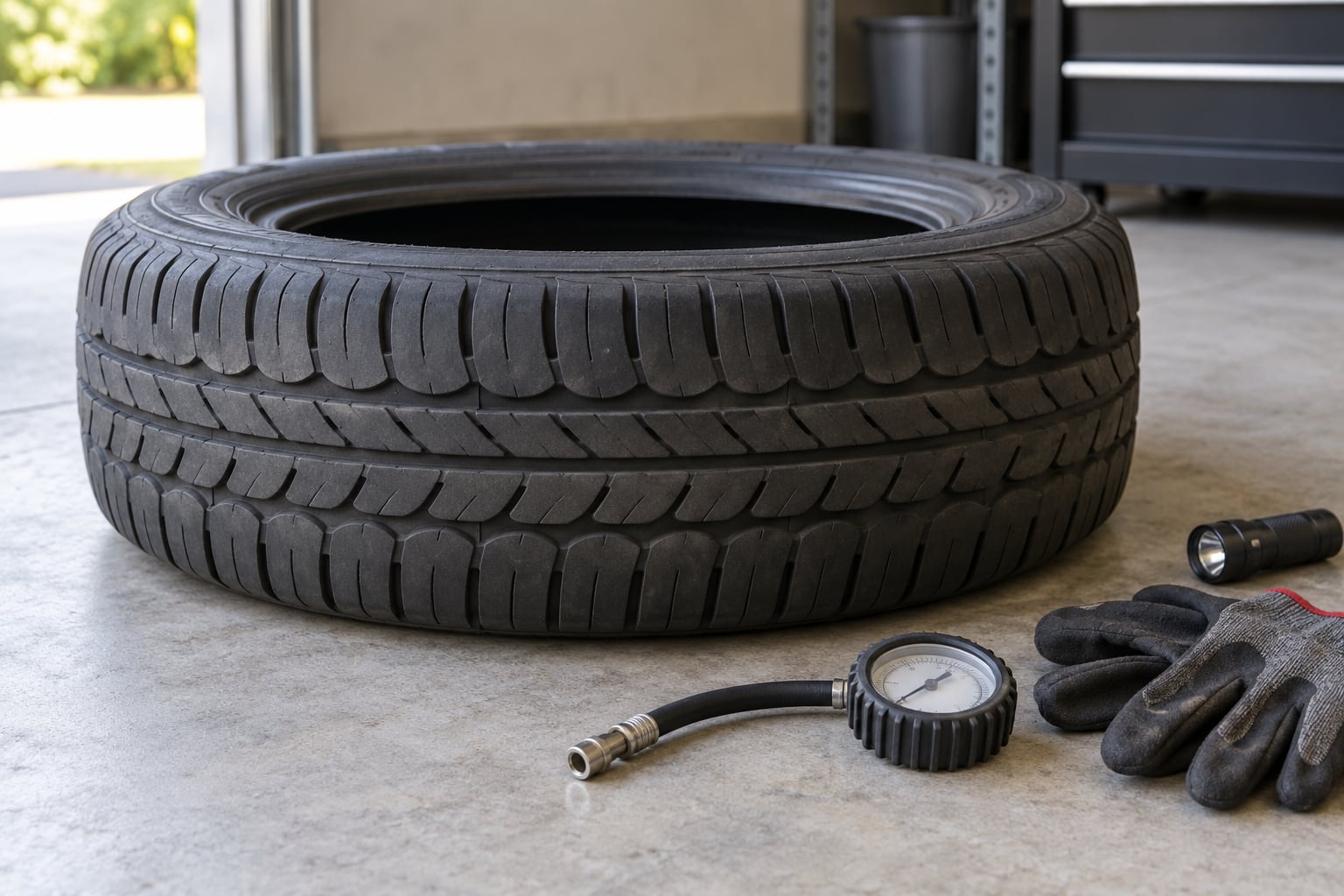
Tire cupping is uneven tread wear that shows up as repeating shallow dips around the tire, also called scalloping. It happens when a wheel bounces instead of staying planted on the road, and the top three causes are worn shocks or struts, an out-of-balance wheel, and suspension parts gone loose.
The fix is not a new set of tires. Correct the mechanical fault first, then replace the damaged rubber, or you will buy the same problem twice within 15,000 miles.
Tire cupping causes and fixes come down to two questions: why is the wheel moving, and how much rubber is left. Fix them in that order.
Table of Contents
- What Is Tire Cupping and Why Does It Happen?
- Tire Cupping Causes and Fixes at a Glance
- How to Tell Tire Cupping Apart From Other Wear
- What Causes Tire Cupping?
- How to Diagnose Tire Cupping Step by Step
- Tire Cupping Fixes: What to Repair First
- Do You Need New Tires or Suspension Parts?
- Frequently Asked Questions
- Conclusion
What Is Tire Cupping and Why Does It Happen?
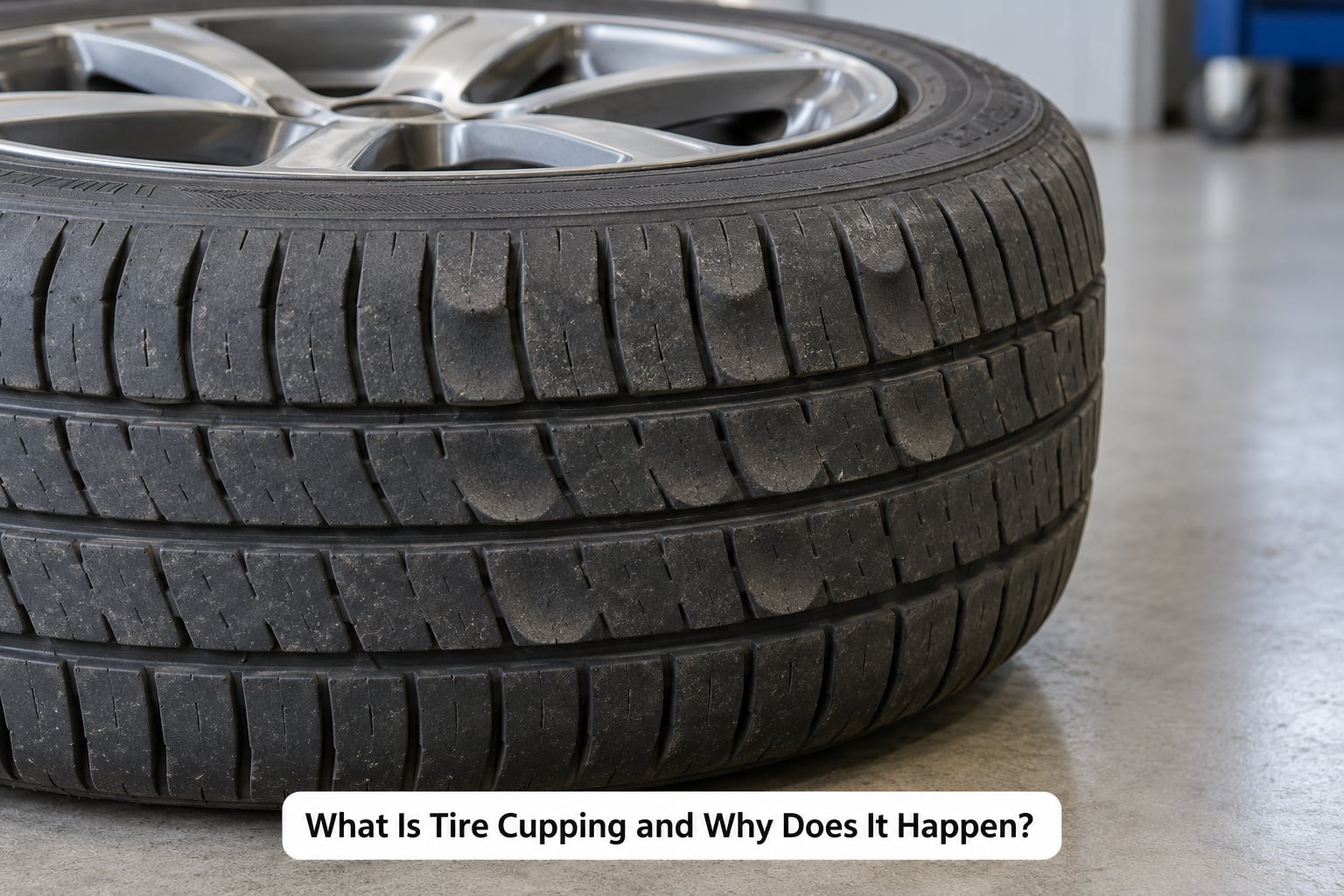
Cupping forms when the wheel hops up and down as you drive. Each time it leaves the pavement and comes back down, that contact patch wears slightly more than the stretches between bounces, so the tread ends up with a rippled, wavy pattern rather than an even surface.
A healthy damper no longer manages wheel movement, so the tire absorbs energy meant for the shock absorber instead of converting it into heat. Twenty thousand identical bounces over a highway trip add up to a visible scallop.
What you will notice first is sound. A cupped tire produces a rhythmic hum or helicopter-like thump that rises in pitch with speed and stays with you in both lanes. Run your hand across the tread and the surface feels stepped or lumpy rather than flat.
Feathering is the pattern people confuse it with most, and they are opposites. Feathering is one-sided wear where the tread blocks shave to a wedge on one edge, caused by toe and camber being out of spec. Cupping is symmetrical across the width of the tread and repeats around the circumference. Our guide to tire feathering and its causes breaks that difference down further.
Tire Cupping Causes and Fixes at a Glance
Start by matching what you see and hear to the most likely source, then check that one before moving on.
| Symptom | Likely cause | Quick check | First fix |
|---|---|---|---|
| Repeating dips across the whole tread, hum with speed | Worn shocks or struts | Bounce test at one corner; push down hard and release | Replace shocks or struts in pairs |
| Single patch of cupping on one tire | Out-of-balance wheel or tire | Vibration that grows with speed on smooth pavement | Balance the wheel, replace a tire with a bulge or runout |
| Clunk over bumps, wandering on straight roads | Worn ball joints or tie rod ends | Rock the tire short of lock to lock | Replace the joint, then align |
| Fast tire wear, uneven wear bar-to-bar | Alignment out of spec | Check toe with a gauge or have it printed | Set alignment to the placard spec |
| Edges worn to the same low depth, middles fine | Underinflation, underloading | Compare cold pressures to the door jamb | Inflate cold to placard pressure |
| Center strip gone first | Overinflation or overload | Weight check, cold pressure check | Correct pressure, drop load, rotate |
| One heavy block worn flat | Locked brake or seized caliper | Touch the rim after driving; it will be hot on one side | Repair the brake, replace the tire |
| Cupping on all four tires, plus a shimmy | Bent rim or wheel runout | Look for a lipped or cracked rim edge | Replace or refinish the wheel |
| Cupping only on lowered or camber-kitted cars | Excessive camber from a modification | Measure inner versus outer shoulder depth | Reduce camber, re-align, replace both tires on the axle |
Which axle cups tells you something too. Cupping that shows up only on the rear often traces back to load-related imbalance or rear dampers rather than alignment, since rear toe is usually adjusted less than front toe. Front-only cupping points more directly at steering and front suspension wear, because those components set alignment and fight every bump.
How to Tell Tire Cupping Apart From Other Wear
Every uneven wear pattern has a signature. Hold the tire up and sight across the tread from the side, then from directly above, so you can see which direction the pattern runs.
| Pattern | What it looks like | Usual cause |
|---|---|---|
| Cupping or scalloping | Shallow repeating dips and raised patches all the way around | Bouncing wheel from worn dampers, imbalance, or loose suspension |
| Feathering | Tread blocks wedge to one side like a saw blade | Toe or camber out of spec |
| One-side edge wear | Inner or outer shoulder low, center still deep | Camber too high or too low, worn control arm bushings |
| Center wear | Rib area worn smooth while shoulders keep depth | Overinflation, chronic overloading |
| Flat spot | One hard patch opposite the valve stem after a brake lockup | Grabbing brake or ABS event |
Wheel bearing noise is the other common mix-up, and it sends people to the wrong repair. Bearing noise changes as the car is loaded from side to side in a corner; cupping noise does not, because the tire tread is physically deformed and hits the same way whether the car is turning left or right.
| Clue | Cupped tire | Bad wheel bearing |
|---|---|---|
| Noise in a gentle lane change | Little or no change | Grows noticeably quieter or louder |
| Tread feel | Lumpy or stepped under your hand | Smooth |
| Speed behavior | Pitch rises and falls in a repeating cycle | Steady growl, often a droning tone |
| Fix | Fix the cause, then replace rubber | Press and replace the bearing or hub assembly |
If a tire is down to the wear bars, has exposed cords, a bulge, cracking, or a bead that no longer sits flat, stop diagnosing and replace it. No amount of alignment or rotation makes that tire safe. You can read more about reading these patterns in tire wear patterns and what they mean.
What Causes Tire Cupping?
Worn or Damaged Suspension Components
Shock absorbers and struts are the most common single cause. Once the fluid inside a damper ages and the piston seal starts to weep, the part stops controlling wheel movement, and the tire handles the rest.
Ball joints, tie rod ends and control arm bushings fail the same way. Once a bushing is torn, the wheel can shift a fraction of an inch in the slot every time you cross a seam, which is enough to set a repeating wear spot.
Wheel Alignment Problems
Toe and camber outside the manufacturer’s range push the tread onto one portion of its width, so an overworked patch gets scrubbed faster than the rest. Correct toe, camber and caster to the values printed in the door jamb, not to whatever the alignment rack defaults to.
Camber kits and lowered coilovers are the exception. Pulling several degrees of negative camber moves the load to the inner shoulder by design, and cupping shows up faster than most owners expect.
Wheel Imbalance and Bent Wheels
A wheel with a small spot of extra weight at the rim lip, or a rim that is out of round, forces the assembly to hop once per revolution. That single event per rotation is exactly what a scallop is.
Parked-lot potholes and curbs are the usual culprits on an otherwise straight wheel. Dynamic balancing catches weight variation, while runout covers the shape of the rim itself.
Overinflation, Underinflation, and Improper Tire Load
Pressure changes the wear pattern more than most people expect. Too little pressure lets the shoulders collapse into the road, and too much pressure forces the center rib to carry the whole vehicle.
Always set cold pressures to the number on the driver’s door jamb placard. The sidewall maximum is a limit for single-axle full-load use, not a daily target. Our step-by-step guide to checking tire pressure correctly covers the cold-reading detail most people get wrong.
Aggressive Driving, Braking, and Road Conditions
Nothing here creates cupping on its own, but every extra cycle through a fault multiplies it. Hard braking and cornering loads the suspension, washboard roads and frost heaves keep the dampers working, and a pothole can bend a rim that then cups a new tire.
Truck and SUV owners see this sooner. Payload and tongue weight stay on the rear tires, so the rear axle carries the fatigue and often wears out first.
How to Diagnose Tire Cupping Step by Step
Run this sequence in order. It takes about ten minutes and tells you whether the problem is the tire or the vehicle.
- Drive first, then look. Note the speed at which the hum appears and whether it changes in a lane change. That alone separates cupping from a bearing.
- Hand across the tread. Feel along the full circumference in two or three places. Cupping catches the edge of your palm; feathering does not.
- Sight the tread from the side. A rippled surface is cupping. A wedge-shaped block is feathering, and a low shoulder is a camber problem.
- Compare all four tires. Matching cupping on one tire only points to that wheel. Cupping across the whole set points at dampers, pressure, or load.
- Check cold pressures on all four. Compare each to the door jamb placard and check all four, not just the two you think are low.
- Check for physical damage. Look for bulges, sidewall cuts, exposed cords, a bent rim lip, and a visible crack in the wheel.
- Touch the rims after driving. One rim noticeably hotter than the others on a straight road usually means a dragging brake, not cupping.
- Bounce test the corner. Push the vehicle down hard at one corner and release. It should settle once. Continued oscillation means that damper is done.
- Rock the wheel for play. With the vehicle on the ground, rock the tire short to full lock and listen and feel for a clunk that means loose steering or suspension joints.
- Get balance and alignment printed. Ask the shop for the before and after numbers on the printout so you can see whether the toe and camber changed.
Tire Cupping Fixes: What to Repair First
The order matters more than any single part. Skipping ahead is the reason owners report getting an alignment and then watching the new tires cup a few thousand miles later.
- Replace the damaged tires and wheels first if they are ruined. If the rubber is unusable or a rim is bent, it will never wear evenly no matter what else you fix.
- Repair the mechanical cause. Shocks or struts in pairs, then ball joints, tie rod ends, control arm bushings, wheel bearings, or a seized caliper.
- Correct pressure and load. Set cold pressures to the placard on all four tires and put the vehicle back to a sensible weight if it has been overloaded.
- Balance all four wheels. Dynamic balance, and check runout on any wheel that took a hit.
- Set the alignment. Toe, camber and caster to the manufacturer’s numbers, and re-check the alignment after any suspension part that changes geometry, including shocks and struts.
- Only then install new tires. Match new tires in pairs on the same axle, and keep the alignment spec handy for the next service visit.
Ask the shop for a written repair order naming the actual failed part, not just a line that says service suspension. If the answer to what caused the cupping is vague, the new tires may be gone before their useful life.
Do You Need New Tires or Suspension Parts?
You need new tires when the tread is at or past the wear bars, when cords or belts show through the rubber, when there is a bulge or sidewall damage, or when cupping has taken the tread uneven enough to lose wet-weather grip. You also need them when one tire is worn far below the other three, since a difference that large changes how the car handles on braking.
You need suspension parts when a corner bounces more than once, when a ball joint, tie rod end, or bushing shows play, or when a tire on that corner is cupped while the matching tire on the other corner of the same axle is fine.
Sometimes the answer is neither, and the honest one is rotation. If cupping is shallow, the tire has plenty of life left, and the mechanical cause has been corrected, rotating moves the worn patch to a different part of the circumference where it spreads out. That works for mild cases only. If the root cause is still there, the tire will cup again in a few thousand miles.
On warranties, tire manufacturers generally cover defects in materials or workmanship, and uneven wear caused by impact, potholes, or overloading. Cupping from a suspension fault or a bad alignment usually falls outside that coverage, so read the exclusion list before filing anything.
Cupping that returns after a fresh set of tires is the clearest signal that something mechanical was missed. Track the mileage when cupping reappears and how fast it came back, and take that number to a shop that will test the car rather than just sell alignment.
Frequently Asked Questions
Is tire cupping fixable?
The cause is fixable, but the cupped rubber itself is not. Once a tire has scalloped, no rotation, balance, or alignment will flatten it out again. Replace the tires after correcting whatever made the wheel bounce, such as worn shocks, a bad balance, or a loose ball joint. That order matters, because new tires installed before the mechanical fix usually cup again within 15,000 miles.
What is the most common cause of tire cupping?
Worn shocks and struts are the most common single cause. Once the damper stops controlling wheel movement, the tire bounces and each landing point wears deeper than the tread between them, leaving a repeating scallop. Out-of-balance wheels and worn ball joints or bushings run close behind. Pressure and load problems change the pattern rather than producing a true scallop.
Is it safe to drive on cupped tires?
Short trips at low speed are usually fine if the tire still has usable tread depth and no sidewall damage. Cupping reduces grip and raises noise, and on a highway trip the wheel is less planted than it should be, which matters in rain. Replace them if the tread is near the wear bars, if you see cracks or bulges, or if the ride feels unsettled at speed. Get the cause looked at either way.
Can bad wheel bearings cause cupping tires?
Rarely. A dry or failing wheel bearing adds noise, and a seized one adds drag that can overheat one tire, but a bearing by itself does not produce the repeating scallop pattern. The better test is a gentle lane change: bearing noise gets noticeably louder or quieter as weight shifts, while cupped tire hum stays about the same. Check for a hot rim on one side to rule out a dragging brake.
Will tire cupping go away on its own?
No. Cupped tread wear is permanent, so it will not fade with time or mileage. Rotation can make mild cupping less noticeable by moving the worn patch, but only if the mechanical cause has been corrected first. If the shocks, balance, or alignment are still wrong, the new wear pattern appears on the same tire within a few thousand miles.
Do I need new tires or just an alignment?
It depends on the rubber. If the tire has life above the wear bars and the cupping is shallow, fixing the cause, aligning, and rotating may be enough. If the tread is at the wear bars, cord is showing, or the tires are unevenly worn below the point of usable grip, replace them. Get the alignment done first so the new set wears evenly from the start.
Conclusion
Start by running your hand across all four tread surfaces and comparing them side by side, then set every cold pressure to the door jamb number. If the pattern is there, take the car in and ask for the suspension and balance check before you authorize any tires.
That single step is what separates a one-time tire purchase from buying the same set twice. As of 2026, the repair order above is still the sequence that keeps new rubber from cupping in its first 15,000 miles.