
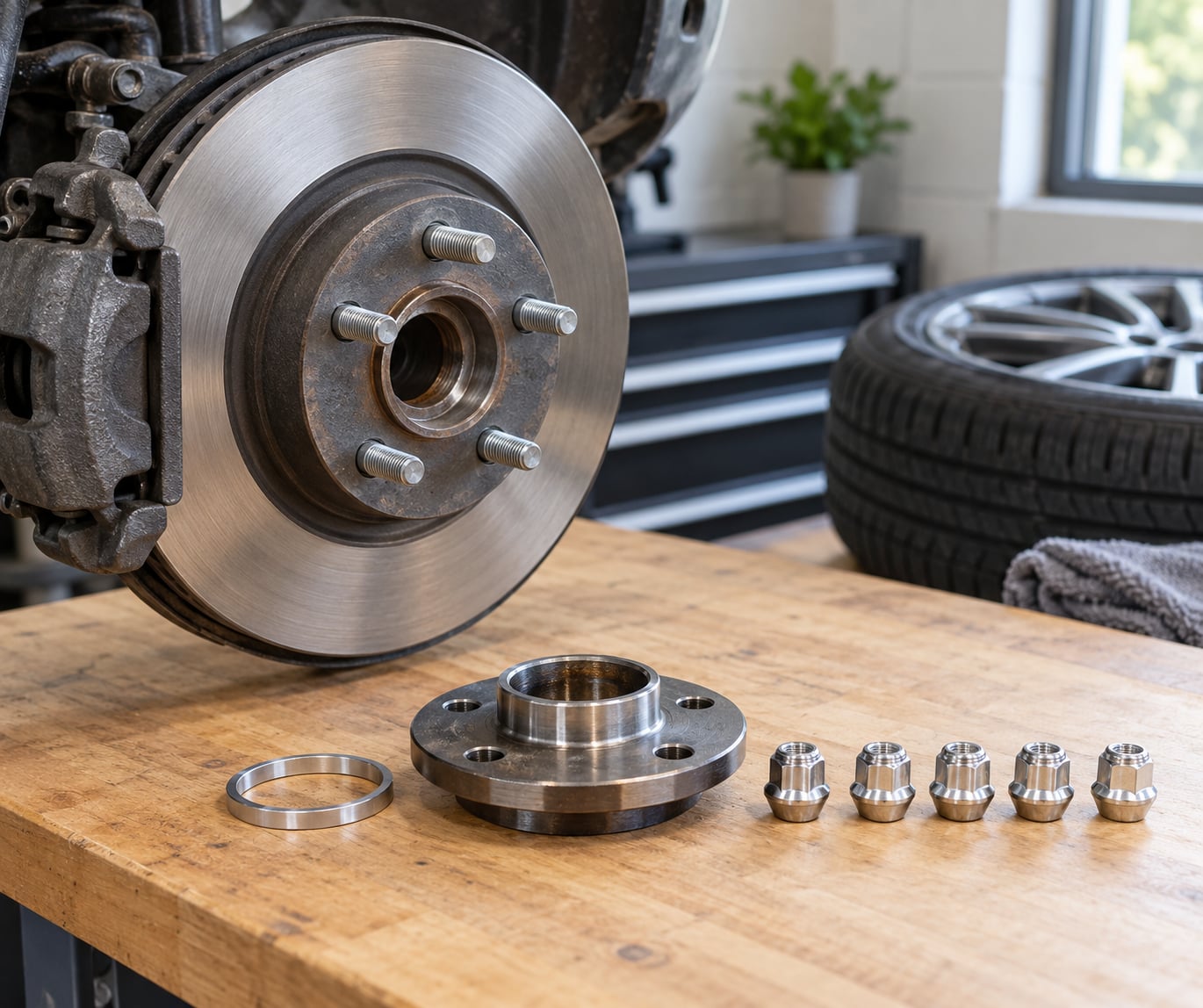
A hub centric ring is a precision plastic or aluminum ring that sits between your wheel’s center bore and the hub pilot bore, centering the wheel so it spins true instead of vibrating. Also called a spigot ring, a centering ring or a hub ring, it carries no load — the lug nuts do that. On a BMW the part is usually a thin plastic ring, but the fitment rules still decide whether your wheel centers properly, sits at the right offset, or shakes above about 37 mph.
This is hub centric rings explained for BMW owners specifically, because the German cars use several bolt patterns and bore sizes in the same generation and it is easy to assume a ring that fits a 5×120 wheel will also suit a 5×112 one. It will not. The bore, the pilot and the offset are three separate numbers, and only one of them is the ring’s job.
Let’s take them in the order you would actually meet the problem: what the part is, whether it is a spacer in disguise, what it does to your offset, how to check whether your wheels need one, how to fit it, and how to tell when something is wrong.
Table of Contents
- Hub Centric Rings Explained: What They Do
- Are Hub Centric Rings and Wheel Spacers the Same?
- Do Hub Centric Rings Change Wheel Offset?
- How to Check if a BMW Uses Hub Centric Wheels
- How to Install a Hub Centric Ring Safely
- What Can Go Wrong with the Wrong Hub Centric Ring?
- Hub Centric Rings vs. Generic Wheel Spacers: Which Should You Choose?
- Frequently Asked Questions
Hub Centric Rings Explained: What They Do
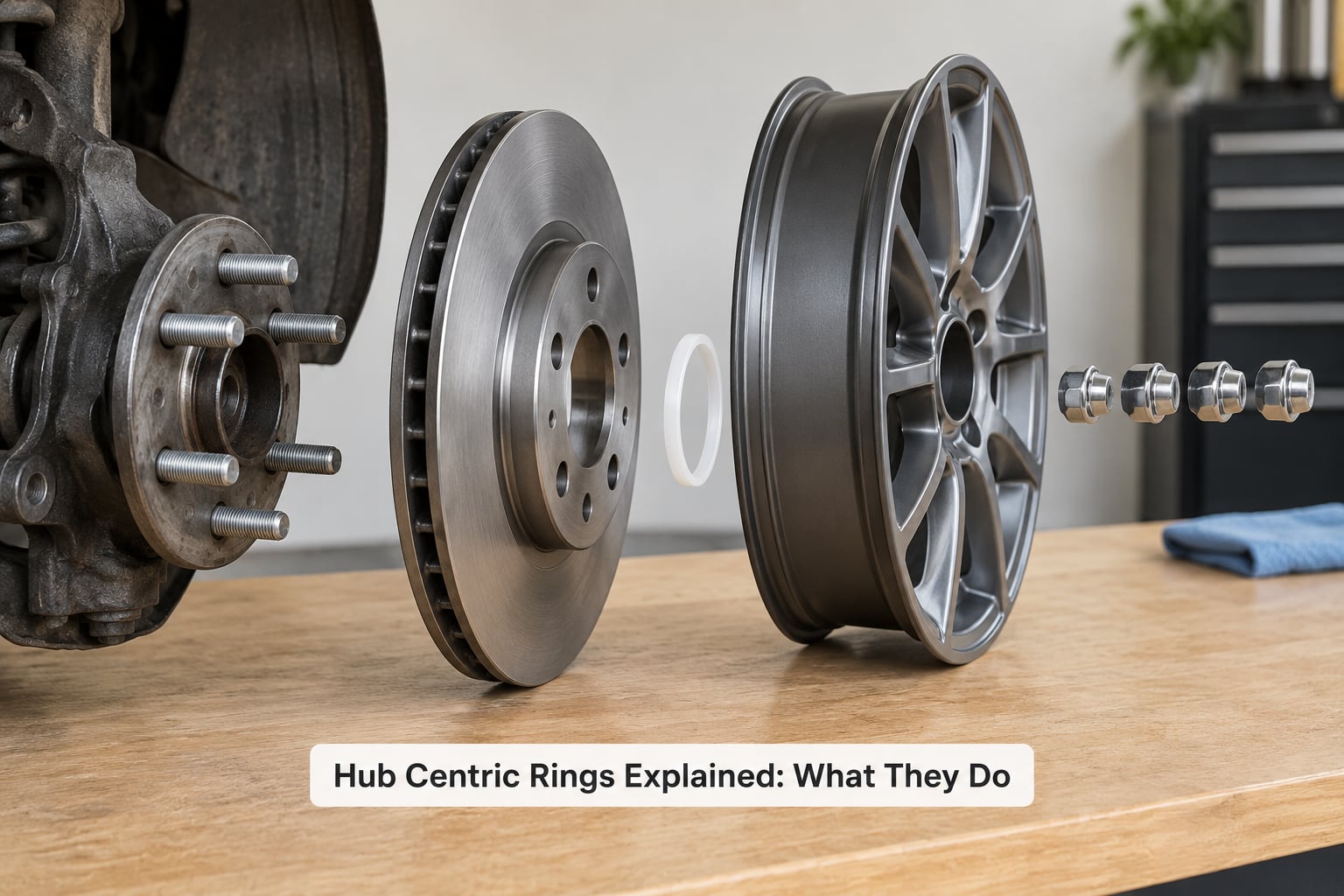
The name describes the job. The ring makes the wheel hub centric, meaning the wheel is located by the hub rather than by the studs alone. Without it, the wheel is held on at whatever position the studs and nuts pull it to.
Two synonyms come up constantly and both mean the same object. A spigot ring describes it by what it slips over — the pilot on the hub is sometimes called the spigot. A centering ring or hub ring is just the American spelling of the same part. Retail listings use all three, and the size is written the same way in every case.
What the ring is not doing
The most common misconception is that the ring holds the wheel on. It does not. During mounting it briefly carries the wheel’s weight so the wheel hangs in the right place, then the lug nuts take over: friction between the mating faces plus clamping force through the studs carries the load from that point on.
That is also why a ring can be made of plastic. If it were structural, plastic would be a strange choice. Acetal and polycarbonate rings are the norm on street cars precisely because a non-marking, corrosion-proof insulator does the centering job without touching the hub surface in a way that could gall or corrode it.
The three parts you are looking at
When a BMW wheel is off the car, three separate components sit between the road and the hub face, and they fail in completely different ways. Confusing them is the reason people chase the wrong repair.
| Component | What it does | Where it sits | How it typically fails |
|---|---|---|---|
| Wheel hub and pilot | Locates the wheel and carries axle load into the suspension | Inboard end of the knuckle, through the rotor | Corrosion, pitting on the face, bent or worn studs |
| Brake rotor and hat | Stops the car and, on most BMWs, provides the flat surface the wheel bolts to | Over the hub pilot, outboard of it | Wear grooves, runout at the hat, heat checking |
| Hub centric ring | Centers the wheel on the pilot while it is fitted | Between the hub pilot and the wheel center bore | Cracking, rattling when proud of the bore, or falling out entirely |
Notice the failure column. A damaged rotor hat produces a vibration that looks identical to a missing ring, which is why checking the hub and rotor before ordering parts saves people real money.
Are Hub Centric Rings and Wheel Spacers the Same?
No, they are different parts that solve overlapping problems. A ring is a thin sleeve whose only job is centering. A spacer is a thick disc that pushes the wheel outward, and some spacers also center while others do not. On a BMW this matters, because a 5×120 wheel that needs plus sizing has two separate fitment requirements, and a thin ring only solves one of them.
| Feature | Hub centric ring | Hub centric wheel spacer | Lug centric wheel spacer |
|---|---|---|---|
| Typical thickness | About 0.12 to 0.32 inch | About 0.20 to 1.00 inch | About 0.20 to 1.00 inch |
| Center pilot feature | Always present, it is the whole part | Usually present on quality versions | Absent, a plain disc with holes |
| Position | Between hub pilot and wheel bore | Between hub face and wheel bore | Between hub face and wheel bore |
| Effect on wheel offset | Reduces it by the ring thickness | Reduces it by the spacer thickness | None, which is the problem |
| Carries wheel load | No | No, but it spreads clamping force | No, and it may preload the studs |
| What it is used for | Centering a universal-bore wheel | Centering and plus sizing together | Pushout only, on a vehicle designed for it |
The row that trips people up is the pilot feature. A hub centric spacer has a spigot that locates on the hub pilot, so it centers the wheel and pushes it out at the same time. A lug centric spacer is just a thick disc with holes; the wheel hangs on the studs, and on a hub centric BMW that means the wheel is no longer centered by anything at all.
Members on r/AskMechanics warn specifically about the second case, describing spacers without correct centering as altering the relationship between wheel and hub and putting far more stress into the studs and hub bearings than the design intended. If you need pushout on a BMW, the spacer you want is the hub centric one, sized so its pilot matches your hub.
How Hub Centric Rings Work on a BMW Wheel
Trace the load path and the logic of the ring becomes obvious. Cornering and braking forces go from the tire into the wheel rim, through the wheel’s lug holes into the studs and lug nuts, then through the studs into the threaded holes of the brake rotor hat or the hub flange. The rotor hat on most BMWs is what the wheel bolts to, and the hub pilot sits inboard of it as a short spigot of metal.
The wheel therefore needs something to tell it where to sit on that spigot while you tighten the nuts. That is the ring’s entire contribution to the assembly. Once the nuts reach the specified torque, clamping force pulls the wheel flat against its mounting face and friction holds it there, which is exactly how the wheel behaves whether or not a ring was used.
What changes without a ring is concentricity, not strength. Without a ring, the wheel is pulled inward until the nuts bottom on the studs or seats, and it can sit a thousandth of an inch or two off center. Over a rotation that offset wobbles the wheel through the same path again and again, so the wheel spins eccentrically and the shake builds with speed. Suspension movement makes it worse, because every time the wheel moves through bump and rebound the slop is taken up in a slightly different place. Owners on r/e46 chasing a shimmy at 50 to 60 mph land on the same conclusion: any little play at the center becomes a problem quickly.
Do Hub Centric Rings Change Wheel Offset?
Yes, but only slightly, and only because of where the ring stacks. Wheel offset is the distance in millimeters between the wheel’s mounting face and its centerline. Anything inserted between the hub and the wheel pushes the wheel outboard and therefore reduces offset by exactly its own thickness.
Take a typical BMW 5×120 wheel with an offset of ET35. With a 0.20 inch ring fitted, the effective offset becomes ET30. With the 0.47 inch plus-size rings used to clear big brake hardware, the effective offset is ET23 — which is why aggressive setups pair thicker rings with wheels whose offset was chosen to compensate.
| Setup | Spacer or ring thickness | Wheel offset | Effective offset |
|---|---|---|---|
| Factory fitment | None | ET35 | ET35 |
| Centering ring only | 0.20 inch | ET35 | ET30 |
| Thin hub centric spacer | 0.39 inch | ET35 | ET25 |
| Double-spaced for clearance | 0.79 inch | ET35 | ET15 |
A thin stock-equivalent centering ring is not a way to gain arch clearance. It exists for centering, and the fraction of an inch it removes from offset is a side effect, not a feature you plan around.
If you genuinely want more clearance or a wider track, that is plus sizing, and the offset arithmetic runs through the whole stack including the wheel itself. Plus sizing wheels explained for BMW fitment and offset covers how the numbers stack and where the clearance actually comes from.
How to Check if a BMW Uses Hub Centric Wheels
Most modern BMWs are hub centric, and so are the great majority of aftermarket alloy wheels, which is why rings are so widely sold. But do not infer the answer from the car alone. Check the wheel in front of you, because the deciding factor is the relationship between its center bore and your hub pilot, not the badge on the center cap.
The visual checks
With the wheel off, look at how the center bore meets the hub. On a hub centric wheel the bore is a close-fitting hole that the pilot fills almost completely, and the wheel sits on a broad flat face with no raised cone around each lug hole. On a lug centric design the holes have wide countersinks or cones, and the small center bore does nothing at all — the wheels sit on those cones.
Second check: whether the rotor hat or hub face is machined flat and reasonably clean. A pitted, rust-blistered or uneven face will stop the wheel sitting flat whatever you fit in the center, and no ring corrects it. Third: compare rotor and wheel weight and construction. A factory BMW alloy has a thick, cast mounting pad around a small bore; a cheap universal-bore wheel is thin, has a wide-open center and a small chamfer, and is the reason the whole ring business exists.
The measurement procedure
This is the step most guides skip. Five measurements give you everything you need.
- Get the car supported properly. Use wheel ramps and axle stands on firm ground or a workshop lift rated for the car, engage the parking brake and select park. Never work under a car held by the jack alone.
- Clean the hub pilot first. Wipe off surface rust and dirt with a wire brush and a degreaser before you measure. Grime hides a chamfer and skews the reading.
- Measure the pilot. Place a digital caliper across the outside of the protruding pilot and close the jaws gently on the flat land, not on the chamfer at the end. Take three readings around the pilot and use the average. Measure the section the ring will actually sit on, because some BMW pilots are stepped in two diameters.
- Measure the wheel center bore. With the wheel off the car and face down, measure inside the bore with a bore gauge if you have one, or a digital caliper with the jaws inserted carefully so you do not splay them. Take four readings at north, east, south and west and average them, because a bore that is slightly oval is a common manufacturing reality.
- Write it outer to inner. The size is always quoted larger number first. A 73.1 to 57.1 ring has a 73.1 mm outside diameter that fits the wheel bore and a 57.1 mm inside diameter that slips over the hub pilot. Getting this backwards is the most common sizing mistake and it shows up constantly on forums.
While the wheel is off, note the bolt pattern stamped on the back of a spoke or on the rim, and read the tire size from the sidewall. If you have never decoded a tire code, how to read a tire sidewall covers the section width, aspect ratio and load index that you need for fitment checks.
Hub centric ring sizes explained: the common fits
These are the size pairs you will see most often in listings and size charts. Treat them as a starting point for matching, not as a substitute for your own measurements. Ring sizes are metric by convention, so bore and pilot diameters stay in millimeters even if your caliper has an inch mode.
| Ring size (OD to ID) | Wheel bore | Hub pilot | Typical where seen |
|---|---|---|---|
| 73.1 to 57.1 | 73.1 mm | 57.1 mm | Universal-bore wheels on many European cars |
| 66.6 to 57.1 | 66.6 mm | 57.1 mm | Older German and Japanese fitments |
| 70.1 to 66.6 | 70.1 mm | 66.6 mm | Mid-size universal applications |
| 76.2 to 56.1 | 76.2 mm | 56.1 mm | Japanese fitments, including some Subaru models |
| 65.1 to 63.4 | 65.1 mm | 63.4 mm | Classic BMW and Mercedes fitments |
| 67.1 to 65.1 | 67.1 mm | 65.1 mm | Older 5×114.3 setups |
| 72.6 to 65.1 | 72.6 mm | 65.1 mm | Common 5×120 conversion rings |
| 74.1 to 72.6 | 74.1 mm | 72.6 mm | 5×112 and 5×120 combinations |
How close does the fit have to be?
Not mathematically identical, but close enough that there is no perceptible play. A tolerance of plus or minus 0.004 inch is the figure most ring makers quote, and that is a sensible target. The ring should slide onto the pilot with firm hand pressure and stop there, and when you push the wheel on it should feel supported rather than wobbling.
If the ring slides on loose, do not use it. A slightly undersized ring lets the wheel rock, and a wheel that rocks on the hub is what produces the knocking over bumps that owners spend months chasing. If it will not go on at all, forcing it will mark the pilot and the bore; you have the wrong size.
One more check that almost nobody explains: the ring must sit nearly flush. Lay a metal straightedge across the wheel’s mounting face and look at whether the ring stands proud. If it does, the wheel rocks, and that rocking is felt as a knock over every bump and a rattle at speed. Shaving a fraction of an inch off the outside diameter with a file or on a belt sander brings it flush, then re-check the fit.
How to Install a Hub Centric Ring Safely
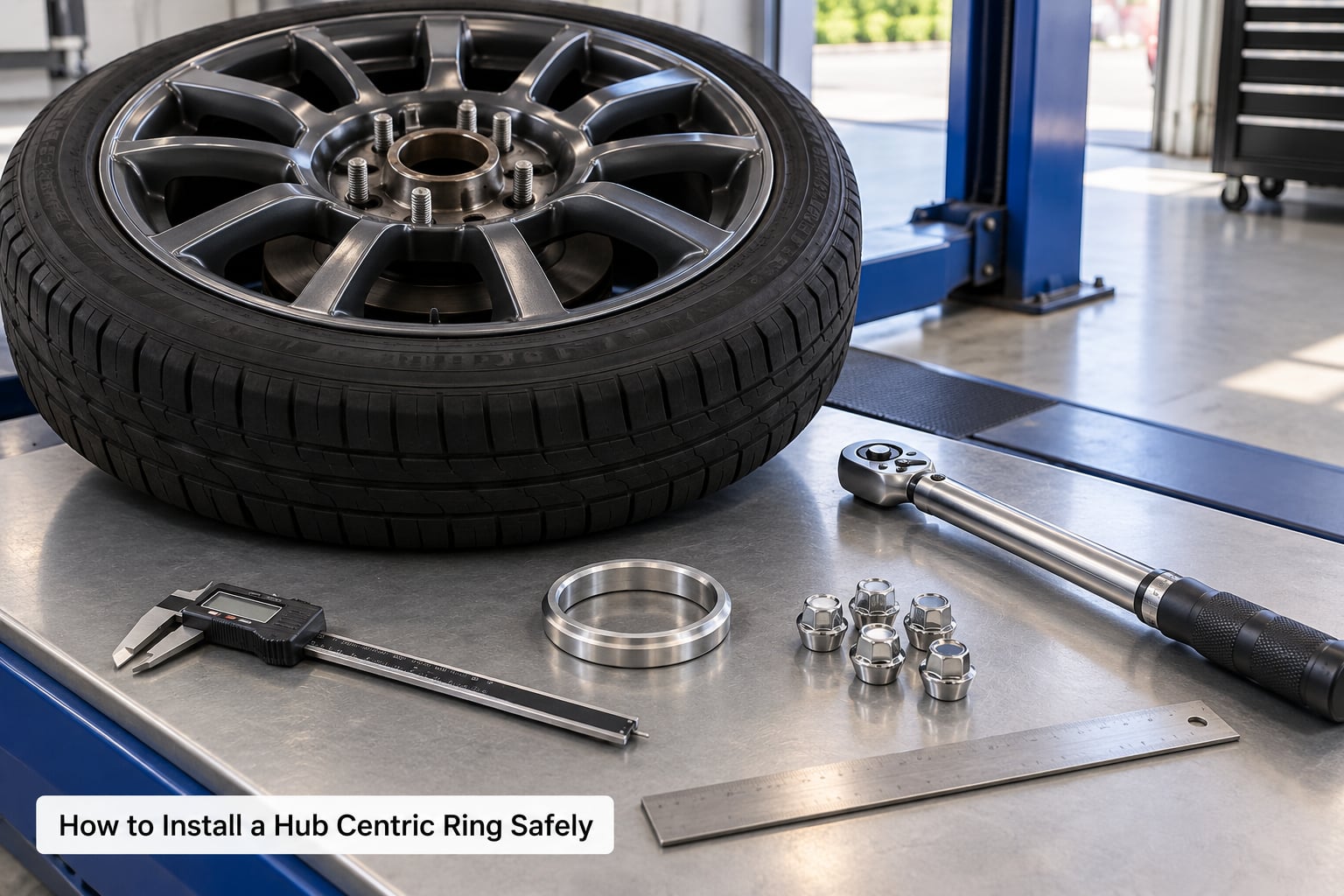
Fitting a ring takes minutes with the wheel already off, and an hour with a wheel still mounted on the car. The procedure below assumes the wheels are off, which is where most people end up anyway when they are chasing a vibration.
- Confirm the size before anything else. Match your pilot and bore measurements to the ring. Put the ring on and confirm the size is right before you disturb the brake and suspension hardware.
- Inspect the hub face. Check for rust scale, pitting, corrosion around the pilot, and studs with damaged or stretched threads. Clean the mounting face and the bore with a wire brush, brake cleaner and a lint-free cloth. A thin film of anti-seize on a metal-to-metal hub contact surface helps at reassembly; follow the procedure in the vehicle service manual.
- Check the studs and hardware. Look at each stud under good light. Replace any that are bent, corroded through or have worn threads, and use new lug nuts where the manufacturer specifies them — many BMW wheels are designed for single-use nuts.
- Seat the ring. Slide the ring fully onto the pilot and press the wheel on top of it. It should seat by hand with firm pressure. Fit the straightedge across the face and confirm the ring sits flush, trimming a fraction of an inch off the outside diameter if it stands proud.
- Fit the wheel and torque in a star pattern. Bring the wheel on over the studs, finger-tighten the nuts, then tighten in a cross or star sequence in several passes so the clamping force builds evenly around the hub. Torque to the value in the BMW owner’s manual or service manual for your wheel and vehicle, not to a generic number, and not to feel. Do not use an impact wrench for this job; it can preload one nut before the others and leave the wheel sitting proud.
- Lower the car, then re-check. With the car on the ground and the load back on the suspension, re-torque if the manual calls for it, and re-check the torque again after roughly 60 miles of driving. This accounts for the initial bedding-in of the mating surfaces.
- Confirm it is fixed. Drive slowly in a straight line first. Any steering wheel shake that disappears under gentle braking load but returns with throttle is a centering or balance problem, not a tire pressure problem.
Professional fitting is worth it when the wheels are new, expensive or when the hub face shows corrosion. When you are not sure, a shop will check the runout at the rotor hat with a dial gauge, which settles the question in a couple of minutes.
What Can Go Wrong with the Wrong Hub Centric Ring?
Almost every ring problem shows up as noise or shake before it shows up as a visible defect. Here is how to read the symptom.
| Symptom | Most likely cause | What to check |
|---|---|---|
| Steering wheel vibration between 35 and 75 mph, appearing right after a wheel change | Missing ring or wrong ring size, or a wheel that was never balanced | Center bore against pilot diameter, then balance the wheel |
| Shimmy at lower speed with visible wheel movement | Ring undersized, so the wheel rocks on the pilot | Fit and flush, and check the bore for ovality |
| Rattle or click over bumps, worse mid-corner | Ring sitting proud of the bore, or debris trapped behind it | Straightedge flush check and clean the bore |
| Wheel will not hold balance, weights keep needing re-checking | Loose ring, pitted hub face, or a bent stud | Hub surface condition and stud alignment |
| Rattle from behind the arch that comes and goes | Ring cracked or fallen out entirely | Remove the wheel and inspect the ring and bore |
| Wheel extremely hard to remove, hub needs a grinder | Metal ring galling or fusing to the pilot | Penetrating oil, and replacement with a plastic ring |
| Click over bumps even with rings fitted | Nut seating, hub wear or stud damage, not the ring | Torque, stud threads and hub face |
Members on r/tires make a common claim that aftermarket wheels are lug centric anyway and rings are therefore redundant. That claim is situational at best. A wheel with a wide-open 73.1 mm bore is nothing but hub centric, and no cone on the lug holes is doing anything useful on a car whose hub does the locating. The same people will tell you the ring is what centers the wheel, which is the correct answer.
Stop driving if any of these happen
A wheel that visibly moves, a lug nut that will not hold torque, a metallic clunk that changes with cornering, or studs showing movement in the hub are all reasons to stop the car and get it checked. Those are hub, nut or stud failures rather than ring failures, but they share the same consequence, so they do not get diagnosed from a driveway at speed.
If the vibration appeared after fitting new wheels and does not change with throttle, get the wheels balanced before you go looking for anything more expensive. Plenty of owners have replaced a hub on the strength of a balance problem. If the alignment feels off afterwards, our guide to camber, toe and caster for BMW owners covers the settings that actually go wrong after a wheel or suspension change.
Hub Centric Rings vs. Generic Wheel Spacers: Which Should You Choose?
For a factory-style setup where your wheel bore matches your hub, choose a ring and nothing else. A thin hub centric ring of the correct ID and OD restores proper centering and costs nothing but a few minutes. If the bore and pilot already match closely, you do not need a ring either — fitting one only changes your offset by its thickness.
When you need the wheel further out for arch clearance, brake clearance or track width, choose a hub centric spacer with a pilot that matches your hub. That single part centers the wheel and pushes it out, and it does both jobs properly. Avoid a plain disc with holes on a hub centric BMW: it pushes the wheel out without centering it, which puts the wheel position in the hands of nut-to-nut tolerance.
Then there is material, and this is where street cars and track cars want different answers.
| Factor | Plastic (acetal or polycarbonate) | Anodized aluminum |
|---|---|---|
| Best suited to | Street cars and daily driving | Track and race use |
| Strength under hard cornering | Good, with a little give | Higher, resists deformation |
| Effect on the hub | Insulates, will not mark or corrode the pilot | Can gall or seize onto the pilot |
| Heat behavior | Insulates the hub from brake heat | Conducts heat straight into the hub |
| Removal | Easy, comes off by hand | Can need penetrating oil or heat |
The Summit Racing knowledgebase puts it plainly: plastic rings are the better choice for street cars because metal rings can corrode and make wheel removal a workshop job, while metal rings suit race cars where stiffness matters more than the risk of a hub that has fused itself to a ring. The same logic explains the owner stories on the evolutionM boards about aluminum rings clicking and flexing over bumps.
One more thing to keep separate: rings and spacers solve different centering problems. A ring fixes the gap between hub and wheel bore. A spacer fixes the offset, and only a hub centric spacer fixes centering as well. Needing both is common on BMWs with 5×120 wheels that have to clear big brakes, and in that case the correct part is a single thick hub centric spacer rather than a stack of rings.
Frequently Asked Questions
Are hub-centric rings the same as wheel spacers?
No. A ring is a thin sleeve, usually 0.12 to 0.32 inch, that only centers the wheel on the hub pilot and slightly reduces offset as a side effect. A spacer is a thicker disc, usually 0.20 to 1.00 inch, that pushes the wheel outboard. A hub centric spacer also centers, while a lug centric spacer has no pilot and will not center a BMW wheel at all.
How thick should a BMW hub-centric ring be?
Thin rings run about 0.12 to 0.32 inch and the correct thickness is whatever your bore and pilot measurements require, usually no more than a few thousandths of an inch of play. Pick the smallest ring that closes the gap, because every extra thousandth reduces your effective wheel offset and moves the tire closer to the arch liner. Trim the ring if it stands proud rather than adding thickness elsewhere.
Can a hub-centric ring cause a wheel to come loose?
Not on its own. Once the lug nuts reach the specified torque, friction between the mating faces and clamping force through the studs hold the wheel, and the ring only centers it during fitting. A ring can be involved indirectly: a loose or undersized ring lets the wheel rock, and a wheel that rocks can preload the studs unevenly. Correct sizing, flush fit and correct torque remove that risk.
Do hub-centric rings affect wheel offset and tire clearance?
Marginally. A ring reduces effective offset by exactly its own thickness, so a 0.20 inch ring on an ET35 wheel leaves you at ET30. For arch clearance that is rarely enough to matter, and it is not the purpose of the part. If you want meaningful clearance you need a hub centric spacer, and the offset arithmetic should be worked through the whole stack before you order.
Can I use a hub-centric ring on any BMW wheel?
Only if the ring inner diameter matches your hub pilot and its outer diameter matches that wheel’s center bore. Bolt pattern does not guarantee fitment, and BMWs across one generation can use 5×112 and 5×120 with different pilots. Keyed or splined wheels are a separate fitment question, so check the wheel’s part number with the manufacturer or measure both diameters with a caliper before buying anything.
Start with a caliper and five minutes. Measure the pilot on your hub and the center bore in the wheel, write the pair outer to inner, and you have the ring size without guessing. That single measurement also settles whether you need a ring at all, which is the question most owners cannot answer from the outside of the car.
When the wheel goes back on, torque the nuts in a star pattern to the figure in your service manual, check the ring sits flush with a straightedge, and re-check the torque after about 60 miles. If a vibration shows up at highway speed before the ring is fitted, get the wheels balanced first, because a balance problem looks identical to a centering problem and you will not settle it by guessing.
That is hub centric rings explained end to end for a BMW: measure, match, fit, verify. Get those three numbers right and the part is the cheapest, least interesting and most effective thing you can fit to a wheel.
Updated for October 2026. Always follow the torque values and procedures in your BMW’s owner’s manual and service manual, and have any corrosion or stud damage checked by a qualified technician before you drive.