
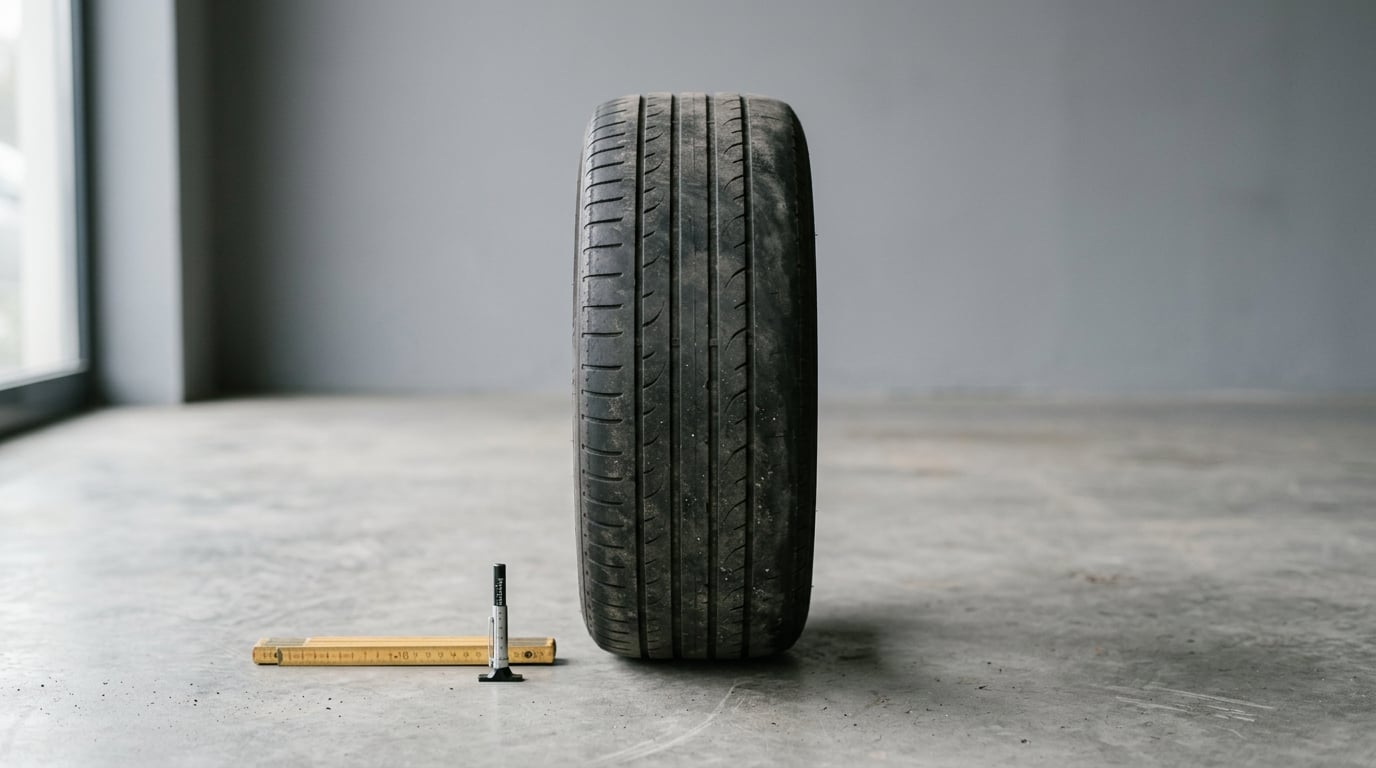
Tire wear patterns are the shapes your tread takes as it wears down, and each shape points to a cause. Worn shoulders usually mean wrong inflation pressure, diagonal or feathering tread blocks mean the wheels are out of alignment, and repeating dips mean a wheel is out of round. Read the pattern first and you fix the actual problem instead of buying four new tires that wear out the same way.
A tire wears wherever it is loaded hardest, and the load distribution across the tread is set by three things: inflation pressure, wheel alignment geometry, and whether the wheel is true. Overinflate and the center takes the beating. Underinflate and both shoulders do. Tilt the wheel and one side goes. That is the whole logic behind every pattern below.
This is the cheapest diagnostic tool you own. Five minutes of walking around your car at the gas station tells you whether a tire, an alignment, or a suspension part is wearing out, and in most cases the same fault is quietly costing you in fuel economy and eating bushings and shocks while it goes.
One boundary first. If you see cord showing through the tread, a bubble or bulge in the sidewall, or a tire that has been run down to the bare fabric after a blowout, stop driving on it and do not diagnose it yourself. Those are replacement decisions, not wear-pattern reading.
Table of Contents
- Tire Wear Patterns and What They Mean at a Glance
- How to inspect your tires safely
- What uneven edge wear means
- What center or shoulder wear means
- What feathering or diagonal wear means
- What cupping or scalloped wear means
- What one-sided wear means
- What irregular or spotty wear means
- What tire wear patterns cannot tell you
- What to check after noticing abnormal wear
- When should you replace a worn tire?
- Frequently Asked Questions
- Can tire alignment fix uneven wear that has already developed?
- Why is only one tire wearing faster than the others?
- Does abnormal tire wear matter more on an all-wheel-drive vehicle?
- Should I rotate tires to even out uneven wear?
- Do worn tires need to be replaced as a set or can they be replaced individually?
- Conclusion
Tire Wear Patterns and What They Mean at a Glance
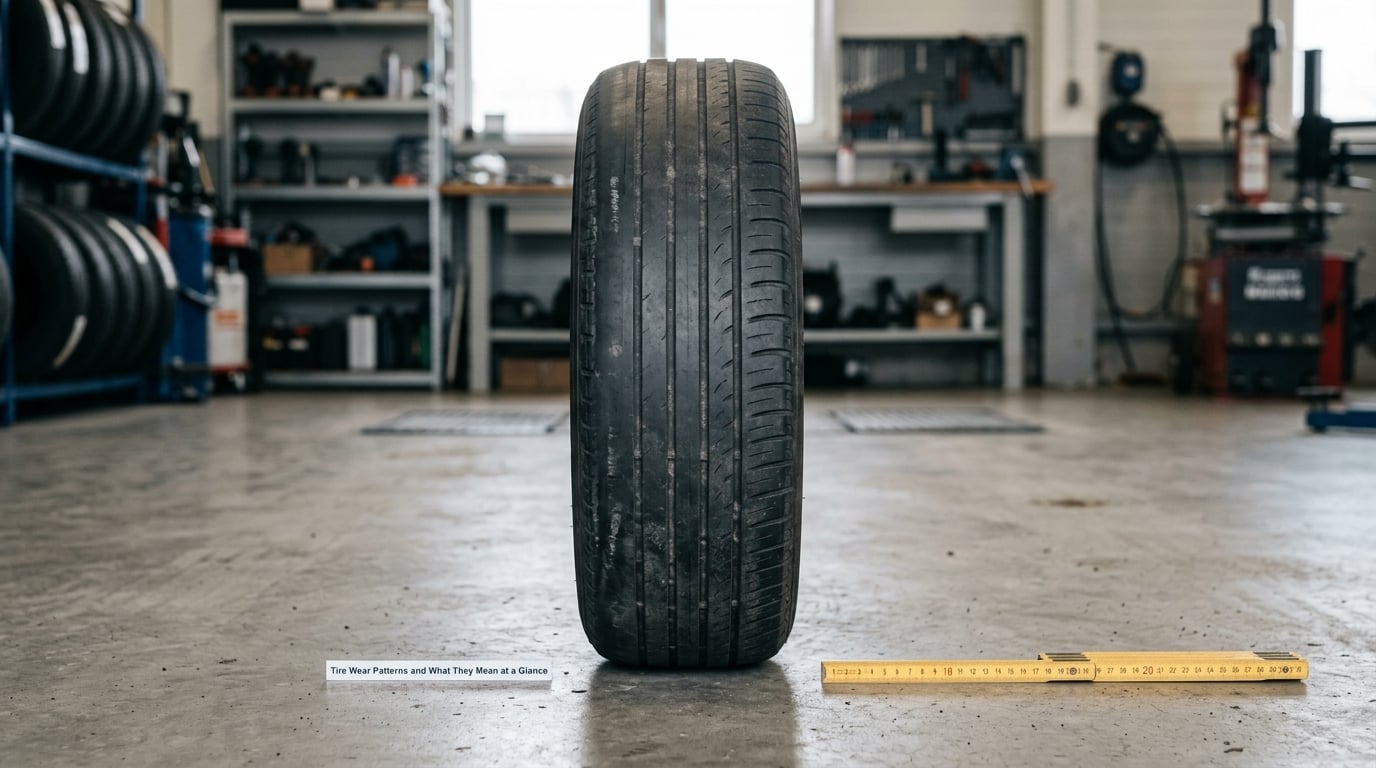
| Pattern | What it looks like | Usual cause | Urgency | What to do |
|---|---|---|---|---|
| Even wear | Center and both shoulders wear down at the same rate | Correct pressure, correct alignment, regular rotation | None | Keep rotating on schedule |
| Center wear | Middle of the tread is worn smooth, shoulders and edges still have depth | Chronic overinflation | Soon | Set cold pressure to the door-jamb spec, check monthly |
| Both shoulders worn | Both outer edges of the tread are low, center is fine | Chronic underinflation | Sooner | Inflate to spec; replace if the shoulder is already below the wear line |
| Inner shoulder wear | Inside edge of the tread is the lowest part of the tire | Camber or toe out of spec, worn steering parts | Sooner | Alignment check, replace worn components first |
| Outer shoulder wear | Outside edge of the tread is the lowest part | Negative camber from a worn strut or bushing | Sooner | Alignment check plus a suspension inspection |
| Feathering | Tread blocks taper like the feathers of an arrow, across the tire | Toe misalignment (toe-in or toe-out) | Soon | Alignment; rotation can hide it temporarily, not fix it |
| Cupping or scalloping | Repeating high and low dips around the circumference, often 3 to 5 inches apart | Out-of-round wheel, shifted wheel on the stud, worn shocks | Sooner | Measure wheel runout, then balance or replace the wheel |
| One-sided wear | Half the tread is nearly gone while the other half still has full depth | Alignment out of spec, chronic overloading, bent suspension part | Now | Alignment and suspension check before driving far |
| Flat spot | A single bald patch at one point around the circumference | Locked or hard braking, ABS not intervening, panic stop | Watch it | If it reappears after rotation, have the brakes checked |
| Patchy or spotty wear | Random bare patches and islands in the middle of the tread | Wheel balance, loose wheel hardware, suspension damage, towing | Now | Torque check, balance, and a look at the suspension |
| Fast inner edge on AWD or hybrid | Inner edge low, outer edge fine, and it comes back after every rotation | Torque split at the front axle on an all-wheel-drive or hybrid | Plan for it | Shorten the rotation interval, match all four tires |
Most of these are not emergencies. A center-wear pattern needs a pressure check this week. A one-sided wear pattern needs a shop this week, because the same geometry problem is working on the parts that steer and stop the car.
Urgency in the table means how soon to act, not how dangerous the car is to drive across town. If a tire is down to the last legal fraction of an inch, the answer is the same regardless of what caused the wear.
How to inspect your tires safely
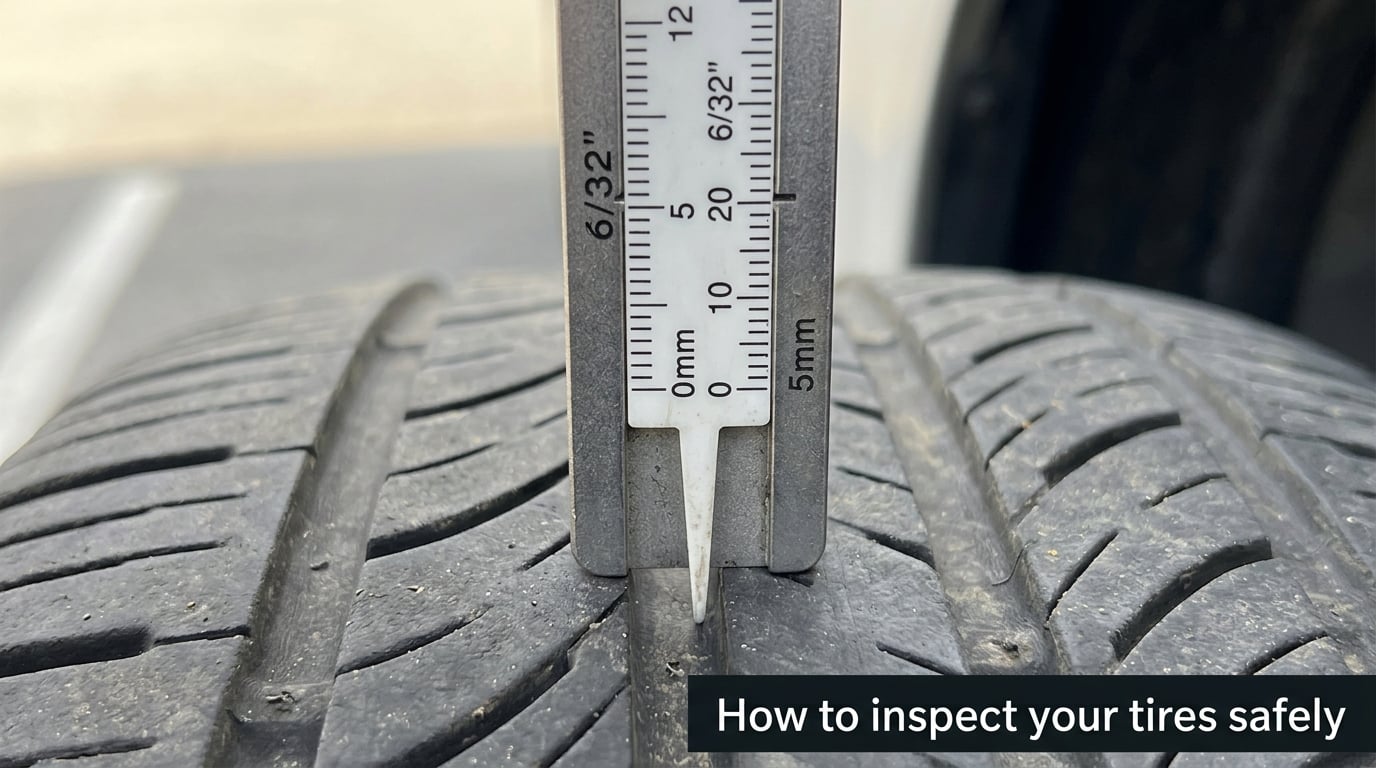
Look at your tires in daylight, on level ground, with the engine off and the car parked. A parking lot or your own driveway works; a shaky gas station forecourt with an incline can fool you on pattern symmetry, and a dark garage hides the very bumps you are looking for.
When and where to look
Start at the front, walk clockwise around the car, and look at every tire from both above and at a low angle from the side of the tread. The low angle is where edge wear shows itself, and it is the view most people skip.
Compare left to right on each axle, then compare front to rear. A tire that looks fine next to its partner is fine; a tire that is 4/32 of an inch shallower than the one beside it is already telling you something.
How to measure tread depth
Use a tread depth gauge, which is a dollar or two at any auto parts store, and measure in the three places the brief calls for: two points on the outer half of the tread and one near the center. Read the gauge at the bottom of the groove, not the shoulder.
The coin test is a fallback, not a measurement. A quarter works reasonably in a wide tread groove on a common passenger tire and badly on a narrow performance tire, and neither a penny nor a nickel tells you anything close to 2/32 inch. Winter conditions are when the inaccuracy actually costs you.
Signs that mean stop and get a professional look
Visible cord, a sidewall bulge, a bubble under the tread, exposed belt steel, or a tire where the wear is on the sidewall rather than the tread. Those are not patterns to decode. They are reasons to call a shop and ask about roadside help if the car is currently being driven.
Check the sidewall while you are down there. The DOT code is four digits: the first two are the week of manufacture and the last two the year, so 2524 means the week of June 2024. Six to ten years is the usual replacement window regardless of how much tread is left, because rubber hardens and cracks from the inside out.
What uneven edge wear means
Edge wear that is worse on the inside of the tread usually points to camber, and edge wear that is worse on the outside usually points to camber in the other direction. Neither is a pressure problem, which is exactly why this pattern sends people to the tire shop for four new tires and end up with the same pattern in 15,000 miles.
Camber is the angle the wheel sits at when viewed from the front of the car. Too much negative camber, where the top of the wheel leans toward the car, loads the inside edge. Too much positive camber loads the outside. A car that has been lowered, or one with a bent or blown strut, a collapsed control arm bushing, or a sagging spring, changes camber without anyone touching an alignment spec.
The tell for a suspension part rather than an alignment setting is the companion symptom. If the car pulls to one side, the steering wheel sits off-center even on a straight road, or the inside edge keeps coming back after a fresh alignment, something is bent or worn and an alignment alone will not hold.
What to do: have the shop measure camber and caster on a rack, and ask them to inspect the strut, bushing, and ball joint before adjusting anything. Replacing a tire on a worn tire is a waste, and aligning a car with a bent part is a waste of a different kind.
What center or shoulder wear means
Center wear means the tire was carrying more load than its shape intended, and the only thing that reliably does that is too much air. Overinflated, the sidewalls bulge out of contact with the road, the tread crowns into the pavement, and the middle strip goes first. Check the cold pressure on all four against the number on the driver’s door jamb, not the number molded into the tire’s sidewall, which is a maximum rating and not a target.
Shoulder wear on both edges means the opposite: chronic underinflation. The sidewall flexes with every revolution, the tread edges carry the load, and the shoulders scallop away from the inside out. The damage here is not always reversible. A tire that has been run low carries a permanent crease in the sidewall, and even after reinflation it will not hold pressure as well or ride as quietly as it did.
Here is the pattern that fools people: overinflation can also cause shoulder wear on some designs and load ratings, because a stiff overinflated tire contacts the road over a smaller patch and can roll its shoulders oddly. If your shoulders are low and the center is fine, and the pressure is correct, look at the tire’s load rating and speed rating next rather than assuming the gauge is right.
Pressure also falls about 1 psi for every 10 degrees Fahrenheit of temperature drop, which is why a tire that reads fine in July reads low in January. Set pressure cold, in the morning, before driving more than a mile. If a tire needs air every month, you have a slow leak, and that leak is the cause of the wear you are looking at.
What feathering or diagonal wear means
Feathering is easy to feel and easy to miss. Each tread block is worn to a ramp rather than flat, higher on one edge, lower on the other, and the ramps line up in diagonal rows around the tire. Run your hand across the tread and you can feel the steps like a washboard in one direction.
The cause is almost always toe, the angle the front of each wheel points in or out relative to the car’s centerline. Toe-in or toe-out scrubs the tread sideways, so one edge of every block wears faster than the other. Feathering often comes with a shimmy or a steering wheel that no longer centers, and it frequently shows up on a car that has never had an alignment since new.
Rotation can reduce feathering, and that is a trap. Move the tire to the rear and the diagonal ramps partly average out, so the tire looks better and the misalignment is still there, now on a different tire and a different side of the car. Treat rotation as a reason to rotate, not as a fix.
What cupping or scalloped wear means
Cupping shows up as repeating dips and high spots around the circumference, usually spaced three to five inches apart, and the spacing is the clue. A pattern that repeats at a consistent interval across the tire points at the wheel, not the tire’s internal construction.
The usual causes are a wheel that is out of round, a wheel that has shifted on the studs, a rim damaged by a pothole, or shocks and struts worn enough that they can no longer control the wheel. Wheel runout of a few thousandths of an inch, enough for nothing, is enough for the tire to slap the pavement once per revolution and scoop a dip each time.
Sometimes the culprit is the brake hardware rather than the wheel: a brake that drags on one side puts a flat spot at one point on the circumference, and the driver feels it as a steering-wheel pulse. Diagnosis here takes a dial indicator on the wheel and a brake inspection, so this is a job for a shop with the equipment.
What one-sided wear means
One-sided wear is the pattern where one half of the tread is far lower than the other, and it is the one pattern I would not drive on for a long trip. It means the tire is only using half of itself, so the remaining half is doing work it was not designed for, and the load on the wheel is concentrated on one side of the suspension.
Causes run from ordinary to expensive. An alignment well out of spec, chronic overloading, a bent control arm or tie rod from a pothole, a shock or strut that has failed on one side, or a tire mounted backwards on the rim so the pattern runs against its design all the way around. A stuck parking brake does the same thing and is the cheapest of the list to rule out.
The symptom that confirms it is a car that pulls. If the steering wheel is centered and the car drifts to one side on a straight, level road, treat it as a mechanical fault, not a tire to replace. Get it on a rack.
What irregular or spotty wear means
Irregular wear covers patchy, spotty, and random loss of tread in the middle of the tread rather than along an edge. The list of causes is short and each one is worth chasing: a wheel out of balance, loose wheel hardware, a bent suspension part, repeated hard braking or a chronic brake drag, and heavy towing on a tire not rated for the load.
Balance problems usually show as a vibration through the steering wheel that comes and goes with speed, while a local weight or a shift on the studs produces a single flat spot. Loose hardware is the one to rule out first, because it is also the one that becomes a very bad afternoon on the highway. Have the lug torque checked at every tire service, and if a wheel has recently been removed, re-torque it after 50 to 100 miles.
Spots in the center of the tread after hard braking or a skid are a braking issue, not a balance issue. If the spot moves to a different part of the tire after you rotate, that confirms it. If it comes back in the same place relative to the wheel, the wheel or the brake is at fault.
What tire wear patterns cannot tell you
A wear pattern narrows the field. It cannot confirm a diagnosis. Tread appearance shows you the symptom the tire has accumulated over thousands of miles; it cannot tell you the current number of camber degrees, whether a control arm is bent, whether a sidewall has a hidden crack behind the tread, or whether a strut is about to fail.
Two more limits worth naming. Tread depth alone says nothing about the condition of the belts and inner sidewall, and tires that have been run underinflated can look acceptable from above while being structurally compromised. And a car that has never been aligned may have an alignment well outside spec with tread blocks that still look acceptable, so a good-looking tire is not proof of anything beyond itself.
The practical rule: use the pattern to decide what to ask a shop for, and let the shop measure. Camber, caster, toe, and wheel runout are all rack measurements, and a hand-held eyeball is not a substitute for one.
What to check after noticing abnormal wear
Work through this in order. It takes about fifteen minutes and it stops you from replacing tires that did not need replacing, or driving a car that needed more than tires.
- Check cold pressure on all four. Compare to the door-jamb spec, not the sidewall. Add air to the low ones, then recheck in a month. A tire that needs air again is a leak, and the leak is the cause.
- Measure tread depth in three spots per tire. Note which tire is the shallowest and by how much. A 4/32 inch difference across an axle is enough to distort the handling and load the drivetrain on an all-wheel-drive vehicle.
- Compare the four tires to each other. Print the numbers on your phone. If one tire is dramatically shallower than the other three, you are looking for a leak, a brake drag, or a single-wheel mechanical fault rather than an alignment setting.
- Check the sidewalls and inside of the tread. Look for cuts, bulges, exposed fabric, unevenly worn ribs inside the tire, and objects still lodged in the grooves.
- Note the tire age and size. Read the DOT code on all four. Tires of different brands, models, or wear ratings on the same axle wear at different rates by design.
- Test the car on a straight, level road. If it pulls, the steering wheel will not center, or you feel a vibration that rises and falls with speed, you have mechanical symptoms that need a rack, not a gauge.
When you get to the shop, ask for a printout of the alignment numbers before and after, ask for the wheel runout to be measured on any tire with cupping, and ask them to torque-check the wheels. If the wear was one-sided, ask them to look at the strut and control arm bushings on that corner before they turn the alignment wrench. That one question is the difference between a fix and a treadmill.
When should you replace a worn tire?
The legal floor in the United States is 2/32 of an inch, and the widely recommended threshold is 4/32 of an inch. In 1.6 mm and 4.8 mm respectively, those numbers are the two people actually look for. Treat 2/32 as the point where the tire is illegal, not as permission to keep driving, and treat 4/32 as the point where you start planning the replacement.
For most drivers I would move earlier than either. Below 4/32, wet braking distances lengthen noticeably, and the gap between a worn tire and a bald tire is where blowouts live. In rain, snow, or cold, drive on the shallower of the pair to the tread you need, and rotate more often rather than waiting.
| Remaining depth | Where you stand |
|---|---|
| Above 6/32 inch | Plenty of margin. Keep rotating and keep checking pressure. |
| 6/32 to 4/32 inch | Serviceable. Plan replacement within the next few months and monitor monthly. |
| 4/32 to 2/32 inch | Replace soon. Wet-weather grip and braking are already compromised. |
| Below 2/32 inch | Out of legal service in the US. Do not drive it. |
| Any depth, 10 years or older | Replace regardless. Rubber hardens and cracks from the inside out, and a bald-looking tire is not the only failure mode at age. |
Replacing a pair versus all four is worth thinking through. If the remaining two on the axle are the same brand, model, size, and wear rating and are within about 4/32 inch of the new pair, matching pairs on an axle is workable on a front-wheel-drive or rear-wheel-drive car. On an all-wheel-drive or hybrid vehicle, a tread depth difference across the front axle sends the two tires to different axle ratios and makes the drivetrain work harder, so there I would replace all four or at least keep the depth difference under 2/32 inch.
Whatever you do, match the tire size, the load rating, and the speed rating on all four. A tire with a lower load rating than the car calls for is a hard limit, not a preference, and mixing ratings on one axle puts the weaker tire in the path of every cornering load. The same rule applies to the sidewall codes and treadwear ratings, which are relative comparisons between tires, not mileage promises.
Frequently Asked Questions
Can tire alignment fix uneven wear that has already developed?
No. Alignment stops further uneven wear, but it cannot restore tread that has already been removed unevenly. Once a tire has developed feathering, one-sided wear, or a cupping pattern, replacing that tire is the only way to get a full, even surface back. The alignment still needs to be corrected first, or the new tire will wear the same way.
Why is only one tire wearing faster than the others?
A single tire wearing much faster than its three partners points to something local rather than a global setting: a slow leak, a brake drag on that corner, a bent wheel, or a damaged suspension part on that side. Compare all four tires with a tread gauge, check that corner for heat at the wheel hub after a drive, and have the car on a rack. Replacing that one tire without finding the cause usually buys you months.
Does abnormal tire wear matter more on an all-wheel-drive vehicle?
Yes, meaningfully. On an all-wheel-drive or hybrid vehicle, the front axle in particular sees higher torque and a different load path than on a two-wheel-drive car, and the center differential reacts hard to a tread depth difference across an axle. That is why inner-edge wear keeps coming back on those vehicles. Shorten the rotation interval and keep all four tires at a similar depth to protect the drivetrain, not just the grip.
Should I rotate tires to even out uneven wear?
Rotate on schedule, yes. To fix uneven wear, no. Rotation is designed to even out the normal differences between front and rear axle loads, and it works well for that. It can make a feathering or cupping pattern look better by averaging the tread, which is exactly why it misleads. If a pattern returns in a similar form after two rotations, the cause is still there and needs an alignment or wheel measurement.
Do worn tires need to be replaced as a set or can they be replaced individually?
On a front-wheel-drive or rear-wheel-drive car, replacing two on an axle is usually fine if the other two are the same brand, model, size, load rating, and wear rating, and within about 4/32 inch of tread depth. On an all-wheel-drive or hybrid vehicle, replace all four or keep the difference under roughly 2/32 inch, because the drivetrain is sensitive to a mismatch across the axle. Never mix a lower-rated tire onto the same axle as a higher-rated one.
Conclusion
Start with the free checks: set the cold pressure to the door-jamb spec, measure tread depth in three spots on each tire, and take a photo of the wear pattern before anyone rotates anything. That photo is half the diagnosis, and it lets a shop tell you what changed since the last visit.
Then deal with the cause before the rubber. A center-wear pattern needs air, a shoulder pattern needs an alignment check, a one-sided pattern needs a rack and a suspension look, and a repeating dip needs the wheel measured. Fix the fault first, replace the tire second, and the same money buys tires that last instead of tires that wear out in a season.
Worth reading next: what PSI your tires need in winter, how to tell how old a tire is, and what tire feathering is and what causes it.