
If you are only buying two tires, put both of them on the rear axle and move the older pair to the front. That is the answer from tire manufacturers, the shops that install them, and the mechanics who write about handling. The rear tires do the least work on most cars, so giving them the freshest tread is what keeps the car from swapping ends on a wet road.
The part people argue about is why, and the answer is a single word: oversteer. It is a specific, unpleasant handling condition, and putting the good tires where it is least likely to happen is a low-effort safety habit. This guide covers the reasoning, the exceptions, and how to check the installation afterwards so the recommendation actually pays off.
Table of Contents
- Should Two New Tires Go on the Front or Back? Quick Answer
- Why Put New Tires on the Rear Axle?
- What About the Front Tires?
- Can You Put One New Tire on the Front and One on the Back?
- Do FWD, AWD, and Rear-Wheel-Drive Cars Follow the Same Rule?
- How to Check and Install the New Tires Safely
- When Might the New Tires Belong on the Front?
- Frequently Asked Questions
- Can I put two new tires on the front of my car?
- Is it unsafe to have two different tires on the front and rear?
- Should all four tires be the same for an AWD BMW?
- What if one tire is damaged but the other three look fine?
- Do the new tires need to match exactly for safe driving?
- Does putting new tires on the rear make braking distances shorter?
- The Short Version
Should Two New Tires Go on the Front or Back? Quick Answer
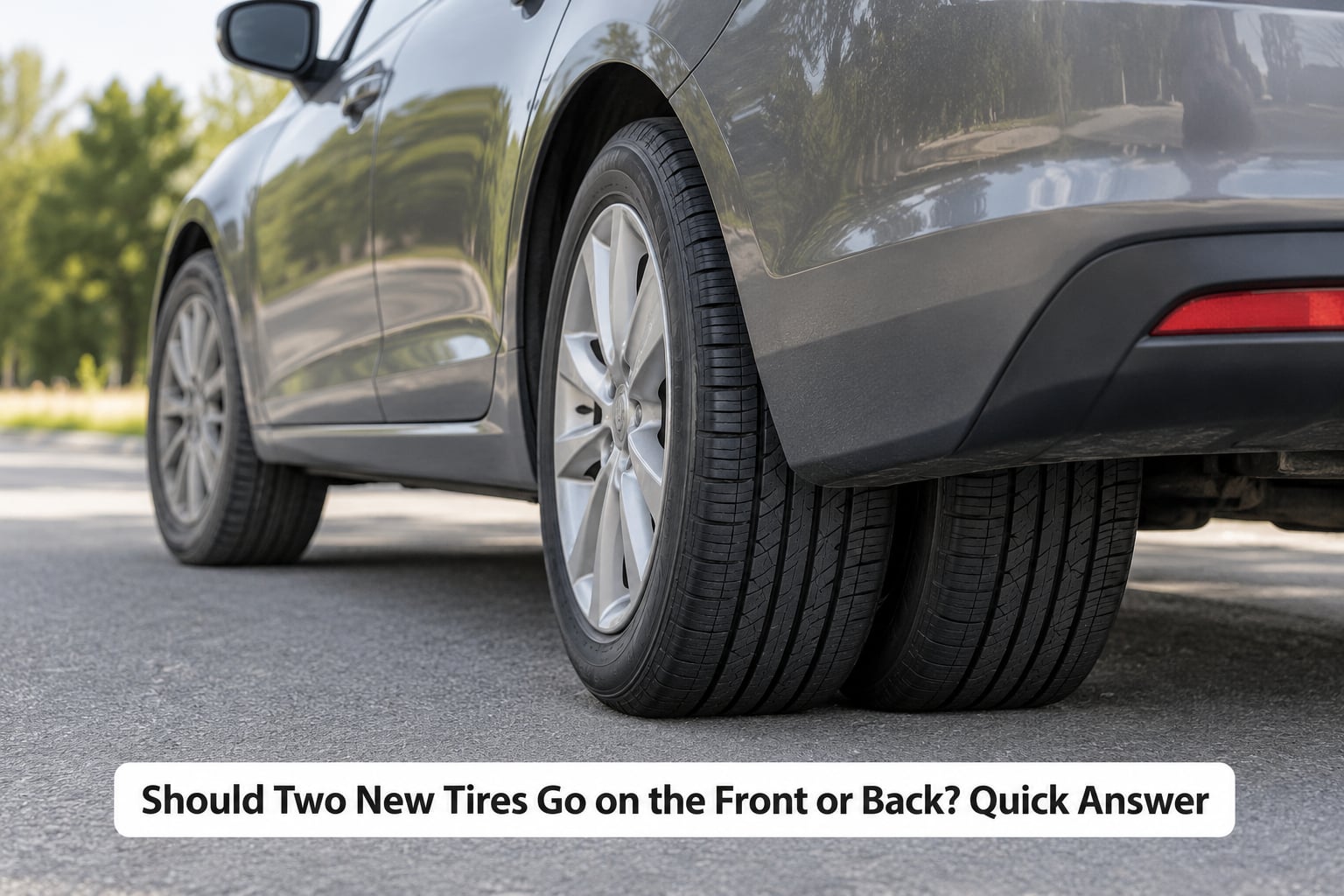
Should two new tires go on the front or back? Put both new tires on the rear axle. The older, more worn pair moves forward to the front, where the steering and braking loads already wear tread fastest.
Three reasons sit behind that answer, and each one is independent of the others:
- It keeps the car from oversteering. Grippier rear tires mean the back end stays planted if the front washes out.
- It improves water evacuation. Deeper tread blocks move more water out from under the tire before it hydroplanes.
- It makes handling predictable. Understeer is a condition most drivers already know how to correct. Oversteer is not.
That answer holds for front-wheel-drive, rear-wheel-drive, and all-wheel-drive cars, and it holds in dry or wet weather. It changes only when the tire maker, the vehicle maker, or a purpose-built setup says otherwise, which I will get to further down.
Why Put New Tires on the Rear Axle?
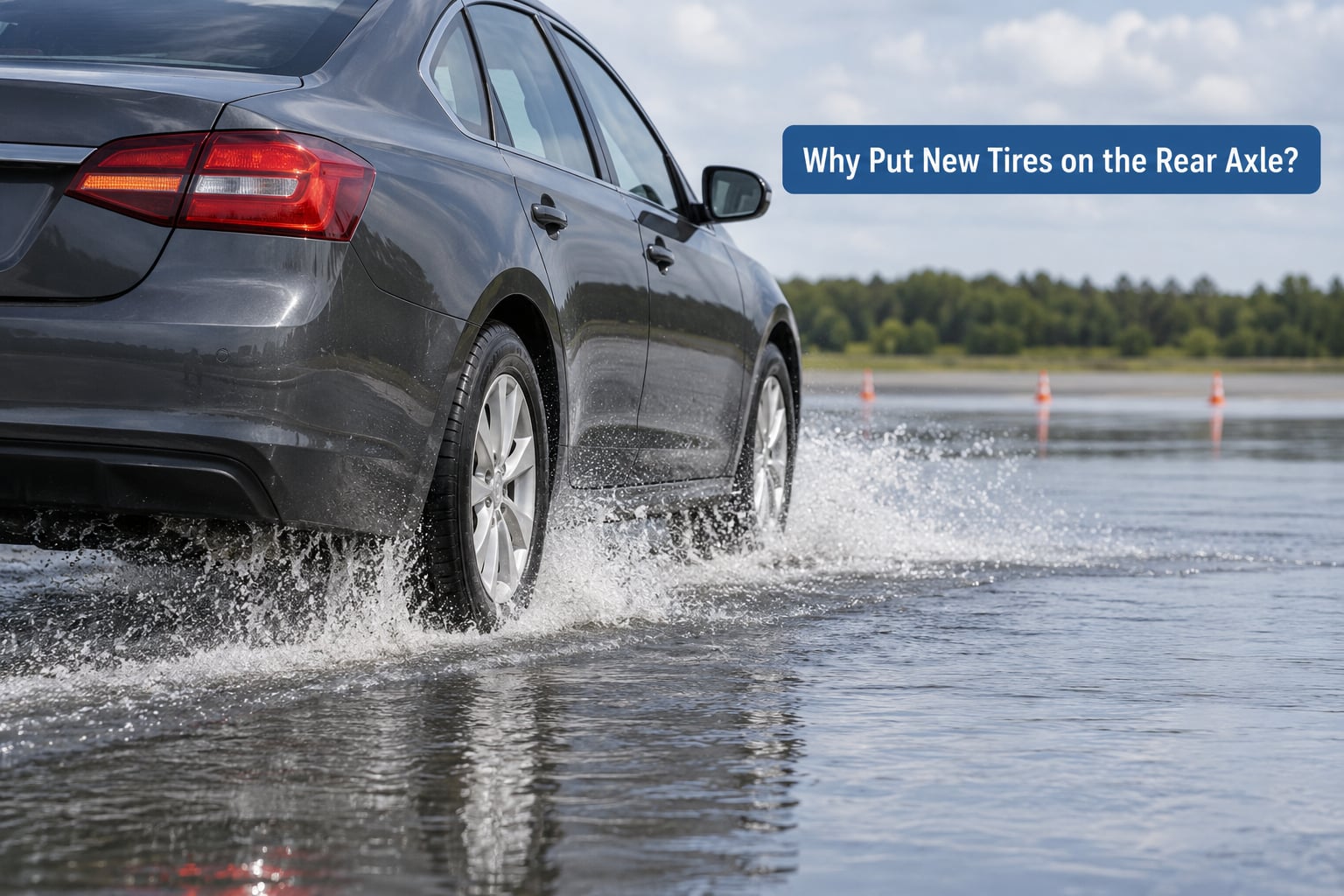
The reason comes down to how a car behaves when one axle stops gripping. Every car has a balance point, and tires are what set it.
Understeer versus oversteer, in plain terms
Understeer is when the front tires give up first. The car refuses to turn where you steered it and pushes wide toward the outside of the corner, and you fix it by easing off the throttle and unwinding the wheel a little. Every driver does this without thinking about it.
Oversteer is the opposite. The rear tires give up first, the tail swings out, and the car rotates. Correcting it means catching a slide with countersteer and throttle control, which is a technique most road drivers have never had to practise. On a wet road, that swing can become a spin in under a second.
New tires on the rear are the cheapest way to make sure the front is the axle that lets go first, because understeer is the failure mode you can handle.
Hydroplaning and uneven water evacuation
Tread depth is how a tire pushes water aside. A tire with 11/32 inch of tread can move a lot of water per minute; a tire down at 4/32 inch moves much less. Water that is not pushed aside piles in front of the contact patch, lifts the tire off the road, and you hydroplane.
Mix a fresh pair with a worn pair across the axles and the car hydroplanes in sequence rather than all at once. That is the dangerous version. The rear breaks away, the front is still gripping and pushing, and the car snaps sideways. Matching the new tires on one axle means that axle either holds or lets go as a pair.
Braking stability and weight transfer
Weight moves toward the front under braking, and toward the rear under acceleration. On a typical front-wheel-drive car the split is roughly 60/40 front to rear, so the rear tires carry less of the car’s weight in a straight line and gain more of it during hard braking.
That is why the rear axle is where a car is most likely to get light oversteer in the wet, and why the rear axle is where fresh tread earns its keep. Braking distances do not meaningfully change either way, but the stability of the car while it stops absolutely does.
Why the old thinking said the opposite
Older advice put new tires on the front because front tires wear faster and steering feel mattered more. That predates modern stability control, ABS, and the deep-water testing that tire makers now publish. Modern systems are designed around the car understeering safely, and tire makers have updated their guidance to match.
What About the Front Tires?
The older pair you moved forward still has to be safe. Rear placement protects the car from oversteer; it does not make a bald or cracked front tire acceptable. The steering axle is the one that has to hold the car pointed where you are asking it to go.
Run through this list before you drive away from the shop:
- Tread depth. At least 4/32 inch is the practical minimum for a steer tire, and most shops will not put anything under 4/32 on the front. Two 32nds of an inch is the legal floor in most states and it is not a comfort level.
- Age. Look for the DOT code on the sidewall. Four digits mean the week and year of manufacture, and rubber starts to harden well before it wears out. Anything past six to ten years old deserves suspicion even with deep tread.
- Damage. Check for cuts that reach into the belt, bulges, exposed cords, and sidewall scuffs. A tire that has been repaired with a plug in the shoulder or a sidewall is finished.
- Uneven wear. Feathering across the tread, a bald spot on one side, or a difference between left and right all point at alignment, worn shocks, or a driveline issue. New rear tires will not fix that, and the new pair will wear the same way.
- Pressure. Check cold pressures on all four, not just the new ones, against the placard on the door jamb. A tire that has been sitting on a shelf for months usually needs air before it goes on.
If the older pair fails any of those checks, the two-tire replacement stops making sense. Replace all four.
Can You Put One New Tire on the Front and One on the Back?
You can do it, but it is the worst of the available options. Splitting the pair means neither axle has a matched set, so the car loses the predictable, all-or-nothing behavior that is the whole point of the rear placement recommendation.
You end up with a front tire and a rear tire that may have different tread depths, different grip levels, and in some cases different construction, even if they came out of the same box. On a car with stability control, the system reads the two axles disagreeing and makes interventions based on data it cannot quite trust.
The only situations where one-and-one is defensible are narrow: a single puncture in an otherwise healthy set, where the replacement matches the remaining tires exactly, or a temporary fix while you source a matched pair. If you are choosing between splitting the pair and moving both new tires to the rear, choose the rear.
And if the tire maker’s markings on your existing tires differ from the new ones, ask a tire professional before fitting. Tire manufacturers state plainly that mixing tires from different lines, sizes, or load ratings on the same axle changes the way the vehicle handles, and on an AWD system it can damage the drivetrain components.
Do FWD, AWD, and Rear-Wheel-Drive Cars Follow the Same Rule?
Yes on placement, no on everything else. Drivetrain changes how fast your tires wear and how the weight sits, but it does not change which axle you want to give the best tread to.
| Drivetrain | Typical weight split | Where tread wears fastest | Placement advice |
|---|---|---|---|
| Front-wheel drive | About 60/40 front to rear | Front, from steering and braking | New pair on the rear |
| Rear-wheel drive | About 50/50 or rear-biased | Rear, from drive torque | New pair on the rear |
| All-wheel drive | Varies by model | Depends on axle torque split | New pair on the rear, but match all four closely |
Why AWD does not make grip equal everywhere
All-wheel drive sends torque to all four wheels, so it is tempting to think tire grip stops mattering on which axle they are mounted. They still matter. AWD systems can only send torque to an axle, and they can only do that within the grip that axle’s tires have. If one axle has old tires, the drivetrain is working with the worst tires on the car, and some systems will actively reduce torque to that axle to compensate.
There is a second reason to be conservative with AWD. Because drive torque is shared, the tires at each axle are expected to be similar in circumferential speed, and badly mismatched sizes or tread depths confuse the system. Many manufacturers state a maximum tread depth difference, commonly expressed in 32nds of an inch, and a good number of shops will quote four tires for an AWD car on that basis alone rather than on the condition of the tread.
BMW fitment specifics
For a BMW, follow the tire specification in your own documentation rather than a general rule, because the fitment is not always symmetric. Many models carry a staggered setup: a wider tire and a different size on the rear than the front, and in some cases the staggered size is a standard or performance option rather than an aftermarket choice. If your car is staggered, that settles the placement question before it starts.
On a non-staggered BMW, check three things on the tire you are buying: overall diameter within the range your vehicle allows, load rating and speed rating at or above what the vehicle requires, and a full set of four that match in size, type, and construction. The load rating one catches people out, especially on older models where the placard calls for a higher rating than a current tire line offers in that size.
How to Check and Install the New Tires Safely
Whether a shop does the work or you do it in the driveway, the checks are the same. Work through them in order and you will catch problems before the car leaves the lift.
Match the tires before anything else
Confirm the two new tires are the same model, same size, same load rating, and same speed rating. A mismatch within a pair is the most common cause of a tire that wears oddly or pulls to one side. The sidewall code carries most of this information if you are comparing two tires side by side.
Check the DOT date and the tread
New tires can sit in a warehouse for a year or more before you buy them. Check that the DOT date is reasonably recent, and look at the tread for any irregularity. A tire with a scuffed or glossy patch from a demonstration or a fitment check is not one you want on the road.
Check size, load rating, and speed rating
Compare the new tires against the placard on the driver’s door jamb, not against the old tires alone. Placards give the factory-recommended size and the required load rating. Never fit a tire below the required load rating, and be cautious with any tire whose overall diameter falls outside what your vehicle allows, which matters on cars with tire pressure monitoring and on staggered setups.
Torque the wheel hardware properly
Use a torque wrench, not an impact gun alone. Star pattern, and check again after 50 to 100 miles. Under-torquing lets a wheel loosen, and over-torquing stretches the studs, both of which are far more expensive than the ten minutes the job takes. If the wheels use locking lug nuts, the key belongs with the car.
Set pressure cold, then recheck
Inflate to the placard value, not the number on the tire sidewall, which is a maximum. Cold means the car has been parked for at least three hours or driven less than a mile. Recheck after the first drive, because pressures rise with heat and a fresh tire can need a top-off.
Get an alignment when wear suggests it
If the old tires showed uneven wear, the cause is still there. An alignment corrects toe, camber, and caster, and suspension parts that are worn or bent will undo a new alignment quickly. If a tire is being replaced early because of a pull or a bald spot, treat the alignment as part of the repair rather than a separate errand.
Test drive and feel the car
Take a short drive on a quiet street and then a highway loop. Listen for a hum that changes with speed, feel for vibration through the wheel, and check that the car tracks straight without the steering fighting you. Then watch your tire pressure monitoring system. If it lights up on a fresh tire with correct pressure, have the shop recheck the sensors and the system.
If you are unsure about any of this, especially with a steering or suspension symptom, have a qualified technician look at the car. Follow the owner’s manual for your specific vehicle; it is the last word on fitment and pressure.
When Might the New Tires Belong on the Front?
There are real cases where the standard advice inverts, and they are worth knowing so you can recognize them.
When the manufacturer says so
Your vehicle’s documentation takes priority over any general guidance. Some vehicles are designed and tested around a particular tire arrangement, and some performance models use a staggered fitment where the rear runs a wider tire at a larger diameter. In those cases the correct front and rear positions are fixed by engineering, not preference.
Track and competition use
On a track, the priorities change. Dry grip, steering feel, and predictable turn-in matter more than rain stability, and many performance tire lines are designed to be mounted on the steering axle. If you drive a lot of track days, follow the requirements set by the tire maker and the vehicle maker for the compound you are running, and follow the recommendations of the shop or instructor who knows your car.
That advice is for a very different environment than a wet commute, which is the environment the rear-axle recommendation was built for.
Purpose-built vehicles
Some vehicles are engineered the other way, with drivetrain layouts, weight distribution, and stability control tuning that assume the front axle has the traction. The manufacturer’s documentation is the only reliable source for whether your particular vehicle is one of them.
One more practical note on shop policy. Many retailers will mount two new tires on the rear without discussion, and some have corporate rules that say so outright. A few will honor a request to mount them on the front instead. If you ask for front placement and the shop declines, that is a policy call on their side, and the safe move is to let them do the rear.
Frequently Asked Questions
Can I put two new tires on the front of my car?
Only when your vehicle manufacturer specifies it or your car uses a staggered fitment where the front and rear sizes differ. On a standard car, two new tires on the front leave the rear with the oldest tread, and a rear that lets go first produces oversteer that is hard to correct. Track-focused setups are a separate case with their own requirements.
Is it unsafe to have two different tires on the front and rear?
It is not ideal, and it is the reason the two new tires go on the same axle. Different tread depths on different axles mean the car loses grip in sequence rather than all at once, which is what turns a small slide into a spin. Two matched tires on one axle give you predictable, consistent behavior.
Should all four tires be the same for an AWD BMW?
Closely matching all four matters more on an AWD BMW because the drivetrain shares torque across both axles and expects similar rotational behavior. Follow the staggered fitment in your vehicle documentation if you have one, and if you do not, use four tires of the same model, size, and load rating. Many shops quote four for this reason before tread condition even enters the conversation.
What if one tire is damaged but the other three look fine?
Look at the DOT dates and models across all four. If the damaged tire can be replaced with an exact match and the remaining three are healthy, a single replacement is a reasonable repair. If the other three are a different model, a different size, or older than you want, replace all four instead. A tire that took a serious impact should be discarded even if the sidewall looks fine.
Do the new tires need to match exactly for safe driving?
The two new tires on an axle should match each other in model, size, load rating, and speed rating. A tire maker will not support mixing different lines or constructions on the same axle, because the grip no longer behaves the same on each side of the car. Across axles the requirements are looser, though matching overall diameter still keeps your speedometer and tire pressure monitoring accurate.
Does putting new tires on the rear make braking distances shorter?
No. Stopping distance is about total grip and the tire compound, not about which axle the freshest tread sits on. What fresh rear tires do improve is stability while the car is slowing down, because a rear that holds onto the road keeps the car from swinging. On a car with strong front-wheel drive understeer already built in, that is the part worth buying.
The Short Version
Both new tires on the rear axle, the older pair to the front, matched within the pair. It takes no extra time, costs nothing extra, and it puts your best tread on the axle most likely to lose the car in the rain.
Before you drive away, confirm the older front tires have real tread left, the wheel hardware is torqued, the pressures are set to the door placard, and the car tracks straight. If the front tires are worn out anyway, skip the two-tire plan and replace all four while you are in there. Updated for 2026.