
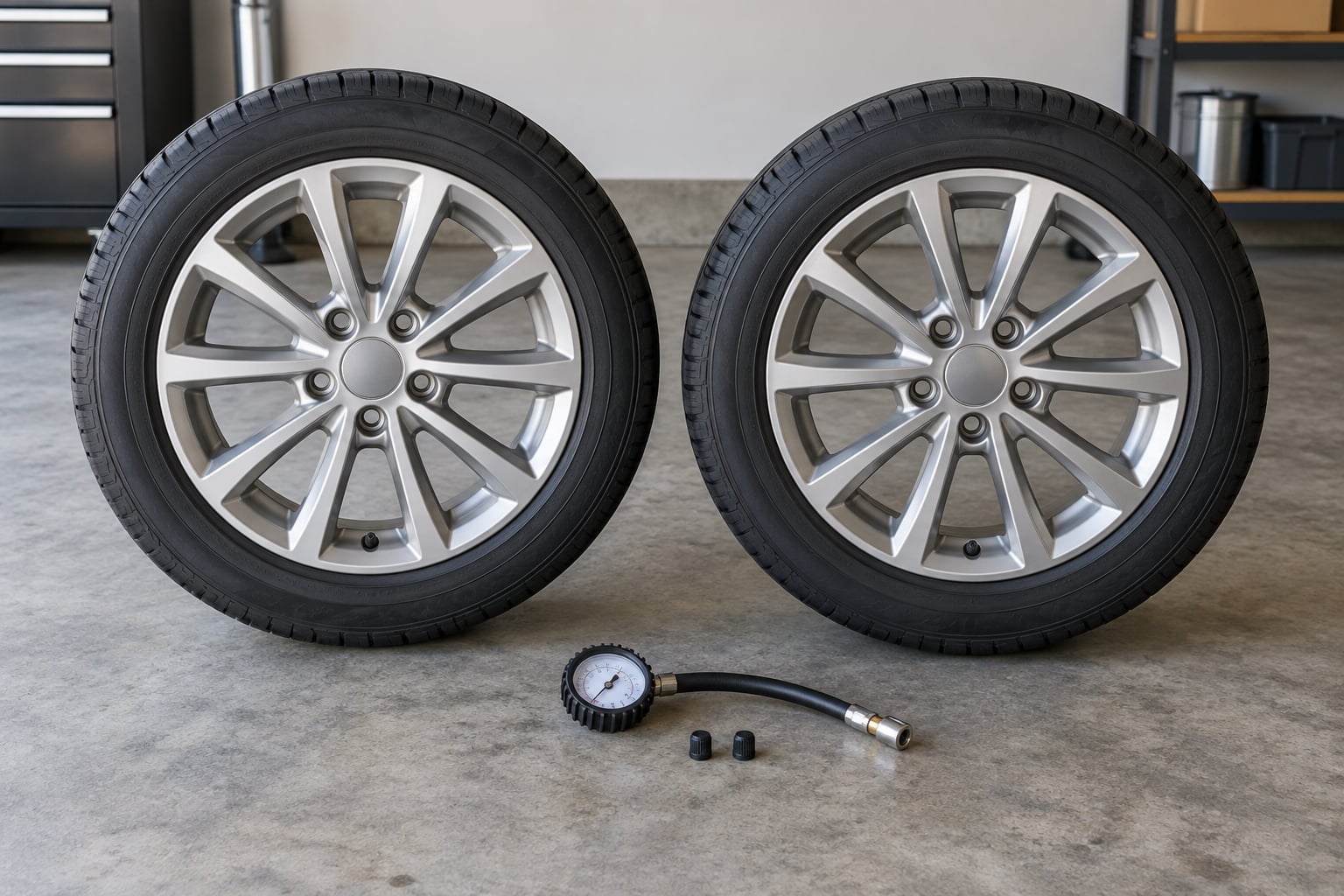
If you are deciding between nitrogen vs air in tires for a BMW, ordinary air is the right call for almost every driver. Dry nitrogen holds pressure a little longer and carries almost no moisture, but the gap is small on a street car and the fill is rarely free. The bigger lever is checking cold tire pressure monthly and inflating to the number on your door jamb.
There are a few situations where nitrogen earns its keep, mainly track days and sustained high-speed driving. This guide covers what actually changes, what is just marketing, and how to tell which gas is already in your tires.
Table of Contents
- Nitrogen vs Air in Tires at a Glance
- What Is the Difference Between Nitrogen and Air in Tires?
- How Nitrogen and Air Affect Tire Pressure
- Does Nitrogen Prevent Tire Aging and Rim Corrosion?
- Performance and Fuel Economy Differences
- Safety, TPMS, and Tire Service Considerations
- Cost, Convenience, and Availability
- Which Should You Choose?
- Frequently Asked Questions
- Bottom Line
Nitrogen vs Air in Tires at a Glance
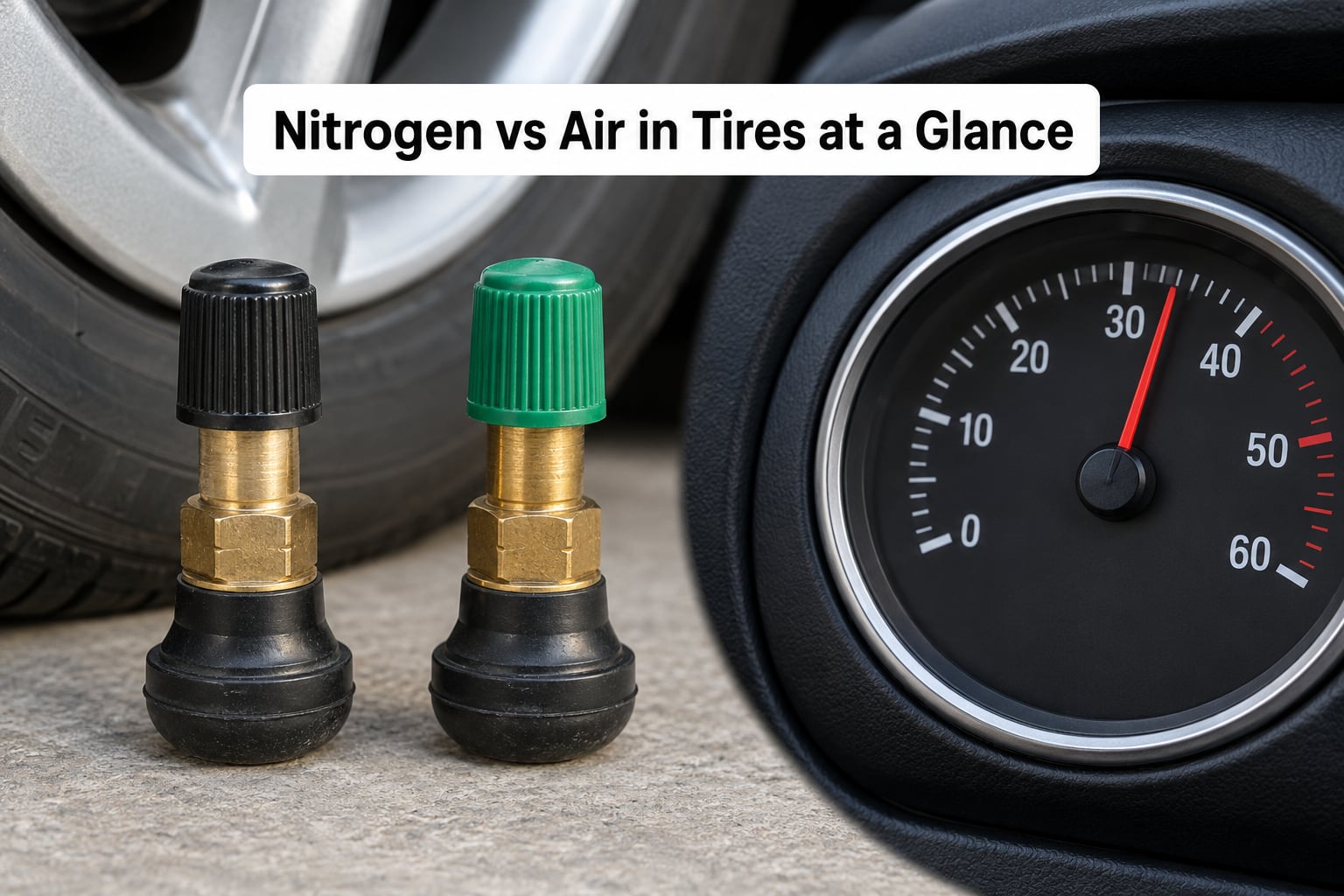
Here is the head-to-head. Air wins on access and cost, nitrogen wins on pressure retention and moisture.
| Factor | Regular Air | Nitrogen |
|---|---|---|
| Composition | About 78% nitrogen, 21% oxygen, roughly 1% water vapor and trace gases | Typically 93-95% pure, purified and dried |
| Moisture content | Contains water vapor that condenses inside the tire | Dry, with almost no water vapor |
| Pressure retention | Baseline; loses pressure steadily through permeation and small leaks | Tested at roughly one-third less pressure loss |
| Temperature behavior | Moves about 1 PSI per 10 degrees Fahrenheit, same as nitrogen | Identical pressure-temperature relationship |
| Effect on rim and sensor corrosion | Moisture can rust steel rims and TPMS sensor cores over years | Slows moisture-driven corrosion on long-lived vehicles |
| Effect on tire aging | No measurable difference in tread or sidewall aging | No measurable difference in tread or sidewall aging |
| Fuel economy | Baseline | About the same, unless pressure is allowed to drop |
| Handling response | Baseline | Essentially identical once both are at correct pressure |
| Tire appearance | Standard | Valve caps often differ, nothing else |
| Availability | Home compressor, gas station, any tire shop | Tire shops, dealer service departments, some grocery chains |
| Cost | Effectively free at home | Often included with new tires, otherwise a per-tire fee |
| Best for | Daily driving, winter, older tires, roadside top-offs | Track use, sustained high speed, extreme heat |
What Is the Difference Between Nitrogen and Air in Tires?
The difference is smaller than the sales pitch suggests, because ordinary air is already mostly nitrogen. A tire filled from a shop’s compressor holds about 78% nitrogen, 21% oxygen, and roughly 1% water vapor plus trace gases. Nitrogen fill gas is purified and dried to 93-95% purity, so the meaningful differences are the oxygen content and the moisture.
That matters because tire rubber is not a perfect barrier. Gas slowly permeates through the inner liner, and the rate depends on the gas, the pressure difference across the rubber, and temperature. Nitrogen crosses that barrier more slowly in practice, which is why nitrogen-filled tires hold pressure longer.
Why purity differences often wash out in daily driving
You will hear that nitrogen molecules are simply bigger, so they squeeze through slower. That is shorthand, not the full chemistry, and it gets challenged on automotive forums for good reason. Molecular velocity alone would argue the other way. What actually drives permeation is the partial pressure of each gas inside the tire and how the rubber’s polymer structure interacts with it, and nitrogen happens to sit at a higher partial pressure for the same total PSI.
Members of r/NoStupidQuestions make this point well: the popular explanation is a memorable story more than a mechanism. The outcome still favors nitrogen. The magnitude is just modest, which is exactly why it never shows up as a difference in how a commuter car feels.
How Nitrogen and Air Affect Tire Pressure
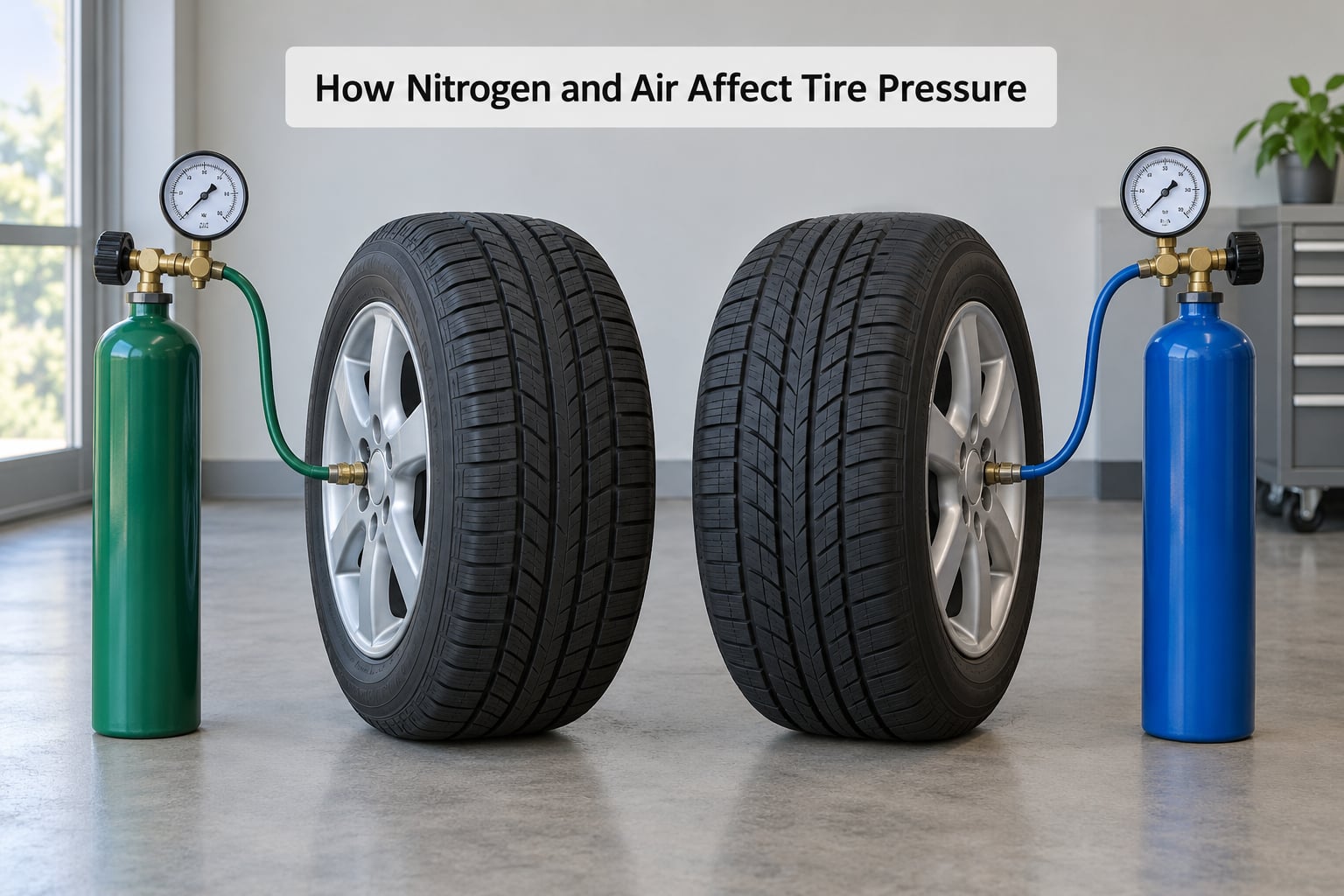
Nitrogen reduces how fast a tire loses air, and it does not change how pressure responds to temperature. Both gases obey the same rule, roughly 1 PSI of pressure change for every 10 degrees Fahrenheit of tire temperature. A tire at 35 PSI cold may read near 40 PSI after a fast highway run in summer, no matter what gas is inside.
Consumer Reports ran one of the more-cited tests: 31 tire models, inflated and tracked for a year. Nitrogen-filled tires finished about 1.3 PSI higher than their air-filled counterparts. NHTSA work reported nitrogen tires losing roughly one-third less pressure over time.
One-third sounds large until you put it in a BMW context. A 1.3 PSI difference on a 35 PSI tire is well under 4%, and it does not rescue a tire that started out underinflated. If your door jamb says 35 and you fill to 32, no gas choice fixes that. Monthly cold checks do more for you than the fill ever will.
Owners on r/Cartalk land on the same conclusion the hard way: most drivers are losing pressure because of a slow leak, a worn valve core, or simple neglect, not because of gas chemistry. Find the leak first. Then the gas barely matters.
Does Nitrogen Prevent Tire Aging and Rim Corrosion?
Partly, and only over a long horizon. Nitrogen fill carries almost no water vapor, so it does not introduce the condensation that ordinary air can leave inside the tire. That is the mechanism behind the corrosion argument, and it is real, just slow.
Moisture inside a tire contributes to oxidation of the steel belts, corrosion of the bead area, and eventual rust of the TPMS sensor core and the wheel itself. On a modern car with modern paint and coatings, a properly maintained tire replaced every five years is unlikely to show meaningful corrosion from fill gas. On a fifteen-year-old daily driver with a scratched alloy and a corroded sensor core, dry nitrogen genuinely slows the process.
What nitrogen does not do is extend tire life. Tread wear, sidewall cracking, and age-related degradation are driven by mileage, heat, UV exposure, and how long the tire sits. Several shops advertising nitrogen as a way to make tires last longer are overselling it. If you want tire life, park on concrete instead of grass, keep pressure up, and rotate on schedule. Our guide to preventing flat spots during storage covers the parking side of that.
Performance and Fuel Economy Differences
Once both fills sit at the same correct cold pressure, a tire does not care which gas is inside. Steering response, braking, ride quality, and cornering balance come from pressure, compound, tread pattern, and suspension. Nitrogen does not add grip.
Fuel economy follows the same logic. The EPA figure often quoted is roughly 0.2% per PSI of underinflation, which is a rule of thumb about how much you lose when a tire is soft, not a nitrogen bonus. If nitrogen holds 1.3 PSI more over a year and you would otherwise have topped off, you may claw back a rounding error of fuel. Nobody measures it at the pump.
Where the argument gets more honest is sustained high-speed driving. Long highway runs at high ambient temperature heat tires more than a daily loop ever does, and consistent pressure matters more in that scenario. A run-flat-equipped BMW on a long summer highway trip is a case where you want every bit of stability you can get. That still does not make nitrogen a performance upgrade. It makes it a marginal one for a marginal scenario.
If cold temperatures are your concern, the number that matters is your target pressure, not the gas. What PSI should car tires be in winter walks through how to read the door-jamb spec and why cold weather pressure drops are normal.
Safety, TPMS, and Tire Service Considerations
The tire pressure monitoring system in your BMW reports pressure regardless of what gas is inside, so nitrogen does not change how TPMS behaves or when the low-pressure warning comes on. Nitrogen tires still go flat, still lose air over months, and still need the same monthly check. If a shop sells nitrogen as protection against blowouts, that is not what it does.
Service is where the real tradeoff shows up. Topping off a nitrogen-filled tire with ordinary air is safe. It dilutes the purity, so your tire gradually becomes a mixed-gas tire, but no one has ever damaged a tire by adding air to it. Patching a puncture, rotating positions, and swapping to a spare all work the same way with either gas.
What to do after a puncture in a nitrogen-filled tire
If you take a puncture in a nitrogen-filled tire, do not sit on the shoulder worrying about the gas. Plug or patch it from the inside per the tire maker’s limits, reinflate to the door-jamb cold pressure, and run nitrogen back in later if you want the fill to stay consistent.
The only real annoyance is purity bookkeeping. Owners on r/AskEngineers get tangled up asking whether 38 PSI of nitrogen matches 36 PSI of air. It does not need to. Set the same cold PSI for both gases, which for most BMWs is the number on the door jamb placard rather than the number on the tire sidewall. Air is what nearly every tire is designed and tested around.
If your car came from a dealer with nitrogen already in the tires, you will usually find green valve caps as a hint, though plenty of shops use black ones and plenty of owners replace them. If you run tires that need to hold pressure between services, our run flat tires pros and cons guide covers the other way to buy margin.
Cost, Convenience, and Availability
Air costs nothing extra if you own a compressor, and a compressor also handles every other tire job in your garage. Nitrogen is commonly included with a new tire purchase, and some dealers, membership warehouses, and tire chains hand it out free to service customers. Standalone fills are usually a modest per-tire charge, and rates vary by region and shop, so treat any figure you hear as typical US range rather than a quote.
Convenience is the quieter argument. If you get a warning light in a town with no nitrogen pump, ordinary air at the nearest service station is worth more than any pressure-retention advantage. Several owners describe exactly this on r/Cartalk, including the customer who had nitrogen purged from tires because he had no way to top them off himself.
Dealers do upsell nitrogen, and r/skeptic has treated it as an alleged scam for years. The scam framing is wrong, because the gas does something measurable. What is fair to say is that on a street-driven car the measurable thing is small, and the upsell has a motive. Our take: take the free fill if it is genuinely free, keep a compressor for everything else, and do not pay for nitrogen you would not pay for a tire rotation.
Which Should You Choose?
Choose air for a BMW that sees ordinary roads, and choose nitrogen for a BMW that does not. The decision is really about how the car is used, not about the car.
| Use case | Recommendation | Why |
|---|---|---|
| Daily commuting | Air | Pressure retention gap is tiny; air is free and available everywhere |
| Winter and cold climates | Air | Cold pressure swings are temperature-driven, not gas-driven |
| Long highway hauling | Air, checked often | Consistent pressure matters more than gas, and stops are frequent enough |
| Track days and motorsport | Nitrogen | Hot, high-speed running rewards stable pressure; shops on track expect it |
| Extreme heat climates | Nitrogen if free | Modest benefit, no downside if the fill comes at no cost |
| Older tires on a high-mileage car | Air plus leak repair | Corrosion is a symptom of age and neglect, not fill gas |
| Show cars with long storage | Nitrogen | Drier gas slows moisture issues during long parked periods |
| Lowest maintenance cost | Air | One compressor handles top-offs, repairs, and everything else |
Simple rule: if the fill is free, take nitrogen and forget about it. If someone is charging you for it on a daily-driven car, decline and put that money into tires worth keeping.
Frequently Asked Questions
Is nitrogen in tires safer than regular air?
No, not directly. Both gases behave the same once a tire holds the correct cold pressure, and neither prevents a blowout on its own. Nitrogen is slightly drier, which can slow moisture-related corrosion of the rim and TPMS sensor core over many years. For everyday safety, correct pressure, sound tires, and monthly checks matter far more than the fill gas.
Do nitrogen-filled tires need less pressure maintenance?
They lose pressure more slowly, but you still check monthly. Consumer Reports found nitrogen tires ended about 1.3 PSI higher after a year across 31 models, and NHTSA reported roughly one-third less loss. That difference disappears into the noise on a car driven normally. Underinflation still drives uneven wear, heat, and reduced fuel economy regardless of what is inside.
Can I put nitrogen in tires that currently use air?
Yes, and many shops will do it as a purge and refill. Topping a nitrogen tire off with regular air is also fine. Mixing the two gases is not dangerous, it just dilutes the nitrogen purity, so your tire gradually becomes a mixed-gas tire. No tire has ever been damaged by having ordinary air added to it, which is why roadside top-offs with air are perfectly acceptable.
Will nitrogen improve a BMW’s fuel economy or handling?
Barely, and only indirectly. Once both fills are at the same correct cold pressure, steering response and ride quality are identical, because those come from pressure, compound, and suspension. On nitrogen vs air in tires, the fuel economy angle comes from staying properly inflated, since the EPA puts underinflation at roughly 0.2% per PSI. Nitrogen may help you stay closer to target over a year, which is a rounding error at the pump.
How do I know whether my tires contain nitrogen or air?
Check for green valve caps first, which most nitrogen shops use as a marker, though many use black caps and owners swap them out. Ask the shop that mounted your tires, since service records usually note a nitrogen fill. If nothing is documented, assume air. You cannot tell by looking at the tire, and the TPMS sensor reports the same pressure either way.
Bottom Line
Regular air is the correct fill for a BMW that lives on public roads, and nitrogen is a reasonable, free upgrade if a shop offers it. Take the free fill on a new tire set, skip the paid one on a daily driver, and use nitrogen deliberately for track days and sustained high-speed runs.
Before anything else, check your cold tire pressure against the door-jamb specification and look for a slow leak. If a tire is losing air, no gas fixes that. If the tire holds pressure and your corners look even, you have already handled the part that actually matters.