
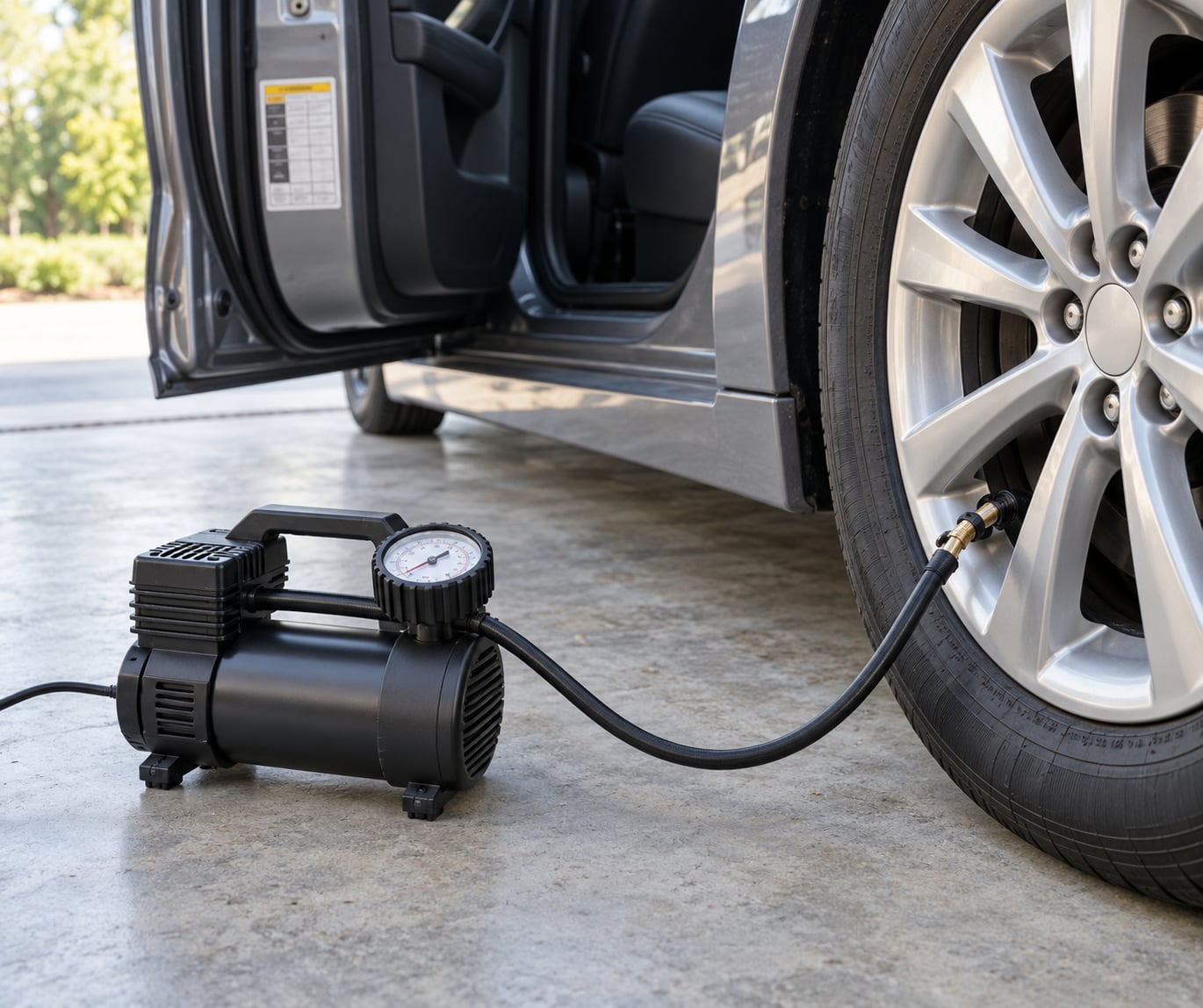
Learning how to inflate a tire with a portable compressor takes about five minutes per tire once you know the target pressure, and the whole job needs no more than a compressor, a pencil gauge and the pressure placard on your door jamb. Most mistakes come from using the wrong number or working on a hot tire, not from the equipment.
A tire that sits a few PSI under its placard reading wears faster, rolls softer, and gets worse fuel economy. Correct it before a trip rather than on the shoulder of a road, and a portable compressor in the trunk pays for itself the first time a gas station air pump is broken or the one down the road costs a coin you do not have.
Table of Contents
- What You Need
- Step-by-Step
- Common Mistakes
- Frequently Asked Questions
- Can a portable air compressor inflate a completely flat tire?
- Should I inflate tires when they are hot?
- Do I need the engine running to use a 12V tire inflator?
- Why will my portable compressor not fill my tire?
- How accurate is the gauge built into a portable tire inflator?
- When should I take a low tire to a professional instead of using my compressor?
- Conclusion
What You Need
Gather these before you crack the trunk, because half of a tire job is setup:
- A portable compressor with a hose long enough to reach the valve stem without dragging the unit across the ground.
- An independent tire pressure gauge, ideally a pencil-style gauge you keep in the glove box. The gauge built into the unit is convenient, not authoritative.
- Your door-jamb placard or the owner’s manual, for the correct cold pressure for your exact vehicle and tire size.
- A quality air chuck with a thumb lock, so the connection holds pressure while you walk to the next tire.
- Your key, to unlock the driver’s door jamb so you can read the placard.
- Optional but useful: a small bottle of soapy water for leak testing, a flashlight, and a valve cap tool if the caps are stuck in place.
The placard numbers differ from the sidewall numbers for a reason, and it helps to know which one you are reading before you start. How to read a tire sidewall breaks down the codes, and how to check tire pressure correctly covers the cold-versus-hot timing in more detail.
Step-by-Step
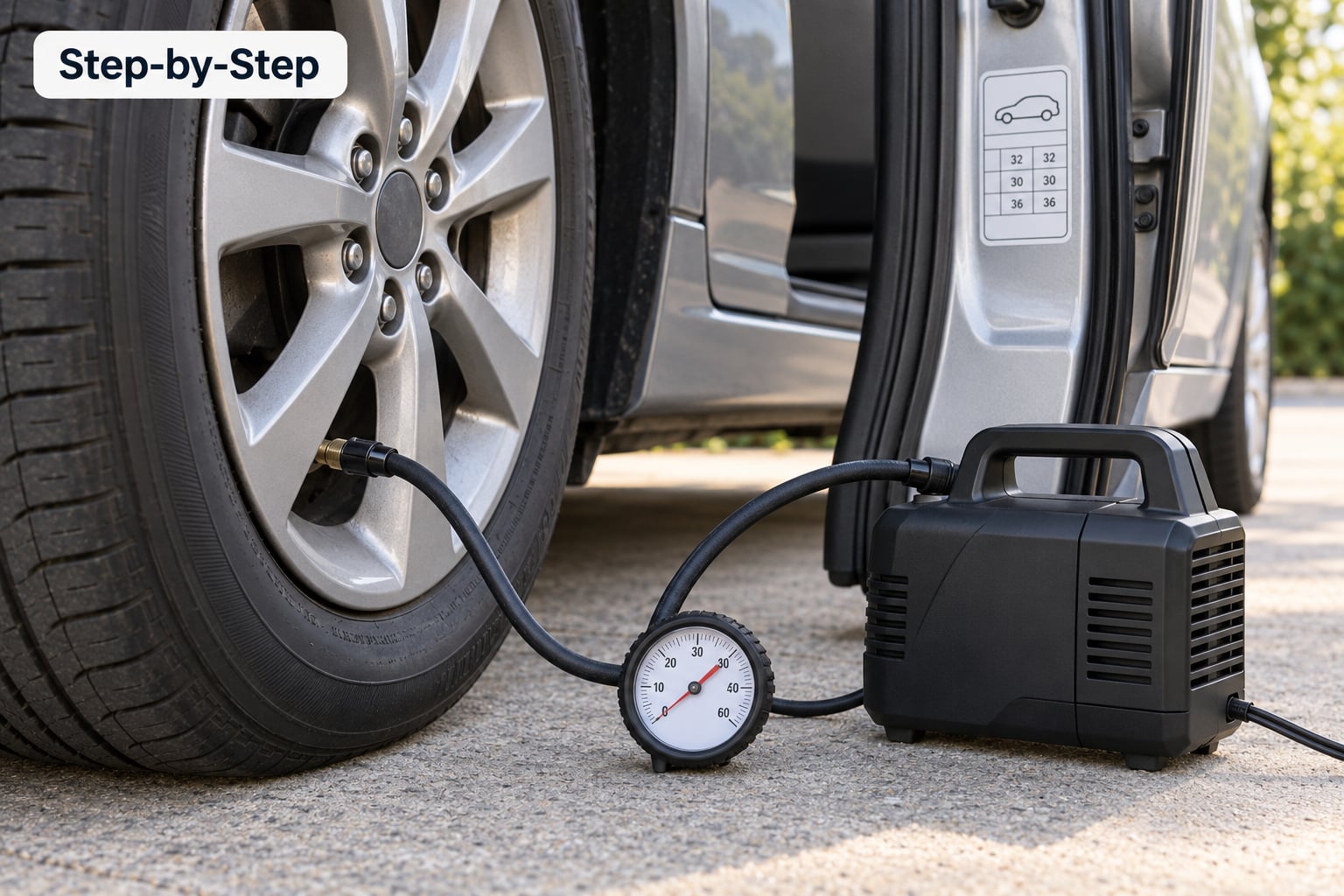
Work in this order. It is slower than wrenching air in as fast as the hose blows, and it is the reason your tire ends up at the number on the placard rather than at a number you guessed.
How to Inflate a Tire With a Portable Compressor
Park on level ground, in shade if you can, and set the parking brake. Level and out of the sun is what makes the reading mean something. Then unclip the compressor, run its power lead to the 12V accessory socket or connect its battery, and give it a quick test run before you touch the tire.
Unscrew the valve cap and put it in your pocket, because the cap is easy to lose and it keeps grit and road salt out of the valve core. Push the chuck onto the valve stem and lock it. You want to hear a soft hiss stop; if it keeps hissing, the chuck is not seated and no reading you take will be right.
Check the Tire and Set the Target Pressure
Read the pressure with your own gauge before you add any air. A tire that has lost 8 PSI and holds it will come right back up. A tire that has lost 8 PSI and keeps losing it will not, and that difference is worth knowing before you spend twenty minutes filling the wrong tire.
Set your target from the driver’s door jamb placard, which lists cold pressures for your vehicle at its rated load. Some placards show two sets: one for normal load and a higher one for a full cabin and cargo. Use the higher figure when you are carrying people or a load.
Treat the sidewall maximum as a ceiling, never a target. It exists to describe the tire’s structural limit under specific test conditions at low speed, not a number you should drive down the highway at.
Run the Compressor in Short Bursts
Small single-cylinder inflators feel slow because the tire’s back pressure fights the pump hardest above roughly 35 PSI. That is physics, not a fault, and it is why a top-off from 30 to 35 PSI takes a couple of minutes while the last 5 PSI can take twice as long.
Run in bursts of 10 to 15 seconds, then stop and let the unit breathe. Consumer units are typically rated for a duty cycle of around 10 to 15 minutes before they need a cool-down, and a fourth tire can be what pushes a small unit past that.
If your unit has a preset pressure or automatic shut-off, set it to your target and let it stop itself. If it does not, you are the shut-off, which is exactly why the bursts matter.
Stop at the Correct PSI and Disconnect Safely
Stop the pump before you judge the reading. While air is moving, back pressure in the hose inflates the displayed number, often by a pound or two, and owners regularly think they overshot when they are actually a little short. Switch off, wait fifteen seconds, then read the gauge.
Reach for the last quarter inch by hand if you have the airflow for it. Then close the valve core firmly with the valve cap tool or the chuck’s locking collar, so the core seats and any remaining hiss stops.
Pull the chuck off with a straight tug. A slow, deliberate pull releases the air cleanly. Yanking it at an angle can pop the core out of the stem and turn a top-off into a trip to the tire shop.
Recheck Tire Pressure and Inspect the Result
Repeat for all four tires, then check every one again with the independent gauge before you screw the caps back on. Owners who trust a built-in gauge routinely find it reads one to three PSI off a known-good pencil gauge, and a cheap tire gauge is a five-dollar fix for that doubt.
Look at the tire while it is inflated. A bulge in the sidewall or tread, bubbles at the bead, a cut, or a visible cord means the tire needs replacement rather than air. Fill those and you are covering a problem that gets worse every mile.
Recheck in the morning. A tire that holds overnight is sound. One that drops noticeably overnight has a leak, and a slow leak is a common reason a tire looks fine at the shop and low again in a week. How to fix a slow leak in a tire covers the DIY checks worth trying first.
Common Mistakes
These are the errors that come up again and again, and each has a simple correction.
Using the sidewall maximum as your target. It is a limit, not a recommendation. The placard is the number your vehicle was engineered and tested around.
Bleeding a hot tire down to cold spec. A tire driven for an hour reads 3 to 4 PSI above its cold pressure. Let it cool for three hours or more, or let it down only to the placard figure if you must drive immediately.
Trusting the running gauge. Hose backpressure inflates the reading. Switch the pump off, wait, then read.
Ignoring a leak. If a tire loses more than a couple of PSI in a week, you have a leak. Put a drop of soapy water on the valve core and the bead; bubbles tell you where the air is going.
Blowing the accessory socket fuse. Many 12V sockets are rated well below the 10 to 15 amps a small inflator pulls. Run the engine so the alternator carries the load, use a battery pack or cordless unit if you have one, and stop if the plug or socket gets hot.
Overrunning the duty cycle. Heat shortens the life of the motor and the seals. If the housing is too hot to hold a hand on, stop and let it cool for ten minutes before the next tire.
Expecting a fully flat spare to go up fast. From flat, a small unit can take 10 to 20 minutes a tire, and low-output units under about 30 PSI may never finish. For a truly flat tire roadside, a 12V unit is a convenience; a shop compressor is a repair.
Frequently Asked Questions
Can a portable air compressor inflate a completely flat tire?
A 12V portable compressor can bring a completely flat tire back up, but it is slow. Budget 10 to 20 minutes per tire with a typical single-cylinder unit, and expect a big slowdown above 35 PSI as back pressure builds. Units rated under about 30 PSI output may never reach placard pressure. If you can reach a shop compressor, use it and keep the portable unit for top-offs and emergencies.
Should I inflate tires when they are hot?
Add air to a hot tire only when you need to drive, and add enough to reach the placard figure. A tire that has been driven for an hour reads 3 to 4 PSI above its cold pressure, so bleeding it down to the placard number while hot leaves you under-inflated once it cools. For accurate work, park in shade and leave the vehicle sitting for at least three hours.
Do I need the engine running to use a 12V tire inflator?
Yes, for anything beyond a quick top-off. A small inflator pulls roughly 10 to 15 amps, and many accessory sockets are fused below that, which can blow a fuse or overheat the socket. Running the engine keeps the alternator supplying the current so the battery is not the one paying. Never leave the engine running in a closed garage.
Why will my portable compressor not fill my tire?
Check three things. First, the tire may be losing air as fast as the pump adds it, so feel for leaks at the valve core and bead with soapy water. Second, small single-cylinder pumps stall in airflow above roughly 35 PSI, which looks like a failure but is normal. Third, a preset may be set below your target. If the unit will not hold a connection, the chuck or valve core is worn.
How accurate is the gauge built into a portable tire inflator?
Treat it as a rough guide, not a measurement. Owners comparing built-in digital gauges against a known-good pencil gauge commonly find one to three PSI of error, and some read high because of hose back pressure while the pump runs. Keep a quality pencil gauge in the glove box and check every tire with it after switching the pump off.
When should I take a low tire to a professional instead of using my compressor?
Take it in when the tire shows a sidewall bulge, tread bubbles, visible cracks or exposed cord, when it loses more than a couple of PSI in a week despite a good soapy-water check, or when a wheel has been driven on while flat. Those are structural failures that air will not fix. A compressor is the right tool for pressure, not for damage.
Conclusion
Start with the door-jamb placard, not the sidewall, and read the tire before you touch the compressor so you know whether you are topping off or chasing a leak. Inflate in 10 to 15 second bursts, switch the pump off and confirm the number with an independent gauge, and put the caps back on. Recheck the pressures the next morning; anything that dropped while parked needs attention rather than more air.