
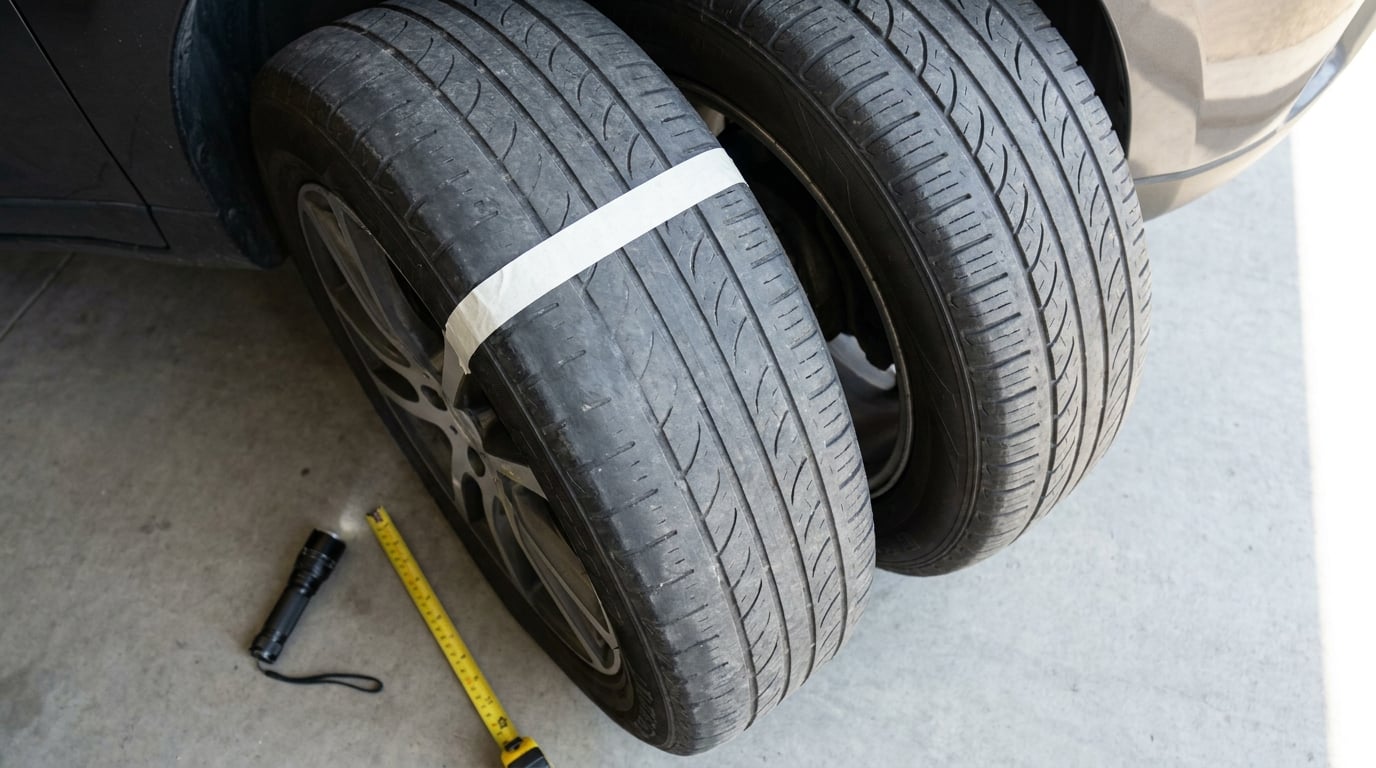
If your car pulls to one side, the steering wheel sits crooked while you are driving straight, or one tire is noticeably flatter than the others, it probably needs an alignment. The fastest way to learn how to tell if you need an alignment is a three-part check in this order: tire pressure, tire wear, then how the car tracks on flat ground. Ten minutes in a parking lot catches most cases, though it cannot replace a rack-mounted measurement.
Alignment is the geometry of your suspension, made of camber, toe and caster, held at the settings your manufacturer published. When it drifts, the tires scrub sideways instead of rolling straight, and everything downstream feels it: uneven tread, a vague steering feel, extra fuel burn, and faster wear on ball joints, bushings and tie rods.
One warning before you start. Not every car that pulls needs an alignment, and not every alignment fixes a car that pulls. Worn steering and suspension parts are the usual reason an adjustment does not stick. This guide is built around telling those two situations apart.
Table of Contents
- What You Need
- Step-by-Step: How to Tell if You Need an Alignment
- 1. Look for the vehicle pulling to one side
- 2. Check for uneven or feathered tire wear
- 3. Inspect the steering wheel for being off-center
- 4. Notice the car wandering or making vague turns
- 5. Check for a vibrating steering wheel or seat
- 6. Compare tire wear from side to side
- 7. Look for a rough, bouncing, or unsettled ride
- 8. Check the vehicle’s records and recent service history
- Common Mistakes When Checking Vehicle Alignment
- Frequently Asked Questions
- Conclusion
What You Need
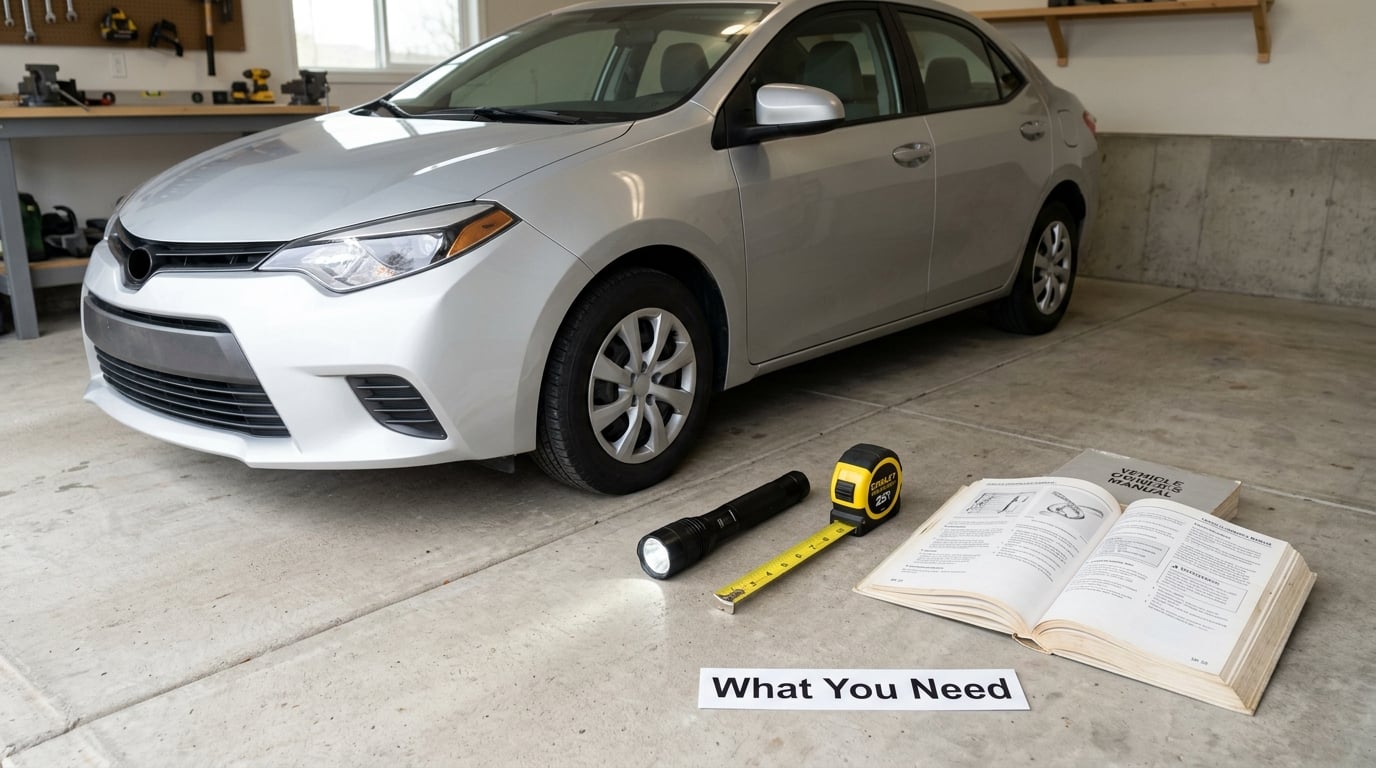
None of this is expensive, and most of it is already in the trunk or the glove box.
- The owner’s manual for the factory tire pressures, the tire rotation pattern, the ride height specification and the listed alignment interval. Do not use the maximum pressure printed on the tire sidewall as your target.
- Service records and any past alignment printouts, which usually live in the glove box or on a tire shop account.
- A phone or note app, so you can record what each tire looks like before anyone changes it.
- A flashlight for looking at tread at a low angle in a garage.
- A tape measure to compare tread depth across the same point on each tire.
- A quality tire pressure gauge, checked against the door-jamb spec with the tires cold.
- A flat, level concrete surface, such as an empty parking lot or a clean garage slab.
If you are still putting together a tool list, our guide to what tools you need for basic car maintenance covers the handful of hand tools worth owning before you crawl under anything.
Be clear about what this kit can and cannot do. Nothing here measures camber, toe or caster. The check separates “probably an alignment” from “probably a tire, a balance or a worn joint,” and that is genuinely useful because it saves you paying for the wrong work.
Step-by-Step: How to Tell if You Need an Alignment
Work through these eight in order. Each one narrows the problem, and each has a look-alike cause you can rule out in a few minutes before blaming the geometry.
1. Look for the vehicle pulling to one side
A steady pull is the clearest single sign, and the first thing most people notice. Get the tire pressures to spec cold, take a short drive on a level road, and hold the wheel loosely with one hand. If the car drifts with almost no steering input and stays consistent in speed, alignment is the likely cause.
Rule out the look-alikes first: one tire a few psi lower than the others will pull, a brake dragging on one side will pull, and a worn tie rod or ball joint will pull while also adding play or noise. If the car is lowered or has wide aftermarket tires, negative camber can pull too, and no adjustment will make it drive straight until the setup is changed. Never judge pulling by whether the steering wheel looks centered; plenty of cars hold the wheel off center on purpose.
2. Check for uneven or feathered tire wear
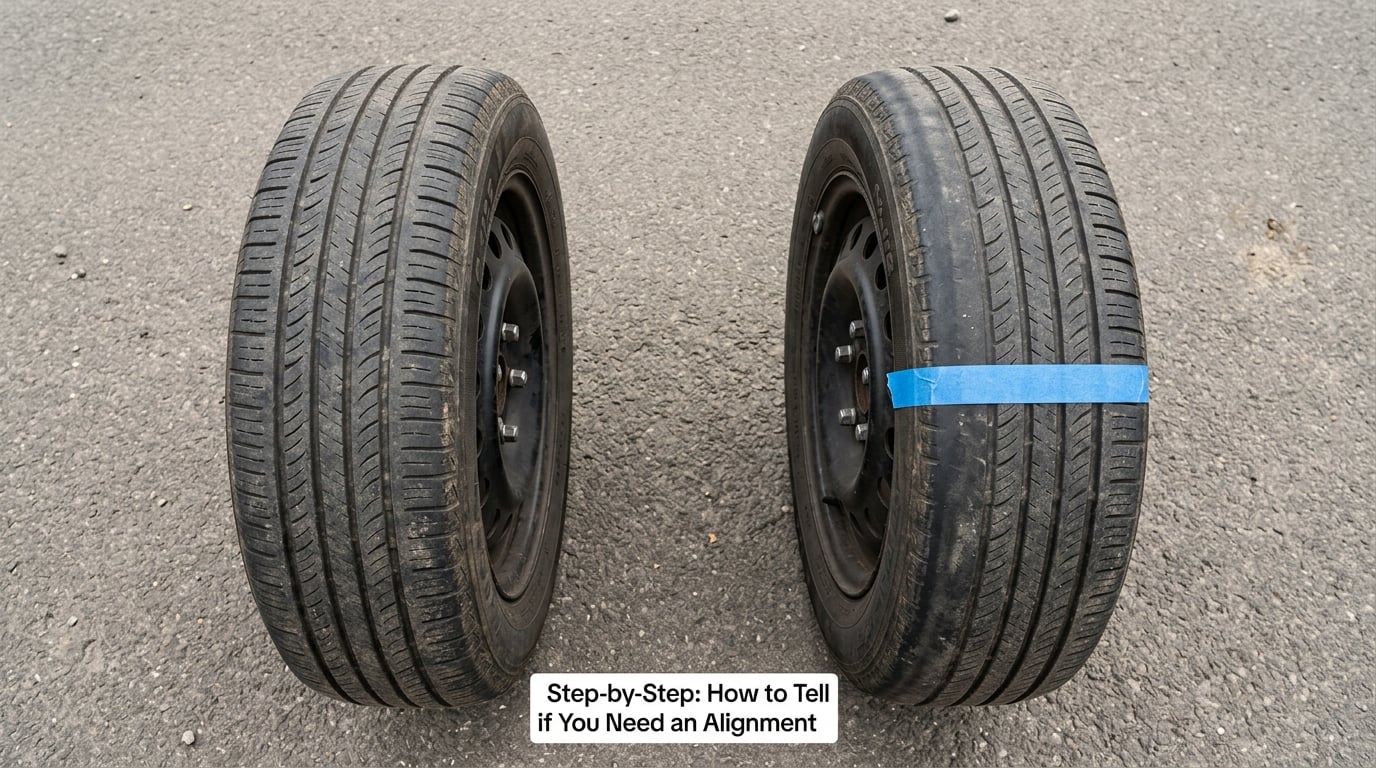
Tires tell the truth over thousands of miles. Tread worn faster on the inner or outer edge points to camber being off, so one shoulder is carrying more load than the other. A tire that is low on one side of the tread and high on the other is showing toe. Feathering, where the tread blocks point sideways like a saw blade, is the classic toe signature.
Other patterns point elsewhere: a center band worn faster than both shoulders usually means chronic overinflation, both shoulders worn means underinflation, and scalloped or wavy blocks suggest pressure problems or a warped wheel. Read all four tires, because a full set of fresh tires can go uneven inside 5,000 miles when toe is out. If the tread is fine but the tires are old anyway, check the date codes next with our guide to how to tell how old a tire is.
3. Inspect the steering wheel for being off-center
A crooked steering wheel is a clue, not a verdict. The useful comparison is between where the rim sits and where the car is actually pointing, not how the wheel looks against the spokes or against the badge. Judge it on a straight, flat road at steady speed.
A wheel that stays off center while the car tracks straight usually means toe is out on one side. A wheel that is off center and the car also wanders points toward caster, which is what makes a steering wheel fail to self-center. Some cars come from the factory with a designed off-center angle, so a car you have always owned this way is probably not a new alignment problem.
4. Notice the car wandering or making vague turns
Wandering is the feeling that the car does not want to hold a line and needs constant small corrections. Lane changes take more than one input, and the car feels like it is rolling on something slightly soft. Crosswinds make it much worse, because a misaligned car has less straight-line stability to resist them.
Before scheduling an alignment, check the tire pressures and the tread depth on each side, since a pressure difference or a badly worn tire produces exactly this complaint. Worn steering components feel vague in the same way, and mixing tire types on an all-wheel-drive vehicle can do it on its own. If the wandering started right after lowering springs or a suspension change, expect alignment to be part of the fix rather than the whole fix.
5. Check for a vibrating steering wheel or seat
Do not start with vibration. Most vibration is not an alignment problem. A wheel that is out of balance, a bent rim from a curb strike, a tire with a separated belt or a warped brake rotor all produce a hum or buzz, and a wheel bearing often shows up as a growl that changes with speed.
Misalignment can add to it. Severely incorrect camber or toe makes the tread scrub, and a worn tire on top of that can shimmy at highway speed. Note the speed where the vibration appears, whether it changes when you brake or change lanes, and whether you feel it through the seat or the pedal. Buzz in the pedal is a rotor or wheel problem, not geometry. Park the car, rock the wheel and check for play; free play means a worn joint, and no alignment will change that.
6. Compare tire wear from side to side
Park on level ground and look at all four tires from the same height, then use the tape measure across the same point on each tread. A consistent difference between the two sides of the car is more meaningful than a small amount of variation, and it usually points at a single adjustable angle.
Photograph each tire before anything gets changed, because a shop is far more likely to explain a pattern if you can show it to them. Check the rotation pattern in the manual while you are there: on many front-wheel-drive and all-wheel-drive cars the pattern is directional, and rotating against it can accelerate the uneven wear you were trying to catch. Matching tread depth across the axle matters more on those same vehicles.
7. Look for a rough, bouncing, or unsettled ride
Alignment changes geometry, not spring rates. If the car floats over small bumps, thumps over expansion joints, clunks when you turn or hits one bump and bottoms out, the cause is usually shocks or struts, springs, bump stops or bushings, and a bent wheel from a serious curb strike.
That said, a car that is badly out of spec will feel unsettled too, because the tires are working sideways. The difference is that a rough ride does not improve with a new alignment. If the car is smooth on smooth roads and only complains on broken pavement, write that down for the technician, because it narrows the search.
8. Check the vehicle’s records and recent service history
Before paying for another alignment, pull the history. Look for curb strikes, potholes, bottoming out after speed bumps, suspension or steering work, the date and size of the last tire set, any ride height change, previous alignment printouts and warning lights that have come on since. That list is often more diagnostic than the driving test, and it tells the technician what to look at first.
Mechanics on r/MechanicAdvice and mechanics.stackexchange repeat the same point about pulling: an alignment will not fix it when ball joints, tie rods or bushings are worn, and those parts have to be replaced first. Asking for that inspection up front avoids a second visit. While you are under there, sweeping under the car for weeping fluid is worth doing, and an oil catch can is the easy way to catch small leaks you would otherwise miss under a car park.
Common Mistakes When Checking Vehicle Alignment
- Diagnosing from a five-minute drive. A pull shows up on a warm car, at steady speed, on level ground. A cold car with cold tires, a sloped road or a full load of passengers will mislead you, so drive it a few miles first.
- Adjusting tire pressure after checking. A difference of a few psi between two tires causes a real pull, and it will fool you. Set the pressures to the door-jamb number cold, then repeat the test before drawing any conclusion.
- Assuming vibration means alignment. Balance, a bent rim and a warped rotor are the far more common causes. Get the wheels balanced and rule out tire damage before you pay anyone to change an angle.
- Swapping or rotating wheels without the manual. Directional tires and manufacturer rotation patterns exist for a reason, and rotating against them speeds up the uneven wear you were trying to diagnose.
- Accepting an alignment without measurements. Ask for a printed report showing before and after readings for every wheel and which adjustments were made. If a shop cannot produce that, you have no way of knowing whether anything moved.
Keep the report with the service records. Next time the car feels vague, a previous printout tells you whether the geometry has drifted since and by how much, which is worth a great deal more than a verbal assurance.
Frequently Asked Questions
Can bad alignment make a car vibrate?
Sometimes, but rarely on its own. Severely incorrect camber or toe makes the tread scrub sideways, and on an already worn tire that can turn into a shimmy at highway speed. Far more often a vibration comes from an out-of-balance wheel, a bent rim or a warped brake rotor, and it shows up in the seat or the pedal rather than the steering wheel. Buzz that appears at one set speed and changes when you brake is almost never an alignment problem.
How often should I get my wheels aligned?
Most manuals list a check interval in miles or years, commonly somewhere between 10,000 and 15,000 miles, and plenty of owners never look at it. Treat that as a guideline rather than a schedule. Get checked sooner after a curb strike, a pothole, bottoming out, suspension work or a new set of tires. Cars that are lowered, or that run wider tires, drift out of spec faster and benefit from shorter intervals.
Does replacing tires automatically include an alignment?
It is usually offered as a free courtesy check with new tires, and some shops include a full alignment with the purchase. A visual check is not a measurement, so ask whether the work was done on a rack to the manufacturer’s specifications and ask to see the numbers. If you are replacing only two tires on a car that had visible one-sided wear, an alignment matters more than usual, not less.
Is wheel alignment necessary after replacing struts or control arms?
Treat it as required rather than optional. Struts and control arms establish the wheel’s position, so replacing them moves camber and toe away from spec even if nothing else changed. Doing the alignment first means the new parts are out of spec within weeks and you are back at the shop. The right order is parts first, alignment second, and a recheck of the fasteners after a short drive.
How much does a wheel alignment usually cost?
It varies by region, shop type and how much adjustment the vehicle needs, and the numbers move around enough that any figure printed here would age badly. What stays consistent is the shape of it: a two-wheel alignment usually costs less than a four-wheel one, front-only work costs less than all four wheels, and cars with lowering springs or wide performance tires take longer on the rack. Ask for a written quote and a printed before-and-after report.
Conclusion
Start with the free checks. Set the tire pressures to the door-jamb spec cold, read the tread on all four tires with a flashlight, and photograph anything that looks uneven. Then drive the car warm on flat ground and see whether it pulls or wanders with no steering input from you.
Write down what you felt and what you saw before you call anyone. If pulling, wandering or uneven wear survives that sequence, get a rack measurement and ask for the printed before-and-after numbers, because a misaligned car will chew through a good set of tires faster than most people expect.