
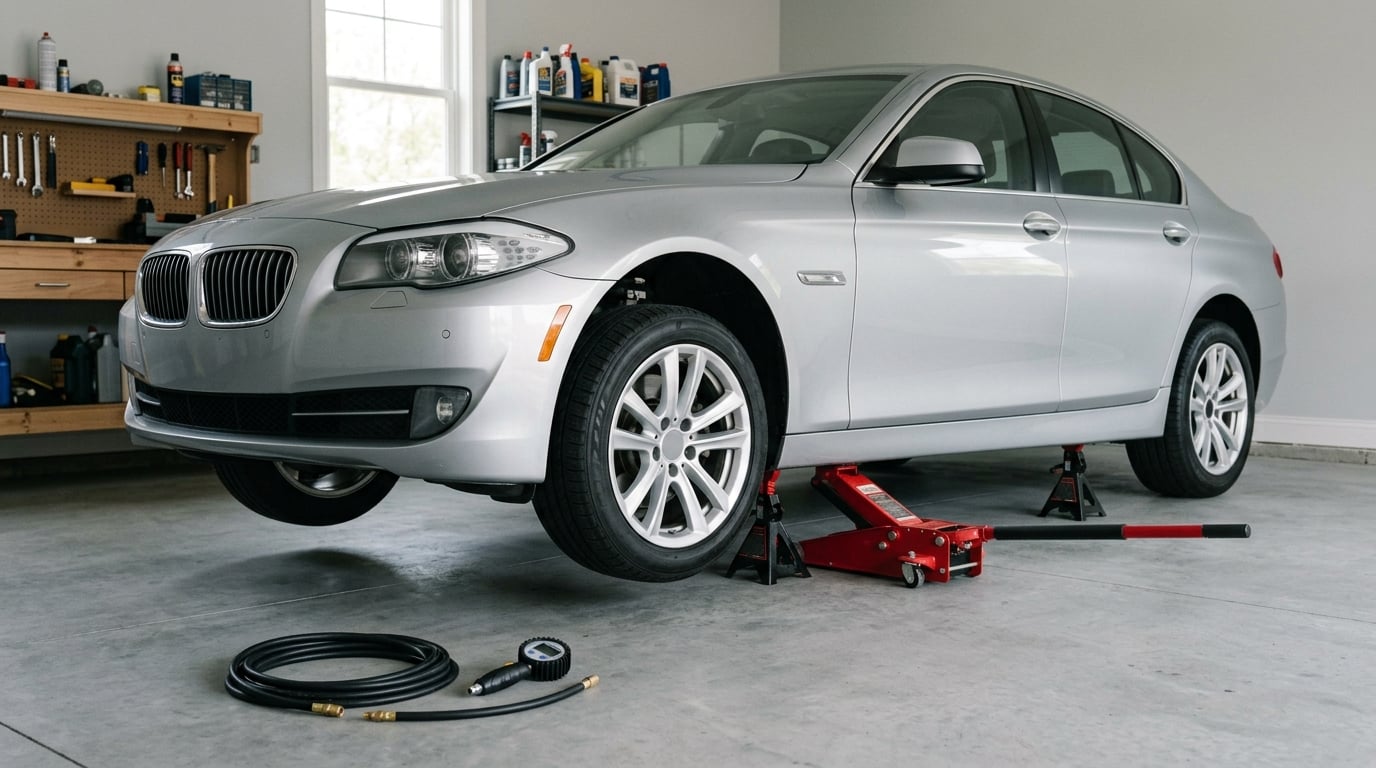
A parked BMW holds its full weight on four small contact patches for weeks at a time, and rubber held compressed under that load takes a set. That set is what people call a flat spot, and it shows up as a steering wheel vibration at highway speed rather than a visible dent. To prevent flat spots on tires during storage, set the pressure from the driver-door placard, take the extra weight off the car, park it somewhere level and cool, support it safely, and move it a few inches every couple of weeks.
Set aside about twenty minutes at the start and half a minute a month after that. The monthly part is what separates a car that comes out of storage round from one that shudders down the on-ramp.
Table of Contents
- What You Need
- Step-by-Step: How to Prevent Flat Spots on Tires During Storage
- Common Mistakes
- Frequently Asked Questions
- Can BMW tires develop flat spots from long-term storage?
- How long should I store a car without moving it?
- Should I overinflate my tires before storing a BMW?
- Does rotating the tires during storage help prevent flat spots?
- Can I store a BMW on jack stands to protect the tires?
- What should I do if a tire still has a flat spot after storage?
- Conclusion
What You Need
Most of this list is things already sitting in a garage. Nothing here is a specialty purchase, and none of it is a gimmick.
- The owner’s manual for your model, mostly for the lifting points and the tire placard location
- The tire pressure placard on the driver’s door frame, which is the number that matters, not a tire shop’s memory
- A tire pressure gauge you trust, or a compressor gauge accurate to a pound or two
- Rated axle stands and jack pads, or manufacturer-approved storage supports
- Chalk or painter’s tape for marking tire position (FL, FR, RL, RR) and bagging hardware
- A clean, level storage surface that is not bare concrete if you can help it
- Load-control gear: a luggage compartment you can actually empty, plus whatever takes your roof box or bike rack off
If a tire gets stacked, add a couple of wide boards or a piece of plywood so the stack does not lean against a wall, where the sidewalls take the load instead of the tread.
Step-by-Step: How to Prevent Flat Spots on Tires During Storage
1. Choose a Level, Cool Storage Location
A firm, level, shaded surface keeps the load even across all four contact patches and limits the temperature swings that age rubber. Check the ground first: a slab that dips toward a drain puts more weight on the two tires at the low end, and that is exactly how uneven the load becomes on paper.
Sweep off oil, standing water, grit, and anything that would make a tire roll. Then look at what is running nearby. Space heaters, a furnace, a water heater, and solvents all attack rubber, and so does ozone from electric motors, arc welders, and some lamp transformers. A quiet corner of an attached garage is usually better than the spot right next to the tools.
On the tire construction side, this is where it helps to know what you own. Modern radial tires on a BMW recover from a set almost every time. Bias-ply tires, common on older RVs, trailers, and classic cars, can hold a flat permanently. If the car is on bias-ply, assume the storage steps below matter more, not less.
2. Check and Correct Tire Pressure Before Storage
Start at the placard on the driver’s door frame, not with the number molded into the sidewall. Check the tires cold, meaning the car has been parked for a few hours or driven less than about a mile, because rolling friction heats the air and gives you a reading that is high.
For storage itself, most owners bump the pressure up to the max cold PSI printed on the sidewall, or roughly five psi over the placard figure. The extra pressure holds the bead and upper sidewall in shape while the car sits, and it offsets the slow leakage every tire loses over months. When the car goes back into service, bleed that pressure back down to the placard value before you drive away.
You will see the stored pressure on the dashboard as a low-pressure warning once the car moves, and that is expected. Inflation target: every tire matches its applicable cold-pressure number before the car is put away, and matches the placard again on the way back out.
3. Reduce the Load on the Tires
Static load is the whole mechanism. Every extra pound sitting in the cargo bay, toolbox, or roof box presses down on the same four small contact patches, which is more deformation for the same tire construction.
Empty the luggage compartment, take out the cargo liner and the tool chest, pop off the roof box or bike rack, and pull the battery maintainer out of the trunk if it is stowed there. For a nine-month winter storage, this is the single biggest free improvement you can make, and it takes one trip to the garage wall.
Do the same on the wheel set if you are storing tires separately. Hardware, straps, and a shelf full of stuff stacked on top of a tire is load the tire was never designed to carry.
4. Support the Vehicle Correctly
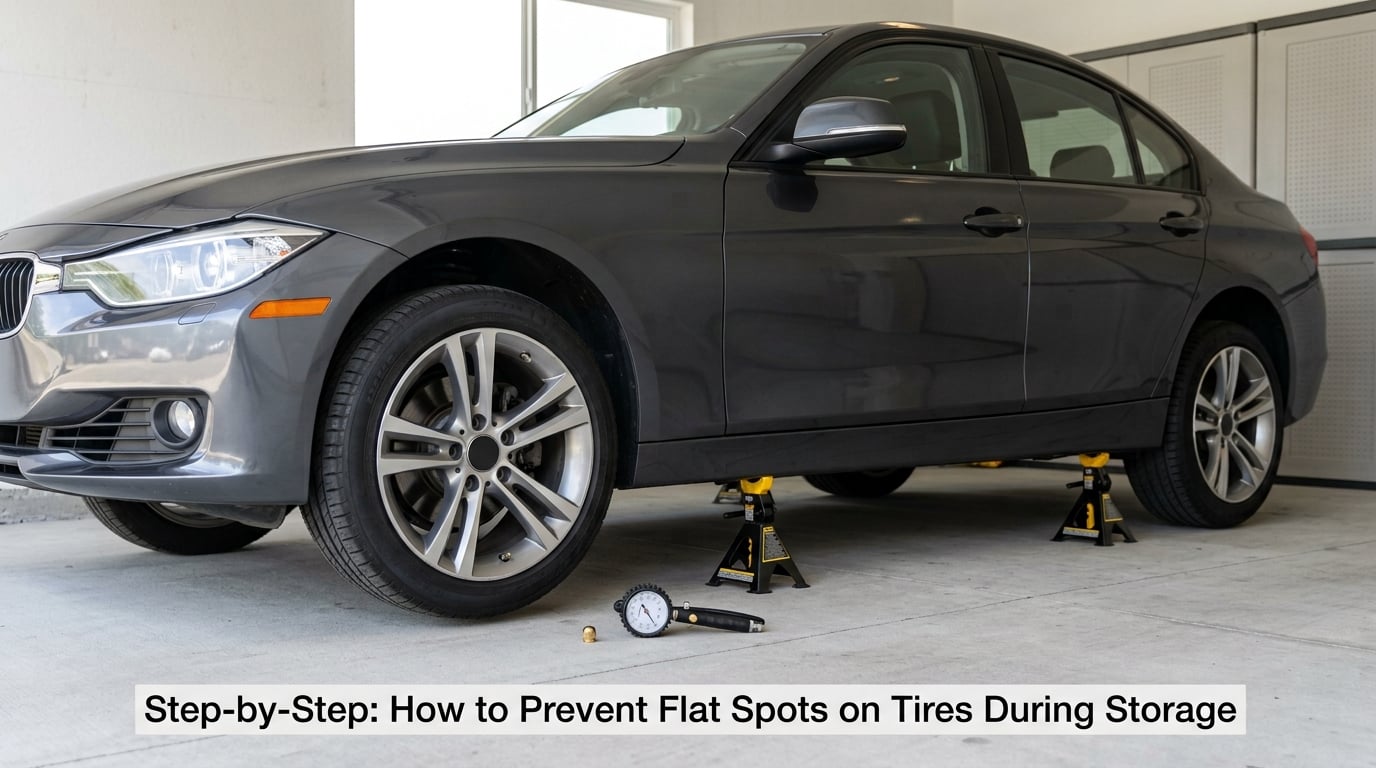
A BMW’s suspension settles slowly when it sits, and that shift changes how the tires are loaded. If you are putting the car up on supports, use the lifting points named in the owner’s manual, jack stands rated well above the car’s weight, and correctly placed jack pads. Support stands are for stability, not for holding the car by themselves.
Never leave the car on a jack alone, and never substitute stacked wood blocks, a stack of magazines, or a slab of cinder block for rated stands. On a level floor with the tires carrying the car properly, no supports are needed at all, and that arrangement keeps the tire load steady.
Once the car is up, the flat spot question is answered for those tires, and new ones take over: rubber sitting in a garage collects dust, and a tire that runs against a jack stand, a jack, or a swing arm can pick up a scuff or a cut. Cover them and check clearance before you walk away.
5. Move the Car to Prevent Flat Spots on Tires During Storage
Changing the contact patch is the most effective habit in this whole routine, and it costs nothing. Every couple of weeks, roll the car forward a few inches and back, or forward and to a different side of the garage. A short drive of ten minutes around the block does even better because the tire flexes through its whole range while warm.
Owners report the same thing in forum threads: a car driven even occasionally through the storage months rarely develops flat spots, while a car that never moves and a set of wheels leaning in the corner both pick up a set. A monthly tire-pressure check fits into the same visit, so do both on the same day.
For stacked tire-and-wheel assemblies, the same logic applies to position. Change the order of the stack now and then so the bottom tire is not carrying everything for six months.
6. Inspect Tires and Suspension After Storage
Check pressure cold, first, before anything else. Then walk each tire and look for cuts, bulges, embedded debris, cracking on the sidewall, and tread wear that is heavier on one side than another. Uneven wear after a long storage points at something mechanical, not at the tire itself.
Also look for what caused the flat spot. A tire rub from a jack stand, a jack, a fender liner, or a low-hanging exhaust component leaves a scuff or a distinct wear patch, and the answer is clearance, not a new tire. If a tire shows a deep flat spot that has not rounded out, a bulge, or exposed cord, have it inspected before you drive normally.
Expect a little vibration for the first few miles. If it fades as the tire warms and flexes, that is bounce-back and nothing more. If it stays at highway speed or shows up in the seat as well as the wheel, stop and have the wheel and tire checked.
Common Mistakes
Most of what goes wrong comes down to pressure, load, or impatience. The fixes are short.
- Leaving stored pressure on the car. If you stored at max cold PSI or five psi over the placard, bleed back down to the placard figure before the first drive. Reset the TPMS at the same time if the car warns.
- Inflating to the sidewall maximum and calling it permanent. The sidewall number is a maximum cold pressure, not a storage pressure, and it is not the number to run on the road. Use it only for the storage period, and only if it does not exceed the placard load figure.
- Leaving the car packed. Cargo, roof boxes, racks, and tool chests are static load on four contact patches. Take them out.
- Parking on a slope or bare, gritty concrete. A slope concentrates load on two tires, and grit works into the tread. Level the spot and lay down boards or a mat.
- Storing next to a heater, water heater, solvent, or electric motor. Heat, chemicals, and ozone age the compound whether or not the tire is driven.
- Bagging a damp tire. A tire bag traps whatever moisture is in the rubber, and mold follows. Let the tire dry completely, and skip the cheap plastic bags that hold condensation against the sidewall.
- Supporting the car with improvised gear. A jack alone, wood blocks, or a leaning stack of tires can fail without warning. Use rated stands at the manual’s lifting points, or leave the car on its tires.
- Assuming every flat spot is harmless. Most are temporary. A bulge, exposed cord, or a spot that does not round out after a short drive is a reason to stop using the tire.
One habit ties all of this together: keep a paper checklist on the inside of the storage door with the storage pressure, the tire positions, and the date. Two minutes of bookkeeping at the start and a monthly tick mark is what stops next year’s storage from repeating this year’s mistake.
Frequently Asked Questions
Can BMW tires develop flat spots from long-term storage?
Yes, though it depends on the tire. A parked BMW’s weight sits on four small contact patches, and rubber held compressed for months takes a set. Modern radial tires on most BMWs round back out within a few miles of driving. Bias-ply tires on older RVs, trailers, and classic cars can hold a permanent flat spot that never recovers.
How long should I store a car without moving it?
There is no safe number, so treat any long layup as a reason to keep a habit. A few weeks rarely leaves a mark. A few months can. Rolling the car forward a few inches, or driving it around the block, every couple of weeks changes the contact patch and is the cheapest flat spot prevention there is.
Should I overinflate my tires before storing a BMW?
Most owners do, and the usual choice is the max cold PSI on the sidewall, or about five psi above the door placard value. The extra pressure holds the bead and upper sidewall in shape and offsets slow leakage. You must bleed it back down to the placard pressure before driving, and expect a low-pressure warning from the TPMS.
Does rotating the tires during storage help prevent flat spots?
It helps, and it costs nothing. Change which tire sits at the bottom of a stacked set, or move the car to a different spot in the garage, so the same patch of rubber is not compressed for six straight months. Rotate on the same schedule as your monthly pressure check.
Can I store a BMW on jack stands to protect the tires?
You can, and the tires off the ground cannot flat spot, but that is where the safety work goes in. Use the lifting points in the owner’s manual, rated axle stands, and jack pads, never a jack alone and never wood blocks. The tires then need cover from dust and clearance from stands, jacks, and suspension arms.
What should I do if a tire still has a flat spot after storage?
Drive slowly first and let the tire warm and flex. If the vibration fades within a few miles, the spot was temporary and the tire is fine. If it persists at highway speed, comes with uneven tread wear, or the tire has a bulge or exposed cord, stop using it and have a shop inspect the tire and wheel.
Conclusion
Flat spots come from one thing, which is weight sitting in one place for a long time. Pick a level, cool spot away from heaters and electric motors. Set pressure from the driver-door placard, bump it to the sidewall max cold PSI for storage, and bleed it back before driving. Take the cargo, roof box, and tool chest off the car. Support it with rated stands at the manual’s lifting points if you lift it at all, and never with a jack alone or a stack of wood.
Then move it. Rolling the car a few inches or driving it around the block every couple of weeks is what actually keeps the contact patch from setting, and it is free.
If you do only one thing, read the tire pressure placard on the driver’s door frame and check all four tires cold before the car goes to sleep. It takes five minutes, it tells you the number every other step depends on, and a wrong starting pressure makes the rest of the routine pointless.