
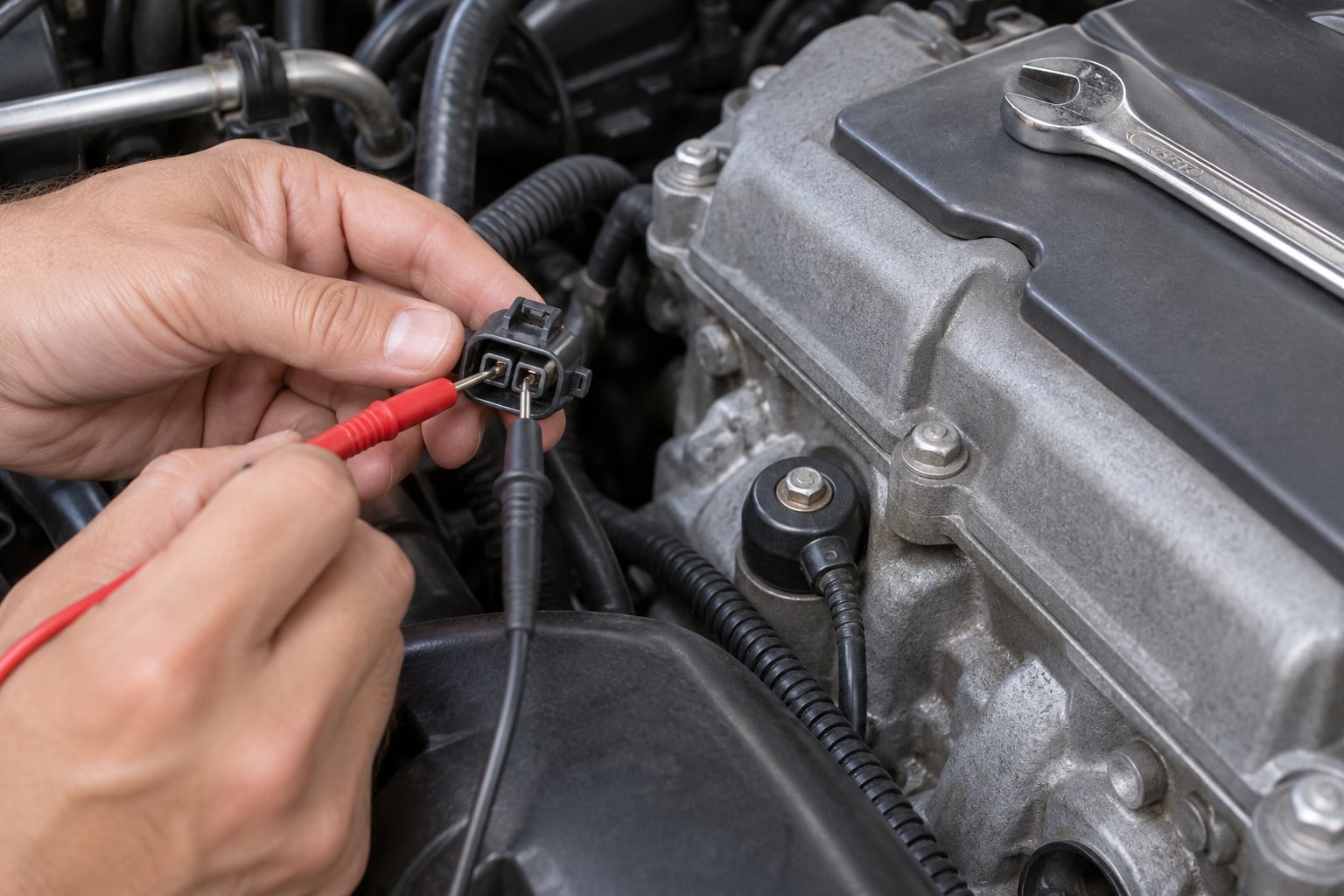
The most common signs of a bad knock sensor are a lit check-engine light, a noticeable drop in power, worse fuel economy, and a hesitation when you accelerate. The knock sensor is the engine computer’s only early warning for detonation, so when it goes quiet the computer quietly pulls timing and your car feels softer. Those symptoms overlap with plenty of other faults, which is why confirming the cause matters more than swapping parts.
On a BMW or any other performance car, the difference is sharper. A healthy engine that starts, idles, and revs clean but knocks the moment it pulls under load is the classic load-dependent knock sensor case. My rule is simple: read the code first, listen second, and never replace a sensor before the wiring has been looked at.
Table of Contents
- Symptoms of a Bad Knock Sensor at a Glance
- What Does a Knock Sensor Do?
- What Are the Symptoms of a Bad Knock Sensor?
- What Causes a Knock Sensor to Fail?
- How to Tell a Bad Knock Sensor From Engine Knock
- How to Diagnose a Bad Knock Sensor
- Do You Need to Replace a Bad Knock Sensor?
- Is It Safe to Drive With a Bad Knock Sensor?
- Frequently Asked Questions
- Conclusion
Symptoms of a Bad Knock Sensor at a Glance
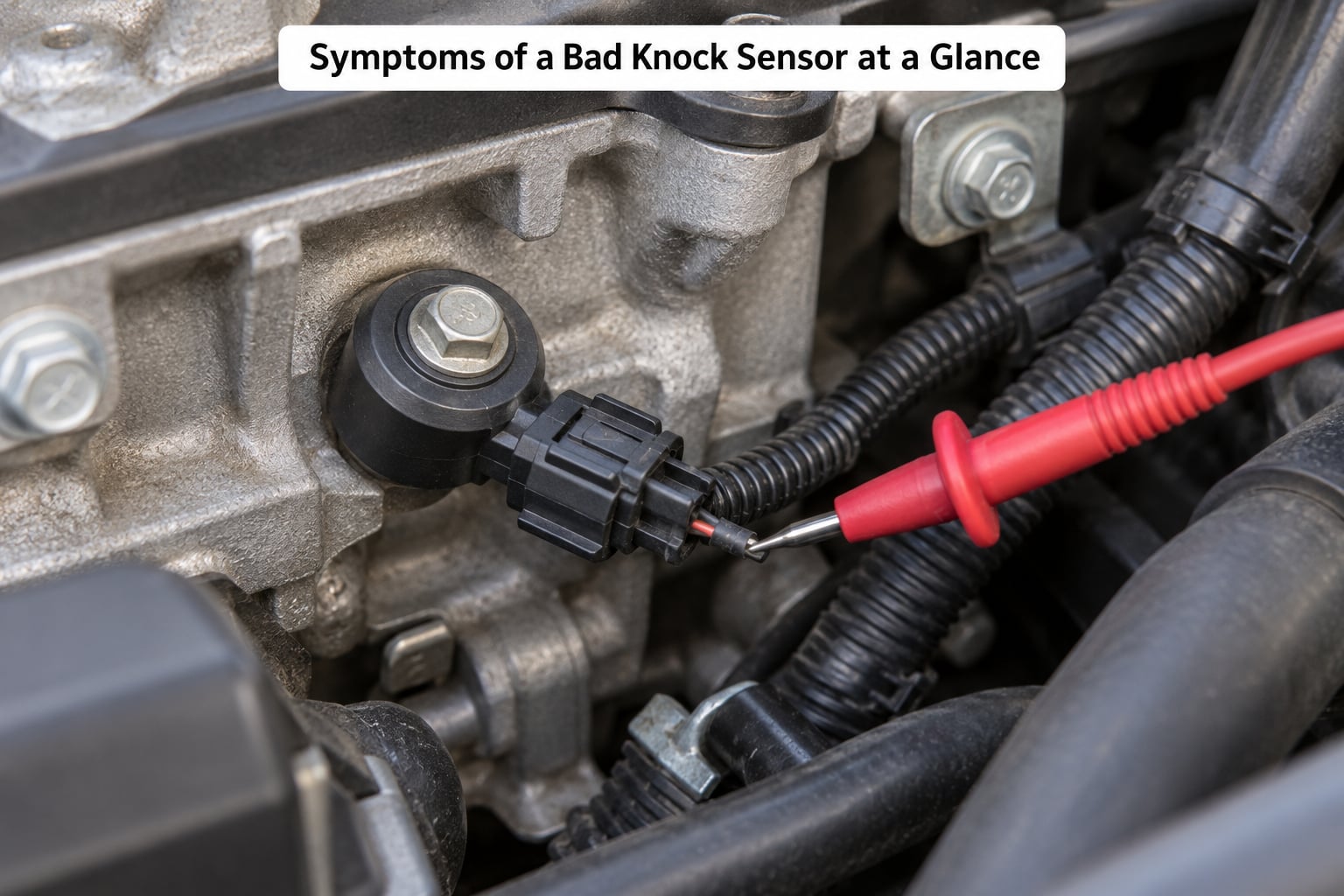
Every symptom below traces back to one chain of events. A faulty sensor stops reporting, the powertrain control module falls back to conservative default timing, and everything the driver notices follows from that.
| Symptom | What the module is doing | How to confirm it | Severity |
|---|---|---|---|
| Check-engine light on, no other warning | Knock sensor circuit fault recorded | Scan stored codes, look for P0325 through P0328 | Moderate |
| Reduced power and slow acceleration | Ignition timing being pulled to a safe default | Compare live timing data before and after a road test | Moderate |
| Hesitation or jerking under load | Repeated timing corrections during the pull | Feel it in low gear at steady rpm, not at idle | Moderate |
| Fuel economy drops noticeably | Timing retard burns more fuel for the same work | Compare trip computer average to your usual figure | Low |
| Rough idle, stumble, occasional misfire | Fuel and timing corrections going in and out | Watch ignition counters and misfire counts in live data | Moderate |
| Pinging or metallic ringing under load | Real combustion knock, or a false signal from a leak or mount | Listen at steady cruise, then check exhaust and mounts | High if real |
| Engine feels different after warming up | Heat soaks the connector or degrades the sensor | Compare cold start to hot behaviour | Varies |
Two of those rows get confused more than any other. Row six is not automatically a failed sensor, and row two is not automatically a failed sensor either. Both need a scan before they mean anything.
What Does a Knock Sensor Do?
A knock sensor is a piezoelectric device bolted to the engine block, usually on the side of the block or under the intake manifold. Vibration energy from abnormal combustion is converted into a small voltage signal and sent to the engine control module.
The module watches that signal inside a detection window of roughly 6000 to 8000 Hz, which is where combustion knock lives. When it sees the signal, it retards ignition timing for that cylinder and, on turbo engines, can also dial back boost. That is the whole job: catch the knock a few milliseconds before it becomes a hole in a piston.
Here is why this matters when the sensor fails. Detonation is the uncontrolled burning of the air and fuel mixture after the flame front should have finished, and it produces pressure spikes far beyond what the block was designed for. A working sensor is the guard rail. A dead one means the engine runs unprotected, which is a different problem from a car that merely feels sluggish.
What Are the Symptoms of a Bad Knock Sensor?
Here they are in the order most owners notice them, with an honest note on how reliable each one is on its own.
- Check-engine light with a knock-related code. The clearest signal, and the only one that appears in every case. A stored knock sensor circuit malfunction code is the starting point, not the conclusion.
- Reduced power and hesitant acceleration. The car pulls soft and can feel like it hesitates before getting going, especially from a low rpm. This is the most common complaint and the least specific one.
- Worse fuel economy. Timing retard means the engine burns extra fuel to make the same power. The drop is usually noticeable but rarely dramatic.
- Rough idle or stumble. Some engines idle unevenly or stumble at low speed as the module corrects fuel and timing in and out.
- Misfires or jerking in gear. Owners regularly bring a car in for a transmission complaint because the jerking happens under load. It is the engine, not the gearbox.
- Noise that may not be the sensor. A metallic ping under load can be real knock, a leaking exhaust gasket, or a tired motor mount transmitting a false signal.
Why the symptoms show up under load and not at idle
This is the pattern that separates a knock sensor fault from most other electrical sensor faults. At idle there is very little cylinder pressure, so there is very little to knock with. A car with a failed knock sensor will start, idle, and rev to 3000 rpm in a quiet garage without complaint.
Then it pulls out under load, climbs a hill, or merges onto a highway, and that is when the timing is being pulled and you feel the hesitation. If your car feels fine everywhere except under load, that is a real clue rather than a coincidence.
Once a fault like this is severe enough, the module can also put the engine into limp mode, which cuts power and fuel delivery to protect the engine.
What Causes a Knock Sensor to Fail?
In my experience the sensor itself is the least likely culprit. These are the causes in rough order of how often they turn out to be the answer.
- Heat-damaged wiring harness. The connector and the run of wire beside the exhaust manifold cook over time on older vehicles. This is the single most common root cause, and it gets misdiagnosed as a bad sensor constantly.
- Corrosion at the connector or ground point. Moisture gets in, the pins go green, and the signal becomes intermittent.
- Oil or coolant contamination. Fluid on the sensor face or inside the connector changes the way it responds to vibration.
- Physical impact damage. A sensor gets knocked during a repair, or the mount cracks and the sensor no longer sits flush against the block.
- Internal failure from age. The piezoelectric element itself degrades, or a hairline crack opens inside the housing. No external sign is visible.
- Incorrect installation. A new sensor fitted with a dirty gasket, wrong torque, or a gap between the sensor and the block reads almost nothing.
- Engine-side vibration or movement. Worn motor mounts, an exhaust leak, or a modified engine can create a false signal that the module reacts to just as seriously as a real knock.
Notice that four of those seven are wiring or installation problems, which is why the diagnosis order below puts the connector check before the sensor test.
How to Tell a Bad Knock Sensor From Engine Knock
This is the most important distinction on the page. A failed knock sensor is an electrical fault you can live with for a short while. Real engine knock is a mechanical event that ends engines, and it needs the engine shut down.
| Clue | Failed knock sensor | Real engine knock or valvetrain noise |
|---|---|---|
| The sound | Usually none at all, or a faint ping | Metallic ringing, clanking, or a rapid tap that rises with rpm |
| When it appears | No sound, just a soft or hesitant feel under load | Appears under load, at a steady rpm, and gets louder as you hold it |
| What changes it | Nothing you do externally; the code tells you | Adding load, high load at low rpm, or climbing a hill in gear |
| Dashboard | Check-engine light, often with a knock sensor code | May be clean until the knock gets serious |
| What to do | Scan, inspect, test, then replace if confirmed | Stop driving and investigate immediately |
There is a third category that confuses everybody, and that is valvetrain noise. A lifter tick or a rattle that changes with oil temperature has nothing to do with combustion and nothing to do with the knock sensor. On N54 and N55 BMWs in particular, a VANOS rattle at low rpm is easy to mistake for a combustion noise that isn’t there. If the sound is present at idle and at 2000 rpm with no load, read BMW VANOS rattle causes and fixes before you blame the sensor.
How to Diagnose a Bad Knock Sensor
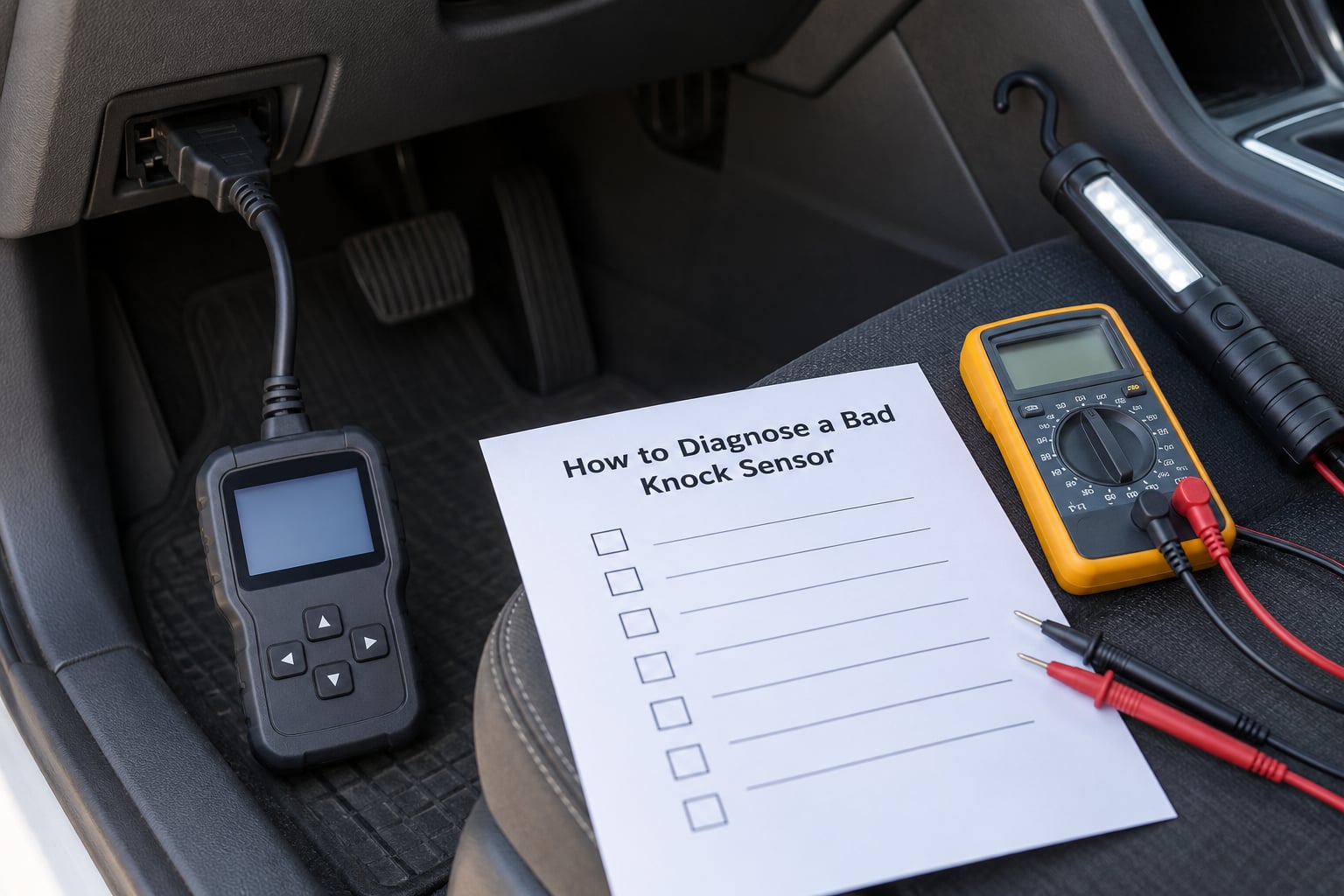
Work through these in order. Each step is cheap and rules something out, so skipping ahead wastes money.
- Scan stored and pending codes. Read the module with a scan tool before touching anything. Note whether the knock code is stored, pending, or permanent. A code that keeps coming back after clearing points at an intermittent circuit rather than a dead sensor.
- Review live data. Watch commanded versus actual ignition timing during a pull. Timing that stays pinned at the conservative value with no knock event logged is a strong signal that the sensor is not reporting.
- Inspect the connector and wiring. Unplug it and look. Green or white corrosion on the pins, a melted back of the connector, or a stiff section of wire near the manifold tells you the answer without another tool. Also check the ground point and the shield on twisted-pair circuits.
- Run the tap test with a multimeter. Disconnect the sensor, set the meter to volts DC, and connect it across the sensor signal and ground. A healthy sensor sits at roughly 2.5V baseline. Then tap a wrench on the exhaust manifold while watching the meter. The reading should spike above baseline as the sensor picks up the vibration. No spike means the sensor is dead. A reading that sits at zero volts with no baseline means the open circuit is in the wiring, not the sensor.
- Rule out the false-signal sources. Check for exhaust leaks ahead of the sensor, worn motor mounts, and aftermarket intake or exhaust parts. A leak or a soft mount can produce a signal good enough to make the module pull timing on a perfectly healthy engine.
- Check the sensors that mimic it. A failing crankshaft position sensor produces a similar loss of power and rough running. If the code and the symptoms don’t line up, test that too.
How to read P0325 through P0328 without jumping to conclusions
These four codes cover the same circuit in most manufacturers’ schemes. The number tells you which sensor or circuit, not what is broken inside it.
| Code | Plain meaning | Most likely cause |
|---|---|---|
| P0325 | Knock sensor 1 circuit malfunction, bank 1 | Failed sensor, damaged harness, or bad connector |
| P0326 | Knock sensor 1 signal range performance, bank 1 | Weak or intermittent signal, often heat damage |
| P0327 | Knock sensor 1 excessive low frequency, bank 1 | Exhaust leak, worn mount, or wrong sensor fitted |
| P0328 | Knock sensor 1 signal performance, bank 1 | Air gap behind the sensor or internal failure |
Two cautions on the codes. First, a knock code often arrives as a companion to a code about a catalytic converter or an oxygen sensor, and the knock sensor is a red herring in that case. Second, clearing a code proves nothing. If it comes straight back, you have a circuit problem that a parts swap will not fix.
One more thing worth knowing: a burned-out check-engine light bulb does not stop a scanner from reading codes. Plenty of owners assume a dark dash means a clean engine when the bulb has simply died.
Do You Need to Replace a Bad Knock Sensor?
Replace the sensor when the tap test shows no response to vibration, the wiring and connector are clean and intact, and the code returns. That combination is a confirmed fault and the sensor is a few dollars of part plus however long access takes.
Do not replace it when the wiring is heat-damaged or corroded. You will fit a perfect sensor to a broken circuit and get the same code back, having spent the money and the afternoon. Fix the harness first, then test.
On access difficulty: a knock sensor on the side of the block is often reachable with the engine in the car, though the manifold and heat shielding can make it fiddly on transverse layouts. One buried under the intake manifold is a different job entirely, and on many BMW engines the intake has to come off. If you have never done that on the car, the labour time is the whole cost of this repair, and a technician with the vehicle-specific service information is the sensible call. Check the manual for the year and engine before buying anything.
Is It Safe to Drive With a Bad Knock Sensor?
It is drivable in most cases, and it is not urgent in the way a failing catalytic converter or a coolant leak is. With no signal, the module runs conservative timing and you lose some power and economy. What you lose is protection: if genuine knock does develop, nothing slows it down.
Stop driving and get it looked at if the engine makes a metallic knocking or ringing sound, if the power drop is severe enough to feel unsafe, if it runs rough enough to misfire, or if warning lights come on beyond the check-engine light.
Unplugging the sensor is a useful diagnostic move rather than a permanent fix. The module will set a knock sensor circuit code and revert to default timing, which on some cars means noticeably more power because the retard is gone, and on others means no change at all. Either way, you have thrown away the engine’s detonation protection, so treat it as a trip to the shop and not a solution.
Frequently Asked Questions
Can a knock sensor fail intermittently?
Yes, and it is one of the more confusing faults to live with. Heat-damaged wiring and corroded connectors often fail only once the engine is warm and the metal expands, so the code sets on a drive and clears on a restart. A code that reappears within a few days of clearing, or a symptom that only shows up on a long highway pull, points to a circuit problem rather than a dead sensor. Inspect the connector and the harness run near the exhaust before buying anything.
Will changing the knock sensor fix a check-engine light?
Sometimes, and only when the sensor is genuinely the fault. If the wiring, connector, or ground is damaged, a new sensor plugs into the same broken circuit and the light comes straight back. Run the tap test first: no response to a tap on the manifold with roughly 2.5V at baseline present means the sensor is dead, while zero volts points at the wiring instead. A code that also brings a catalytic converter or oxygen sensor code with it usually is not a knock sensor problem at all.
How many knock sensors does a BMW have?
Most BMWs use more than one. Straight-six engines in older cars typically have three, one per pair of cylinders, and many of these are not independently replaceable, so a full set is often the sensible order. Later four-cylinder engines with two sensors per block are common too, and turbocharged models may run separate sensors front and rear. Check the year and engine code, because the count, the position, and how much has to come off to reach them all vary widely between generations.
Can bad knock sensors damage the engine?
A failed knock sensor does not damage the engine by itself, but it removes the protection that stops real detonation. If the engine starts knocking for another reason, a bad fuel, worn plugs, carbon deposits, or a low octane rating, there is nothing left to pull timing and protect the block. That is the scenario where a sensor fault turns into an expensive rebuild. Treat a knock code as a priority for diagnosis rather than a reason to panic.
What does a knock sensor trouble code usually mean?
P0325, P0326, P0327, and P0328 all point at the knock sensor circuit on the first bank. The number distinguishes a generic circuit malfunction from a signal that is out of range or performing poorly, but none of them tells you which part has failed. The most common culprits are a heat-damaged harness near the exhaust, a corroded connector, a loose ground, and only then the sensor itself. A knock code that arrives alongside a catalytic converter code is usually a red herring.
Should I replace a knock sensor as part of routine maintenance?
No. A knock sensor is not a service item with a replacement interval. It has no routine replacement schedule, and swapping a working sensor on a healthy engine changes nothing. Replace one when a code is confirmed, the wiring checks out, and the tap test shows the sensor is not responding. On high-mileage cars with a history of heat-related codes in that area, checking the connector during other engine work is sensible, but it is inspection, not replacement.
Conclusion
Symptoms of a bad knock sensor show up as lost power, hesitation under load, worse fuel economy, a rough idle, and a check-engine light, and the reason for all of them is the same: the module is running conservative timing because nothing is telling it the combustion is clean.
Your first four moves, in order:
- Scan for stored and pending codes before you touch a spanner.
- Rule out real engine knock by listening for a metallic sound that changes with load, and rule out valvetrain noise that changes with temperature.
- Unplug the sensor and inspect the connector, the pins, and the harness run near the exhaust.
- Run the tap test. Roughly 2.5V at baseline with a spike when you tap the manifold means the sensor works and the fault is upstream. No spike means replace it. Zero volts means fix the wiring first.
If you are chasing a code that comes and goes, remember that on most of these cars the thing that actually needed replacing was the wiring, not the sensor. That is the piece people skip, and it is why the same code keeps coming back.