
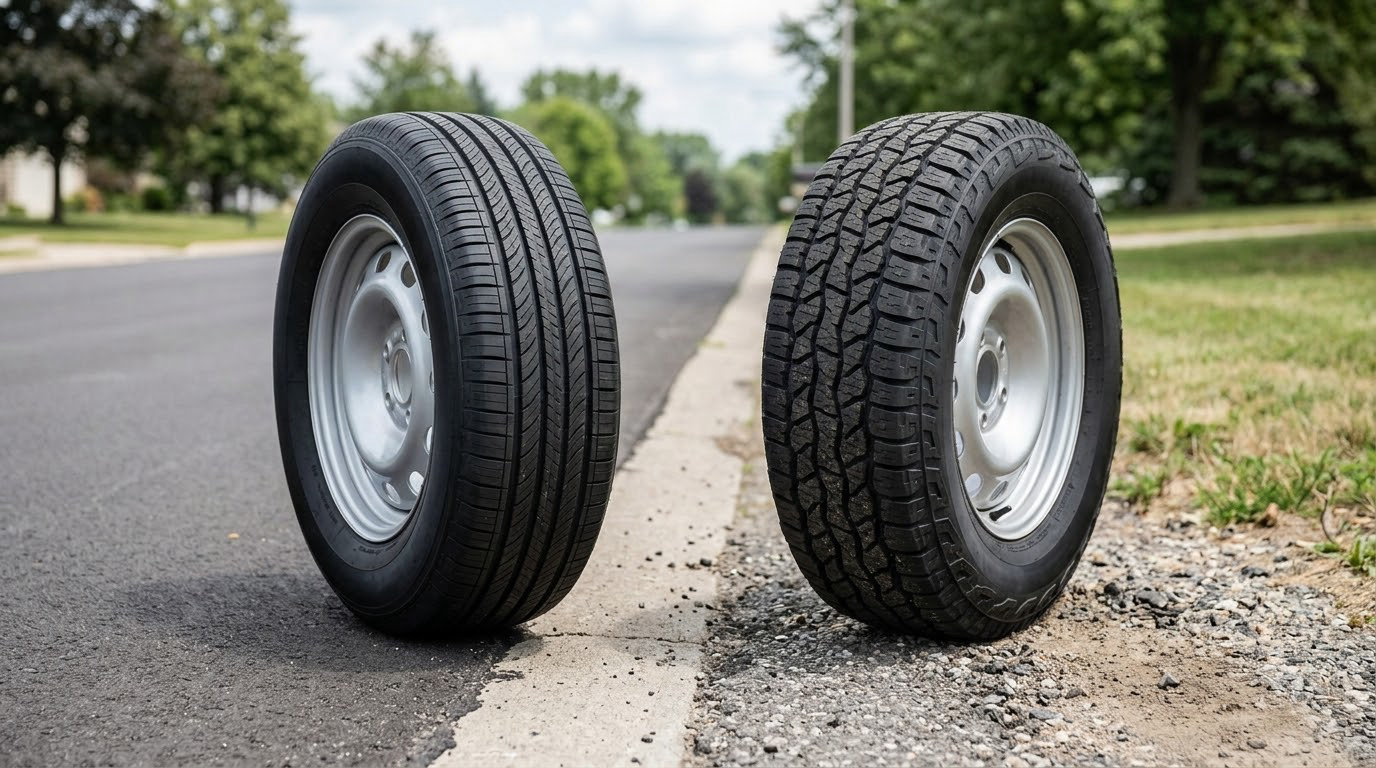
If you drive 90 percent or more on pavement, highway terrain tires are the better pick for daily driving: they are quieter, they roll further on a tank of fuel, and their tread lasts longer. If a regular slice of your year is spent on gravel, snow, or dirt, all-terrain tires buy you traction and tougher sidewalls that a highway tire simply does not have.
That is the whole argument, honestly. Everything past this point is the detail behind it: where the noise comes from, how much fuel you give up, how quickly the tread disappears, and what happens when snow shows up in February.
Table of Contents
- All Terrain vs Highway Tires for Daily Driving at a Glance
- Which Tires Are Better for Everyday Commuting?
- How Do Tread Patterns Affect Road Noise and Comfort?
- Do All-Terrain Tires Provide Better Wet and Snow Traction?
- Which Tire Type Handles Rain, Snow, and Ice Better?
- How Do the Tires Affect Fuel Economy and Range?
- Are All-Terrain Tires More Expensive to Replace?
- How Do Tire Types Affect Steering Response and Handling?
- Which Should You Choose?
- Frequently Asked Questions
- The Bottom Line: What to Do First
All Terrain vs Highway Tires for Daily Driving at a Glance
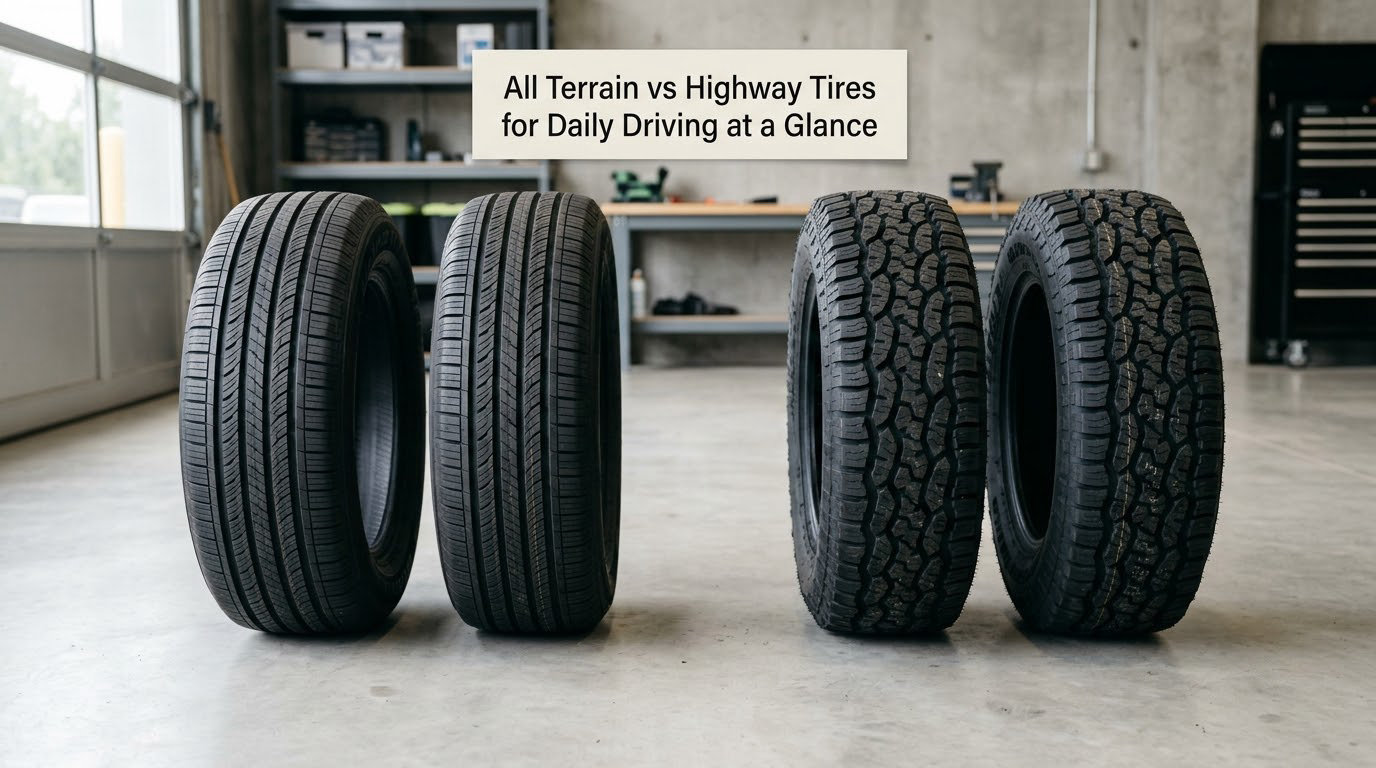
The table below settles most of it. Highway terrain wins the on-road rows, all-terrain wins the rows involving loose surfaces, and the middle rows are where the real debate lives.
| Criterion | Highway Terrain (H/T) | All-Terrain (A/T) |
|---|---|---|
| On-road comfort | Soft, quiet, isolates expansion joints and broken pavement | Firmer and busier over the same surface |
| Cabin noise at 30 to 50 mph | Low hum, easy to talk over | Noticeably louder, tread roar grows with speed |
| Steering response | Quick, precise turn-in | Slightly slower, more deliberate |
| Dry pavement grip | Very good | Good, though not usually better |
| Wet grip and braking | Typically the better tire on clean cold pavement | Varies widely by tread design and compound |
| Packed snow | Weak unless winter-rated | Noticeably better, especially with siping |
| Loose gravel and dirt | Weak, can skate on loose surfaces | Strong, this is its design job |
| Sidewall and puncture resistance | Thinner, more road impact damage over time | Thicker, reinforced, abrasion resistant |
| Fuel economy | Lower rolling resistance, higher mpg | More resistance, usually a small drop |
| Tread life | Longer wearing mileage | Shorter replacement interval |
| Relative replacement cost | Lower per tire, spread over more miles | Higher per tire, spread over fewer miles |
| Best for | Commuting, highway, towing on pavement, city driving | Mixed roads, winter, gravel access, weekend trails |
| Buy it if you… | Never leave pavement | Lose pavement regularly, in any season |
One warning before you read the rest: the word “all-terrain” covers a huge range. A mild, street-biased all-terrain and a rowdy mud-and-rock tire both carry that label, and they behave very differently on a commute. Assume the average all-terrain is a compromise, not a trail tire.
Which Tires Are Better for Everyday Commuting?
The Real Answer to All Terrain vs Highway Tires for Daily Driving
Daily driving rewards efficiency of everything: quiet, comfort, low fuel burn, long tread life. You are paying for a tire every single day, and every mile is a mile on the same smooth surface.
Highway terrain tires were designed for exactly that job. Shallow, closely spaced tread blocks, a compliant sidewall, and a compound tuned to resist heat rather than bite into gravel. They are what a carmaker fits when the car is meant to be driven on roads.
All-terrain tires shift the budget toward toughness. Taller tread blocks with wider gaps between them flex independently on loose ground, and a stiffer sidewall takes hits that would damage a highway tire. That capability costs you noise, fuel economy, and tread depth.
The percentage-of-unpaved rule
Here is the shortcut most owners eventually land on, and it matches what I hear on tire forums: below about 5 percent unpaved driving, all-terrains are capability you will never touch. Between 5 and 20 percent, a mild all-terrain starts to justify itself. Above 20 percent, or if winter is genuinely bad where you live, you are past the point where a highway tire is the right answer.
The forum consensus on noise is more nuanced than the marketing. Owners running aggressive all-terrains on 90 percent road use generally say the ride is firmer but the difference over pavement is not dramatic, while the complaint about noise shows up again and again, especially in the 30 to 50 mph city range.
One useful framing if you want to know what your future self will think: buying all-terrain tires for a car that never leaves the road is like buying a winter coat in July. It works, it is not broken, and you will quietly resent the weight for years.
How Do Tread Patterns Affect Road Noise and Comfort?
Road noise comes from three things working together: how big the tread blocks are, how far apart they sit, and how stiff the sidewall is that connects them to the car.
Highway tires use small, tightly packed blocks with narrow grooves. The rubber stays flatter against the road, the sidewall flexes gently, and the contact patch moves across the surface like a whisper. Add a silica-rich compound that stays cool, and you get a tire that can be quiet at 70 mph.
All-terrain tires reverse that logic. Blocks are taller, wider, and spaced farther apart so they can sink into gravel, snow, and mud instead of bridging over them. Each block flexes on its own as it enters and exits the contact patch, and that flexing is the roar you hear in the cabin.
Stiffer sidewalls add to it. The sidewall is what absorbs impact from expansion joints, potholes, and broken asphalt, and the reinforcement that makes an all-terrain resist rocks and thorns also makes it less compliant. You feel more of the road and hear more of it.
The noise gets loudest exactly where most people drive. City speeds put the tire through thousands of small deflections per mile, which is where a loose tread pattern makes the most noise. At highway speed the broader pattern actually settles down somewhat, and wind noise on the windows tends to mask the tires.
One thing worth knowing about the noise reviews you will read online: a lot of all-terrain noise complaints come from drivers who just upgraded from bald off-road tires, so the comparison is unfairly dramatic. Plenty of owners argue the complaints are inflated by the wrong baseline. Judge the noise against the quiet tire you had, not against a mud-terrain you never bought.
Do All-Terrain Tires Provide Better Wet and Snow Traction?
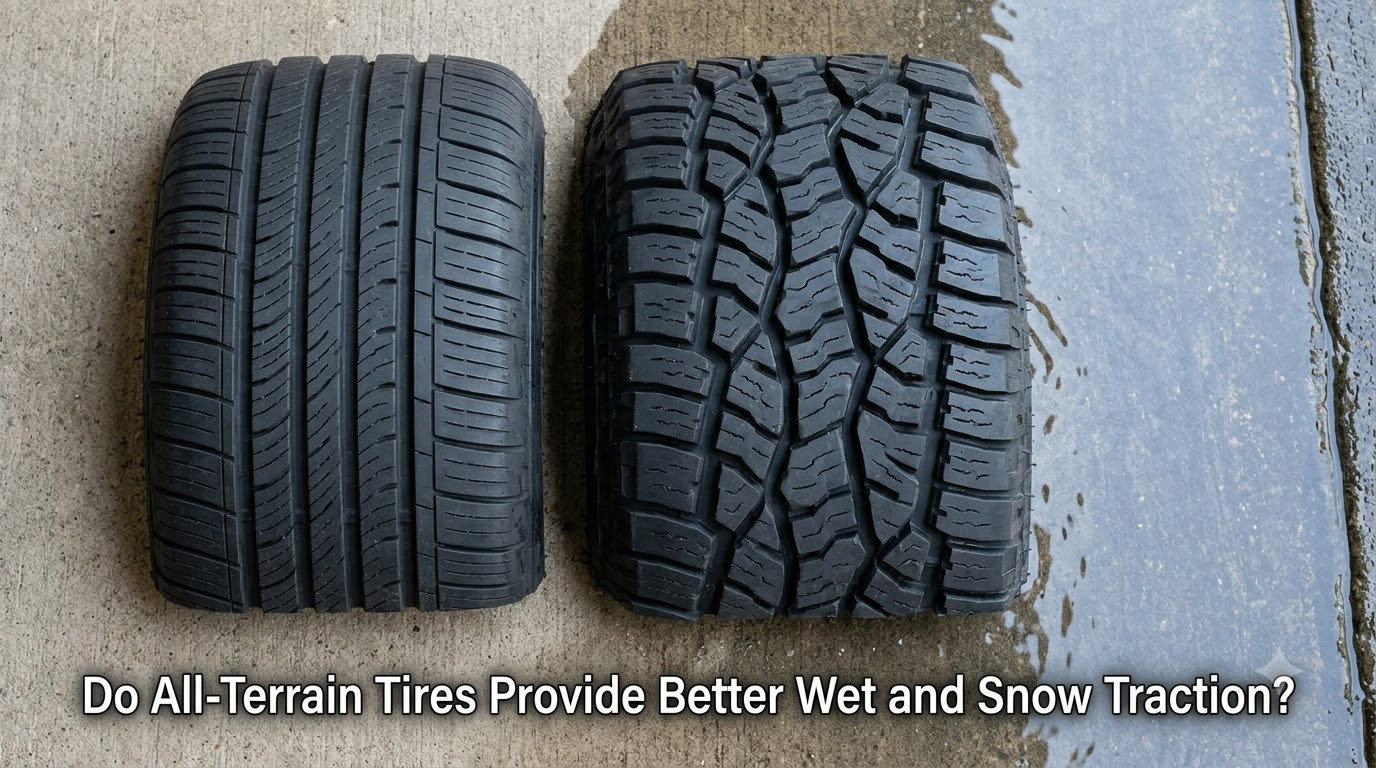
Sometimes, and not for the reasons most sellers imply. Wet and snow traction depend on compound, tread depth, and whether the tire is actually rated for winter, and category alone tells you very little.
On rain, a highway tire with a squared tread profile and four straight grooves moves water out from under the contact patch efficiently, and its harder compound resists the heat that builds on wet pavement. Many drivers see wet braking improve when they move from a knobby all-terrain back to a touring tire.
On snow, the equation flips. Tread blocks that stand taller and space wider have more edges to catch loose snow and give the compound something to shear against, which is why all-terrain tires are usually the better choice in packed snow than a summer highway tire with no winter rating at all.
That is where siping comes in, and it is the most underused trick in winter driving. Sipes are tiny slits cut into the tread blocks. They let the blocks flex so the surface can bite into them, and they are why a tire can hold on to packed snow it otherwise has no business gripping. Some all-terrain tires come with them molded in.
Do not confuse a good all-terrain with a winter tire. Winter-rated tires use a soft compound that stays supple below about 40 degrees, and that compound matters far more than tread shape in true cold. A summer highway tire on snow is dangerous no matter how good the tread looks.
Safety note, and it is not a small one: follow the temperature ratings on your tires and your vehicle placard. Below freezing, a tire not rated for that temperature loses most of its grip regardless of category. If you drive in real winter conditions, winter tires or a siped all-season plus a full winter set beats an all-terrain compromise every time.
Which Tire Type Handles Rain, Snow, and Ice Better?
Break it down surface by surface, because the answer changes every time.
- Loose gravel and dirt: All-terrain, clearly. The block edges and sidewall lugs dig in. A highway tire floats over loose gravel and can feel vague or nervous at low speed.
- Packed snow: All-terrain usually wins, and dramatically over a summer highway tire. Siped blocks help more than extra tread depth.
- Slush and slushy water: This one favors the highway tire. Slush fills the voids in an aggressive tread, and once filled, the tire behaves like a slick.
- Standing water and heavy rain: Highway terrain, more often than not. Continuous grooves and a squared profile evacuate water better, and the harder compound runs cooler and grips sooner.
- Ice: Neither. Ice is a compound problem, not a tread problem. Both categories lose badly, and both should be driven on with more margin than you would on dry pavement.
The pattern is worth noticing: all-terrain tires are better on surfaces that are not road, and highway tires are better on surfaces that are. That is not a flaw in either design, it is the design working as intended.
How Do the Tires Affect Fuel Economy and Range?
Highway tires help your fuel economy, usually by a few percent, and the mechanism is rolling resistance. The energy you feel as the car accelerating away from a light comes from flexing the tire. More flex per mile means more fuel burned for the same trip.
An all-terrain flexes more, for three reasons at once. Bigger tread blocks deform more as they roll. Wider gaps mean the block edges and the tread face deform independently. And a stiffer, heavier sidewall compounds the effect. More heat, more fuel, faster wear of the same tread depth.
Owners notice this as a small but consistent drop in daily-driver economy. A truck on a mix of highway and city running might sit in the high teens to low twenties mpg and treat that as the baseline they compare other setups against, which is a better illustration than anything printed on a tire sidewall.
Two myths worth busting while we are here. First, all-terrains do not automatically destroy your mpg; a mild street-biased all-terrain in a well-aligned car often loses less than owners assume. Second, bigger is not automatically better. A taller tire in a larger wheel is heavier, and unsprung mass is expensive at both ends of the odometer.
Three things move your number more than the category does. Alignment is the big one, especially if you have aggressive tires that wear unevenly. Pressure matters, because underinflated tires flex more whether they are highway or all-terrain. And the vehicle itself dominates: a sedan and a lifted truck will never match on mpg regardless of what is bolted to them.
If you want a real number rather than a forum guess, run an A/B test. Fill the tank, drive a repeatable 200-mile loop that includes highway and city segments, and record the mpg. Swap to the other tire on the same route, same pressures, same weather window. Owners trust that kind of number more than any sidewall claim.
Are All-Terrain Tires More Expensive to Replace?
Usually yes, per tire, and usually no, per mile. Here is why that distinction decides the question for most daily drivers.
What drives the gap between a highway tire and an all-terrain tire in the same size: brand and product line, the size itself, construction and ply rating, the load range, the retailer’s markup, and how specialized the tread design is. A mainstream touring tire in a common passenger size sits at one end of that scale. A heavy-duty, load-range tire in a less common size sits at the other.
The gap widens when people make one specific mistake, which is changing size at the same time. Going to a larger overall diameter usually means a wider wheel and a lower-profile tire, and those three changes together can add more than the all-terrain choice itself. If you want a tougher tire, change the tire first and leave the size alone.
The treadwear rating on the sidewall is your best clue, and it is worth learning to read. A number around 180 to 200 on a highway tire versus 140 to 160 on an all-terrain is a real difference, not marketing. Multiply that against the tread life you actually get, which depends heavily on wheel width, alignment, and whether you rotate.
That gives you a cost-per-mile number you can compute yourself. Divide the tire cost plus mount and balance by the miles you expect to get. Then add the fuel delta: mpg drop multiplied by annual miles multiplied by what you pay per gallon. The tire that looks expensive on the receipt is frequently the cheaper tire per mile, and the tire that looks cheap is frequently not, once you divide.
One more caution: treadwear rating and street reality diverge sharply. An aggressive tread run on a wide wheel, out of alignment, will underperform its rating badly. An aggressive tread on a narrow wheel, rotated on schedule, will beat it.
How Do Tire Types Affect Steering Response and Handling?
Highway tires feel more connected in a parking lot and through a sweeper, and the reasons are structural rather than marketing.
Turn-in comes from how quickly the front axle can change direction. A shallow, stiff tread block resists side load better, so the tire responds immediately to steering input. A tall, flexing block on an all-terrain gives a little first, then settles, which reads as softer rather than slower. Drivers who like precise feel notice this most at low and medium speed.
Steering effort follows a similar line. A compliant sidewall absorbs more of the force before it reaches your hands, so highway tires often feel lighter and smoother on center and off-center steering. All-terrains build more assist and give more feedback at the limit, which some drivers prefer because it tells them where the front end is.
Overall diameter matters more than most people expect. Increasing diameter slows steering response and lengthens the distance it takes to react, regardless of tread type. It also raises the center of gravity a little and changes the gearing feel. If you care about driving response, keeping the factory diameter is the single most effective change you can make.
Cornering stability follows. Highway tires hold a consistent line on clean pavement and warm up predictably. All-terrains can feel vague on smooth curves until the blocks settle into a rolling pattern, then they are perfectly fine. Neither is dangerous; they are simply honest about what they are optimized for.
For a car like a BMW, the factory fitment was chosen for exactly the daily-driving case: the quiet tire, the precise steering, the long tread life. A sport-sedan or sport-wagon driver who stays on pavement gains very little by moving to all-terrain and gives up the two things the car is best at.
Which Should You Choose?
Match the tire to the roads you actually drive, not the ones you might drive once a year.
- Pure paved commuting and highway: Highway terrain, every time. It is quieter, more efficient, and lasts longer, which is the whole point of a daily-driven car.
- Mixed pavement and gravel, light dirt roads: A mild street-biased all-terrain works well here. You give up a little noise and economy and get sidewall protection and a lot more confidence on loose surfaces.
- Frequent winter conditions: Buy winter-rated tires, not all-terrain by default. If you cannot commit to a second set, a siped all-weather tire is a stronger winter performer than a non-rated all-terrain.
- Light gravel and forest road access only: All-terrain is justified if it is a regular trip, not an annual one. Occasional gravel with a highway tire is a caution-speed situation, not a capability gap.
- Towing on pavement: Highway terrain tires, correctly rated for the load. A stiffer all-terrain sidewall does not raise your safe towing capacity; the load index on the tire does.
- Performance driving: Highway terrain, or a summer or all-season extreme performance tire. An aggressive all-terrain softens turn-in and adds noise exactly where you are most sensitive to both.
- Regional climate matters more than category: A dry, mild metro area pushes you toward highway tires. A mountain town with a six-month winter pushes the other way.
A five-question checklist
Answer these honestly and the decision makes itself.
- What percentage of my annual driving happens off pavement?
- Do I drive in real snow and ice, and is my current tire winter-rated?
- Do I tow, and what load index does that require?
- How much cabin noise and ride harshness can I genuinely tolerate every day?
- Is my alignment and tire size going to stay at the factory figure?
If the answer to the first question is under 5 percent, buy highway terrain tires and save the money for something you will actually enjoy.
Before you buy, verify the size and load rating on the door jamb placard against what the tire actually says, check that the wheel width suits the sidewall, and keep the overall diameter close to factory. A professional installation with an alignment will make a bigger difference to how the tire feels than the category choice itself, and it is far cheaper than replacing a set of tires that wore out crooked.
Frequently Asked Questions
Are all-terrain tires bad for daily driving?
No. They are safe and predictable on pavement, just less refined. The real costs are cabin noise, a firmer ride over broken pavement, a small fuel economy drop, and faster tread wear. If you drive mostly on road and accept a compromise, a mild street-biased all-terrain is a perfectly reasonable daily-driven tire. If you never leave pavement, you are paying for capability you will not use.
Which type is quieter on the highway?
Highway terrain tires, clearly. Small tightly packed tread blocks and a compliant sidewall absorb road texture instead of transmitting it, and the quieter compound runs cooler under steady highway load. The gap is widest in the 30 to 50 mph city range, where tread roar is most exposed, but highway tires stay ahead at speed too. Wind noise on your windows will often hide the difference entirely.
Do all-terrain tires wear out faster than highway tires?
Yes, typically. The taller blocks flex more per revolution, generating heat that wears the tread, and aggressive tread edges abrade faster on pavement. Sidewall treadwear ratings reflect this, with many all-terrains rating around 140 to 160 against 180 to 200 for mainstream highway tires. Alignment, wheel width, and whether you rotate on schedule can shift real-world mileage by thousands of miles in either direction.
Are all-terrain tires better in snow than highway tires?
Against a summer highway tire, yes, mostly because tall blocks and siping give the compound edges to grip. Against a proper winter tire, no. Below about 40 degrees the rubber compound matters more than tread shape, and that is the whole argument for winter-rated tires. If you drive in genuine winter conditions, winter tires or a siped all-season set will outperform an all-terrain compromise in almost every measurable way.
Can I mix highway and all-terrain tires on my car?
Keep all four tires the same category, size, load rating, construction type, and ideally the same model and wear level. Mixing changes the grip and rolling radius across the car, which changes how it brakes, steers, and behaves in a slide. On a vehicle whose electronic systems assume equal tire diameter, running mismatched pairs can trip warnings and reduce stability control function. Replace as a set of four.
How many miles should all-terrain tires last?
On a daily-driven car on pavement, many well-made all-terrain tires run roughly 40,000 to 60,000 miles, and highway terrain tires commonly reach 60,000 to 80,000 or more. Aggressive tread on a wide wheel, poor alignment, or no rotation shortens that noticeably, and light off-road use costs tread depth that never comes back. Check pressure monthly, rotate every 5,000 to 8,000 miles, and judge replacement by measured tread depth rather than by the date you bought them.
The Bottom Line: What to Do First
For all terrain vs highway tires for daily driving, the answer comes down to one number: how much of your year happens off pavement. Under 5 percent and the highway tire wins on every axis you will actually notice. Well above that, and the all-terrain tire pays for itself in traction and sidewall toughness.
Before you order anything, check the size and load rating on your door placard, keep the overall diameter near factory, read the treadwear rating, and compare noise and comfort ratings from a third-party tester rather than from the reviews on the product page. Then have the tires installed and aligned by a shop that balances correctly.
Everything else in this comparison is refinement. Those three checks are what actually keep you safe and happy on the road every day.