
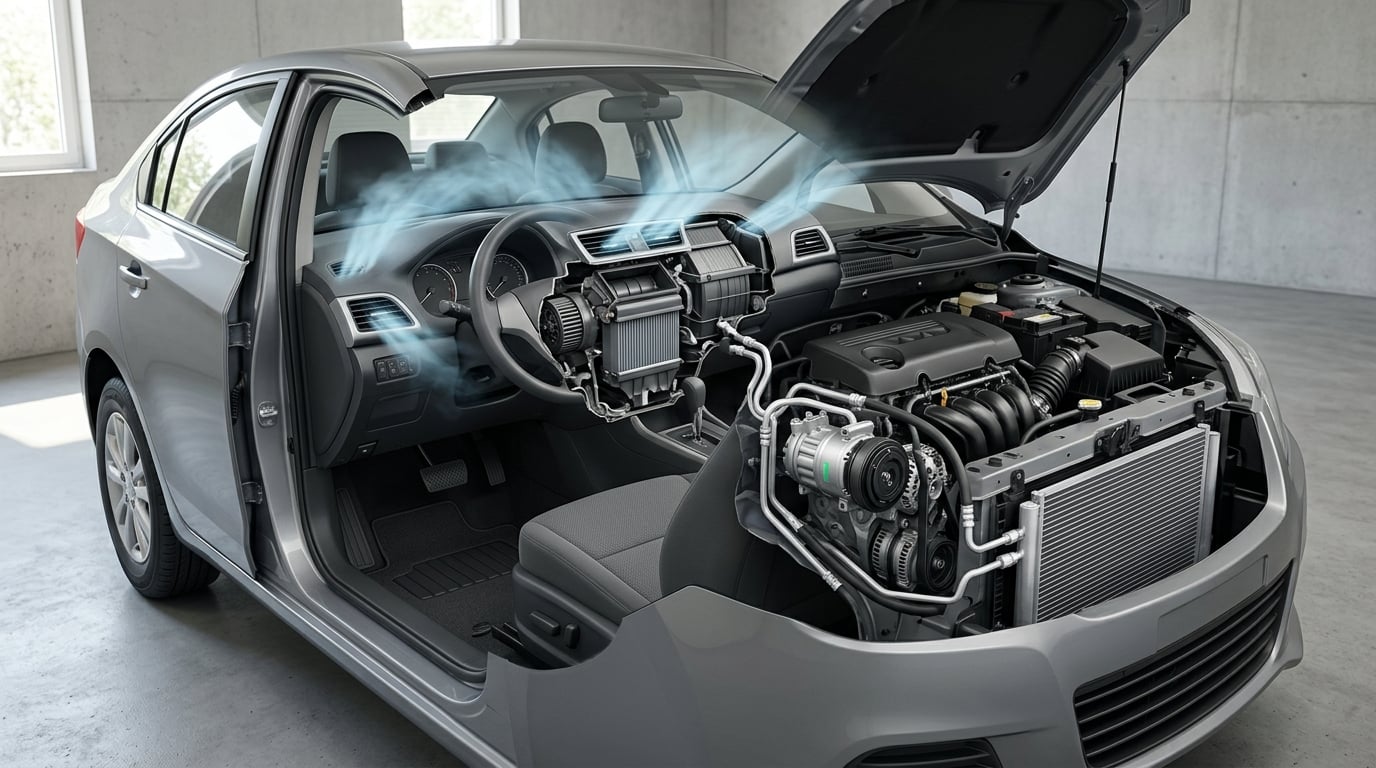
A car’s air conditioning works as a closed loop that circulates refrigerant to remove heat and humidity from inside the cabin and release it outside. An engine-driven compressor squeezes low-pressure refrigerant vapor into a hot, high-pressure gas, and every part after that is just that heat being handed off from one component to the next.
It never actually makes cold. It moves heat, which is the same reason your A/C dries the air on a rainy afternoon, and the same reason a car with a blocked condenser can feel unmanageable on a hot day. Last updated for September 2026.
Table of Contents
- What Does Car Air Conditioning Do?
- How Does Car Air Conditioning Work? The Refrigeration Cycle
- Why Does Car Air Conditioning Use Refrigerant?
- What Controls the Temperature and Airflow?
- Why Is the Air Sometimes Warm, Smelly, or Weak?
- What Can Car Owners Check Safely?
- When Should You Have the Air Conditioning Serviced?
- Frequently Asked Questions
- Conclusion
What Does Car Air Conditioning Do?
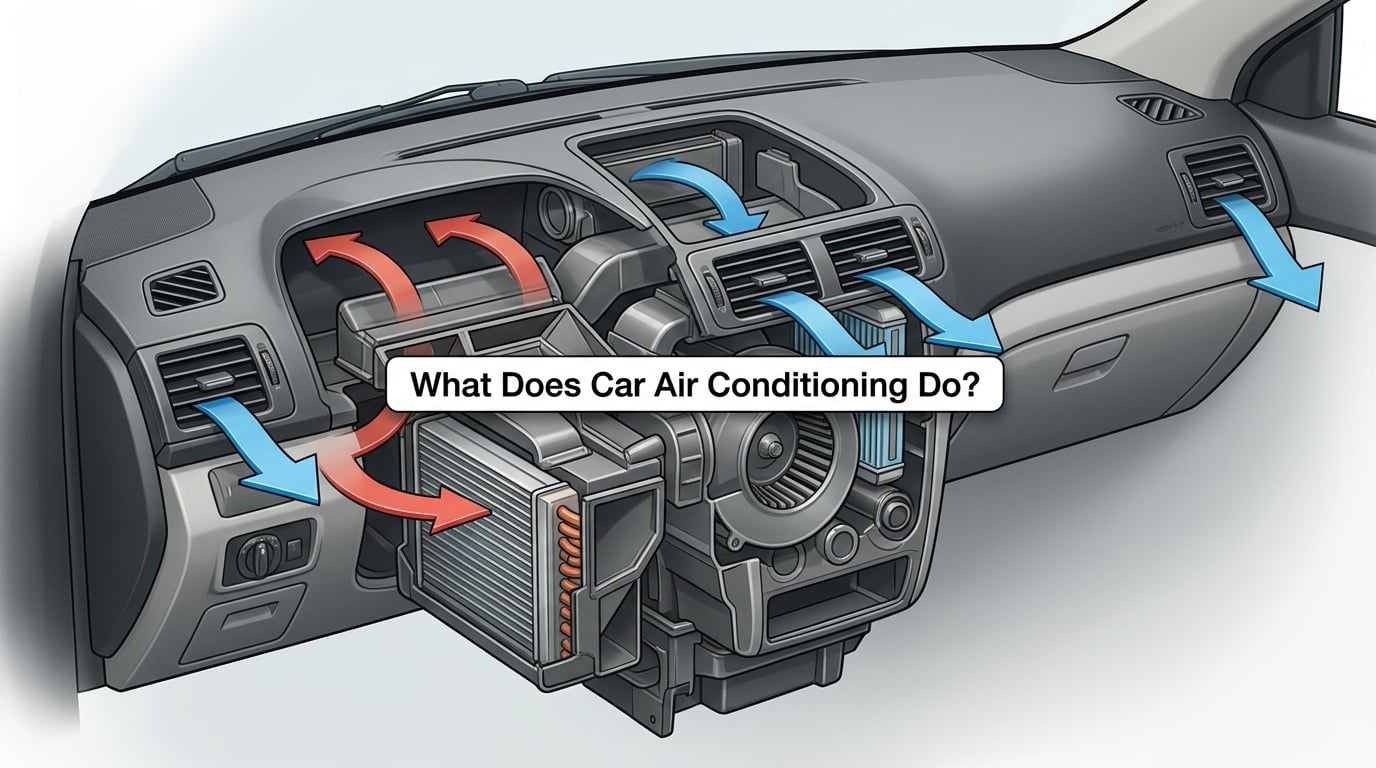
Everything a car A/C system does falls into two jobs: move heat out of the passenger compartment, and take water out of the air while it is there.
Call the first job cooling, and call the second dehumidification. The two happen in the exact same place, on the same coil, for the same physical reason. Air holds moisture until it gets cold, so when warm humid cabin air passes across a coil below its dew point, the water condenses on the coil and drips into a drain under the car. That is why a system that has lost its refrigerant often feels both warmer and more clammy than before.
There is also a heater in most of these cars, and it is a completely separate circuit sharing the same dashboard box. The cooling side uses refrigerant. The heating side uses hot engine coolant, and no part of the A/C cycle is involved when the heater is on. Understanding how car air conditioning works means keeping those two halves apart, because plenty of confusing symptoms turn out to be a heater or blend door problem rather than a refrigerant problem.
How Does Car Air Conditioning Work? The Refrigeration Cycle
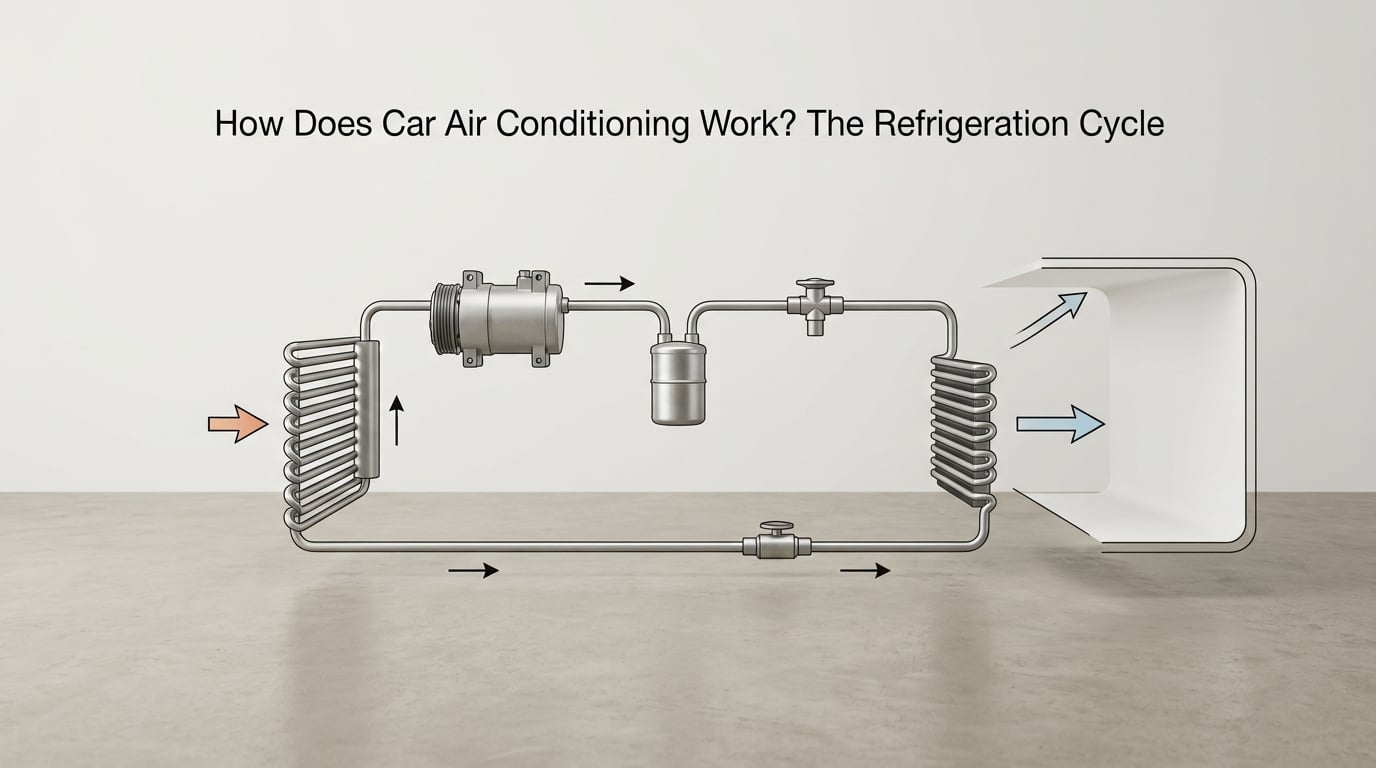
The refrigerant never gets used up. It is pumped around and around a sealed circuit, changing between gas and liquid as it goes, and every stage below describes the same refrigerant at the next point in that loop.
- Compression. The compressor takes cool, low-pressure refrigerant gas and squeezes it into a hot, high-pressure gas. Squeezing a gas raises its temperature, so the refrigerant now carries far more energy than the air around it.
- Condensation. The hot gas enters the condenser at the front of the car, where air moving past it strips off the heat and the gas condenses into a high-pressure liquid. That heat leaves the vehicle entirely.
- Drying and filtering. On many systems the liquid passes through a receiver-drier or accumulator, which traps moisture and debris before anything else can be harmed by them.
- Expansion. The high-pressure liquid is forced through a narrow restriction, an expansion valve or an orifice tube, and the sudden pressure drop makes part of it flash to vapor. The result is a very cold, low-pressure liquid and vapor mixture.
- Evaporation. That cold mixture enters the evaporator behind the dashboard. Warm cabin air blown across the coil gives up its heat to the refrigerant, which boils back into a low-pressure gas.
- Distribution. The low-pressure gas is drawn back to the compressor and the loop starts over. Meanwhile the blower motor keeps pushing air across the chilled evaporator and out through the vents.
Two pressure regions make this easier to picture. Everything from the compressor to the expansion device is the high side, and it runs hot and pressurized. Everything from the expansion device back to the compressor is the low side, and it runs cold and lightly pressurized. A technician reading pressures at the service ports is reading these two states directly.
What Happens Inside the Compressor and Condenser?
The compressor is the part that makes the whole thing possible, and it is usually driven by the engine through a belt and a clutch or an electromagnetic coupling, though some newer vehicles use an electrically driven unit instead. When you press the A/C button, that clutch or motor engages and the compressor starts pulling in low-pressure vapor and pushing out high-pressure vapor. The temperature of the refrigerant climbs sharply at that moment, purely from the compression.
That superheated vapor travels to the condenser, which sits at the very front of the vehicle, usually directly in front of the engine radiator. Airflow from the road, plus a cooling fan in many designs, passes over the condenser fins and pulls the heat out. As the refrigerant loses heat it changes state, and high-pressure vapor becomes high-pressure liquid.
One practical detail here explains a lot of complaints. Because the condenser sits in front of the radiator, whatever blocks one blocks the other. Bugs, leaves, winter salt and a bent core all starve the A/C of the airflow it needs, and a system that was fine last summer can go weak on the same hot day it used to handle well.
How Does the Expansion Valve and Evaporator Make the Cabin Cold?
The liquid refrigerant reaches a narrow restriction, and that is where the magic is. Squeezing through a tiny opening drops the pressure sharply, and part of the liquid flashes instantly into vapor. The mixture that comes out the far side is colder than anything else in the car, often well below freezing, because the energy went into boiling it rather than into heating it.
That cold mixture runs through the evaporator coil inside the dashboard, and the blower motor pushes warm cabin air across it. Heat flows from the warmer air to the colder coil, so the refrigerant absorbs what the cabin gave up, boiling fully into low-pressure gas by the time it leaves. The air that reaches the vents has lost heat and, below its dew point, lost moisture too, which is the condensation that drips away underneath.
The heater core sits in the same dashboard box and works in the opposite direction, on engine coolant rather than refrigerant. When you ask for heat, a blend door sends air across that core instead of the evaporator. When you ask for both, the air is split. That is why a car can blow cold air on one side and warm on the other, and why a stuck blend door can fake a refrigerant problem that does not exist.
Why Does Car Air Conditioning Use Refrigerant?
Refrigerant is the working fluid that carries the heat. It is a sealed loop, meaning the same small charge goes around and around for the life of the system. Nothing is burned and nothing is vented under normal operation, so the fluid level should stay constant for years.
It moves heat by changing phase rather than by being hot. A liquid absorbing energy boils into a gas, and a gas losing energy condenses back to a liquid. A refrigerant is chosen so that it boils at a temperature low enough to chill a cabin, and a pressure that lets it condense at a temperature hot enough to dump heat into outdoor air. Change the pressure and the boiling and condensing temperatures move with it, which is exactly what the compressor and expansion device do.
The receiver-drier or accumulator earns its place because a system that has been open to air can pick up moisture. That component holds a desiccant that absorbs water and traps contaminants, protecting the narrow expansion device and the compressor. In some designs it also meters the refrigerant on the way to the evaporator, doing the job of the expansion valve instead of sitting beside it.
Not every car takes the same fluid. Older vehicles generally use R-134a, while most newer ones use R-1234yf, a lower global warming refrigerant adopted to meet emissions rules. The two are not interchangeable and a wrong charge can seriously damage a system, so the type printed on the vehicle label is the one that goes in. A single unexplained loss of refrigerant usually means a leak, and topping it up without finding that leak just buys a few more weeks.
What Controls the Temperature and Airflow?
A modern HVAC box has its own small control system, and it is worth separating from the refrigerant side because cooling problems often live here instead.
- The A/C button and thermostat. Pressing the button tells the compressor to engage. The thermostat setting sets the temperature the system aims for, usually by cycling the compressor on and off against a sensor near the evaporator.
- The blower motor. Its speed setting is a separate control from temperature. You can have the coldest setting on the machine and still get weak airflow if the blower or a door is at fault.
- The blend door. A damper inside the box mixes cold air from the evaporator with warm air from the heater core to hit the temperature you asked for. It is a common failure and a common reason for one-side-hot, one-side-cold complaints.
- The mode doors. These route air to the face, feet, or both, and control the fresh air and recirculation path. A recirculation door stuck on recirculate can bring in stale smells.
That combination explains the most common confusing result of all: air that feels cool but never gets properly cold. The evaporator may be working fine while the blend door never fully closes, or the cabin filter behind the blower is packed and the sensor is reacting to air it never touches. No amount of turning the temperature dial fixes either one.
Why Is the Air Sometimes Warm, Smelly, or Weak?
Matching the symptom to a stage of the cycle usually gets you into the right neighborhood. Here is the reference view.
| Component | Where it lives | What it does | Pressure and phase in and out | Symptom when it fails |
|---|---|---|---|---|
| Compressor | Engine bay, belt-driven or electric | Circulates refrigerant and raises its pressure | Low-pressure gas in, high-pressure gas out | Clutch or motor never engages, no cooling at all |
| Condenser | Front of the car, ahead of the radiator | Releases heat to outside air | High-pressure gas in, high-pressure liquid out | Weak cooling that worsens at idle or low speed |
| Receiver-drier or accumulator | Engine bay, on the high-pressure line | Traps moisture and debris | Liquid through | Reduced cooling, sometimes icing at the expansion device |
| Expansion valve or orifice tube | At the entrance to the evaporator | Drops the pressure so the refrigerant can absorb heat | High-pressure liquid in, cold low-pressure mix out | Frozen inlet, warm air at the vents |
| Evaporator | Behind the dashboard, inside the HVAC box | Absorbs heat and moisture from cabin air | Cold low-pressure mix in, low-pressure gas out | Foul smell, weak air, damp carpet |
| Blower motor | Inside the HVAC box under the dash | Pushes air across the coils | Air side only | Little or no airflow at any speed |
Weak cooling across the board usually points at the charge itself, at the compressor not cycling, or at a condenser that cannot get air. Intermittent cooling that comes and goes with the weather is often a compressor clutch cycling on and off under thermal load. A noise that kicks in with the A/C is usually belt, clutch or bearing related rather than refrigerant related.
Odor needs its own explanation. That damp, musty smell is usually mold and biofilm growing on a wet evaporator coil that is not draining. A sweet or oily smell, by contrast, suggests refrigerant or refrigerant oil on a leak, and that is a reason to stop driving and get it looked at. A wet floorboard or damp carpet on the passenger side is a blocked condensate drain, not an A/C performance problem at all.
One quirk catches people out every summer. Cooling is often noticeably weaker while sitting in stop-and-go traffic than at highway speed, because the condenser depends on moving air, and moving air is exactly what you do not have at a standstill with fans struggling.
What Can Car Owners Check Safely?
There is a short list of things you can do yourself without touching anything pressurized. Follow your owner’s manual for your specific model, and if a step needs tools you do not have, stop there.
- Confirm the system engages. Turn the A/C on and listen for the compressor clutch or motor, then check that air is actually moving. If nothing engages, note that and tell the technician.
- Look at the cabin filter. Many cars make it reachable from the glovebox or the door jamb. A filter packed with dust and leaves restricts airflow and smells; replace it if it looks loaded.
- Check the front of the car. With the engine off, look through the grille at the radiator and condenser for bugs, leaves, mud or a bent core. This is the cheapest fix in the whole system.
- Look under the passenger footwell. A carpet that is damp or a musty smell in the cabin is a drain hose issue you can often clear without touching the refrigerant circuit.
- Use it sometimes. Running the A/C briefly every couple of weeks keeps the compressor seals lubricated and the system from sitting idle for months.
What you should not do is open a service port, add refrigerant, or replace a pressure component. That circuit holds a high-pressure gas that can cause frostbite, and the wrong fluid damages the system for good.
When Should You Have the Air Conditioning Serviced?
Owner checks and technician work meet at a clear line. Everything above it is yours. Everything below it needs a shop with the gauges, the recovery machine and the wiring diagram.
Refrigerant charging is not a do-it-yourself job, for two reasons. You need to know the correct fluid and the correct charge weight for your car, and more importantly a low system is leaking somewhere. Recharging without finding the leak is the single most common reason the same car comes back with the same complaint a month later. Leak testing, vacuuming the system down before charging, and reading superheat and subcooling are all technician tasks, and so is any electrical diagnosis of the clutch, sensors, or compressor.
Book an appointment rather than waiting if you notice an oily residue on a hose or fitting, a hissing sound near the engine bay, repeated recharges within a year, a compressor that no longer engages at all, or a sweet smell in the cabin. A system that has been idle for years and suddenly stops cooling on its first hot day is worth having checked before you assume it needs a big repair, because the answer is sometimes a single relay or a tired fuse.
Frequently Asked Questions
Why isn’t my car’s AC blowing cold air?
Walk the cycle in order. Is the compressor clutch or motor engaging when you press the button? Is the blower moving air at all? Is the radiator and condenser in front of the car clean, since that airflow is what the condenser needs to release heat? If the compressor runs, the blower runs and the front is clear but the air is only mildly cool, the charge itself is the likely issue and needs a technician to measure it.
What happens if the car AC refrigerant is low?
Undercharge means less refrigerant reaching the evaporator, so less heat gets absorbed and the vents blow only mildly cool. A low charge is almost always a symptom rather than a cause: something leaked, or a compressor is failing. If the system was ever opened to air, moisture can get in and freeze at the expansion valve, which makes the problem worse and can do real damage.
Should you always run the AC in a car?
As routine use, yes. Running the A/C every couple of weeks keeps the compressor seals lubricated and moves moisture out of the system, and many compressors expect to cycle regularly. As a fuel economy question it is a real tradeoff, because the compressor puts load on the engine. Driving with the windows down at low speed often uses more fuel than simply running the A/C.
How long does a car AC system last?
A well-maintained system commonly runs eight to fifteen years and well past that. Where it fails matters more than how long it lasts. The condenser is easily damaged by front-end debris, the receiver-drier and any seals are replaced whenever a line is opened, and the compressor is by far the most expensive component to replace. Keep the front of the car clean and it will last longer.
Why is my car AC not as cold at idle?
The condenser releases heat to outside air, and at a standstill there is very little of it. With the fan unable to pull enough air through the core, the refrigerant cannot condense as well, so less cooling reaches the cabin. Cooling usually improves at road speed, which is a useful clue: if it is weak at idle and fine while driving, suspect airflow through the radiator and condenser.
Conclusion
A car A/C is a sealed loop that compresses refrigerant, dumps its heat into the air ahead of the car, drops its pressure to go cold, and picks heat back up behind the dashboard, over and over.
Start with the simple things: use the controls normally, check the cabin air filter where you can reach it, and look through the grille for debris on the radiator and condenser. If cooling is still weak, or you notice an oily spot, a hissing sound, or a sweet smell, put it in front of a qualified technician and ask them to find the leak rather than just refill it. Knowing the cycle is what turns their explanation into something you can follow.