
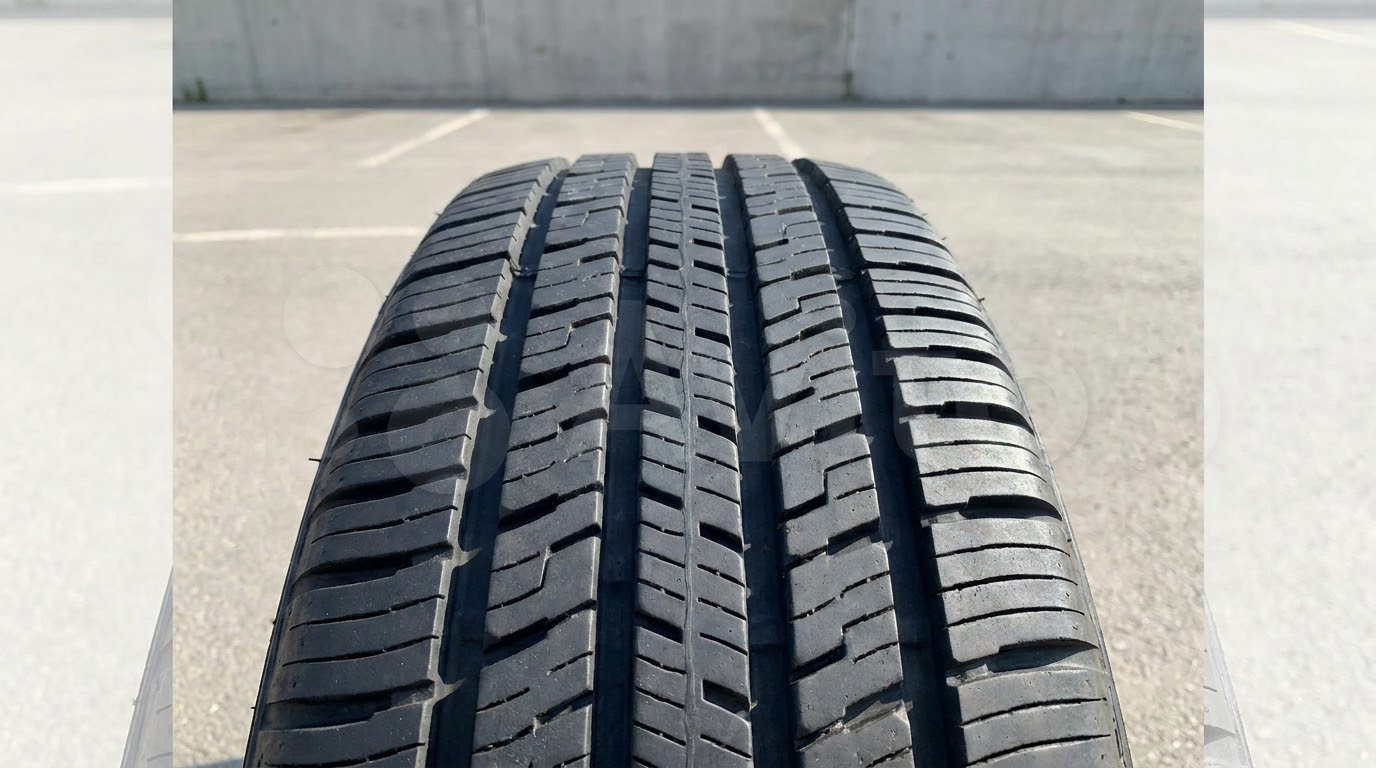
New tires typically ship with 10/32 to 12/32 of an inch of tread, which is roughly 8mm to 9.5mm. Performance tires start shallower at 8/32 to 9/32, and winter or off-road tires start deeper at 12/32 to 16/32, so the number you measure depends on what kind of tire you bought.
The bigger surprise for most drivers is not the depth, it is the difference between models. A tire can be brand new and still read two or three 32nds less than the spec printed on the tire rack. Here is what those numbers mean and how to check the ones on your own car.
Table of Contents
- What Is the Typical Tread Depth on New Tires?
- What Is the Legal Minimum Tread Depth in the US?
- How Do You Measure Tire Tread Depth?
- Why Do New Tires Have Different Tread Depths?
- When Should You Replace Tires Instead of Waiting for the Minimum?
- How Much Tread Do New Tires Have Compared With Replacement Tires?
- Do Tire Tread Depth Gauges Work on Every Tire?
- What Other Tire Problems Can Tread Depth Not Explain?
- Frequently Asked Questions
- Conclusion
What Is the Typical Tread Depth on New Tires?
A standard passenger touring tire usually leaves the factory at 10/32 or 11/32 of an inch. Some models run 12/32, and a few sit at 9/32, so treat 10/32 to 12/32 as the normal band rather than a single fixed number.
Across every tire category, brand new tires fall somewhere between 7/32 and 16/32 of an inch. That spread is deliberate, and it is the reason the answer to how much tread do new tires have is a range and not a spec.
If you are standing at a tire shop wondering whether 10/32 is a lot of tread, it is a healthy starting depth. Owners running a matched set of OE tires report reading 8/32 at 30,000 miles, which tells you how quickly the number falls once the tire is on the road.
What Is the Legal Minimum Tread Depth in the US?
The federal minimum for a passenger vehicle is 2/32 of an inch, about 1.6mm, measured in the major grooves. Below that you are breaking the law in every state that follows the federal standard, and tire wear indicator bars molded into the grooves are designed to reach the road surface at exactly that depth.
Some states set their own higher minimums, and California historically treats 1/32 as the line. Your vehicle manufacturer may also require more tread than the legal floor before it considers the tire serviceable.
Most tire technicians treat 2/32 as a legal limit, not a safe one. Testing shows wet-weather braking and cornering grip fall off sharply in the last couple of 32nds, which is why the common expert recommendation is to replace at 4/32 of an inch, roughly 3mm. That leaves a working margin instead of running on the wear bars.
How Do You Measure Tire Tread Depth?
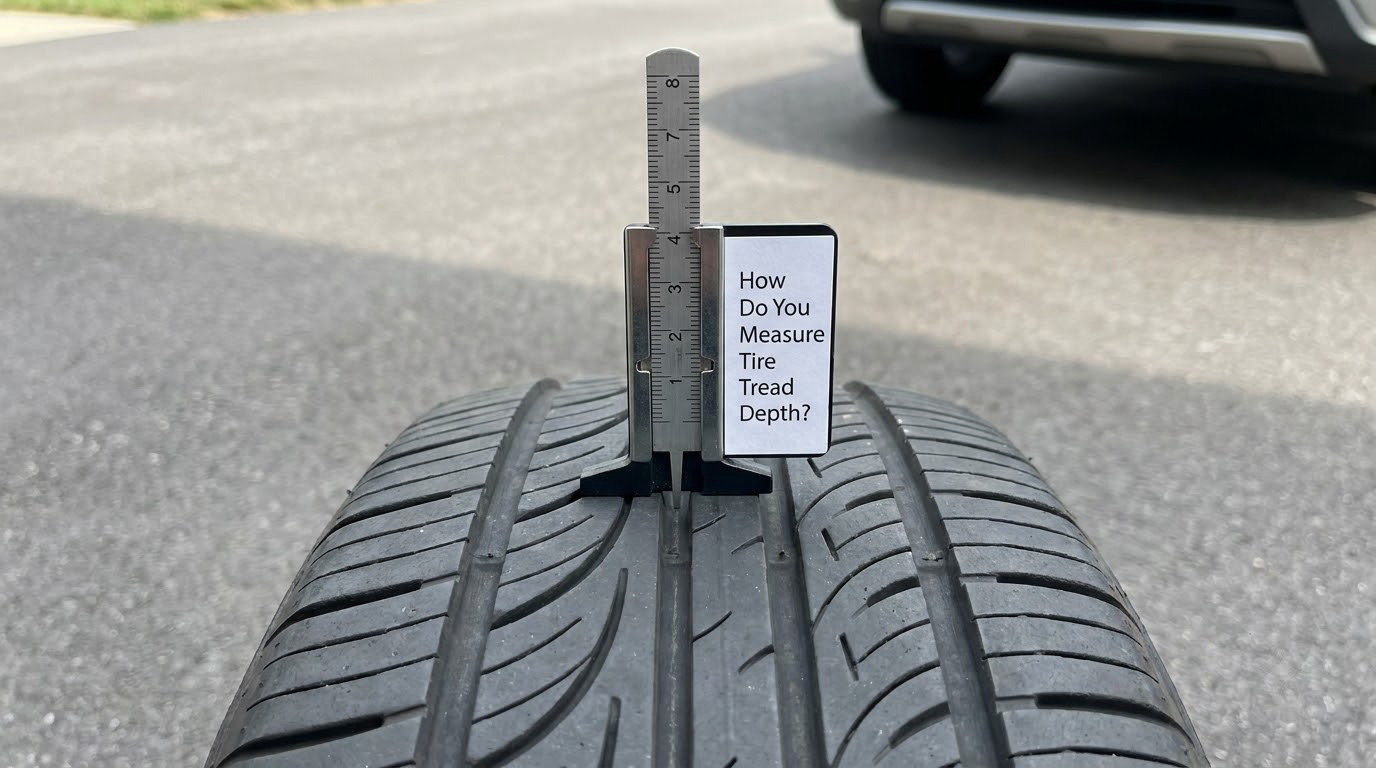
A tread-depth gauge costs a few dollars and gives you the only measurement that is actually in 32nds. Everything else is an approximation.
Park on level ground, set the parking brake, and find the gauge in the trunk or your glove box. Most sit in the tire storage area behind a panel in the trunk floor or under the cargo floor.
Press the gauge tip into the deepest main groove and lift straight up. Read the number on the edge of the bar, which is a small tab marked 0 through 32. That is your depth in 32nds of an inch.
Measure at three spots around the circumference, at least a quarter turn apart, plus the inside and outside shoulder of at least one tire. Take the lowest reading, not the average, because that is the part actually touching the road at that moment.
Repeat the whole routine on all four tires, then compare the readings. A tire that is more than 1/32 off from the others on the same axle is telling you something about pressure, alignment, or suspension.
If you have no gauge, a quarter is a decent stand-in. A US quarter measures about 4/32 of an inch, so if you can push it into the groove until Lincoln’s head disappears, you still have the recommended replacement margin. A penny only covers about 2/32, which is the legal minimum and the worst place to find yourself in a rainstorm.
Why Do New Tires Have Different Tread Depths?
Starting depth is a design decision, not a quality tier. A deeper groove is a bigger water reservoir, which is why winter and off-road tires start deep. A shallower groove on a soft compound protects the contact patch and keeps the tire from squirming in dry heat, which is why performance tires start thin.
| Tire category | Typical new tread depth | In millimeters |
|---|---|---|
| Standard touring / highway | 10/32 to 12/32 | about 8mm to 9.5mm |
| Performance street | 8/32 to 9/32 | about 6.5mm to 7mm |
| Ultra-high performance | 7/32 to 8/32 | about 5.5mm to 6.5mm |
| Winter | 12/32 to 16/32 | about 9.5mm to 12.5mm |
| All-terrain / mud-terrain | 12/32 to 16/32 | about 9.5mm to 12.5mm |
| Light truck / tow | 11/32 to 13/32 | about 8.5mm to 10.5mm |
A new tire is also not necessarily at its maximum possible depth. Rubber is molded, cured, and trimmed, and a tire that has sat in a warehouse or a shop bay for a year or two has had time to lose a 32nd or two without anyone noticing.
That is also the honest answer to the question every tire shop gets asked. A tire built on a retread line spends 50 to 80 hours in the mold curing, and a small amount of surface depth can be lost in finishing, storage, and the first few hundred miles of break-in. A shortfall of 1/32 to 2/32 against the published spec is normal. A tire that arrives at 6mm, or roughly 7/32, on a model that should start at 11/32 is a conversation worth having before you drive away, and owners of European-spec sets have reported exactly that.
When Should You Replace Tires Instead of Waiting for the Minimum?
Do not treat 2/32 as a target. Replace earlier when any of these show up.
- Depth at or under 4/32. That is the practical threshold, not the legal one.
- Uneven wear across a set. Feathering on one edge, cupping, or a bald spot on a nearly new tire points at alignment, inflation, or a worn shock absorber, not a bad tire.
- Different depths on the same axle. Forums keep coming back to this one. A mismatched pair changes how the car corners under braking, and it is the single most common thing people get wrong when adding one tire to an existing set.
- Age. Rubber ages whether you drive it or not. Six years is the widely cited point where manufacturers and tire shops start pushing for replacement even with deep tread, and ten years is the outer limit they consider.
- Pressure history. A set that has been run underinflated wears the shoulders and the center unevenly no matter how much depth is left.
- Visible damage. Cracks across the tread, bulges in the sidewall, exposed belts, or cords showing in the shoulder.
While you have the tires up, read the DOT date code. The last four digits are the week and year the tire was manufactured, so a code ending 2626 means week 26 of 2026. A tire can sit in a warehouse for a year or more and still be sold as new, and a 24-month-old tire will have less usable life than the tread number suggests.
How Much Tread Do New Tires Have Compared With Replacement Tires?
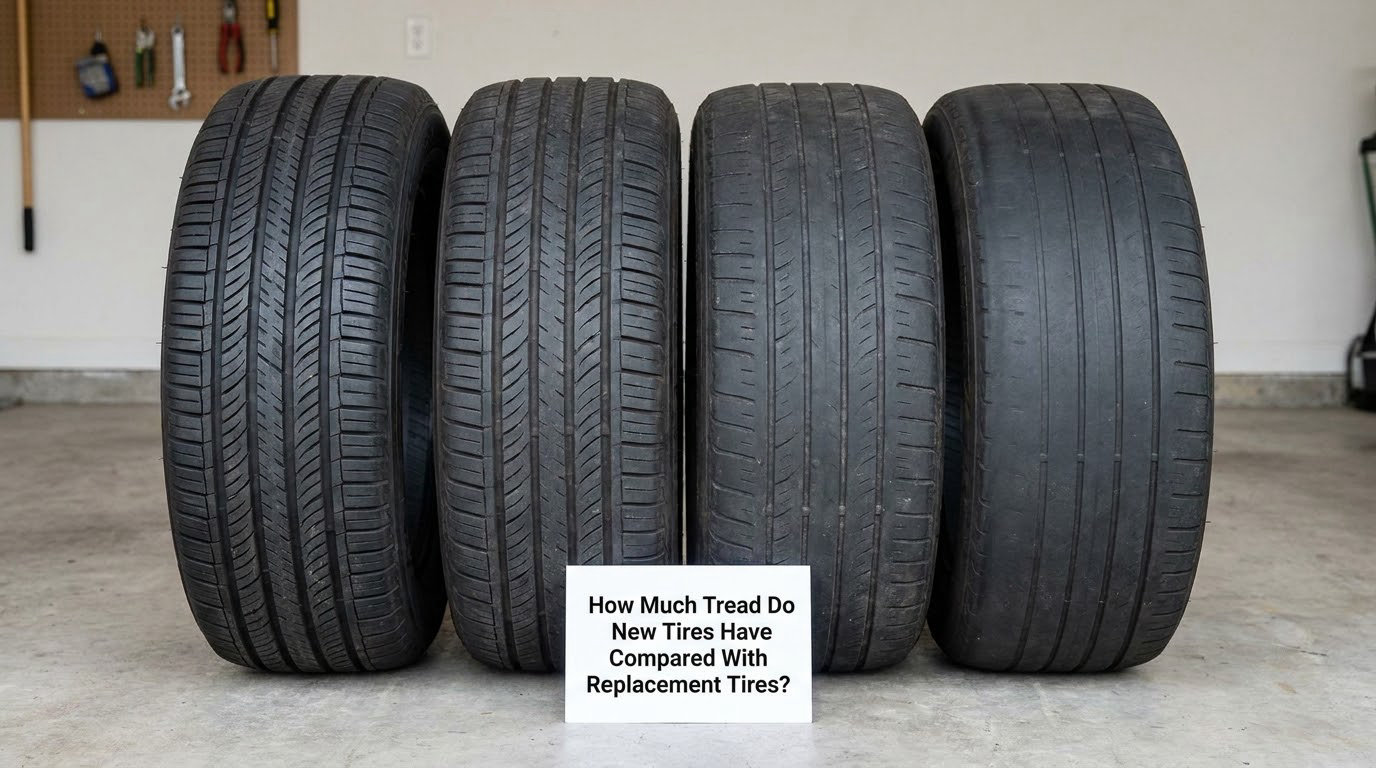
Here is the whole picture in one table, from factory-fresh down to the legal floor.
| Tread depth | Millimeters | Status | Quick test |
|---|---|---|---|
| 12/32 to 10/32 | 9.5mm to 8mm | New tire depth | Quarter sits on the shoulder with room to spare |
| 9/32 to 8/32 | 7mm to 6.5mm | New performance tire depth | Quarter covers Lincoln’s head partway |
| 7/32 to 6/32 | 5.5mm to 4.8mm | Worn but comfortable | Quarter still drops partway in |
| 5/32 to 4/32 | 4mm to 3.2mm | Time to plan replacement | Quarter sits nearly flush with Lincoln’s head |
| 3/32 to 2/32 | 2.4mm to 1.6mm | Below the recommended replacement point | Penny covers more than Lincoln’s head |
| Under 2/32 | under 1.6mm | Illegal in most states | TWI wear bars flush with the road surface |
For metric readers, one 32nd of an inch is about 0.79mm, which is why 2/32 is described as 1.6mm in Europe and 4/32 as 3.2mm. If a tire reads 3mm, that is just under 4/32 and squarely in replacement-planning territory.
For an idea of how far a starting depth carries you, most passenger tires give up roughly 1/32 of an inch every 1,000 to 1,500 miles. A 10/32 tire down to the 4/32 mark has six 32nds to spend, which works out to somewhere around 6,000 to 9,000 miles. On that same rate a 30,000-mile set is a perfectly normal outcome for a driver who rotates every 5,000 to 7,000 miles.
Do Tire Tread Depth Gauges Work on Every Tire?
On most tires, yes, and the gauge is the right tool. The complications come down to tread design and condition.
Directional and asymmetric tread patterns have different groove depths by design, so a shallow reading in one groove and a deep reading in another is normal rather than a defect. Read the widest main groove in each section, and take the shallowest number anywhere on the tire.
TWI wear bars are molded into the main grooves and sit at 2/32 by regulation. When they are level with the surrounding tread, the tire is finished, which is a faster and more reliable read than squinting at a gauge in bad light.
A gauge cannot tell you about a puncture behind the tread block, a cut that sits above the wear bar, or a sidewall that has started to separate. Fresh rubber residue in a groove usually means the tire is scrubbing, which is a problem worth finding before it eats the rest of the tread.
On electric vehicles, expect a faster wear rate than the same tire on a gas car. More mass and instant torque chew through tread faster, and owners have reported a brand new set reading about 6mm, near 7/32, only because that is where that model started.
What Other Tire Problems Can Tread Depth Not Explain?
Plenty. Tread depth measures one thing, and a tire with 12/32 of fresh rubber can still be dangerous or worn out in other ways.
Look at the sidewalls for cuts, bulges, or a scuffed area that stays soft. A bulge means the internal structure has separated, and that tire is finished regardless of what the gauge says.
Run your hand across the tread and look for irregular wear. Feathering across the face points to alignment, cupping or scalloped dips point to shock absorbers or wheel bearings, and a smooth center with worn shoulders usually means the tire spent time underinflated.
Check the pressure cold, on the placard inside the driver door, not the number molded into the sidewall. A tire that has lost pressure repeatedly will never wear evenly no matter how much depth you started with.
Finally, look at the date code and the tire size. Mixing tire types across an axle, or mixing a much smaller tire with a much larger one, changes the handling in a way no tread measurement will show you.
Frequently Asked Questions
Is 10/32 a lot of tread on a tire?
Yes. Ten 32nds of an inch, about 8mm, sits right in the middle of the range for a new standard passenger tire. Touring tires usually start between 10/32 and 12/32, so a tire reading 10/32 new is normal and healthy. Using a common wear rate of roughly 1/32 per 1,000 to 1,500 miles, that leaves about 6,000 to 9,000 miles before you reach the recommended 4/32 replacement point.
What tread depth requires new tires?
Replace at 4/32 of an inch, roughly 3.2mm. That is the widely recommended threshold, not 2/32, which is only the US legal minimum for most states. A quarter is about 4/32 deep, so if you can slide it into the groove until Lincoln’s head disappears, you have just enough left. Replace sooner if the wear is uneven across the tire or the four tires disagree with each other.
Is 30000 miles on a set of tires good?
That is a normal amount for a set of passenger tires, and 40,000 to 50,000 miles is common with sensible driving and rotation every 5,000 to 7,000 miles. Mileage alone is not a verdict though. A tire that wore out evenly at 30,000 is in good shape, while one at 30,000 with 8/32 left has been getting short trips and hard braking. Judge the wear pattern and the remaining depth, not the odometer alone.
How many miles will 3mm tread last?
Three millimeters is about 3.8/32 of an inch, which puts it below the 4/32 replacement point and close to where the wear bars sit. On a common wear rate of 1/32 per 1,000 to 1,500 miles, you have less than 4,000 miles left before the tire is at the wear bars. Plan on replacing it soon rather than banking on the remaining tread.
Is a 2/32 tire tread legal?
In most US states, yes, 2/32 of an inch is the federal legal minimum for a passenger vehicle, and the molded wear bars reach the road at that exact depth. A few states require more, and some require 1/32 as their floor. Legal is not the same as safe. Wet braking and cornering grip fall away sharply in the last 32nds, so most technicians replace at 4/32 instead.
Why do my new performance tires only have 8/32 tread?
Because that is the design. Ultra-high performance tires start around 7/32 to 8/32 and performance street tires around 8/32 to 9/32, compared with 10/32 to 12/32 for a touring tire. A shallower tread protects the contact patch and limits squirm on a soft compound, and the deeper grooves on a touring tire would sacrifice that grip. Owners regularly report 8/32 new with nothing wrong with the tire.
Conclusion
How much tread do new tires have depends on the category, and the range runs from about 7/32 to 16/32 of an inch. Standard passenger touring tires land at 10/32 to 12/32, performance tires at 7/32 to 9/32, and winter or off-road tires at 12/32 to 16/32.
Here is the first step: take a tread-depth gauge to your car and check all four tires at three points each, writing down the lowest number on every tire. Compare those readings to the replacement threshold in the table above rather than to the 2/32 legal line, and note the DOT date code while you are down there. If the four readings do not match each other, the fix is usually pressure, alignment, or a suspension part, not a new tire.