
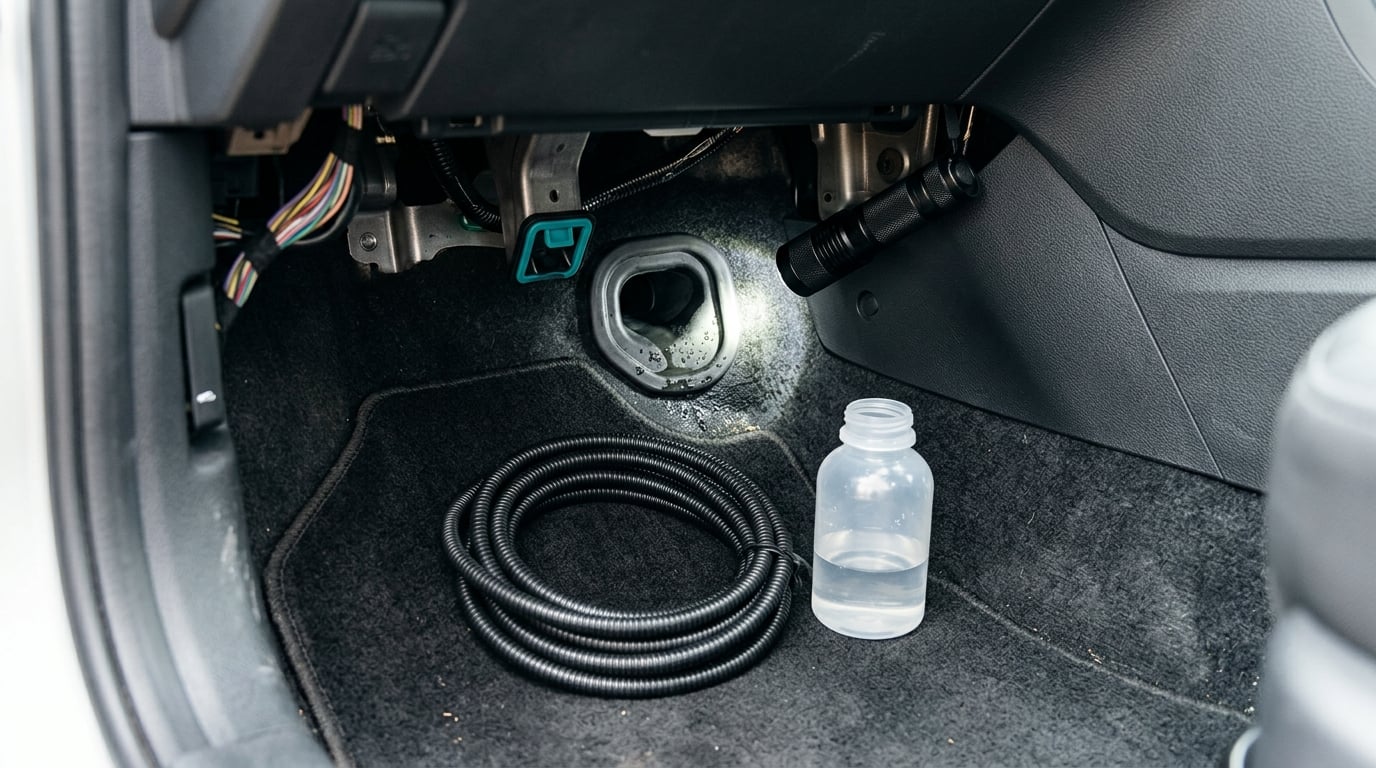
A blocked evaporator drain is the single most common reason a car air conditioner dumps water onto the passenger floor. To clean the car AC evaporator drain, find the small tube that carries condensation out of the HVAC case, clear it gently with a flexible cable, then flush it with lukewarm water and confirm it drains freely. On most cars this takes about 30 minutes and needs only hand tools.
There are two drain layouts in circulation, and confusing them is why plenty of people give up halfway. Most sedans and SUVs route a rubber hose through the firewall and drip onto the road underneath. Many European models, including a good share of BMWs, drain inside the cabin through a valve tucked behind the glove box, which is a harder job but not a dealbreaker.
Before you start, note one thing about a damp footwell on a newer car. If the vehicle is still under factory warranty, a clogged drain is treated as a covered defect in a lot of cases, so filing the claim first costs you nothing and saves the argument later.
Table of Contents
- What You Need
- Step-by-Step: How to Clean the Car AC Evaporator Drain
- Common Mistakes
- Frequently Asked Questions
- Can I use vinegar to clean the car air conditioning evaporator drain?
- Where is the evaporator drain on most BMW cars?
- Do I need to remove the dashboard or evaporator to clean the drain?
- Why does water keep coming back after I clean the air conditioning drain?
- What is the black tube under the passenger side of my dashboard?
- Should I take my car to a mechanic if the drain is still clogged?
- Conclusion
What You Need
None of this is exotic. Almost every clogged drain on a car that has been driven through a couple of autumns comes clear with a flashlight, a flexible cable and a jug of water.
- A flashlight or headlamp, since the outlet is usually in shadow
- A flexible drain-cleaning tool, a soft flexible cable, or a straightened wire coat hanger with the ends rounded
- A bottle brush or a thin flexible pipe cleaner sized to the tube
- A small container or a catch pan to catch the water that comes out
- A clean rag or paper towels
- Gloves, because the condensate has usually picked up grime from inside the case
- Your owner’s manual, for the drain location and cabin filter interval
Optional but useful: an automotive foaming evaporator cleaner, if the ducts smell musty, and a shop vacuum with a paper towel taped across the inlet so no liquid gets pulled into the motor. Tool access and drain placement vary widely by model, so check the manual before you buy anything.
Step-by-Step: How to Clean the Car AC Evaporator Drain
Confirm the Problem Comes from the Drain
The telltale signs are water on the passenger floor mat, a damp or stiff carpet that never dries, a sour or musty smell that gets worse when the air conditioning is on, and a puddle that appears within a few minutes of shutting the car off. A sloshing sound when you turn the corners means there is standing water somewhere in the case.
Not every leak is condensation, so check before you disconnect anything. Condensation is clear, odourless and slightly cool. Coolant is usually coloured, smells sweet, and feels sticky on your fingers. A high-pressure mist that fades quickly is refrigerant rather than water. If the liquid is sticky or smells sweet, stop and take the car in.
Weak cooling is a different problem entirely. If the air blows fine cold while driving but goes warm at a stoplight, that points to airflow, refrigerant charge or a hot engine bay, not a drain.
Locate the HVAC Drain Outlet
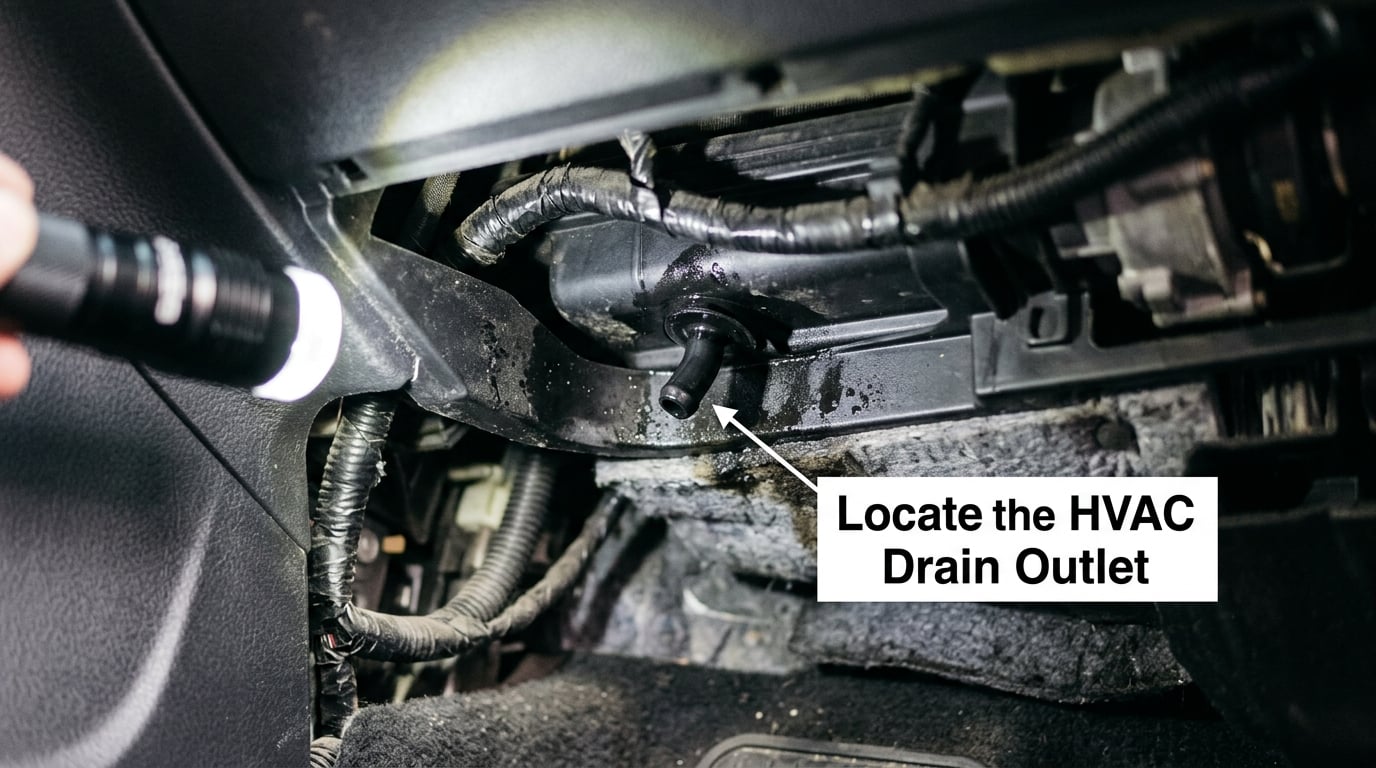
Start with the owner’s manual, which usually has a diagram of the HVAC case and the drain routing for your exact model. After that, work from the two common layouts.
A firewall outlet is the usual case in North American sedans and SUVs. Crouch beside the car on the passenger side, look up under the carpet at the base of the firewall, and follow a short rubber or plastic tube until it meets the body. The tube usually ends in a downward-facing nozzle a few inches off the ground, and you will often see a faint damp patch on the pavement beneath it when the air conditioning has been running.
A cabin drain valve sits inside the HVAC case, usually behind or beside the glove box, and discharges into a tray rather than outside the car. Reaching it means removing the glove box and sometimes a lower side panel. On a car with this layout the water that backs up is what soaks the passenger footwell carpet.
Do not confuse the drain with the fresh-air intake. The intake is wide, sits behind a grille, and pulls in outside air, while the drain is a narrow tube or a small valve that leaks water. If you find a mouse nest in either area, remove it carefully and expect the drain to be blocked behind it.
On BMWs, the location genuinely varies by generation and body style. Some route a hose out through the firewall near the front wheel arch, others drain into the cabin case. Treat any generic photo as a hint and use the manual diagram as the authority for your specific chassis.
Remove Blocked Debris and Flush the Drain
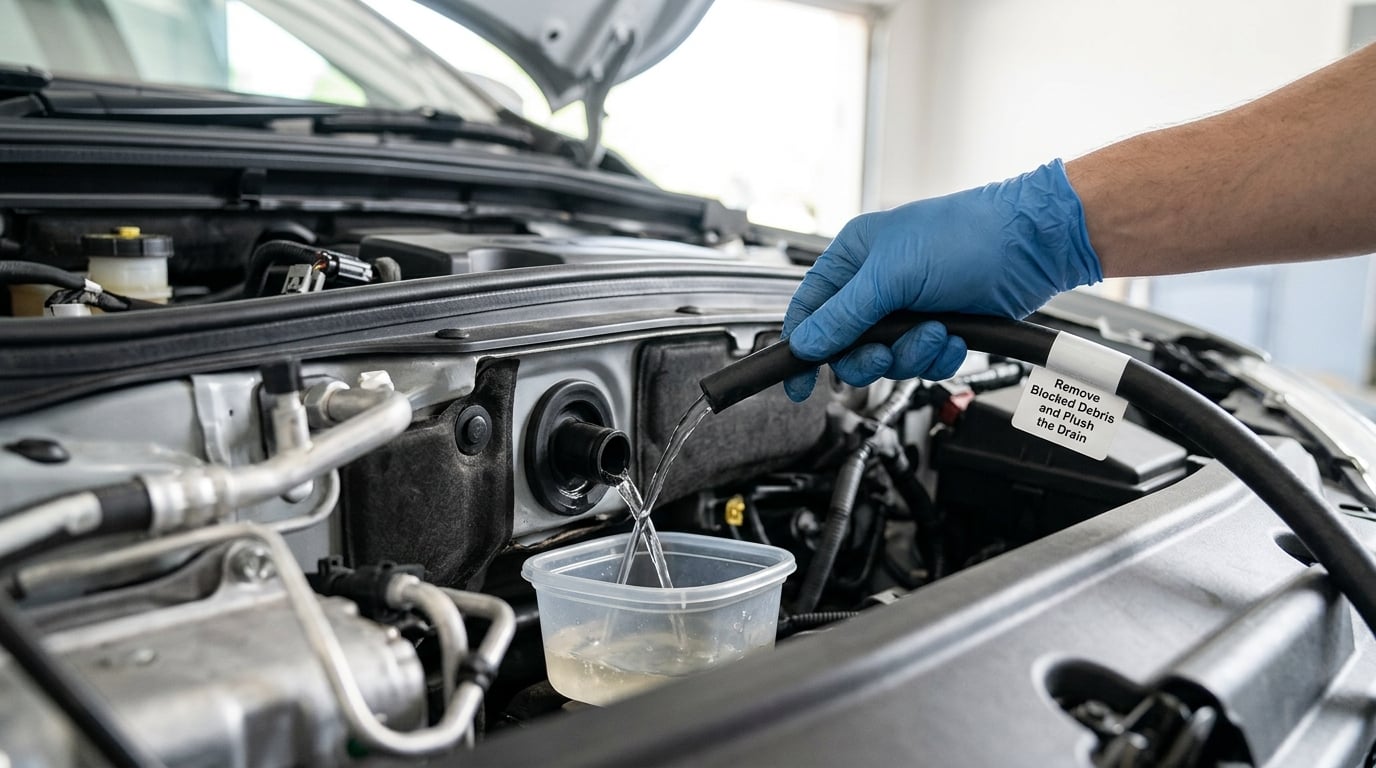
Work on the drain gently. The tube is thin plastic, often softened by heat and age, and the evaporator fins and drain pan sit directly behind it.
Feed the flexible cable into the tube a few inches at a time, rotating it as it goes, and pull the blockage back out rather than pushing it deeper. A bottle brush works well for soft slime. Pull the debris out at the outlet end, because pushing it further in only relocates the problem and the symptom comes back within weeks.
Then flush. A slow, steady stream of lukewarm water through the tube washes out the remaining film, and running the heater on high for a few minutes first helps loosen greasy residue. Stop as soon as the water clears and drains freely. You want the tube to be empty when you finish, not full.
Skip the high-pressure sprayer, boiling water, chemical drain openers, bleach, and anything sharp. High pressure splits the tube or blows it off the case, boiling water warps plastic, and harsh chemicals damage foam seals and the evaporator coating.
Dry and Test the Drain
Remove any standing water from the footwell and let the climate system sit idle for a few minutes. Then start the engine, set the air conditioning to cold with the fan on medium, and watch the outlet while the system runs.
You should feel air being drawn in at the outlet, and any water you pour through the tube should show up and exit rather than backing up. If you want a real test, pour a measured amount of water into the drain pan or tube and watch it leave the outlet end within a minute. If the water sits, the blockage is still there and the flush is not complete.
A cabin valve installation is verified the same way, only from inside the case. If the valve does not seat or opens freely, water stays in the tray even with a clear tube, and that is a part replacement job rather than a cleaning job.
Clean the Drain Tray and Check the Cabin Filter
Where the vehicle allows access, open the glove box and lift out the cabin air filter or the tray access panel. Vacuum out leaves, dust and grey slime from the tray by hand, staying well clear of the heater core hoses and the electrical connectors that sit nearby. If you use a shop vacuum, tape a paper towel over the inlet so liquid cannot reach the motor.
Inspect the cabin filter while you are there. A dirty filter sheds debris straight into the case, and it is also what gives a musty duct smell that returns no matter how clean the drain is. Replace it if it is torn, matted or dark grey, following the interval in your manual. If the filter housing does not seal properly, or the filter is left sitting wet, that alone can overflow the tray.
Foaming evaporator cleaner is worth using at this point for odour, sprayed into the intake as the blower runs on high, with the outlet open and the car parked outdoors. It treats the smell on the coil and drain pan. It does not fix a blockage, so use it after the drain flows, not instead of clearing it.
Address Leaks and Prevent the Blockage Returning
If water still appears after a clean drain, the cause is elsewhere. A dirty tray or a filter that does not seat causes overflow. Water arriving from above the HVAC case, from a disconnected hose, or from a cracked or detached drain tube means the leak has nothing to do with a blockage.
One easy check worth doing: a clogged battery tray drain has put water in the passenger footwell on some cars, so look under the battery too if the puddle keeps coming back with the air conditioning off.
To keep it clear, flush the drain with lukewarm water once at the start of cooling season and watch the outlet to confirm it flows. Keep leaves out of the cowl intake, replace the cabin filter on schedule, and after heavy rain park over a puddle for a minute with the air conditioning on cold to rinse the case. A spring or early summer flush also clears the pollen and dust that settle in the pan.
Then dry the cabin properly if it has been wet. Pull the floor mats, lift carpet edges, run the blower on high without the air conditioning for an hour or two, and leave windows open if the car is parked in sun. Standing moisture in carpet and case foam grows mould, and that is the odour that makes people think the drain is still blocked. A technician is the right call when the outlet cannot be reached, the tube is cracked or disconnected, the valve will not seat, or the floor stays wet after everything above.
Common Mistakes
Spraying cleaner into the dashboard vents. Aerosol sprayed into a vent can wet the evaporator and the case foam, and some propellants damage plastics. Foaming cleaner is meant to be used with the blower running and the system discharging outside, following the can’s instructions. It is not a drain cleaner.
Using boiling water. It warps plastic tubes and the tray lip, and the heat can lift seals. Lukewarm or cool water does the same job.
Over-pressurising the drain. A pressure washer or a stubborn blast of shop air can split the tube or knock it off the case, turning a small job into a case replacement. Low-pressure air and a slow flush are enough.
Pouring in bleach or chemical openers. These corrode metal fittings, attack foam seals and damage the evaporator coating. Clean lukewarm water, or water with a small amount of white vinegar for slime, is sufficient.
Forcing a rigid wire deep into the drain. A stiff wire can puncture the tube or break it off inside the case, which is far worse than the original clog. Use something flexible with rounded ends, and stop if it meets resistance.
Assuming every car has the same drain location. Especially on BMWs, where the routing changed across generations and body styles. Guessing means working on the wrong side of the car or the wrong component entirely.
Leaving the filter or tray wet. A filter installed damp, or a tray that was rinsed but not given time to drain, will overflow again. Dry everything before reassembling, and run the blower on high for a few minutes afterwards.
Frequently Asked Questions
Can I use vinegar to clean the car air conditioning evaporator drain?
Yes, in a small amount. A solution of roughly one part white vinegar to four parts lukewarm water is safe for the drain tube and tray, and it is effective against the greasy film that causes musty smells. Never use it undiluted, and skip it entirely if your vehicle uses a coated evaporator. Do not combine vinegar with bleach. For a plain blockage, clean water does the job just as well.
Where is the evaporator drain on most BMW cars?
It varies by generation and body style, so check the diagram in your owner’s manual. Some BMWs route a short hose through the firewall on the passenger side and discharge onto the road. Others use an internal drain valve inside the HVAC case, reached by removing the glove box. Neither layout is universal across the range, which is why a generic photo of one BMW is not a reliable guide for another.
Do I need to remove the dashboard or evaporator to clean the drain?
Usually no. If your car has a firewall outlet, you can reach the tube from underneath the car and clear it without removing anything inside. Cars with an internal drain valve need the glove box off, and sometimes a lower trim panel, but the dashboard and evaporator stay in place. Removing the evaporator is only ever a job for a technician, and it is rarely necessary to fix a clogged drain.
Why does water keep coming back after I clean the air conditioning drain?
Common reasons are that debris was pushed deeper instead of pulled out, the cabin filter is dirty or not seated, or the water is not coming from the drain at all. A cracked or disconnected drain tube, water dripping from the HVAC case, and a clogged battery tray drain can all put water in the passenger footwell. If the puddle returns with the air conditioning switched off, suspect something other than the drain.
What is the black tube under the passenger side of my dashboard?
It is almost certainly the evaporator drain hose, which carries condensation out of the HVAC case so it does not collect inside the car. Depending on the model it either discharges onto the ground through the firewall or feeds a small internal valve. A second possibility is the cabin blower drain or a wiring conduit, so confirm it by tracing it and checking for water before you cut into anything.
Should I take my car to a mechanic if the drain is still clogged?
Yes, if the blockage sits deeper than your cable reaches, if the tube is cracked or has come loose from the case, or if the internal valve will not open and seat. Those repairs need the glove box apart and sometimes the case opened, which is beyond a garage job. If the car is under warranty, file the claim before paying anyone, because a clogged drain on a new vehicle is often covered.
Conclusion
Start by opening the owner’s manual and finding the drain diagram for your exact model, then look for the tube on the passenger side either at the firewall or behind the glove box. Clear it with a flexible cable, pull the debris out rather than pushing it deeper, and flush slowly with lukewarm water. Finish by pouring a measured amount of water through and watching it exit the outlet, which is the only reliable way to know the drain is genuinely clear.
If you cannot reach the outlet, the tube is cracked or detached, the valve will not seat, or the carpet stays damp after a thorough dry-out, hand it to an HVAC technician. On a car still under warranty, file the claim before opening any tools.