
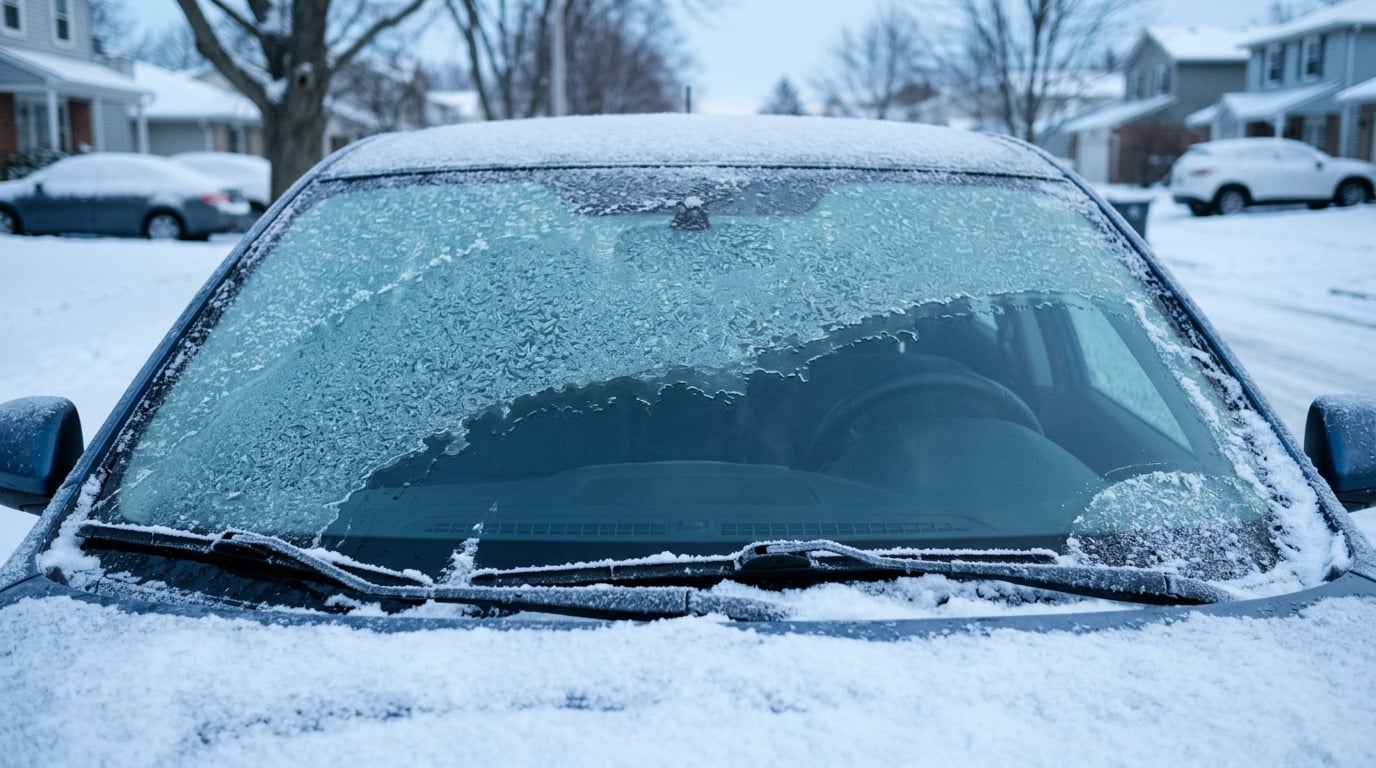
Your defroster takes so long because it has no heat source of its own. It borrows heat from engine coolant, so it cannot clear frost until the engine reaches full operating temperature, and a stuck thermostat, low coolant, a clogged heater core, or weak airflow stretches that wait well past 20 minutes. Here is how to tell which one you have.
That single fact explains almost every complaint I see about slow defrosting, including the ones where the rear window clears in minutes and the windshield does not.
Table of Contents
- Why Does My Defroster Take So Long?
- How Does a Car Defroster Work?
- What Are the Most Common Causes of Slow Defrosting?
- How Can You Tell Whether the Problem Is Airflow or Heat?
- How Do You Fix a Slow Front Defroster?
- How Do You Fix a Slow Rear Defroster?
- What Should You Do Before Driving in Cold Weather?
- Frequently Asked Questions
- Why does my defroster take so long to clear the windshield?
- Is it normal for a defroster to be weak while the engine is warming up?
- Why is my rear defroster not working but the front defroster is?
- Can a clogged cabin air filter make the defroster slow?
- Does using the defroster drain fuel or shorten engine life?
- How often should I check the defroster on a BMW?
- Conclusion
Why Does My Defroster Take So Long?
The direct answer is engine warm-up time. Hot coolant has to reach the heater core behind your dashboard, and that only happens once the thermostat opens at operating temperature. Everything that slows the engine down, or keeps hot coolant away from the core, adds minutes to the wait.
The other half of the answer is that front and rear defrosting are two different systems with very different physics. The rear window uses a resistive grid printed into the glass, so the ice touching the glass melts almost immediately once current flows. The windshield has no grid at all, which is why defrosting it means blowing warm, dry air across a large area of cold glass, and why it is slower by design.
Here is roughly what owners report as normal. Owners on the cherokeetalk forum describe 7 to 10 minutes at idle versus about 5 minutes while driving in 32°F weather, which matches what I have seen in my own cars. A r/fordfusion owner in a colder climate reported 45 to 50 minutes on full blast, and toyotanation owners describe 20-plus minutes at idle.
Those numbers are not a spec sheet. They are a sanity check. The point is that anything still cold after 15 minutes of driving in ordinary cold weather, with a healthy gauge and hot hoses, deserves a look.
How long defrosting should take at a given temperature
These are typical figures for a passenger car with a functioning cooling system and a clean cabin filter. Sub-zero numbers assume a hard frost on the glass.
| Outside temperature | Idling in the driveway | While driving | Slow if still fogged after |
|---|---|---|---|
| Around 40°F | 5 to 10 minutes | 3 to 5 minutes | 15 minutes |
| Around 32°F | 10 to 15 minutes | 5 to 8 minutes | 20 minutes |
| Around 0°F | 20 to 30 minutes | 10 to 15 minutes | 30 minutes |
| Around -20°F | 30 to 45 minutes | 20 to 30 minutes | 45 minutes |
Idling always loses to driving. A stationary idling engine makes far less heat than one running under load, which is the single most common reason owners assume a healthy car is broken.
How Does a Car Defroster Work?
The path is short and worth knowing, because each step is a place the system can fail. The engine heats coolant, the thermostat opens once the engine is at operating temperature, hot coolant flows into the heater core, and the blower motor pushes cabin air across that core and out through the defroster ducts at the base of the windshield.
The heater core is a small radiator. That is the whole trick: the cabin has no furnace, only a heat exchanger borrowing engine heat.
Two more parts matter for visibility. The blend door actuator and heater control valve decide how much of that heated air reaches the windshield outlets instead of the dashboard vents, and on many cars a failed actuator gear means the doors sit in one position and heat never gets to the glass at all.
The air-conditioning system is part of defrosting too, which surprises people. The A/C compressor pulls moisture out of the air, so running the compressor in heat mode is what clears fog and condensation from the inside of the windshield. Without it you can melt frost and end up with fog instead. Owners on r/FordFocus and r/crv point this out constantly, and it is the most useful free fix on this list.
What Are the Most Common Causes of Slow Defrosting?
Ordered from what I find most often to what is genuinely uncommon.
1. Recirculate left on
Recirc pulls cabin air, moisture and all, back through the vents. With the doors closed and the cabin wet, the defroster reheats the same damp air. The top-voted answer on r/crv and r/CX5 is simply to switch to fresh air. Costs nothing, fixes a surprising share of cases.
2. Clogged cabin air filter
A filter packed with dust, pollen or road grit chokes airflow. There is no warning light for this, and the only symptom is a defroster that blows weakly and quietly. Most manuals show a filter access panel behind the glovebox or in the footwell.
3. Weak blower motor or fan resistor
Airflow is the delivery mechanism. A blower that has lost a bearing sounds like a faint whir instead of a roar, and a failed resistor usually means you only get the lower fan speeds. Many cars without a manual blower also use the A/C compressor and the defroster together, so a weak compressor knocks out both.
4. The engine never reaches operating temperature
Short trips, a weak battery, or a car idled for twenty minutes without driving leave the coolant lukewarm. If the temperature gauge never settles in its normal position, the defroster is not broken, it is just waiting.
5. Stuck-open thermostat
The thermostat is supposed to block coolant until the engine is warm. Stuck open, it lets coolant through from the first second, so the engine runs cool, the gauge never climbs, and the heater core stays barely warm. This is a shop job.
6. Low or leaking coolant
Check the expansion tank cold, before you start the car. A sweet smell at the vents, a damp passenger-side carpet, or a puddle under the car overnight all point at a leak. Losing coolant eventually cooks the engine, so this one stops the troubleshooting and starts the repair.
7. Clogged heater core
Debris, corrosion and electrolysis build up inside the core until little coolant passes through it. The clue is heat that is fine at idle and weak at highway speed, where flow through the engine is much higher. A pressure test and a flow check are how a shop confirms it.
8. Broken defrost actuator gear or faulty sensor
On r/fordfusion a recurring failure is a plastic defrost actuator gear that snaps and leaves the doors in one position. No heat fault at all, just no heat at the windshield. On mazdas247 owners complain the fan output stays weak even when heat is clearly present.
Also worth ruling out: the glass itself
Dirt, road salt, wax and pitted glass all slow clearing, and clogged drain holes at the base of the windshield trap moisture against the glass. None of this is a mechanical fault, and all of it is free to fix with a clean and a scratch remover.
How Can You Tell Whether the Problem Is Airflow or Heat?
Split the system in half. Airflow problems feel weak, heat problems feel cold. This sequence takes about ten minutes in a parking lot.
Start the car, set the fan to high, temperature on hot, and air on fresh. Put your hand at the defroster vents, not the dashboard vents. If the air is moving but cool, the blower is working and the heat side is the problem. If the airflow itself feels thin, you have an airflow problem and no need to touch the cooling system.
Then check the engine state. Watch the temperature gauge until it reaches its normal reading, and compare how long that takes to how long the cabin takes to warm. Feel the two large heater hoses at the firewall: if both are hot once the gauge is up, coolant is reaching the core. If the engine is at temperature and both hoses are cool, suspect the thermostat.
Note whether every outlet is weak or only the windshield. Cold dashboard vents with warm defroster vents means the blend door or control valve is misrouting the air. Weak everywhere means the blower or the filter.
Finally, compare idle with driving. A car that heats well at 45 mph but not while idling is telling you something about coolant flow or a control strategy, not a dead blower.
How Do You Fix a Slow Front Defroster?
Start with the free stuff, in this order.
Switch recirculate off, run the A/C compressor in heat mode, and set the fan to high. Open the dashboard and side vents fully so nothing chokes the path, and aim at least two of them at the windshield. Clear snow and ice off the cowl grille at the base of the windshield, because a blocked intake starves the defroster ducts of air no matter how hot the air is.
Then drive. Cold-idling in the driveway for twenty minutes is the least effective way to warm an engine, and it burns fuel for it. A steady highway drive on a cold morning typically beats a long idle by a wide margin.
Next, replace the cabin air filter if it is more than a year old. It is a cheap part, usually behind the glovebox, and the manual shows the panel. Clean the inside of the windshield with glass cleaner rather than warm breath, which just adds another layer of moisture.
Past that, it is a shop. A stuck thermostat, a leaking heater core, a failed blend door actuator, a weak compressor or an electrical fault needs the pressure test, scan tool and wiring access that a driveway does not have.
How Do You Fix a Slow Rear Defroster?
The rear window is a different repair. It uses heating lines bonded between the layers of glass, driven by current through a relay, usually on a timer of 10 to 15 minutes. Check the owner’s manual for the fuse rating and relay location, then test the fuse.
Broken grid lines are recognizable: horizontal or vertical streaks where frost and condensation refuse to clear, while the rest of the glass behaves normally. A window that stays completely cold everywhere means no power is reaching the grid, which points at the fuse, the relay, the button, or vehicle electronics, not at damaged lines.
Grid damage itself is not repairable at home. There are clear grid repair kits, but the honest answer for a laminated rear window with damaged lines is replacement, and on some vehicles the glass is expensive enough that it is worth a quote first.
Do not drill into the glass, sand it, or bridge damaged lines with wire. It rarely holds, and it can turn a small defect into shattered glass. Likewise, do not bypass or jumper any defroster wiring. If the system needs power it is not getting, a shop should trace it.
What Should You Do Before Driving in Cold Weather?
Clear the outside of the glass first. A scraper and a de-icer clear frost in seconds that hot air would spend ten minutes on, and heat applied to a frosted windshield melts the frost before the glass can take the stress of a scraper.
Start the car, switch off recirculate, turn the compressor on, set heat and high fan, then drive rather than idle. Keep the vents aimed at the glass and the dashboard vents closed so all the air goes forward.
On genuinely deep frost, budget the extra time. Plan to be on the road five minutes later than normal, because clearing a windshield at 0°F in a parked car is slow by physics, not by fault. In snow, clear the cowl and the drain holes at the base of the windshield.
And know your limit. If glass stays unclear after driving for fifteen minutes, the safe move is to pull over, wipe what you can and drive slowly with the windows cracked, rather than guess. A partly clear windshield with airflow across it is workable. A guessed-at one is not.
Frequently Asked Questions
Why does my defroster take so long to clear the windshield?
Because the front defroster has no heating element. It blows air heated by engine coolant, so it cannot clear frost until the thermostat opens and the engine reaches operating temperature. Add a clogged cabin filter, a weak blower or a clogged heater core and the wait easily passes twenty minutes. The rear window uses a glass grid, which is why it clears in minutes.
Is it normal for a defroster to be weak while the engine is warming up?
Yes, and it is the most common explanation. Until the gauge settles in its normal position, the coolant is still warming and the heater core cannot produce much heat. A car idled in the driveway can take longer than one that is driven. Weak heat that persists after the engine is fully warm is a fault, not a warm-up delay.
Why is my rear defroster not working but the front defroster is?
The rear window runs on its own fuse, relay and timer, and can fail without touching the heater system at all. Frost clearing in streaks points to broken grid lines, which means a new window. A window that stays completely cold everywhere means no power is reaching the grid, so check the fuse and have the relay and wiring traced.
Can a clogged cabin air filter make the defroster slow?
Yes, and there is no warning light for it. A packed filter restricts airflow, so the defroster blows quietly and weakly even with the heat working perfectly. The symptom is thin airflow at the windshield vents rather than cool air. Most manuals show a filter access panel behind the glovebox, and the part is cheap.
Does using the defroster drain fuel or shorten engine life?
The blower, compressor and heater all add load, but the bigger cost is idling. Sitting in a driveway with the engine running for twenty minutes burns fuel with little heat produced, because an idling engine makes far less warmth than one under load. Driving gently for the same period warms the cabin faster and uses less fuel.
How often should I check the defroster on a BMW?
Check it once a year before winter, and test both the front vents and the rear window grid. On most BMWs from the last two decades the common failures are a cabin filter behind the glovebox, a weak blower motor, or a heater control valve and actuator that can stick. Checking at the start of the season means a weak symptom gets looked at before you need it.
Conclusion
Start with the two checks that cost nothing: switch off recirculate, run the A/C compressor, and compare the temperature at the defroster vents against the state of your temperature gauge. Warm air with a fully warm engine means airflow, so look at the cabin filter and blower. Cool air with a warm engine means heat, so look at coolant level, then the thermostat and heater core.
And remember that the windshield is always going to be slower than the rear window. That difference is built into the design, not a symptom of anything.