
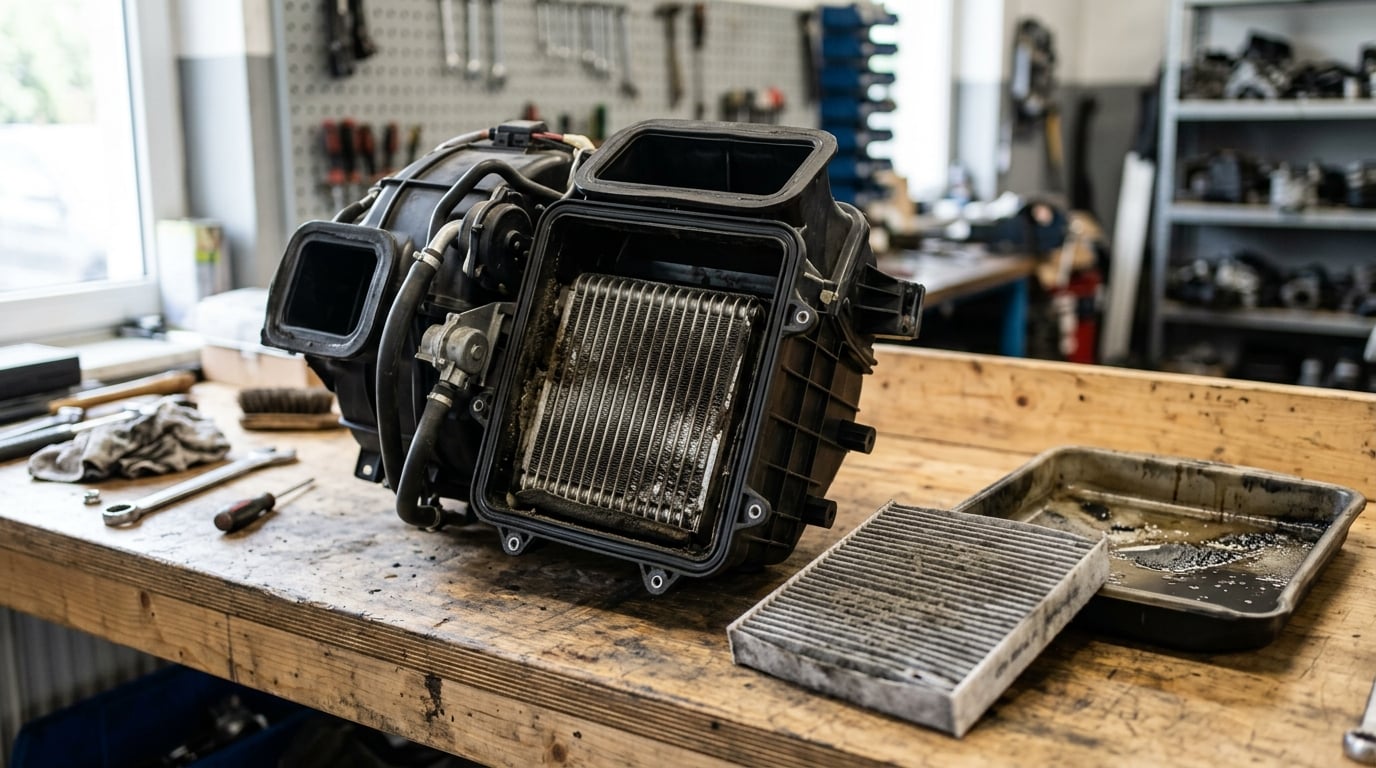
If your air conditioner smells like vinegar, the smell is almost always mold, mildew, or bacteria growing on damp metal inside the unit — usually the evaporator coil, the condensate pan beneath it, or a drain line that has partly clogged. It is a moisture problem, not a burnt-out component, and most of it is fixable in an afternoon.
The odor gets worse in humid weather, hits hardest in the first minute of airflow, and can come from a home window unit, a split system, or a car’s evaporator. Before you buy any cleaner, spend five minutes confirming the source is the AC and not a battery, a coolant leak, or a spilled bottle of vinegar under the seat.
Table of Contents
Why Does My AC Smell Like Vinegar?
The short answer is condensation plus dust plus time. Any air conditioner pulls warm air across a cold coil, and moisture in that air condenses onto the fins as liquid water. That water collects in a shallow pan and drains away through a line.
When the unit shuts off, the coil stays wet for a while. Dust, skin cells, pollen, and cleaning-product residue settle into those wet fins and pan, and microbial colonies establish themselves there. Run the system again and the blower pushes air straight across that growth, carrying the odor into the cabin or the room.
The “vinegar” part is real chemistry, not your imagination. Microbes metabolize the organic film and produce organic acids, so the smell reads as sour and sharp rather than earthy. The same mechanism explains why the odor is so much more noticeable in the first thirty seconds, then fades as the coil dries and the blower clears the concentrated smell out of the ductwork.
One hint from the TacomaWorld forum: owners there describe the same pattern, running the fan on fresh air rather than recirc and finding the odor is worst for the first half minute. That is a coil problem, not a duct problem.
There is a second, less common family of smells here. A failing blower motor, corroded wiring, or electrical arcing can emit ozone, which is sharp and metallic. It is not the same odor, and it deserves different handling.
Why Does My AC Smell Like Vinegar After the Car Sits?
Because the whole system is a closed, damp box while it is parked. Water that formed during the last cooling cycle has nowhere to go, the evaporator stays wet, and the interior air is warm and still. A NissanClub thread put it plainly: the mold smell comes from water sitting in the system after the car is switched off.
Two things make the first minutes so loud. Recirculate mode pulls cabin air that already carries odor back through the coil, so the smell compounds. And the blower at full speed on startup moves more air per second than it will for the rest of the cycle, stirring up the growth on the fins and blowing it into the cabin before the coil warms enough to dry.
High humidity makes all of it worse. In humid air there is more water condensing on the same coil, so a car that sits outside in summer humidity can develop a strong odor overnight even if the drain is working. The cabin air filter matters too: a wet, dirty filter holds moisture against the fins and adds its own dust load.
The odor can also show up on the heat side. Owners on a Kia forum reported a vinegar smell from the vents every time the heat was switched on, which points at a wet evaporator or blower housing rather than anything specific to cooling mode.
The Most Likely Causes of a Vinegar Smell
Ordered from common to urgent, these are the possibilities, with the clue each one leaves behind.
Mold or bacteria on the evaporator coil and condensate pan
The most frequent cause by a wide margin. The fins and the pan turn grey, green, or black, and the drain outlet is slow or nothing comes out at all. You will often find a black, slimy film in the pan if you can reach it. On a window or portable unit this is exactly what people find when they open the case, as the surviving top comment on the r/hvacadvice thread describes: condensation, then black goop in the coils.
A dirty or failing air or cabin-air filter
A saturated filter traps dust, pollen, and moisture, and it does it right against the coil. Clogged filters also cut airflow, which slows the coil’s drying time. A filter that is visibly grey, bent, or has been in place well past its service interval is worth replacing before anything else.
Smoke or chemical contamination
Cigarette smoke, vaping residue, spilled cleaning products, paint fumes, and stored solvents all deposit on the coil and get coated by the same condensation film. The smell tends to be strongest in recirculate mode and often changes character after a car wash or a new bottle of air freshener.
Weak battery acid or battery terminal corrosion
Weak battery acid has a genuinely sharp, vinegar-like smell, and corrosion on the terminal can leak a faint mist of it. This is the one home-A-C-adjacent answer that does not apply to your house unit but does to your car, and it is worth ruling out. Clues: white, blue-green, or powdery crust around the battery posts, a corrosion smell at the front of the engine bay rather than through the vents, dim headlights, slow cranking, or a battery warning light.
Coolant or refrigerant-related leakage
Engine coolant is a sweet smell, and it is unmistakably different. Refrigerant loss is harder to smell on its own, but an undercharged system can freeze the evaporator in spots, which traps moisture and promotes growth, and a leak can carry an oily film into the airflow. Clues include reduced cooling output, a low-pressure gauge reading, a visible stain, or a puddle under the car. None of that is a do-it-yourself job.
Moisture intrusion and other residue problems
Water tracked in on wet carpets, a blocked cabin drain, a leaking headliner, a wet trunk, or an interior that was never fully dried after a wash all create the damp conditions the bacteria need. Sometimes the smell is not the AC’s fault at all.
How to Check Whether the Smell Is Mold or a Fluid Leak
Work through this in order, with the vehicle off and the key out for anything involving the engine bay. It takes about ten minutes and it will tell you whether you are dealing with a cleaning job or a repair.
- Turn the AC off at the controls and wait. If the smell fades within minutes, it is coming from the air path.
- Start the system on fan-only, low speed, and breathe at each vent in turn. The vent that smells strongest tells you where the coil is in the vehicle.
- Check the cabin-air filter location listed in your owner’s manual and look at the filter. Many manuals allow access; some do not, and forcing the housing can crack the case.
- Look under the dashboard and driver-side footwell for dampness, discoloration, or a water stain on the carpet or the pad. Wet carpet in a spot the air does not reach is not an AC problem.
- Open the hood and look at the battery. Note any crust, whitening, green-blue powder, or a wet film around the posts. Corrosion and dampness on top of a battery mean stop, and do not touch it bare-handed.
- Check for coolant under the car after it has been parked, and look for colored residue at the radiator or condenser.
- Compare the smell with the windows open and the ventilation set to fresh air. A duct- or cabin-source smell does not change much; a coil smell changes noticeably as the air path is disturbed.
Use this symptom checklist to match what you notice against what it usually means:
- First 30 seconds, then fades — a wet coil being stirred by startup airflow. Check the cabin-air filter and drain flow first.
- Steady the whole time it runs — heavy growth in the pan, blower housing, or ductwork. Look at the coil and pan condition.
- Only in recirc mode — a cabin or evaporator source rather than fresh-air ductwork. Check the cabin filter and blower housing.
- Worse after rain or humidity — more condensation plus slow or blocked drainage. Check the condensate drain and pan.
- Sharp smell near the engine bay with corrosion crust — battery acid, not mold. Check the battery terminals and battery condition.
- Sweet smell, visible fluid, weak cooling — a coolant or refrigerant issue. Qualified technician only.
- Wet carpet away from the vents — water tracked in rather than an AC leak. Check the carpet, trunk, and seals.
- Comes with the heater, not the AC — a shared heater core or blower housing. Check the blower housing and evaporator.
Stop and step away from the diagnosis if you find pooling water, visible leakage, a warning light, a burned or melted wire, or a chemical odor strong enough to sting your eyes or throat. Those are not cleaning problems.
How to Remove the Vinegar Smell from Your Car AC
Do these in order, and follow your owner’s manual for access and any cleaning product it specifies. A non-approved cleaner can damage the coil coating or the blower housing plastic.
- Switch the vehicle off and remove the key. Open a door or two to ventilate while you work.
- Replace the cabin-air filter if the manual allows access. Set the old one aside; if it is grey and damp, that is your answer for the moment.
- Inspect the condensate drain beneath the HVAC case. Clear the outlet of leaves and slime with a soft wire or a flexible plastic tube, never a stiff rod, and never compressed air that can push debris further in.
- Apply a manufacturer-approved evaporator or coil treatment to accessible surfaces only, following the label for dose and dwell time. Wear gloves and ventilate. Never mix bleach with vinegar, ammonia, or any other cleaner, and never mix two products at all.
- Wipe the accessible vents and the visible parts of the blower housing with a damp cloth and a mild solution, again with no product mixing.
- Run the blower on high with fresh air and the A/C on for at least 30 minutes to dry the coil, then another 15 minutes with the fan on high and the compressor off.
- Check again for dampness in the footwell and around the filter housing, and address whatever is putting water there.
Spraying something into the vents will not fix a contaminated filter, a battery leak, a coolant leak, or a blocked drain. It only moves the smell around for a day or two, and it is the most common reason people think their car has been cleaned and the smell simply comes back.
For a window or portable home unit, the same logic applies and the access is easier. Unplug it, pull the filter, rinse or replace it, and clean the wet fins and drip tray with a diluted mild detergent and a soft brush. Let the tray dry completely before reassembling.
When Is the Smell a Safety or Repair Problem?
A mild odor that clears after a filter change and a dry-out cycle is a routine maintenance issue. A smell that comes with fluid, corrosion, or a warning light is a repair issue, and it should go to a qualified automotive technician.
Do not handle a leaking or corroded battery yourself beyond looking at it from a distance. Battery acid causes burns, and disconnecting terminals on a modern vehicle can trigger airbag faults or lose settings. Keep water and metal tools away from it and let a professional deal with it.
Also leave these to a technician: anything involving the sealed refrigerant system, refrigerant recharge, an evaporator that is iced up, a blower motor that is noisy or seized, and wiring that looks melted, discolored, or brittle.
See a professional if the odor persists after a filter change and a proper clean, if water is pooling in the cabin, if cooling performance has dropped, if warning lights are on, or if the smell returns after every single heat-and-cool cycle. That last pattern points to an unresolved drain blockage or a persistent moisture source.
The odor itself is usually not an emergency. Mold spores and microbial byproducts can aggravate allergies, asthma, and sinus irritation, so children, older adults, and anyone with existing breathing conditions deserve a faster fix. But a mild vinegar smell is not the same as an acute hazard.
How to Prevent the Smell From Returning
- Replace the cabin-air filter on the schedule in your manual, or roughly every 10,000 to 15,000 miles, and never run a system with a filter that is missing or saturated.
- Keep the condensate drain and its outlet clear. Check the outlet after heavy rain or under a tree that drops debris.
- Run the fan after every cooling cycle to dry the coil, and avoid leaving damp gym gear, towels, or wet umbrellas in the cabin.
- Fix water leaks into the cabin: wet trunk seals, a leaky headliner, or a sunroof drain that backs up.
- Limit smoke in the cabin, and avoid spraying aerosol cleaners, solvents, or air fresheners near the vents.
- Use the car a few times a month. A unit that sits unused through fall and winter develops odor quickly when it comes back into service, which is why the smell often appears on the first hot day of the season.
- If the smell keeps coming back after each heat-and-cool cycle, have the drain and blower housing inspected rather than cleaning the vents again.
Frequently Asked Questions
Why does my AC smell like vinegar when the car starts?
The evaporator collects condensation every time the system cools, and while the car is parked that water sits on the fins. Warm, humid conditions encourage mold and bacteria in that standing moisture, and startup airflow pushes the odor through the vents before the coil dries. It is strongest in the first thirty seconds and usually fades after that.
Can I drive my car if the AC smells like vinegar?
If the odor is mild and there is no fluid, corrosion, warning light, or unusual electrical behavior, driving is generally fine. Switch the system to fresh air rather than recirc to reduce the smell. If you see pooling water, a crusty or wet battery, a sweet coolant smell, or any dashboard warning light, stop driving the HVAC system and get it checked first.
Will replacing the cabin-air filter get rid of the smell?
Sometimes, but not always. A dirty filter holds dust, pollen, smoke residue, and moisture right against the coil, so replacing it is the cheapest first step. If mold is established on the evaporator fins, in the condensate pan, or in the blower housing, a new filter will not clear it and you will need a proper clean.
Why does the smell remain after cleaning the vents?
Surface cleaning does not necessarily reach the evaporator behind the dashboard, the blower housing, or the filter. Contamination can also return quickly if the coil is not dried out afterward, because a wet coated coil re-inoculates within days. Run the system with the fan on high for at least 30 minutes to dry it fully, then reassess.
Is a vinegar smell from a car AC always mold?
No. Mold and bacteria are the most common explanation, but battery acid from a weak or corroded battery also smells sharp and vinegary, and coolant or refrigerant-related residue, smoke, and strong cleaning chemicals can all contribute. A GM-Volt thread put the drain at the center of most cases, so check the drain first, but rule out the battery before you start cleaning.
Start with the cabin-air filter and a look at the battery. If the odor is microbial, the coil, the condensate pan, and the drain are where it lives, and a filter plus a 30-minute dry-out cycle clears a surprising share of cases. If it comes back every time, the drain is blocked or water is getting into the cabin, and that is a technician job rather than a cleaning one.