
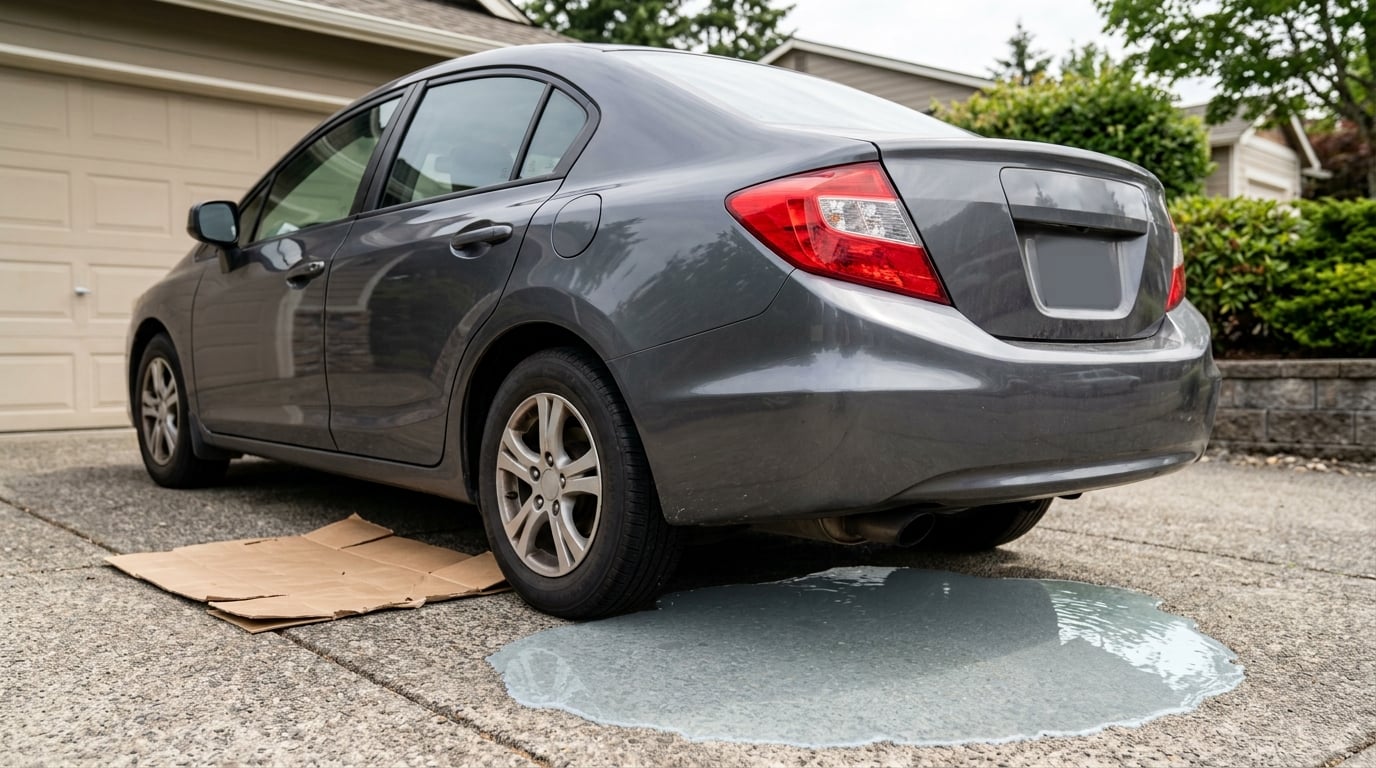
What causes a puddle under the car? Usually the air conditioning. Moisture in the cabin air freezes on the cold evaporator core behind your dashboard, and when you park, that ice thaws and drains out a small tube near the passenger side. That clear, odorless puddle is normal and needs no repair.
The second most common cause is exhaust condensation, a small amount of water that collects in the muffler and drips out the tailpipe or a rusted-through section. After that you are into real territory: engine oil, coolant, transmission fluid, power steering fluid, brake fluid, or fuel. Those are all colored, oily, or sharp-smelling, and they leave a residue on the driveway.
My rule of thumb is simple. Clear and odorless with no residue means nobody needs to touch the car. Anything that is colored, smells sweet or burnt, feels greasy, or grows while the engine is off needs a look. Below is how to sort all of it out in about ten minutes with a flashlight and a piece of cardboard.
Last reviewed in September 2026 by the Garage Boy shop team.
Table of Contents
- Is It Normal for a Car to Make a Puddle?
- How to Tell a Water Leak From Condensation
- What Causes a Puddle Under the Car?
- What Does the Location of the Leak Tell You?
- Why Is My Car Leaking Water After I Drive?
- What Fluid Is Leaking From My Car?
- Should I Keep Driving With a Puddle Under the Car?
- How to Find the Source of a Small Fluid Leak
- Frequently Asked Questions
- What to Do First
Is It Normal for a Car to Make a Puddle?
Yes, sometimes. A puddle of clear water with no smell, no color, and no oily film on the pavement is almost always air conditioning condensation, and plenty of owners find one every single morning.
The first check takes ten seconds: look at your driveway or concrete the next morning before you get in the car. If the spot is wet but leaves no tacky or greasy stain when it dries, you are looking at water, not fluid.
Timing tells you almost as much as color. Condensation appears after the car has been parked for hours with the air conditioning switched on, and it is heaviest on humid mornings. A leak that shows up in the same spot every time regardless of weather is a leak.
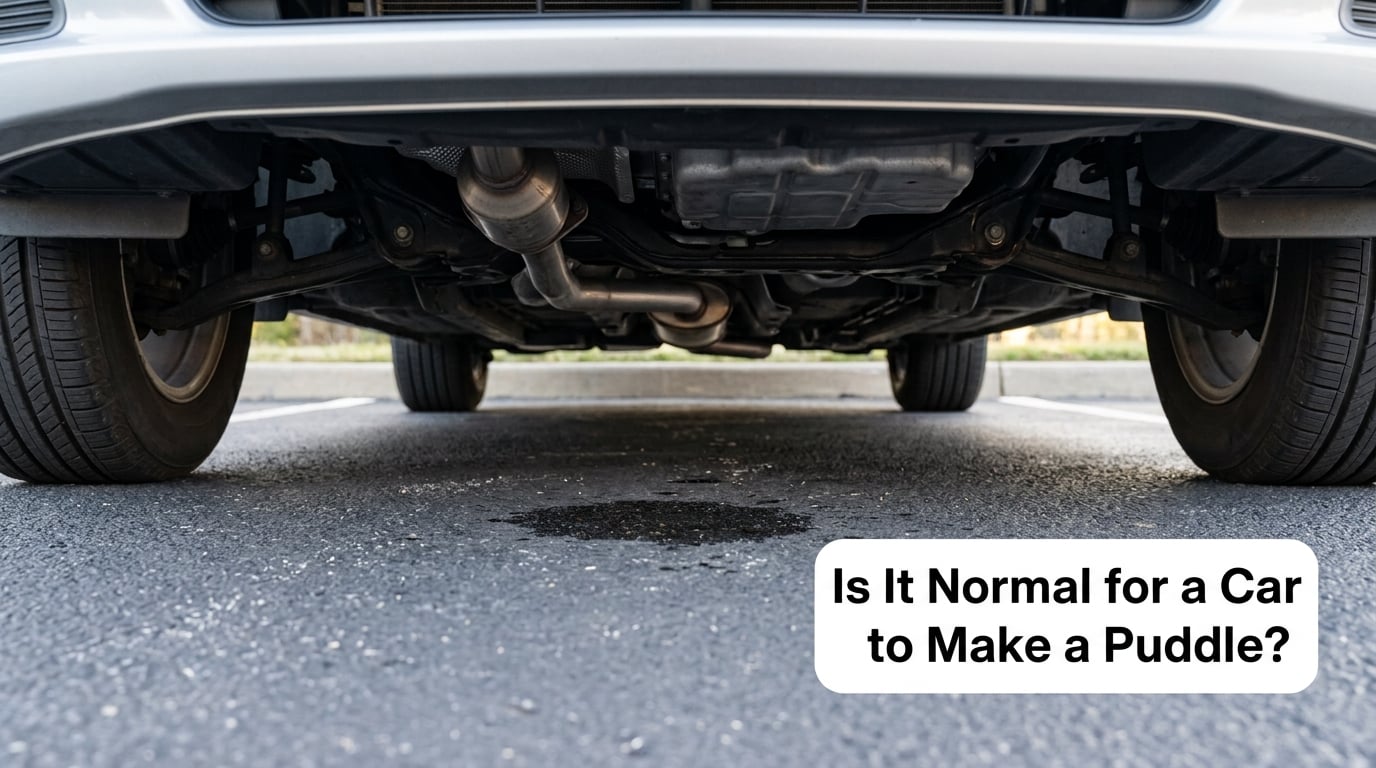
One more thing worth knowing: rain and car washes are red herrings. Water under a car that only appears after heavy rain or a wash is the same water that was sitting in body panels and wheel wells. The test is whether the spot comes back on a dry day with no rain.
How to Tell a Water Leak From Condensation
Run through these seven checks before you do anything else.
- Color. Condensation is water-clear. Anything amber, brown, black, red, pink, green, or milky is a fluid you care about.
- Smell. Condensation has no smell at all. Sweet means coolant, burnt means oil, sharp or fishy means transmission fluid, and a raw petrol smell means fuel.
- Texture. Water soaks into concrete and leaves a clean dry patch. Oil beads up and leaves a greasy film. Coolant is slippery and often leaves a faint colored tint.
- Temperature. Condensation drips are close to air temperature, sometimes slightly warm. A pressurized coolant leak can be hot enough to feel like a shower on your hand.
- Timing. Condensation only shows up after air conditioning use and only on a car that has sat. A real drip keeps going after the car is cold.
- Behavior while driving. If the puddle grows or the fluid level drops between fill-ups, something is going.
- Residue. Look at the edge of the puddle. Clear water leaves nothing. Engine oil leaves a dark, sticky mark that rain does not wash away.
What Causes a Puddle Under the Car?
Here are the nine causes, ordered from the most common and least urgent to the ones that stop your day.
1. Air conditioning condensation
Run the air conditioning long enough and the evaporator core drops below freezing. Water vapor freezes onto it, and that ice melts after you switch off. A drain trough collects the water and a tube under the passenger side of the dashboard sends it out below the car.
If that drain tube gets blocked with algae, leaves, or dust, water backs up and comes out under the headliner or onto the passenger floor instead. That is a cheap fix, and it is a common one on cars that are ten years old.
2. Exhaust condensation
A healthy exhaust system produces water as a byproduct, and that water collects in the lowest point, usually the muffler. It dribbles out the tailpipe when the car is warm.
The version that surprises people is a rusted-through section of pipe. On a r/MechanicAdvice thread about a mystery puddle, the top answer was simply that the exhaust system had holes in it, and that the leak was not a catastrophe but should still be repaired. Water in the exhaust can get into the cabin and foul the smell, and the corrosion keeps going if you leave it.
3. Rain and car wash water
Water sits in doors, wheel wells, and the trunk, then finds its way out over hours. It collects in the same spots every time and it is harmless.
4. Windshield washer fluid
A ruptured washer reservoir, a loose cap, or a cracked hose lets blue-tinted fluid run down the strut tower and drip from the fender well. It smells sharp and sweet, and it keeps dripping after the car is parked.
5. Engine oil
On a high-mileage engine, a slow seep from the valve cover gasket, the oil filter housing gasket, a camshaft seal, or the oil pan gasket is common. The puddle is dark brown to black, feels greasy between your fingers, and leaves a film.
Owners debate how much oil loss is acceptable, and mechanics on forums generally draw the line at a repeated need to top up between normal changes. A drip that beads up overnight is a gasket job. A faint film that does not grow is worth monitoring rather than panicking over.
6. Coolant
Green, pink, orange, purple, or blue coolant comes from the expansion tank, a radiator hose, the radiator cap, the water pump, the thermostat housing, the heater core, or a cracked radiator. It smells sweet, feels slippery, and often shows up as steam or mist in stop-and-go traffic when system pressure spikes.
This is the one to act on quickly. An empty coolant system running even a short distance can warp a cylinder head.
7. Transmission fluid
Red or amber fluid from a transmission pan, a cooler line, or a front seal is one of the most expensive puddles to ignore. It can smell burnt once the fluid is degraded, and a low level shows up as slipping gears or harsh shifts before the light comes on.
8. Power steering fluid and differential fluid
Both are usually red or amber, both are oily, and both leak from hoses, the rack, the front pump, or a rear cover. A low power steering reservoir gives you a groaning or whining noise on tight turns, which is often the first warning you get.
9. Brake fluid or fuel
Brake fluid is clear to amber and it eats paint, so if you find a puddle that strips the coating off your driveway, do not touch it. Get a shop on it. A gas smell under the car is the same conversation: stop and have it looked at.
What Does the Location of the Leak Tell You?
Nobody covers this, and it is often the fastest clue you have. Fluids do not drip straight down from the source, they run along the underbody and pool away from it, so treat the table as a starting point rather than a verdict.
| Where the puddle sits | Likely system | What to check |
|---|---|---|
| Center, just behind the front bumper | Radiator, lower hose, water pump, transmission cooler lines | Coolant level in the expansion tank |
| Passenger side, under the dash area | Air conditioning condensate drain | Wet headliner or soaked carpet |
| Driver side, near the firewall | Heater core or a nearby hose | Sweet smell after warming the cabin |
| Engine bay, dripping straight down | Valve cover gasket, oil filter housing, oil pan | Dipstick level and the oil light |
| Rear axle area | Differential, fuel tank lines, rear brake line | Differential oil and fuel smell |
| Behind the car, near the tailpipe | Exhaust condensate or a rusted pipe section | Holes in the muffler or tailpipe |
On a longitudinal BMW, for example, an oil filter housing gasket seep shows on the engine side, the valve cover gasket tends to run down the block, and a fuel tank or fuel line problem pools toward the rear axle. If you own a different make, the pattern holds, the part names change.
Why Is My Car Leaking Water After I Drive?
Heat explains most of the “only when it is warm” puddles, and it is the reason many people think their car is fine until it is not.
After a long drive the air conditioning evaporator is the coldest it will ever be, so the most condensation comes out right when you park. Exhaust water behaves the same way, dripping hardest in the first ten minutes after you get home. A leak that is invisible when the car is cold often shows itself once the exhaust expands and the system pressure rises.
Stop-and-go traffic with the air conditioning running is the worst case for a small coolant leak, because the radiator fan cycles and the pressure spikes. On a pinhole in a lower radiator hose, that can mean no puddle in town and a steady one on the highway.
Winter adds two more. Melted road salt and snow collect in body pans and drip for hours, and a blocked A/C drain that froze over only works when the weather warms up.
What Fluid Is Leaking From My Car?
Color narrows the field fast, but confirm before you decide anything.
| Color | Texture | Smell | Likely fluid | Urgency |
|---|---|---|---|---|
| Clear, odorless | Watery | None | Air conditioning condensation | No action |
| Clear, slippery | Watery | Sharp or fishy | Brake fluid | Stop driving |
| Red or amber | Oily | Burnt, fishy | Transmission or power steering | Book a shop |
| Amber to black | Greasy, sticky | Burnt | Engine oil | Top up and monitor |
| Green, pink, orange, purple | Watery, slippery | Sweet | Coolant | Act quickly |
| Blue or pale blue | Watery | Sharp, soapy | Windshield washer fluid | Cheap fix |
Do not touch fluid from a car that is still hot, and keep washer fluid, brake fluid, and fuel away from your skin and eyes. Brake fluid in particular will strip paint off concrete in a few hours, so park somewhere you do not mind losing a patch.
Check the levels before you judge anything. The dipstick, the coolant expansion tank, and the power steering reservoir each take thirty seconds, and a dropping level with no puddle usually means the fluid is going somewhere inside the engine bay, where it burns off on the exhaust.
Should I Keep Driving With a Puddle Under the Car?
It depends entirely on what is leaking. This is the table I would give anyone calling the shop.
| What you see | Can you drive it | How fast to act |
|---|---|---|
| Clear, odorless water after air conditioning use | Yes | No action unless the carpet or headliner is wet |
| Water near the tailpipe or from a rusted pipe | Yes | Book the exhaust repair within a month |
| Amber to black oil, a few drops overnight | Usually yes | Top up, watch the level, fix at the next service |
| Red or amber transmission or power steering fluid | Short trips only | Book a shop now |
| Colored or sweet-smelling coolant | Only to a shop | Same day, do not push the distance |
| Fluid that eats paint, brake fluid | No | Tow it |
| Smell of fuel or a puddle that grows fast | No | Stop, switch off, have it recovered |
One warning about the aftermath. Owners who drove a car with a low coolant system report bent connecting rods and hydro-lock, where liquid in the cylinder stops the piston and bends the rod. If you already did it, top the coolant up, drive gently, and get a pressure test and a combustion leak check rather than waiting for the temperature gauge.
How to Find the Source of a Small Fluid Leak
You will not find every leak this way, but you will rule a lot of them out.
1. Get a dry surface
Park on clean, dry concrete or a light-colored driveway with the engine off and cold. Wipe the area first, then let the car sit.
2. Check every reservoir against the dipstick
Engine oil, coolant, brake fluid, power steering fluid, and washer fluid. Photograph each level with your phone so you have a baseline.
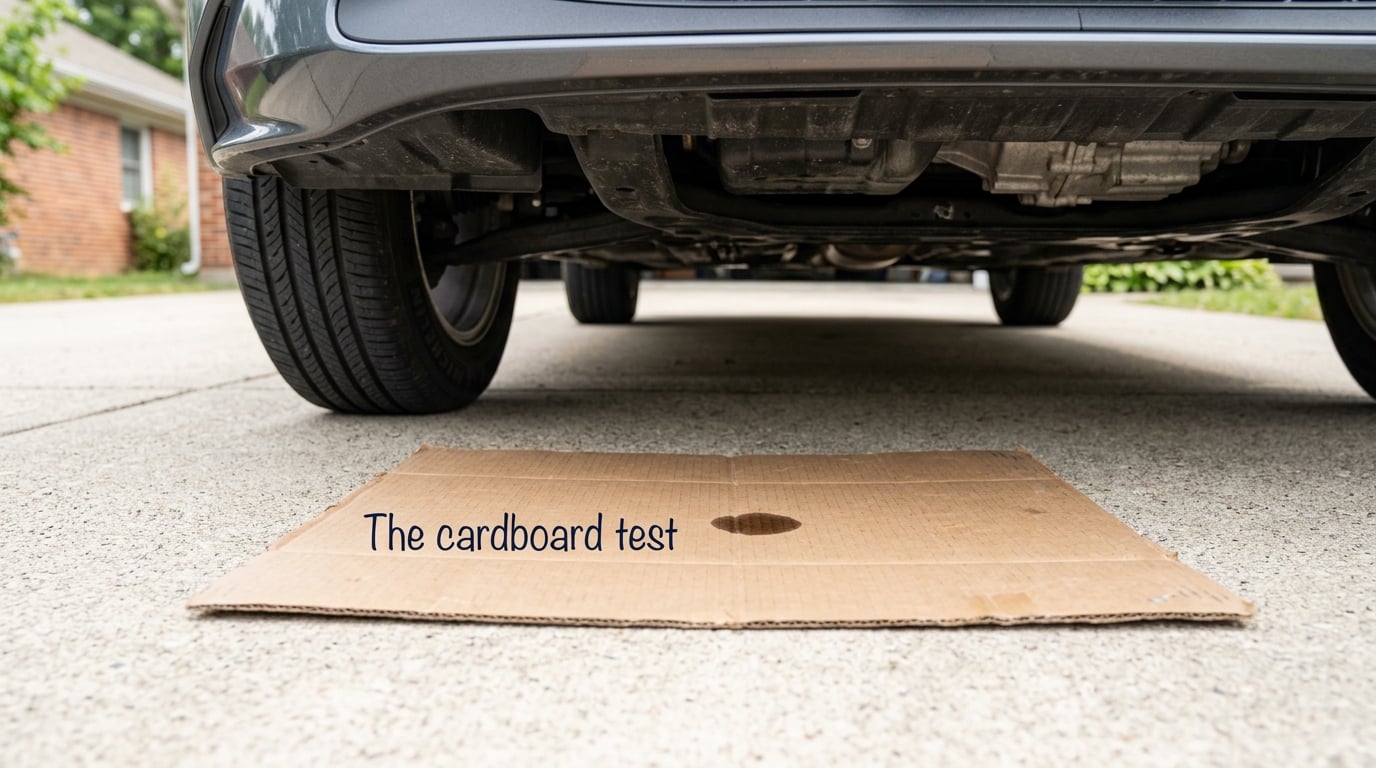
3. The cardboard test
Slide a sheet of cardboard, newspaper, or a plastic grocery bag under the car, leave it overnight, and pull it out in the morning. A wet spot on the cardboard gives you a rough position even when the puddle itself has wandered.
It often comes up empty, and that is not proof of anything. Drips run along shields and crossmembers and pool far from the source, so if the cardboard is dry but the level is dropping, the leak is probably higher up in the engine bay.
4. Watch it while the engine runs
With the car safely on a level surface and the parking brake set, have someone watch under the car while you rev gently. A drip that appears at idle and grows with revs points at a gasket or a rotating seal.
5. Test the air conditioning side
Run the air conditioning on cold for fifteen minutes, then park. Drips from the passenger side that start immediately are normal. Water inside the cabin means a clogged condensate drain.
6. Check the exhaust and the dipstick again
Look inside the tailpipe for holes, and run a finger along the muffler for a rust hole. Then recheck the fluid levels. A level that dropped overnight is stronger evidence than any puddle you can see.
Use the owner’s manual for reservoir locations and fluid specifications, and get a qualified mechanic for anything involving fuel, brake fluid, or a pressurized system. A UV dye added to the cooling or oil system and a pressure test are two tools a shop has and you do not.
Frequently Asked Questions
Is it normal for a car to leak water after washing it?
Yes. Water enters door seals, wheel wells, and the trunk during a wash and drips out for hours afterward as the car moves and warms up. It is normal if the puddle is clear and odorless, shows no oily residue on the driveway, and does not come back on a dry day with no rain. If water keeps appearing regardless of weather, you have a leak worth tracking down.
Why is my car dripping water only in the morning?
Overnight condensation. Moisture in the air freezes on the cold evaporator core while the air conditioning runs, then thaws and drains out after you park. Humid mornings produce the largest puddles, which is why it seems worse in summer. A morning puddle that leaves a greasy or colored stain is not condensation, so check the dipstick and the coolant reservoir before you relax.
Is water under a car always a leak?
No. Air conditioning condensation and exhaust condensate are both normal, and rain or car wash water accounts for a surprising share of panicked phone calls to shops. A genuine leak is colored, oily, or sweet-smelling, it leaves a residue, and it keeps producing fluid on a dry day with the air conditioning off. Clear, odorless, residue-free water needs no repair.
What does engine oil look like when it leaks?
Dark brown to black, and it feels greasy and sticky between your fingers rather than running like water. It leaves a dark film on concrete that rain will not wash away, and it often beads up into a drop overnight under the engine bay. A slow seep on a high-mileage engine is common, but needing to top up between normal oil changes means the gasket, seal, or oil pan needs attention.
Can air conditioning condensation make a puddle under a car?
Yes, and it is the single most common cause. Cold air from the evaporator drops moisture out of the cabin, it freezes on the core, and it drains out a tube under the passenger side once the ice melts. The puddle is clear, odorless, and leaves no stain. If the condensation comes out inside the cabin instead, the drain tube is likely blocked and worth clearing.
What should I do if I see a large puddle after driving?
Do not drive on it until you know what it is. Check the color and smell from a safe distance, look at the temperature gauge and any warning lights, and check the coolant reservoir and oil dipstick while the engine is cold. If it is coolant, or smells like fuel, or feels slick and hot, do not start the engine again and have the car recovered to a shop.
What to Do First
Note what the weather was doing and exactly where the puddle sits, then look again on a dry day with the air conditioning off. If it is clear, odorless, and leaves no film, you have condensation and no repair to think about.
If it is colored, oily, or smells sweet, burnt, or sharp, check the fluid levels cold, then book a shop. Fast on coolant, brake fluid, and anything that smells like fuel, because those three turn a puddle into a much more expensive problem within days.