
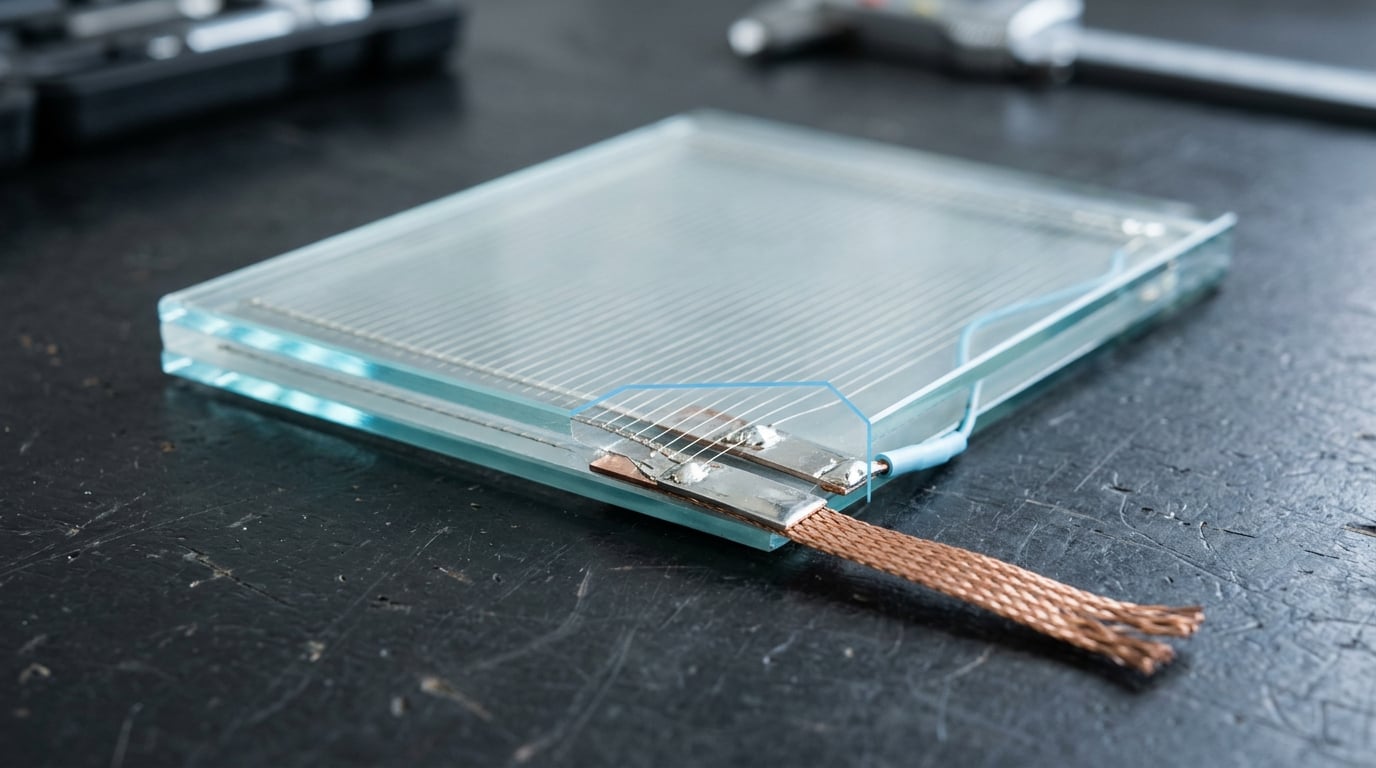
A heated windshield works by running low-voltage current through a fine heating element hidden inside the glass. Press a button and current travels from a fuse and relay into metal terminal strips at the bottom edge of the windshield, crosses a grid of micro-wires or a transparent conductive film sandwiched in the laminate, then returns to the battery through a ground strap. The glass warms from within, so ice, frost and fog shed from the inside out.
That inside-out heating is the whole trick. Airflow defrosters push lukewarm engine air across the glass and lose most of that heat to the frozen road before you can see through it. A heated element warms the surface itself, which is why the front screen clears in minutes when the rear window takes ten or fifteen.
If you are new to this, here is the short version:
- Only the front windshield is special. The rear window has used heated elements for decades; the front version is far more expensive and far more common on trucks and premium trims.
- The heating grid lives inside the laminate, not on the surface, so you cannot wipe it or see it clearly.
- The circuit is ordinary 12-volt wiring: button, control module, relay, fuse, element, ground.
- Partial clearing is a real and specific symptom. It usually points at a broken run of element rather than a dead circuit.
- Undersized replacement glass silently deletes the feature. Ask for the heated part number before the work starts.
Table of Contents
- What Is a Heated Windshield?
- How Does a Heated Windshield Work?
- Electrically Heated Windshields
- How a Hot-Fluid Windshield Heater Works
- What Powers a Heated Windshield?
- Why Does a Heated Windshield Fog or Frost?
- What Is the Difference Between Front and Rear Defrosters?
- Common Signs a Heated Windshield Is Not Working
- Can You Repair a Heated Windshield?
- How to Use a Heated Windshield Safely
- Frequently Asked Questions
- What to Check First
What Is a Heated Windshield?
A heated windshield is a laminated safety windshield with conductive heating elements built into it between the outer and inner glass plies. Current through those elements warms the whole pane evenly, clearing ice, frost and condensation before you start driving.
Laminated glass has a plastic interlayer, usually polyvinyl butyral, sandwiched between two glass plies. Windshields use it because the laminate holds broken glass together instead of letting it shatter into the cabin. A heated windshield simply adds conductive material to that interlayer, which is why heated and non-heated glass of the same shape are not interchangeable.
What a heated windshield is not
This is where most confusion starts. Four different things get called a heated windshield, and only one of them heats the glass.
| Feature | What actually heats | What it clears | Typical current draw |
|---|---|---|---|
| Heated windshield | Element grid inside the front glass | Front glass: ice, frost, fog | Roughly 1,000 to 1,500 watts on high |
| Heated wiper blades or wiper park zone | A heated strip at the base of the glass | The rubber blade and the parked wiper, so they can move | A small fraction of the windshield circuit |
| Heated washer nozzles | A coil in the nozzle | Freezes the fluid so it can spray | Brief, low draw while washing |
| Hot-air defroster | Engine coolant through a heater core | Any glass it can blow air across | Uses engine heat, not much electricity |
The wiper de-icer is the one that trips people up most often. It warms a narrow band along the bottom edge, so the blades are loose and can sweep. It does not heat the windshield. On many vehicles it runs off the rear defrost button rather than the front one, which is exactly why owners assume the front screen is dead.
How Does a Heated Windshield Work?
There are two technologies doing the same job, and both turn electrical current into heat by pushing it through resistance. Thinner filament, hotter wire.
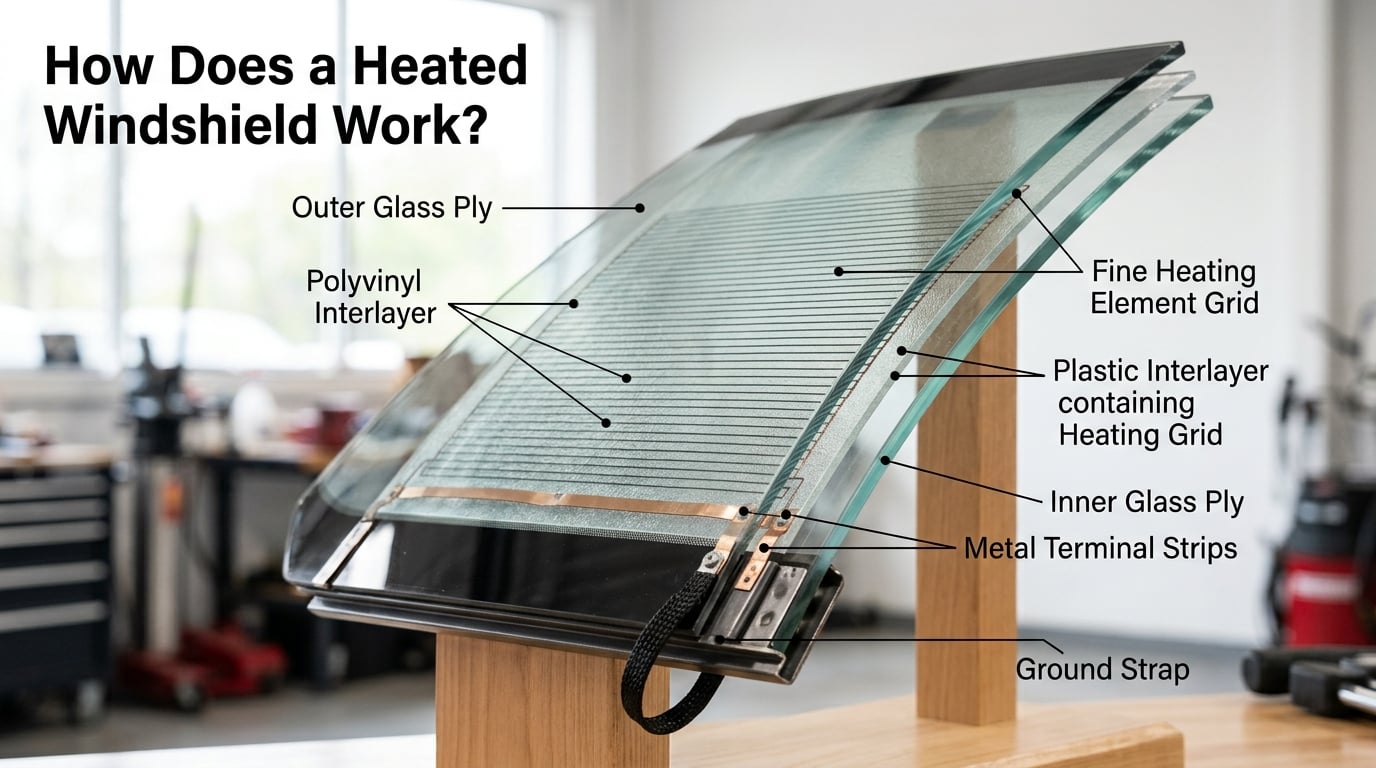
The wire version embeds hair-thin tungsten or nichrome filaments in the interlayer, usually in a few horizontal runs with vertical connections at the sides. The film version coats the interlayer with indium tin oxide, a transparent conductor used in touchscreens, so you see a faint grid rather than visible lines.
Here is the path the current takes, in order.
- You press the button. On many vehicles the heated windshield shares a switch with the rear defrost and the heated mirrors. Some cars have a dedicated front-glass button, and newer ones bury it in the climate control menu or trigger it automatically below a set temperature.
- The body control module takes over. Rather than carrying full heating current itself, the module closes an output and lets a dedicated relay do the switching.
- The relay sends power to the fuse-protected circuit. A typical heated screen is fed by a relatively heavy-duty block fuse, often in the 40-amp range, and some vehicles use two of them, one per side, behind a passenger-side trim panel.
- Current enters the glass at the edge terminals. Small metal busbar strips are laminated onto the lower corners of the windshield and pigtail into the body harness.
- Current crosses the element grid. Here it meets resistance, and the energy shows up as heat in the glass.
- The current returns through the ground strap. A bonded strap from the glass edge to the body completes the circuit. Corrosion here is a leading cause of whole-screen failure.
- The module shuts power off on a timer or temperature reading. A sensor on the glass, usually a small resistive strip bonded to the inner surface, tells the module when the pane has reached temperature.
Heat then conducts outward from the element to both glass surfaces. Because the glass is thin and the whole pane warms at roughly the same rate, the outer surface sheds ice while the inner surface sheds cabin fog at the same time.
Electrically Heated Windshields
Most heated windshields run on the vehicle’s 12-volt system and are managed by a control module that watches time, current and glass temperature. That module is what separates a heated windshield from a rear defroster, which is usually a dumb timer switch with no feedback.
A few design details matter when you are diagnosing one:
- Zoning. Many screens run two or three separately controlled zones. The lower band, where frost and snow build up, often heats first and hardest. A heated wiper park zone may share that circuit.
- Glass temperature sensor. A small resistive element bonded to the inner surface of the glass changes resistance as the pane warms. The module reads it to stop heating at temperature rather than at a fixed time.
- Automatic cut-off. On most cars heating ends after a set period or when the sensor trips, unless you press the button again. That protects the glass and the battery.
- Indicator lamp. The lamp only tells you the switch is latched. It does not confirm any current is flowing, which is why a lit button with no heat is such a common complaint.
Some cars activate front glass heating automatically when the outside temperature sensor drops below a threshold, or when the rear defroster is switched on. If your car does that, there may be no front button at all and nothing wrong with it.
How a Hot-Fluid Windshield Heater Works
A handful of vehicles heat the windshield with hot engine coolant instead of electricity. A circulation pump driven by the engine moves coolant through a heater element mounted behind or inside the glass, and the pane warms from the rear side of the laminate.
The appeal is obvious: it draws far less electrical current, and it can run continuously without touching the battery. The tradeoffs are packaging, weight, pump failure modes and the fact that it does nothing until the engine is running and warm. You see it on a few heavy trucks, buses and older European vehicles rather than on everyday passenger cars.
What Powers a Heated Windshield?
It runs on the same 12-volt electrical system as everything else in the car, which means the alternator and the battery. Engine coolant powers the hot-fluid version only.
On high, a heated front windshield typically pulls somewhere around 1,000 to 1,500 watts. At 12 volts that is roughly 80 to 125 amps, several times what a heated rear window draws on average and far more than the charging system comfortably supplies while the engine is idling. Check the rating in your owner’s manual rather than trusting a general figure.
This is why leaving front glass heating on while parked is a real risk. A battery with a few hours of reserve will recover from a short run, but overnight in freezing weather the engine is off, the alternator is doing nothing, and you have a big resistive load sitting there. Owners on forums report exactly this pattern: dead battery in the morning after leaving the defroster on.
If the system will not switch off, suspect the relay, the control module or a stuck switch rather than the glass. Those parts can hold the circuit closed indefinitely.
Why Does a Heated Windshield Fog or Frost?
Fog forms when warm, moist cabin air touches glass colder than its dew point. The moisture condenses into a film, and that film scatters light until the view goes milky. Frost and ice form when that same moisture freezes, or when snow and ice simply sit on the cold outer surface.
Heating the glass raises its surface temperature past the dew point, so condensation cannot form there. That is the whole principle, and it explains why heated glass clears fog from the inside rather than trying to melt ice from the outside.
Two things follow from this. First, heated glass works well against fog and light frost, where the problem is moisture touching cold glass. Second, it does less about thick ice that formed while the car sat outside, because clearing that ice still depends on heat conducting through the pane to the outer surface.
In practice the combination wins. Heat first, airflow second, then a quick pass with the wipers to throw off slush.
What Is the Difference Between Front and Rear Defrosters?
Both use embedded conductive elements, but they differ in construction, placement, power and how you repair them.
| Heated windshield | Rear window defroster | |
|---|---|---|
| Element layout | Micro-wire grid or conductive film, often zoned | Conductive film printed on the inner surface, or fine wires |
| Position | Inside the laminate, between the plies | On the inner surface of the glass |
| Power draw | High | Moderate |
| Control | Module with temperature sensor and timer | Often a simple timer switch, sometimes shared with the front |
| Repair | A break in the laminate usually means new glass | Surface traces can sometimes be bridged or repaired |
| Why it matters | Driver sits behind it, in the cold, on every trip | Rear view only, and no driver-assistance cameras behind it |
That last row explains why the front screen is so much more expensive. Heated windshield glass carries an electrical feature and, on newer cars, a driver-assistance camera behind the same pane. Both make it a calibrated part rather than a commodity one.
Common Signs a Heated Windshield Is Not Working
Most complaints fall into a handful of patterns. Matching your symptom to the likely cause saves a lot of guessing.
| Symptom | Likely cause | Where to look |
|---|---|---|
| Button lights, nothing heats at all | Blown fuse, failed relay, corroded ground, open busbar | Fuse box, relay, ground strap under the cowl or plenum |
| Only part of the glass clears | Broken run of element, often where a chip or crack crosses the grid | Edge of the affected zone, then the crack itself |
| Clears, then shuts off early | Failing glass temperature sensor or a module cutting out on current draw | Sensor strip on the inner surface, module |
| Works sometimes, fails when cold | Intermittent relay or a marginal ground connection that opens with movement | Ground points first, then the relay socket |
| Will not turn off | Stuck switch, welded relay contacts, control module fault | Switch, relay, module |
| Heat only at the very bottom edge | You are running the heated wiper park zone, not the windshield heater | The button you pressed, and which zone it controls |
Partial heating is its own diagnostic signal rather than a mystery. A section that stays cold while its neighbour clears means current is reaching the glass but a segment of the element is open. Where the cold zone ends, the break usually is.
Can You Repair a Heated Windshield?
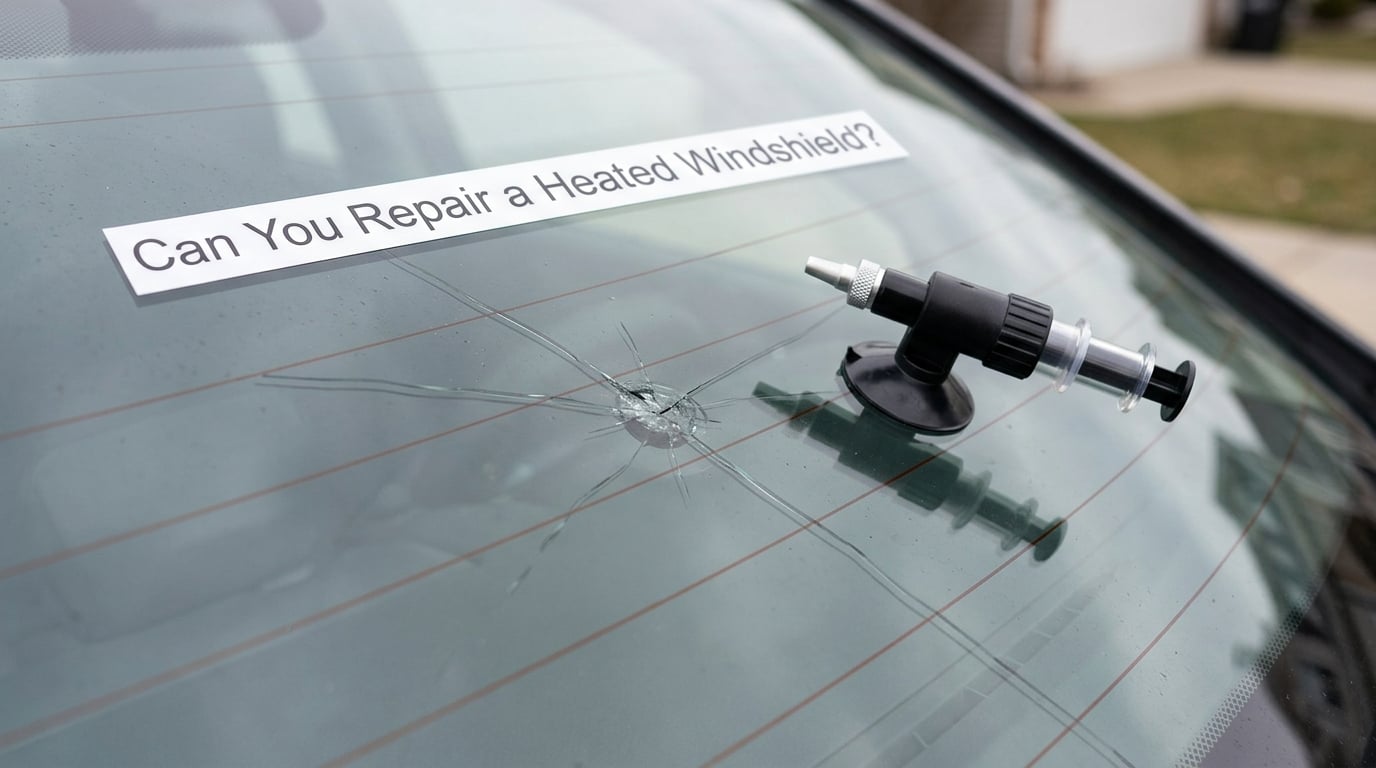
Sometimes. A small chip away from the heating grid can be resin-repaired and the system left alone. Once damage reaches the element, the answer usually changes.
The element and the crack are linked. Heat spreads through the pane unevenly, and thermal stress changes how a crack behaves. A crack that is stable in cold glass can start growing the moment you energize the grid, because one side of the laminate warms faster than the other.
Use these rules:
- Chip does not touch the grid and did not come with a long crack. Repair it, and confirm the heating still works afterwards.
- Crack crosses the element grid. Replacing the glass is the reliable fix. A repair bridge can restore your view, but the heating will likely stay broken or go again.
- Crack is at the edge near the busbars or the ground strap. Replace it. Edge damage compromises the connection and the bond.
- Crack sits inside the field of view of a driver-assistance camera. Even a good repair changes how the camera sees the scene, so the camera has to be recalibrated after the work.
Two warnings. First, fitted glass carries a heating element’s part number that differs from the standard pane. If an installer quotes the non-heated version, you lose the feature and the special price, and nobody may notice until the first cold morning. Second, on a camera-equipped car, replacement means a calibration afterwards or the safety systems work off a wrong picture.
Thermal cycling also works against these repairs over time. Glass that was bonded once, heated and cooled hundreds of times, holds a repair less reliably than the same repair in an unheated pane.
How to Use a Heated Windshield Safely
Run it before you need it. Start it while you clear snow from the roof and let the car warm up, rather than waiting until you are already scraping.
Then work through the checks in order, cheapest first:
- Confirm the control. Find out whether the front glass has its own button, shares the rear defrost switch, or comes on automatically. Your owner’s manual settles this in thirty seconds and it is where most wasted diagnoses start.
- Look for the indicator. Note whether a lamp lights and stays lit. No lamp usually means a switch or fuse upstream of the module.
- Check the fuses. Heated screens are commonly fed by a heavy block fuse, sometimes one per side, located in the engine bay or behind passenger-side trim. Confirm the rating in the manual.
- Check the relay. If the fuse is intact and the button lights but there is no heat, the relay, control module or ground is where owners most often find the fault.
- Clean the ground points. The earth strap under the cowl or plenum corrodes fastest of anything in the circuit. Cleaning it and the mating contact is cheap, needs nothing special, and fixes a surprising share of dead screens.
- Look at the glass itself in the cold. Feeling along the edge for the element lines, or watching which zones clear, tells you whether the current is getting there at all.
A multimeter or a thermal camera will confirm what the glass is doing, and both are cheap tools. What to avoid is probing a live heating element with a test light or jumping terminals to force it on. These circuits move a lot of current, and the wrong connection melts wiring or blows the wrong fuse on the way to your diagnosis. Follow the manual, and hand anything past the fuse and relay to a technician.
Turn the system off once the glass clears. It is built to cycle, not to run for hours, and leaving it energised with the engine off is the classic way to strand yourself on a cold morning.
Frequently Asked Questions
Do all cars have heated windshields?
No. The rear window has had heating for decades, but a heated front windshield is still an option or a trim feature, most often on trucks, SUVs and higher-spec cars in cold markets. Check for a dedicated front-glass button, a shared rear defrost switch, or lines visible near the lower edge of the glass. Brands such as Ford, Land Rover, Jaguar, Volkswagen and several cold-weather packages have offered it.
How can I tell if my windshield is heated?
Look for faint horizontal or vertical lines near the bottom edge of the glass, which are the element runs, and for metal terminal strips at the lower corners. Then check your controls for a front defrost button or a rear defrost switch that also drives the screen. Some cars activate it automatically in cold weather, and the window label or trim list confirms it.
Why is only part of my heated windshield working?
Partial clearing means current is reaching the glass but a section of the element is open, usually where a chip or crack crosses the grid. The break sits near the edge of the cold zone, so look there first. Because the element is inside the laminate, an open section usually means the glass has to be replaced rather than repaired.
How long does a heated windshield take to clear ice?
On a typical cold morning a heated windshield clears light frost and snow from the driver side in a few minutes, and the full pane in roughly five to ten minutes depending on how thick the ice is and how cold it is outside. Thick frozen rain is slower. Airflow defroster helps on top of it, and a quick wiper pass removes the slush.
Can you fix a chip in a heated windshield?
Only if the damage stays clear of the heating grid. A small chip with no long crack can be resin-repaired and the heating left intact. If the crack runs across the element lines, reaches the edge terminals or ground strap, or sits in a camera’s field of view, replacement is the dependable fix, because heating the pane puts thermal stress through the repair.
Does a heated windshield drain the battery?
It can. A heated windshield is one of the largest electrical loads in the car, drawing on the order of a thousand watts or more on high, which the alternator cannot sustain while the engine is idling. Leaving it on overnight with the engine off will flatten a healthy battery. Switch it off once the glass clears and treat a system that will not stop as a fault.
What to Check First
Start by confirming your windshield is actually heated and which switch controls it, because that confusion accounts for a large share of the “it stopped working” posts. Then work outward: fuse, relay, ground strap under the cowl, then the glass itself. A corroded ground is quick to clean and fixes more heated screens than any other single step.
Whatever you find, keep the heated part number in the conversation when the glass needs replacing. Non-heated glass is cheaper and fits, and nobody will mention it unless you ask.