
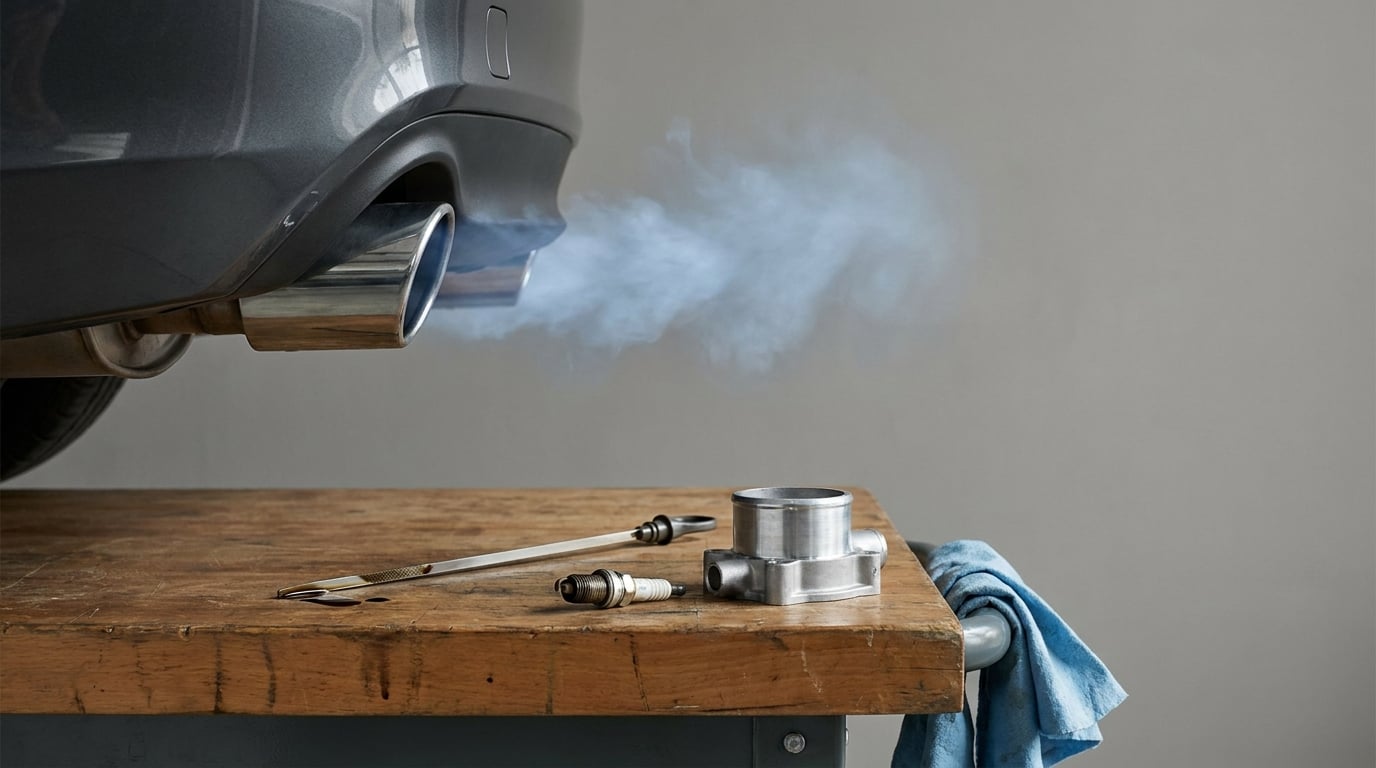
Blue smoke from the exhaust means your engine is burning oil inside the combustion chamber. Oil is getting past a seal, ring, gasket or turbo seal, igniting with the fuel, and leaving the tailpipe as a fine blue-grey plume. Yes, you can usually keep driving for a while — but only if the smoke is a brief puff and the oil level is holding steady. Persistent blue smoke at idle means get it looked at this week.
Below is the diagnostic path I would walk before calling anyone: how smoke colour maps to a fluid, the eight causes worth ranking, when the timing of the smoke narrows the answer, and the point where a shop should take over.
Table of Contents
- What Does Blue Smoke From the Exhaust Mean?
- Blue Smoke vs. White, Black, or Vapor
- What Causes Blue Smoke From the Exhaust?
- Worn valve stem seals
- Worn piston rings or a scored cylinder bore
- Worn valve guides
- A failed crankcase ventilation valve or hose
- A turbocharger shaft seal or oil feed failure
- Head gasket or head and block cracking
- An overfilled or wrong-viscosity engine oil level
- Diesel-specific faults: glow plug, EGR or turbo oil in the intake
- Is a Small Amount of Blue Smoke Normal?
- How to Tell Whether Your BMW Is Burning Oil
- What Problems Are Most Common in BMW Engines?
- Blue Smoke From the Exhaust: Causes and Clues
- When Should You Stop Driving With Blue Smoke?
- How to Prevent Blue Smoke in the Future
- Frequently Asked Questions
- Conclusion
What Does Blue Smoke From the Exhaust Mean?
Blue smoke is oil. The colour is not soot and it is not coolant — it is thousands of tiny oil droplets burning in the exhaust, which scatter light the way a thin oil film on water does. If the plume is bluish and the exhaust smells hot and oily, you are looking at combustion oil.
Oil enters the cylinder three ways: past a valve stem seal on the way past the intake or exhaust valve, past a piston ring on the way around the bore, or through a gasket that has lost its seal. Once inside, it burns incompletely because the spark plug does not ignite it, and what leaves the exhaust is a mist of oily carbon particles.
A useful 60-second assessment before you touch a spanner:
- Cold start only, then it clears? That is the classic valve stem seal signature.
- Smoke at every rev, worse on lift? Piston rings, worn valve guides, or a turbo seal.
- Smoke at idle that never goes? Rings, a failed crankcase valve, or an oil level problem.
- Oil level dropping between changes? Something is consuming oil faster than it should.
Blue-grey smoke that fades to a light haze on a warm engine is often the coolant side instead. Sweet smell, milky residue on the dipstick, and a falling coolant level all point that way.
Blue Smoke vs. White, Black, or Vapor
Colour alone narrows the field, but it does not close it. Here is the version I keep on the wall next to the lift.
| Colour | What it is | Most common cause | How urgent |
|---|---|---|---|
| Blue / blue-grey | Burning engine oil | Valve stem seals, piston rings, turbo oil seal, PCV fault | Promptly — measure the oil level this week |
| Thick white, sweet smell | Coolant entering the cylinder | Failed head gasket, cracked head or block | Stop and check for overheating |
| Thin white, cold engine only | Normal water vapour condensing | Nothing — it clears once the exhaust heats up | None |
| Black | Unburnt fuel or rich mixture | Blocked air filter, leaking injector, faulty MAF | Get it checked if it stays black |
| White haze after long idle or short trips | Fuel washing off a cold engine | Normal behaviour, or a sticky brake release | Low, unless the haze is thick |
One trick for the vapour case: park the car and look underneath about fifteen minutes after a short drive. If the ground under the bumper is wet but not oily, it is condensation. Water beads on a tailpipe during a cold start are completely normal.
What Causes Blue Smoke From the Exhaust?
These are the eight causes that account for the overwhelming majority of blue smoke, ordered roughly by how often I run into them. Each one pairs the cause with the behaviour that usually gives it away.
Worn valve stem seals
A hardened rubber seal on the valve stem lets oil creep down the guide and into the port, where it washes past the valve. It sits there while the engine is off, so the first moments after a cold start produce a thick puff, and once the oil burns off, the smoke goes quiet. On a BMW, expect this on a higher-mileage petrol engine, and it is the most common cause by a wide margin.
Worn piston rings or a scored cylinder bore
Rings seal the gap between the piston and the bore, and once they wear or the bore gets a vertical scratch, oil gets dragged past the ring into the combustion chamber on every power stroke. There is no clean start here: the smoke shows at idle, at cruise and under load, and it is usually joined by a steady drop in oil level. This is the one that needs an engine.
Worn valve guides
A guide that is worn from the top lets oil fall into the intake port as you lift off the throttle, and a guide worn from the bottom feeds the exhaust. Either way the smear of oil is carried into the cylinder, and the smoke is worst on overrun. The other tell is a misfire and an unsteady idle from fouled plugs.
A failed crankcase ventilation valve or hose
The crankcase blows by design into the intake, and the PCV or CCV valve controls that flow. A stuck-open valve, a cracked hose or a failed diaphragm puts pressurised oil-laden vapour straight into the intake, and the plume is thickest at idle and light load. An aftermarket catch can in the wrong place, or a manifold cleaned without new gaskets, both end up here too.
A turbocharger shaft seal or oil feed failure
On a turbo engine the shaft seal keeps oil out of the hot side. When it goes, oil runs along the centre housing and into either the compressor housing or the turbine inlet, and you get heavy blue smoke with big lag until it burns off. On an intercooled engine, watch for the delayed version: oil pooling in the intercooler or in the inlet pipework, which stays clear until you ask for boost and then exhales a cloud.
Head gasket or head and block cracking
This one does not produce classic blue smoke so much as a thin, steady blue-grey haze, and it almost always comes with coolant loss, a sweet smell or a rising temperature. A gasket that only leaks externally is an oil leak, not combustion smoke. Check the dipstick and the expansion tank before you start hunting rings.
An overfilled or wrong-viscosity engine oil level
Oil past the filler height gets aerated and thrown at the ring pack, and it will foam up and spit back out of the filler. Too thin for the engine does the same thing under load. Both give blue smoke that varies with how hard the engine is working, and both are free to fix once you read the filler mark and the owner’s manual spec.
Diesel-specific faults: glow plug, EGR or turbo oil in the intake
Diesel smokes blue for the same reason but with different culprits. A failed or stuck-open glow plug vents unburnt oil vapour into the exhaust, an EGR cooler that has leaked lets engine oil wash into the intake tract, and a worn diesel turbo can feed oil into the manifold. An older common-rail diesel in particular can lay down enough oil in the intake to smoke briefly and hard whenever it gets moving. Note also that a diesel producing thick black smoke under load is a different fault entirely and points at fuel delivery, not oil.
Is a Small Amount of Blue Smoke Normal?
Sometimes, yes. The distinction the forums get right is this one: a puff that happens once and stops is a condition, while smoke that never stops is a fault.
Normal or near-normal cases:
- A classic or low-mileage car puffing blue on the first start after weeks of storage. Oil has crept past the seals while it sat. It clears in seconds and usually stops appearing once the car is driven regularly.
- A brief wisp when you shut off the engine at a light. Vacuum drops, and a small amount of oil-laden vapour gets drawn past an already-dry seal.
- A momentary puff on a diesel after it has been sitting on idle with a fast lane change or a long climb.
- New plugs, new valve cover gasket or a fresh turbo seal, where residual oil burns off over the first few kilometres.
Not normal cases:
- Smoke at every start, even when the engine is already warm.
- Blue at idle, then blue at speed, then blue again when you brake — that is a worn seal or rings, not a seal-off.
- Visible oil on the dipstick, a low reading, or a top-up that disappears between drives.
A car driven mostly short trips sits in the worst of both worlds. It sits long enough for condensation and oil creep, and rarely gets hot enough to burn it off cleanly.
How to Tell Whether Your BMW Is Burning Oil
Work through these in order on a level surface with the engine off. The whole first pass takes about ten minutes and often tells you more than any guess you were going to make from the driver’s seat.
1. Read the oil level properly. Park level, engine off for ten minutes or overnight, pull the dipstick, wipe it, put it back, then read it. Compare against the two marks. Do not judge oil on a slope or right after a drive, because the reading will be low and you will top it up for no reason.
2. Look at the oil colour and texture. Milky or frothy residue on the cap, a beige film, or oil that smells of fuel all mean something other than wear has got into the oil.
3. Check the coolant level and the expansion tank. A dropping level, a sweet smell at the cap, or oily film in the expansion tank changes the whole diagnosis from oil burning to coolant loss.
4. Inspect the crankcase vent hose. With the engine running at idle, look for a steady stream of smoke from the vent hose. An oily hose, a soft or cracked one, or a valve that does not move when you work the throttle by hand all point to a failed PCV or CCV.
5. Pull a spark plug and look at it. On a petrol engine, heavy black soiling or wet, oily deposits on the insulator mean unburnt oil in that cylinder. Comparing plug tip colour across all cylinders is even more useful, and it is where a valve guide problem or a dead injector usually shows up.
6. Run a compression test. This is the first step owners in the BMW and VW communities reach for, and it earns its place. Even compression across all cylinders with the rings, uneven compression on one cylinder, or low readings across the board point you in a clear direction. A low reading with the oil topped up is a head gasket concern until proven otherwise.
7. Run a leak-down test. Pressurise the cylinder while the spark is out and watch the tailpipe and oil fill. Air coming out of the exhaust means rings, bore or valves; bubbles in the fill means the head gasket.
8. Put a borescope in through the spark plug hole. The owners on the engine-building forums are right that this is the tool that answers the question. You can see the piston crown, the bore wear and the valve faces, and you will spot oil running down the inside of the valve or a scored cylinder wall.
Stop the home diagnosis and hand over to a technician when the oil is falling fast, when you see coolant loss, when the compression test is uneven and low, or when the engine knocks. A borescope through a hot engine is also a technician job, not a driveway job.
What Problems Are Most Common in BMW Engines?
On a BMW the extra leaks tend to be external, which is why it helps to look for oil on the underside of the engine before assuming anything internal. None of this is unique to BMW, and plenty of cars with good engines never develop it.
Valve cover gasket and oil filter housing gasket
The oil filter housing seal is the most complained-about leak on older diesel BMWs. Oil runs down the block, wets the wiring loom, and shows up as a burning smell more often than as blue smoke. The valve cover gasket on the N-series and newer inline engines can do the same in places.
The turbo oil lines and the VANOS oil feed
Turbo oil feed and return lines weep, and the oil finds the hot compressor housing rather than the floor, so you get smoke instead of a puddle. The VANOS oil feed on older high-mileage engines is the same story: an external leak, oil on the hot side, a blue puff. A stale smoke smell under load with no visible oil can also be an exhaust manifold heat shield that has dropped and is cooking nearby oil mist.
The diesel particulate filter
A DPF that has gone partial and a turbo that is feeding oil into the intake both show as a warm diesel making smoke under acceleration. The regen, the EGR cooler and the turbo on those engines are the trio worth testing before anything is condemned.
Blue Smoke From the Exhaust: Causes and Clues
Here is the same thing as a single scannable grid: the cause, the pattern that supports it, and the clue that rules it out.
| Likely cause | Smoke pattern | Supporting clue |
|---|---|---|
| Valve stem seals | Thick puff on cold start, clear when warm | Even compression, no coolant loss |
| Piston rings | Continuous, at idle and under load | Fast oil consumption, low compression |
| Worn valve guides | Worst on throttle lift, with misfire | Sooty or oily plugs, rough idle |
| PCV or CCV fault | Thick at idle, easing with revs | Smoke from the vent hose, oily hose |
| Turbo seal or oil feed | Heavy with boost, big lag until it burns off | Oil on the compressor housing or the pipework |
| Intercooler oil pooling | Delayed cloud when you ask for boost | Oil visible in the pipe, smoke after it sits |
| Head gasket or crack | Thin steady haze, worse on a warm idle | Coolant loss, sweet smell, overheating, bubbles in the fill |
| Overfill or thin oil | Varies with load, recent fill or service | Level above the max mark, foaming dipstick |
| Diesel glow plug or EGR leak | Diesel only, on start or on load | Oil in the intake, coolant low, EGR history |
| Valve cover, oil filter or VANOS seal | Smoke with oil on the underside | Visible leak, oil-soaked wiring, smoke smell on the move |
That grid is the fastest way I know to narrow ten possibilities down to two before a shop ever looks at it.
When Should You Stop Driving With Blue Smoke?
Stop the car and do not drive it when any of these show up:
- The oil level drops between fills, or you need oil between service intervals. A leak that empties an engine in a few hundred miles ends the engine.
- The oil pressure warning light comes on, or the gauge drops with the engine warming up. This is a lubrication emergency.
- You are losing coolant, seeing a sweet smell, or the temperature climbs and stays there.
- Blue smoke at idle that never stops, especially with a knocking or rattling noise underneath it.
- The oil on the dipstick looks milky or smells of fuel, or the car is burning oil heavily and smells hot enough to notice from outside.
- There is an obvious weeping fuel smell, or a large oil leak visible under the car.
Keep driving cautiously when the smoke is a one-off startup puff, the oil level is steady, there is no coolant loss and the engine sounds and runs normally. Short trips and gentle driving are kinder than highway miles at sustained load. If it is a diesel and the smoke clears after a couple of minutes, treat that as a prompt to schedule diagnosis rather than a reason to keep commuting.
On what it costs, be careful about two things. First, the diagnosis is a separate job from the repair, and the diagnosis is where the ambiguity sits, especially on a turbo car where the smoke can come from the turbo, the manifold or the crankcase and the first guess is often wrong. Second, get a written estimate naming the specific part and the specific work before anything is done. Ask what happens if the first diagnosis turns out to be the wrong one. Repair costs vary widely by model, engine, labour rate and region, so the number you are quoted is worth more than any range you read here.
One real decision rule: a car that smokes blue only on a cold start from worn valve stem seals is a top-end job on a petrol engine, and the price of it has to be weighed against the value of the car. A car that smokes at all times with falling oil is a bottom-end or turbo job, and it is worth fixing sooner. Only a genuine, verified loss of compression is a rebuild conversation, and getting that measured before you authorise anything will save you from being quoted the expensive answer first.
How to Prevent Blue Smoke in the Future
Most blue smoke is avoidable, and most of the prevention is boring. Use the exact viscosity the manual specifies, and no thicker. Change the oil and filter on the schedule, because degraded oil and a tired filter do accelerate ring and seal wear. Keep the level between the marks, and never top up a clean engine just to silence the rattle. Fix an external oil leak the moment you see it, because external leaks become internal smoke. Check the crankcase vent hose at every service and never plumb a catch can somewhere that bypasses the PCV. If you run a turbo car, give it a proper warm-up and let it downshift gently, since most turbo seal failures are heat cycles. And if you see a milky dipstick or a falling coolant level, treat that as a stop-and-investigate item, not a top-up.
One habit to drop specifically: thicker oil does not fix burning oil. It may mask the smoke on a cold start, and it costs the oil pump and the rest of the lubrication system more than it saves. The same goes for stop-leak additives and thicker-than-spec oil sold as a cure.
Frequently Asked Questions
Can blue smoke from the exhaust be normal?
Yes, in a few specific cases. A brief puff on the first start after a week of sitting is normal on older and high-mileage engines, and so is a small wisp when you shut off at a light. The same goes for a short cloud on a diesel that has been idling. What is never normal is blue smoke at idle, blue smoke on every start, or smoke that follows the car down the road. If the plume is still visible a mile later, you have a fault.
Why is my BMW smoking blue under acceleration?
Under acceleration on a turbo BMW, the first suspect is a leaking turbo shaft seal or oil feed line, because boost pressure pushes oil vapour into the exhaust and the plume is often followed by obvious lag until the oil burns off. On a naturally aspirated petrol engine, acceleration smoke points at worn piston rings, because load is when the ring pack leaks hardest. Intercooled models can pool oil in the intercooler or inlet pipe and dump a cloud the moment you ask for boost.
Is blue exhaust smoke always caused by bad piston rings?
No. Rings are one cause among several and usually the most serious one, but worn valve stem seals are far more common on a high-mileage petrol engine, and they produce smoke mainly on startup. Worn valve guides, a failed PCV or CCV valve, a leaking turbo seal, a crankcase gasket, an external leak running onto a hot surface, and simply too much or too thin oil all produce the same colour. Timing and the oil level separate these far more reliably than the colour does.
Should I drive if my car is burning blue smoke?
Drive carefully if the smoke is a one-off startup puff, the oil level is holding steady between fills, there is no coolant loss, and the engine runs and sounds normally. Do not drive if the oil level is falling, the oil pressure light is on, coolant is disappearing, the temperature is climbing, or the smoke is constant at idle. Those are situations where the next drive can be the one that costs you the engine, or the catalytic converter, or both.
Can a head gasket failure cause blue smoke?
A head gasket failure does not usually give you clean blue smoke. It gives a thin, steady blue-grey haze, and it is nearly always accompanied by coolant loss, a sweet smell at the cap, or a temperature that keeps climbing. A gasket that has failed only on the outside is an oil leak, not combustion smoke. The way to separate the two is to check the oil level and the coolant level on the same drive, and to run a compression test with the radiator cap off to see if air moves in the system.
How do I check if my BMW is burning oil?
Park level on a flat surface, wait ten minutes with the engine off, then read the dipstick, wipe it, reinsert it and read it again. Check for milky or frothy residue on the cap. Look at the coolant level the same day. With the engine idling, look for smoke from the crankcase vent hose and check it is firm and not oily. Then pull a spark plug and compare the tip colour across all cylinders, which will show a single-cylinder problem. A compression test is the next step and settles the rings-versus-gasket question quickly.
Conclusion
Blue smoke from the exhaust is oil, and oil in a cylinder is a clue rather than a verdict. A puff that happens once and then stops, usually on a cold start, is a seal that dried out and is not a crisis. Smoke that never stops, at idle and under load and with the oil level dropping, is a ring, a guide or a turbo seal, and it gets worse the longer you leave it.
So start with the dipstick and the coolant level today, note whether the smoke comes on cold start or on the move, and put a compression test on the list. Those three things turn a guess into a diagnosis, and they take less than an hour of your time.